
Winning NSW Building Disputes – A Homeowner’s Guide

Discovering a defect in your property is incredibly stressful. That feeling when you spot a crack, a leak, or shoddy workmanship in what’s meant to be your safe haven can be overwhelming. If this is you, know you’re not alone.
The world of NSW building disputes is a well-trodden path, with specific government bodies and legal processes set up to protect homeowners. Getting your head around this journey from the very start is the first real step towards getting things sorted.
The Reality of NSW Building Disputes
It’s easy to feel like you’re the only one dealing with this, but building disputes are a surprisingly common—though always challenging—part of property ownership in New South Wales.
This isn’t just a feeling; the numbers back it up. A recent Strata Defects Survey revealed that a staggering 40% of Class 2 buildings had serious defects, landing owners with massive rectification bills. This has led to a flood of disputes, with building defect claims at the NCAT tribunal jumping by 25% in recent years to over 1,200 cases annually. Many of these turn into long, drawn-out legal battles that can take an average of 18 months to resolve. You can dig deeper into these numbers on the NSW Building Commission website.
Who’s Who in the Dispute Process
Navigating a building dispute means dealing with a couple of key players. Knowing who they are and what they do is crucial if you want to move your case forward without wasting time.
- NSW Fair Trading: This is your first stop. Think of Fair Trading as the mediator, not the judge. Their job is to help you and the builder find common ground through their free dispute resolution service. They can issue a Rectification Order to make a builder fix their work, but they can’t force them to pay you money.
- NSW Civil and Administrative Tribunal (NCAT): If you can’t get a resolution with Fair Trading, NCAT is the next step. This is where things get more serious. The tribunal has the legal clout to hear all the evidence, make legally binding decisions, and order builders to cover rectification costs. It’s a formal, court-like setting where having rock-solid evidence makes all the difference.
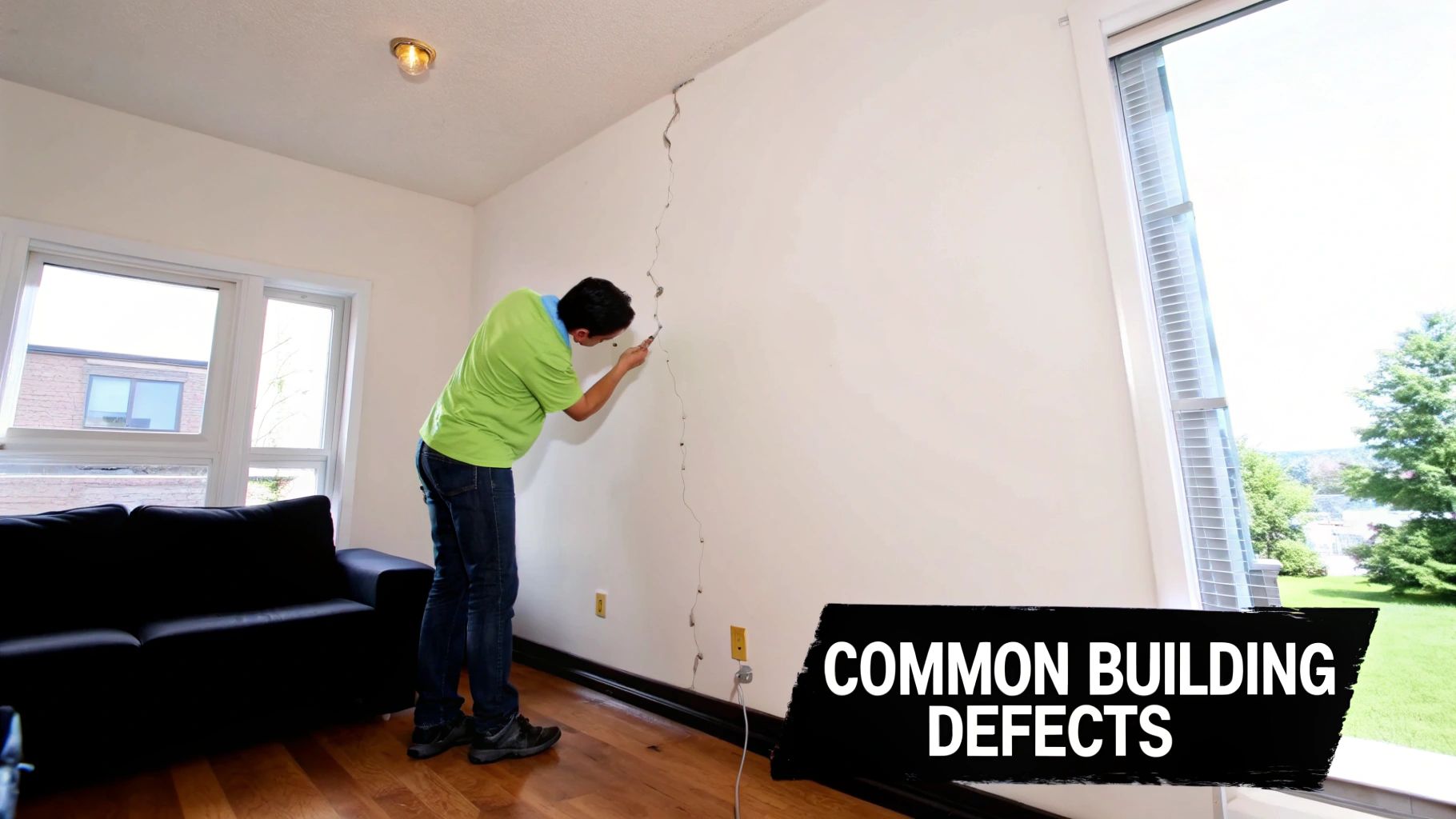
The Usual Suspects: Common Building Defects
Disputes pop up for all sorts of reasons, but we see the same culprits time and time again. Knowing what to look for can help you spot problems early.
In our experience, the most common disputes aren’t always sparked by the most dramatic-looking issues. It’s often the persistent water leaks, terrible waterproofing in a new bathroom, or wonky tiling that end up causing the biggest headaches and costing the most to fix.
Some of the typical defects we see in NSW building disputes include:
- Waterproofing Failures: This is the big one. It leads to leaks, mould, and even structural damage in bathrooms, on balconies, and in basements.
- Structural Defects: We’re talking about serious issues like cracks spreading across walls or slabs, or problems with the building’s foundation. These are always classed as major defects.
- Non-compliant Cladding: The use of flammable or incorrectly installed external cladding is a massive safety risk and a frequent cause of disputes.
- Poor Workmanship: This is a catch-all for a huge range of problems, from a botched paint job and dodgy tiling to windows and doors that were never installed properly.
Building Your Case: Identifying and Documenting Defects

When it comes to winning a NSW building dispute, one thing stands above everything else: solid, undeniable evidence. Vague complaints or “he said, she said” arguments simply don’t cut it. Your power lies in building a detailed record of every single defect, starting from the very moment you suspect something isn’t right.
This isn’t just about snapping a few photos. It’s about methodically building a case that clearly shows the builder failed to meet their contractual obligations and the required Australian Standards.
Major vs. Minor Defects: A Critical Legal Distinction
Under the NSW Home Building Act 1989, the law draws a very clear line in the sand between ‘major’ and ‘minor’ defects. This distinction is crucial because it directly impacts the statutory warranty period — the legal timeframe you have to make a claim.
A major defect is a big deal. We’re talking about a serious issue that makes part of the building unusable, threatens its collapse, or even stops you from living in it. A classic example is a failed waterproof membrane in a bathroom that leads to widespread water damage and structural decay.
A minor defect, on the other hand, is everything else. Think poor paintwork, cracked tiles, or sloppy joinery. While these are incredibly frustrating and absolutely not what you paid for, they don’t compromise the core livability or structural integrity of your home.
Here’s a summary of the statutory warranty periods you need to know.
| Statutory Warranty Periods for NSW Residential Building Work |
| :— | :— | :— |
| Defect Type | Statutory Warranty Period | Examples |
| Major Defects | 6 years from completion of work | Structural collapse, failing waterproofing causing major property damage, issues making a home unsafe to live in. |
| All Other Defects (Minor) | 2 years from completion of work | Cracked tiles, poor paint finishes, sticking doors or windows, defective joinery, minor leaks. |
Understanding these timelines is non-negotiable. Missing these deadlines can, unfortunately, stop your claim before it even starts.
Proven Techniques for Gathering Rock-Solid Evidence
Your goal is to put together a file that leaves no room for argument. You need to think like an investigator, capturing every detail methodically.
Here’s what your evidence-gathering toolkit should contain:
- Date-Stamped Photos & Videos: This is your best friend. Take clear, well-lit photos of every defect. Get in close to show the detail, then pull back for wider shots that show the context. Videos are fantastic for demonstrating issues in action, like a window that won’t shut properly or an active leak. Make sure every file is time and date-stamped.
- A Meticulous Communication Log: Every single phone call, email, text message, and face-to-face chat with your builder needs to be logged. Write down the date, time, who you spoke with, and a summary of the conversation. This log becomes a powerful timeline of your efforts to get the problem fixed.
- Organised Paperwork: Get a folder and keep everything in one place. Your original contract, all approved variations, invoices, receipts, and any written letters or emails from the builder. Having this ready to go is vital when you need to lodge a complaint with NSW Fair Trading or NCAT.
What to Look For: A Quick Defect Checklist
It can be tough to know what’s a genuine defect versus a minor imperfection that comes with a new build. Beyond just spotting a problem, understanding its consequences, like the potential need for professional mould remediation due to a leak, can significantly strengthen your case.
Keep an eye out for these common red flags:
- Water Issues: Look for stains on ceilings or walls, bubbling or peeling paint, visible mould, or persistent damp smells.
- Cracking: While tiny hairline cracks can be normal settling, any larger or growing cracks in walls, ceilings, or concrete slabs need immediate attention.
- Doors & Windows: Do they open and close smoothly? Do they stick or jam? Check carefully for drafts or leaks around the frames.
- Tiling & Flooring: Look for cracked, loose, or uneven tiles (often called ‘lippage’). Are the grout lines consistent and neat?
- Poor Finishes: This is the stuff that often gets overlooked initially. Think messy paintwork, poorly fitted cabinets, and obvious gaps in joinery.
Ultimately, all this evidence you’ve gathered becomes the backbone of your claim. It’s what you’ll use to brief a building consultant like us, and it will eventually be organised into a formal document called a Scott Schedule for any tribunal proceedings. Getting this part right from the start is the foundation of a strong case. To get a better idea of how this information is formally presented, take a look at our guide with step-by-step Scott Schedule examples.
Navigating the NSW Fair Trading Resolution Process
So, you’ve gathered your evidence and documented your case. What now? Your first official port of call will almost always be lodging a complaint with NSW Fair Trading.
It’s really important to understand their role from the get-go. Think of Fair Trading as a mediator, not a judge. Their job is to offer a free and accessible way to resolve the dispute, bringing you and the builder to the table to find a practical solution. The whole point is conciliation – to find common ground and sidestep a drawn-out, expensive legal fight.
Getting Your Complaint Lodged the Right Way
Kicking things off with NSW Fair Trading is pretty straightforward, but getting the details right is vital. You’ll need to fill out their official complaint form, which you can do online. To give your application the best chance of success, you need to have all your evidence ready to go.
This isn’t the moment for a vague summary. You need to be specific. Make sure you provide:
- A clear, point-by-point description of each defect.
- Copies of the building contract, plans, and any written variations.
- Your communication log, showing every attempt you’ve made to sort this out directly with the builder.
- All your date-stamped photos and videos that clearly show the problems.
Being meticulous here does two things: it prevents unnecessary delays and it signals to the Fair Trading officer that you have a serious, well-documented claim.
What to Realistically Expect from Mediation
Once your complaint is in the system, Fair Trading will reach out to the builder and try to mediate. This is usually done through phone calls and emails, with a case officer acting as the go-between. Remember, their role is to encourage an agreement, not to make a legally binding decision.
A key piece of advice here is to manage your expectations. Fair Trading can’t force a builder to hand over compensation or give you a refund. Their real power lies in getting the builder to agree to come back and fix the defective work.
If the builder is willing to play ball, this process can wrap things up quickly and effectively. But if they dig their heels in, deny responsibility, or just refuse to engage, the matter moves to the next stage.
When a Fair Trading Inspector Steps In
If the initial back-and-forth goes nowhere, Fair Trading might send one of their own building inspectors to your property. This is a big step.
The inspector’s job is to physically assess the alleged defects and determine if the work falls short of the Australian Standards or the terms of your contract. They are an independent third party.
Following their assessment, the inspector has the power to issue a Rectification Order. This isn’t a friendly suggestion; it’s a legally binding directive that orders the builder to fix the specific problems within a set timeframe, usually 28 days.
This order has teeth. A builder who ignores a Rectification Order is looking at fines and disciplinary action that could put their licence at risk. It’s one of the most effective tools in the Fair Trading arsenal.
But even a Rectification Order has its limits. It will detail exactly what work needs to be fixed, but it won’t cover any financial losses you’ve incurred as a result of the dispute, like having to pay rent elsewhere. If the builder still won’t comply, or if you’re seeking financial orders, your final move is to escalate the dispute to the NSW Civil and Administrative Tribunal (NCAT).
Escalating Your Dispute to the NCAT Tribunal
So, mediation through NSW Fair Trading didn’t work out. What’s next? Your most definitive step is taking the matter to the NSW Civil and Administrative Tribunal, or NCAT.
This is where things get serious. The dispute shifts from informal negotiation to a formal legal process. It can feel daunting, but knowing what’s ahead is half the battle and puts you in a much stronger position.
Going to NCAT isn’t just about asking the builder to fix things anymore. You’re now applying for legally binding orders. The Tribunal has the power to rule on building claims up to $500,000, which can cover everything from forcing the builder to complete rectification work to ordering them to pay you financial compensation.
Kicking Off the Tribunal Process
Lodging an application with NCAT is a formal procedure, and you need to get it right. It involves filling out the correct application forms, paying the fee, and, most importantly, submitting all that evidence you’ve been carefully collecting. This is the moment your detailed defect lists, photos, and email chains become the foundation of your official case.
Once NCAT accepts your application, they’ll schedule a ‘directions hearing’. Think of this as a case management meeting. It’s a short, initial hearing where a Tribunal Member lays out a clear timetable. They will set firm deadlines for you and the builder to submit all your evidence, witness statements, and any expert reports.
Meeting these deadlines is non-negotiable. Miss one, and you could seriously jeopardise your entire case. This whole structured process is designed to give both sides a fair go at presenting their case before the main hearing gets underway.
For a deeper dive into the nitty-gritty, check out our guide on how to prepare for an NCAT building dispute.
Here’s a simple look at the typical dispute resolution journey in NSW.
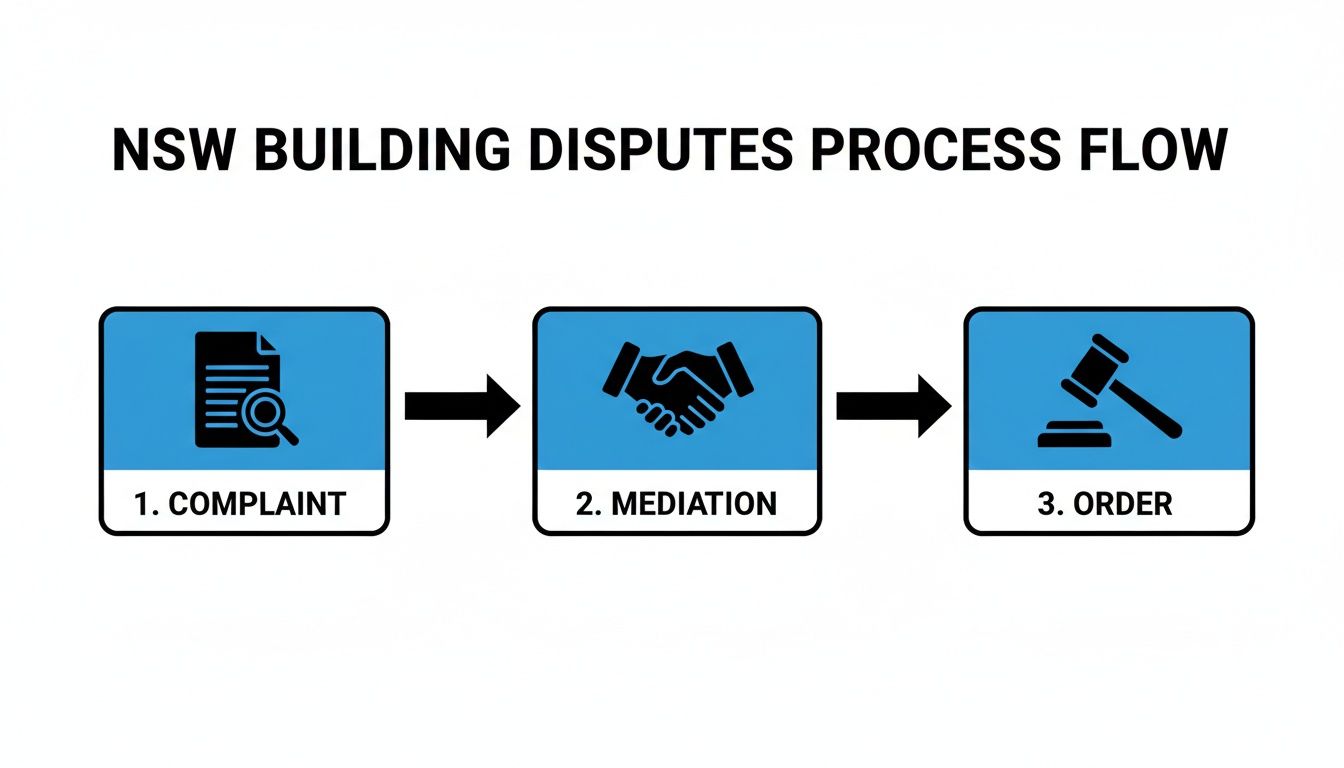
This graphic breaks down the journey, from that first complaint with NSW Fair Trading right through to a potential final order from a body like NCAT.
The Power of Expert Evidence and Scott Schedules
While your own photos and notes are crucial, the single most powerful piece of evidence you can have in an NCAT hearing is often an Expert Witness Report from a qualified building consultant. This independent report translates your frustrations into the technical language the Tribunal needs to see, referencing specific clauses of the National Construction Code and relevant Australian Standards.
This expert evidence is usually presented in a very specific format called a Scott Schedule. A Scott Schedule is a powerful, court-approved document that breaks down the entire dispute into a clear, item-by-item table.
A well-prepared Scott Schedule is a game-changer. It forces the builder to respond to each documented defect one by one, leaving no room for vague denials. It becomes the central roadmap for the entire hearing, guiding the Tribunal Member through the complexities of the case with clarity and precision.
The schedule methodically details:
- Each and every defect you are claiming.
- Your proposed fix and its estimated cost.
- The builder’s specific response to each item.
- A column for the Tribunal Member to make their final ruling on each point.
Putting one of these together correctly is a specialist skill. It needs to be factual, objective, and tied directly to the evidence. This is exactly why bringing in a professional building consultant is a critical strategic move, not just another expense. An expertly crafted Scott Schedule shows you’re serious, organised, and ready to prove your case.
So, you’ve gathered your photos, kept a meticulous log of every phone call, and documented every defect. That’s a fantastic start, but when you step into an NCAT hearing, it’s often not enough to get you across the line.
The Tribunal needs more than just your word that something is wrong. They need an independent, expert opinion that explains why it’s a defect according to the National Construction Code and Australian Standards. This is exactly where a specialist building consultant becomes your most important ally.
A good building consultant isn’t just a builder with a clipboard. Think of them as an impartial investigator. Their job is to provide unbiased, factual, and powerful evidence for the Tribunal, based purely on the Building Code of Australia, the relevant standards, and the fine print of your building contract.
It’s this objectivity that gives their report so much weight. The Tribunal sees them as a neutral party whose sole purpose is to interpret the technical evidence, not to pick a side. They’re experts at translating complex construction jargon into clear, evidence-based arguments that a Tribunal Member can understand and act upon.
The Consultant’s Role from Inspection to Tribunal
Bringing in a consultant is a strategic move that fundamentally strengthens your case. They follow a structured process to make sure every piece of evidence is robust and ready for legal scrutiny.
Here’s what you can typically expect their involvement to look like:
- The On-Site Deep Dive: The first step is a thorough on-site inspection. The consultant will methodically go through every alleged defect, taking detailed notes, precise measurements, and high-resolution photographs.
- The Paper Trail Review: They’ll pour over all your documentation—the contract, architectural plans, council approvals, and your entire communication log with the builder.
- The Expert Report: This is the centrepiece of their work. They produce a comprehensive written report that identifies each defect, explains exactly which code or standard it breaches, and outlines a compliant method for rectification.
- Drafting the Scott Schedule: In many cases, they’ll prepare the Scott Schedule for you. This is a crucial document that methodically lists each defect alongside the estimated cost for repair, creating a clear roadmap for the Tribunal.
- Testifying at the Tribunal: If the matter proceeds to a hearing, the consultant is prepared to attend as an expert witness. They’ll be there to answer the Tribunal Member’s questions and clarify any technical points in their report.
This end-to-end process ensures that from the moment you identify a defect to the final hearing, your case is backed by credible, professional evidence.
Choosing the Right Expert for Your Dispute
Not all building consultants are created equal, and picking the right one is absolutely critical. You need someone with more than just technical knowledge; you need an expert with specific, hands-on experience in the NSW building disputes process and a rock-solid understanding of what NCAT requires.
When you’re interviewing a potential expert, be direct. Ask them about their recent experience with NCAT. A great consultant will confidently walk you through the process, explain their role as an expert witness, and know exactly how to format their reports to meet the Tribunal’s strict standards. Any vague answers should be a major red flag.
To give you a clearer picture, here’s a quick comparison showing why an expert report carries so much more weight than DIY evidence alone.
DIY Evidence vs Expert Report What NCAT Prefers
While your own photos and notes are vital for building a timeline and showing the problem, they tell only part of the story. NCAT needs the “why” and “how,” which is where an expert comes in. An independent report provides the objective analysis and technical authority needed to turn a complaint into a winning case.
| Evidence Type | Credibility in Tribunal | Key Features | Best For |
|---|---|---|---|
| Homeowner Photos & Notes | Moderate | Subjective and lacks technical context. It can show the what but struggles to prove the why. | Your initial complaint to NSW Fair Trading and for documenting the dispute timeline. |
| Expert Witness Report | High | Objective, references specific codes & standards, provides compliant rectification methods & costs. | NCAT hearings and formal legal proceedings where independent, verifiable proof is required. |
Ultimately, an expert report is designed to give the Tribunal Member everything they need to make an informed decision, all in one clear, structured document.
When you’re ready to vet a potential consultant, don’t be shy. Ask them targeted questions like:
- How many NCAT-compliant reports have you prepared in the last 12 months?
- Are you familiar with NCAT Procedural Direction 3, which governs expert evidence?
- Can you provide a redacted example of a report you’ve recently submitted to the Tribunal?
Deciding to hire a professional can feel like a big expense, but it’s really an investment in the outcome of your dispute. A well-written, independent expert report is often the single most influential factor in achieving a successful resolution.
If you’re ready to see how this works in practice, you can learn more about the services offered by specialist building consultants and how they can build a powerful case for you.
Of course. Here is the rewritten section, crafted to sound like it was written by an experienced human expert, following all the provided instructions and examples.
Your Top Questions About NSW Building Disputes, Answered
When you’re staring down the barrel of a building dispute, a thousand questions probably start racing through your mind. It’s a stressful time, and the uncertainty around costs, timelines, and those dreaded “what if” scenarios only makes it worse.
Let’s clear the air. We’ve been in the trenches with homeowners for years, and we hear the same questions time and again. Here are the straight-up answers you need to navigate what’s ahead.
How Much Is This Really Going to Cost Me?
This is the big one, isn’t it? And the honest answer is, it depends entirely on how complex your dispute is and how far down the road you have to go.
Here’s a realistic look at the expenses you might be up against:
- NSW Fair Trading Mediation: Good news first. This initial step is completely free. It’s the government’s way of encouraging a resolution before things escalate, and you should always start here.
- NCAT Application Fees: If mediation doesn’t work, you’ll need to lodge a case with the tribunal. The application fees are fairly minor, but they are just the entry ticket.
- Expert Witness Reports: This is where the real investment comes in. A solid, detailed report from a qualified building consultant is your most powerful piece of evidence. Depending on how many defects we’re talking about and how complex they are, you could be looking at anywhere from $2,000 to over $10,000.
- Legal Fees: While you don’t always need a solicitor for NCAT, it’s often a wise move. Just be prepared for the cost, as legal fees can add up to thousands of dollars pretty quickly.
You have to do a bit of a cost-benefit analysis. The goal is to make sure the cost of the fight doesn’t end up dwarfing the value of the repair bill itself.
What If My Builder Disappears or Goes Bust?
It’s the scenario every homeowner dreads. You’re in the middle of a dispute, and suddenly your builder goes into liquidation, vanishes, or even passes away. It feels like a dead end, but thankfully, there’s a safety net.
Your lifeline here is the builder’s Home Building Compensation Fund (HBCF) insurance. This is a mandatory insurance policy in NSW for all residential projects valued over $20,000.
The whole point of the HBCF is to protect you from financial disaster when your builder can’t finish the job or fix defects. But be warned: making a successful HBCF claim is a notoriously tricky process. It demands rock-solid documentation and following their procedures to the letter.
This is one area where trying to go it alone can backfire. Getting an expert to compile your evidence and guide your HBCF claim is a very smart move—it dramatically increases your chances of getting the payout you’re entitled to.
Can I Just Fix the Defects Myself and Send Them the Bill?
Oh, the temptation is real. When you’re living with a leaky roof or dodgy tiling every day, you just want it fixed. But unless the defect is a genuine, immediate threat to health and safety, you absolutely must resist the urge to repair it.
If you fix the problem, you’ve essentially destroyed the evidence. It’s that simple. You rob the builder, the Fair Trading inspector, and the NCAT Tribunal Member of the chance to see the shoddy workmanship for themselves. The builder can then easily argue that the problem wasn’t that bad, or worse, that your repair job actually caused more damage.
The proper way to handle this is to get a formal order from NCAT. The tribunal has the power to order the original builder to come back and fix it, or—more commonly—order them to pay you the money needed for a different licensed contractor to do the repairs properly.
How Long Do I Have to Make a Claim?
This is critical. In NSW, the clock is ticking from the moment your building work is completed. If you miss the statutory warranty deadlines, your right to make a claim is gone forever, no matter how blatant the defect is.
Mark these timelines in your calendar:
- For major defects (think structural issues, waterproofing failures), you have 6 years.
- For all other defects, the warranty period is just 2 years.
These are not flexible dates. The moment you spot a problem, you need to act. Don’t sit on it, hoping it will go away. Protect your rights by getting the process started immediately.
Navigating a building dispute, especially the technical maze of NCAT or an HBCF claim, isn’t something you should do alone. Awesim Building Consultants provides the independent, expert muscle needed to give your case the authority it deserves. If you’re facing a dispute and need a clear way forward, contact us for a confidential discussion about your situation.

Related Posts

Waterproof Membrane Failure: How Inspectors Find the Cause
Waterproof membrane failure is diagnosed by tracing the water entry point, reviewing design documents, exposing the membrane for visual inspection,
Read More »
Cornice Cracking: How to Tell If the Damage Is Serious
Cornice cracking is one of the most common concerns Australian homeowners raise, and the hard part is not spotting the
Read More »
Digital Construction Consultant Australia: What They Do
A digital construction consultant in Australia manages the technology-driven side of building projects: BIM coordination, clash detection, asset data handover,
Read More »