
When a building dispute gets complicated, you need more than just opinions. You need a construction expert witness.
So, what exactly is a construction expert witness? Think of them as a technical translator for a court or tribunal. They’re a specialised professional whose job is to provide an independent, evidence-based opinion on building-related matters. They take complex construction problems—like defects, shoddy workmanship, or project delays—and break them down into clear, understandable facts.
The Role of a Construction Expert Witness in a Dispute

Let’s paint a picture. A homeowner is convinced their new extension has a leaking roof due to faulty installation. The builder, on the other hand, blames a freak once-in-a-century storm. Without an expert eye, a judge or tribunal member is stuck in the middle of a "he said, she said" battle.
This is precisely where the expert witness comes in. Their role isn't to pick a side; it's to provide an impartial, professional opinion based purely on the facts and their expertise.
The expert witness serves as an independent advisor to the court or tribunal, like the NSW Civil and Administrative Tribunal (NCAT). Their primary duty is to the tribunal itself, not the person who hires them. This is a non-negotiable principle, legally cemented in the Expert Witness Code of Conduct.
An expert witness has an overriding duty to assist the Court on matters relevant to the expert's area of expertise. An expert witness is not an advocate for a party to the proceedings.
In short, they’re there to uncover the technical truth. They do this by methodically investigating the issue, applying their specialised knowledge, and presenting their findings in a structured, unbiased report.
Core Functions and Responsibilities
A construction expert witness does much more than just a quick site visit. Their work is a deep dive, involving careful analysis and detailed reporting.
Here’s what their key responsibilities usually look like:
- Investigating Alleged Defects: They get to the bottom of the problem, meticulously examining things like cracking walls, water leaks, or non-compliant work to pinpoint the root cause.
- Assessing Workmanship Standards: The expert holds the work up against the rulebook—the National Construction Code (NCC), Australian Standards, and the builder's statutory warranties—to see if it makes the grade.
- Providing a Clear Opinion: Based on the evidence, they form a professional opinion on who is responsible for the defect.
- Costing Rectification Works: This is a huge part of the job. They provide a detailed, realistic estimate of what it will cost to fix the identified problems properly.
- Preparing Formal Reports: All their findings are documented in formal reports, often an Expert Witness Report and a Scott Schedule, structured specifically for legal proceedings.
When Is an Expert Witness Necessary?
You don't need to call in an expert for every little disagreement. But when a dispute hinges on complex technical questions that are beyond a layperson's understanding, their involvement is absolutely crucial.
It's time to engage an expert in these common scenarios:
- Significant Building Defects: Think major issues like structural faults, waterproofing failures, or widespread non-compliance.
- Contractual Disputes: When you're at a stalemate over contract variations, project delays, or the quality of finishes specified in the building contract.
- NCAT or Court Proceedings: Once a dispute goes to a formal legal setting, an expert report is almost always needed to present the technical evidence.
By translating the complex language of construction into objective facts, a construction expert witness provides the clarity needed to steer a dispute towards a fair and informed resolution.
Navigating the Legal Rules for Experts in NSW
Engaging a construction expert in New South Wales isn't as simple as just finding someone who knows their way around a building site. There's a strict set of legal rules they must follow to ensure their evidence is fair, reliable, and actually useful to a court or tribunal.
These rules aren't just suggestions; they're mandatory. Get them wrong, and you risk having your expert’s entire report thrown out. Understanding this framework is crucial whether you're a homeowner, builder, or lawyer, as it dictates how your expert must operate. The key document governing this is the Expert Witness Code of Conduct, which applies to all proceedings in NSW courts and the NSW Civil and Administrative Tribunal (NCAT).
The Overriding Duty to the Tribunal
If there’s one principle to burn into your memory, it’s this: the expert's ultimate loyalty is to the court or tribunal, not the person paying their bill.
An expert witness has an overriding duty to assist the Court on matters relevant to the expert's area of expertise. An expert witness is not an advocate for a party to the proceedings.
This is the absolute bedrock of the system. It means the expert acts as an impartial guide, helping the decision-maker understand the technical facts. They are not a "hired gun" brought in to argue your case. Their job is to provide objective opinions based on the evidence, even if those opinions don't fully support your position. Any hint of bias can seriously undermine their credibility, leading to their evidence being given little weight or dismissed entirely.
Key Obligations Under the Code of Conduct
The Code of Conduct lays out a clear checklist of duties that every expert must follow. For a report to be considered valid by NCAT or a court, it absolutely has to tick these boxes.
A compliant expert report must:
- Acknowledge the Code: The expert must start by formally stating they've read the Code of Conduct and agree to be bound by its rules. It's a non-negotiable opening statement.
- State All Assumptions: Every opinion is built on a foundation of facts or assumptions. The expert needs to list these out clearly so everyone can see the basis for their conclusions.
- Detail Qualifications: The report has to outline the expert's specific qualifications, training, and real-world experience that make them an authority on the issues at hand.
- Provide Reasons for Opinions: Simply stating a conclusion is useless. The expert must "show their working," detailing the logical steps and reasoning that led them to their professional opinion.
Knowing these requirements is critical. You can find a complete breakdown of these rules in the latest procedural directions. For a deeper look at the specifics, you can learn more about NCAT procedural directions for expert evidence which sets everything out in detail.
The Joint Conference of Experts
To cut through the noise and streamline the process, tribunals will often order a "joint conference of experts"—sometimes called a "conclave." This is a meeting where the experts for each party sit down together, without any lawyers present, to hash out the technical issues.
The goal is to produce a single document for the tribunal that identifies three things:
- Areas of Agreement: What technical facts do they all agree on?
- Areas of Disagreement: Where, specifically, do their professional opinions diverge?
- Reasons for Disagreement: What is the technical basis for their different conclusions?
The result is a Joint Report. This document is incredibly powerful. It distils a complicated technical dispute down to the core points of conflict, saving a massive amount of time and money at the final hearing. A huge part of an expert's work involves untangling complex regulations, and understanding how technology helps—or hinders—in tasks like reading and interpreting complex building codes can give you a real insight into their detailed analytical process.
Breaking Down the Expert Witness Report

A building dispute can feel like a tangled mess of he-said-she-said claims, technical jargon, and pure frustration. A construction expert witness is the person who cuts through that chaos, bringing order and clarity with carefully structured, evidence-based documents.
These reports are the absolute backbone of a strong case. They transform subjective arguments into an objective analysis that a court or tribunal can actually understand and act on.
The two most critical documents you'll encounter are the Expert Witness Report and the Scott Schedule. They serve different purposes but work hand-in-hand to paint a complete, unbiased picture of the dispute. Let’s pull them apart and see what makes them tick.
The Anatomy of an Expert Witness Report
This is the main event. The Expert Witness Report is a formal, comprehensive document that lays out the expert’s entire investigation, from their initial instructions to their final, reasoned opinions. It’s not a simple quote or a casual list of problems; it’s a meticulously crafted argument backed by hard evidence.
To be accepted by NCAT or a court, this report has to follow the strict rules of the Expert Witness Code of Conduct. A good one will always be built on these essential pillars:
- The Expert’s Qualifications: This is where the expert establishes their credibility. It details their licences, hands-on industry experience, and any specific training that makes them the right person for this particular job.
- The Instructions Received: Think of this as the mission briefing. It clearly states the specific questions the expert was asked to investigate, ensuring their work stays focused and directly tackles the legal issues at hand.
- Facts and Assumptions: Total transparency is key. The expert must list every document they reviewed, the site conditions they observed, and any assumptions they made to arrive at their conclusions.
- Summary of Findings: Here’s the core of the investigation. The expert details their inspection process, identifies defects, and measures them against the relevant Australian Standards and the National Construction Code.
- Reasoned Conclusions: This is the payoff. The expert provides clear, impartial opinions that directly answer the questions they were asked. Crucially, they must explain why they reached each conclusion, showing the logical steps they took.
The real power of an Expert Witness Report isn’t just in its final opinion. It’s in the clear, evidence-based journey it takes to get there. It needs to be a self-contained map that allows anyone to follow the expert’s logic from A to B without needing any outside information.
For a deeper dive into the nitty-gritty, our guide on the NCAT expert witness report breaks down exactly what tribunals are looking for.
Demystifying the Scott Schedule
If the Expert Witness Report is the full story, the Scott Schedule is the cheat sheet. It’s a genius tool, usually set up as a table or spreadsheet, designed to organise a dispute into a clean, item-by-item format.
Its job is simple but powerful: allow a tribunal member to see every single alleged defect, what both parties have to say about it, and what the expert thinks—all in one place. This structured approach is incredibly efficient, cutting through the noise and focusing the hearing on the exact points of disagreement.
Let’s look at how it’s laid out.
Understanding the Scott Schedule Format
A Scott Schedule organises the entire dispute into a side-by-side comparison, making it easy for the tribunal to see precisely where the parties agree and disagree. Here’s a typical breakdown of the columns:
| Item No. | Plaintiff's Claim (The Defect) | Defendant's Response | Expert's Opinion & Recommended Action | Estimated Cost to Rectify |
|---|---|---|---|---|
| 1 | Water pooling on balcony due to incorrect fall. | The fall complies with standards; the issue is from a blocked drain. | The fall does not meet AS 4654.2. Rectification requires re-tiling. | $3,500 + GST |
| 2 | Cracks appearing in living room plasterboard. | These are minor settlement cracks, not a building defect. | Cracks exceed allowable limits. Caused by inadequate wall framing. | $1,800 + GST |
This columnar format forces everyone to be specific. It stops people from talking past each other and instantly highlights what needs to be decided. The expert's columns provide the independent data on defects and costs, which is why the Scott Schedule has become an essential tool in virtually all building disputes in NSW.
How to Choose the Right Expert for Your Case
Picking the right construction expert witness is one of the most critical decisions you'll make in a building dispute. This isn't just about finding someone with a builder's licence; you need a professional who can dig deep during an investigation, write a clear and convincing report, and hold their own under the pressure of cross-examination in a tribunal.
A brilliant technical mind is almost useless if they can’t explain their findings in a way that makes sense to everyone else. The best experts marry deep, hands-on construction knowledge with an unshakable grasp of their legal duties. It’s this combination that often turns a good case into a winning one.
Beyond the Builder's Licence
Simply having a builder's licence is the absolute floor, not the ceiling. It’s the starting point. Your vetting process needs to go much, much deeper to find someone who will genuinely strengthen your case.
The ideal expert has a specific blend of technical skill, legal savvy, and communication prowess. Look for these core strengths:
- Direct, Relevant Experience: Does the expert have specific, hands-on experience with the exact type of defect you're dealing with? An expert in waterproofing residential bathrooms might not be the best choice for a dispute over a failed commercial roofing membrane. The more specific their experience, the better.
- Deep Knowledge of the NCC: They must be completely fluent in the National Construction Code (NCC) and all the relevant Australian Standards. Their opinions have to be grounded in these mandatory industry benchmarks, not just "how they've always done it."
- NCAT Experience and Compliance: Have they actually prepared reports for NCAT before? Do they know the Expert Witness Code of Conduct inside and out? This kind of procedural knowledge is completely non-negotiable.
The credibility of a construction expert witness rests entirely on their ability to remain impartial. Their duty is to the tribunal, not to the party paying their invoice. An expert who acts like a 'hired gun' will lose the trust of the decision-maker in a heartbeat, taking your case down with them.
Gauging Communication and Credibility
Technical expertise is only half the battle. Your expert has to be a clear and confident communicator, someone who can explain a complex building failure in simple terms without glossing over the crucial technical details. Their credibility is just as important as their knowledge.
This is especially true in today's market. Australia’s construction industry has been riding a rollercoaster of cost pressures and labour shortages, which often fuels disputes. For instance, in the September quarter of 2025, total construction work done actually fell by 0.7%, yet building work rose by 4.0%—a complex picture. You can see the full story in the Australian Bureau of Statistics' latest construction data. A good expert can place your specific issue within this broader industry context.
Key Questions to Ask a Potential Expert
When you first talk to a potential expert, don't be shy about asking direct questions. Their answers will tell you a lot about whether they're the right fit. It’s also worth noting that the role of an expert can sometimes seem similar to other professionals. We break down the differences in our guide on what a building consultant is.
Here are some essential questions to get you started:
- Can you describe your experience with this specific type of building issue?
- Why it matters: This confirms their expertise is directly relevant to your situation, not just general building knowledge.
- How many NCAT-compliant reports have you prepared in the last two years?
- Why it matters: This checks their familiarity with current legal requirements and tribunal procedures. Recent experience is key.
- Have you ever been cross-examined in a hearing?
- Why it matters: This tells you they have experience defending their opinions under pressure—a skill that can make or break a case.
- How do you ensure your report complies with the Expert Witness Code of Conduct?
- Why it matters: Their answer should show a crystal-clear understanding that their number one duty is to the tribunal, not to you.
- What is your process for site inspections and collecting evidence?
- Why it matters: This gives you insight into their methodology and how thorough they are. You want methodical, not rushed.
Choosing the right expert is an investment in clarity and credibility. Take the time to vet them properly—it will pay dividends when it matters most.
Understanding Engagement Timelines and Costs
So, you’re in a building dispute. Two questions probably jump to mind straight away: ‘When do I actually need to get a construction expert witness involved?’ and ‘What on earth is this going to cost me?’ Getting the answers right is key to managing both your case and your budget.
Let’s talk timing first, because it’s a common mistake. Most people wait until legal action is well and truly underway, but the smartest move is often to bring an expert in much earlier. Think of it as a pre-flight check. Engaging an expert before you even start formal proceedings gives you a clear, unbiased look at where you stand. It helps you figure out if you have a strong claim worth pursuing.
This early insight means you can build your case on solid evidence, not just assumptions. An initial report can quickly pinpoint the strengths and weaknesses of your claim, potentially saving you a huge amount of time, stress, and money on a fight you might not win.
Breaking Down the Cost Structure
When it comes to cost, don't expect a single, flat fee. The price of an expert witness is broken down based on the time and work needed at each stage of your dispute. Understanding how it all works helps you budget properly and avoids nasty surprises down the track.
Here’s what the fees typically cover:
- Initial Consultation and Review: This is for the expert’s time to look over your first batch of documents – things like contracts, emails, and photos – and give you some initial advice.
- Site Inspection and Investigation: This is a big one. It covers the expert’s travel costs and time on-site, where they’ll meticulously inspect the alleged defects and gather the crucial evidence.
- Report Writing: Often the most significant cost, this reflects the many hours it takes to analyse all the findings, cross-reference everything with the National Construction Code and Australian Standards, and then draft a detailed, NCAT-compliant report and Scott Schedule.
- Meetings and Joint Conferences: If your expert needs to meet with your legal team or attend a conference with the other side’s expert (known as a conclave), their time is billed at an hourly rate.
- Tribunal Appearance: If your case goes all the way to a final hearing, the expert will charge for their time to prepare and give evidence at the tribunal.
The image below gives a simple overview of the key things to look for when choosing your expert.
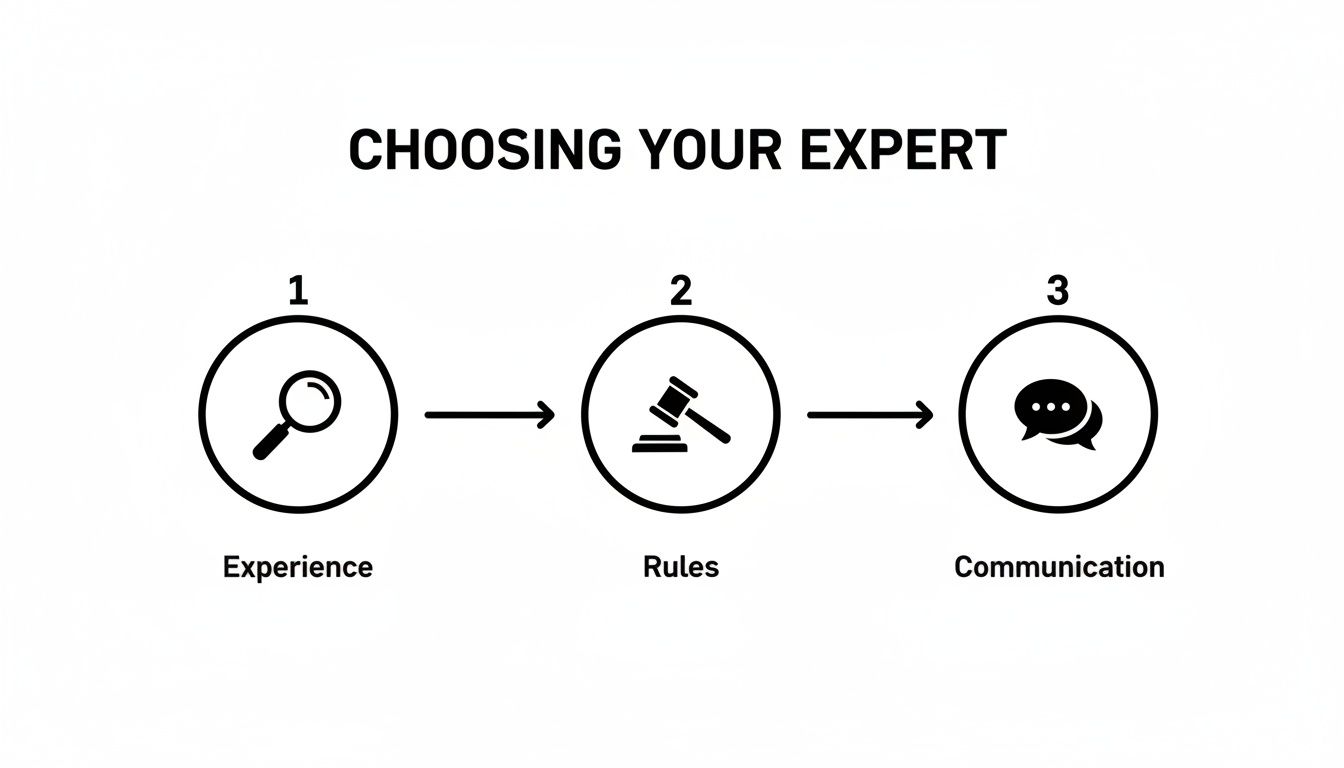
As you can see, it’s about more than just their building knowledge. You need someone who has real-world experience, understands the legal rules inside-out, and can communicate complex ideas clearly.
Realistic Cost Ranges and Financial Context
The total bill can swing wildly depending on how complex your dispute is. For a straightforward residential defect claim with just a few issues, you might be looking at a few thousand dollars. But for a complex commercial dispute with a long list of problems, it’s not unusual for expert costs to climb well over $15,000 by the time you get to a final hearing.
It’s also worth understanding the wider industry pressures that often fuel these disputes in the first place. The Australian construction sector is under serious financial stress, leading all other industries in insolvencies. According to ASIC figures, a staggering 1,153 construction companies went into administration between July and October 2025 alone. This tough environment often leads to payment fights and corners being cut on-site, making an impartial expert more vital than ever. You can read more about these industry pressures on the Altus Group website.
A credible expert will always provide a clear fee agreement upfront, outlining their hourly rates and estimated costs for each stage. This transparency is a hallmark of a professional who understands their role and respects their client's need for financial clarity.
By getting a handle on these timelines and cost structures, you can make a properly informed decision. You’ll be able to engage the right expert at the right time, giving your case the best possible chance of success.
Frequently Asked Questions About Construction Experts
When you're caught in a building dispute, things can get confusing fast. Legal jargon, tribunal procedures, and the sudden need for a "construction expert witness" can feel overwhelming. To cut through the noise, we've answered some of the most common questions we get from homeowners, builders, and lawyers every day.
Getting these fundamentals right can save you from making costly mistakes and help you understand exactly what an expert brings to the table. Let’s break it down.
Can I Just Use a Builder's Quote as Evidence?
This is probably the most common question we hear, and the answer is a hard no. It's a tempting shortcut, but a standard builder's quote simply won't be accepted as proper evidence in a formal hearing at the NSW Civil and Administrative Tribunal (NCAT).
Think about it: a regular quote is a sales document. Its main purpose is to win a job, not to provide an impartial, forensic analysis of a building defect.
For a report to hold any weight, it must be prepared by a qualified expert who formally agrees to follow the Expert Witness Code of Conduct. This is a big deal. It means they've officially stated that their number one duty is to the tribunal, not to the person paying their invoice. A construction expert witness knows how to structure their report to meet these strict legal rules, turning it into a piece of impartial evidence rather than just a commercial quote.
What's the Difference Between a Single and a Joint Expert?
You'll hear these terms thrown around, so it's good to know what they mean for your case.
A 'single expert' is the usual setup. This is where one party—say, the homeowner—hires their own expert to investigate the building defects and write a report. The other side, like the builder, will almost always hire their own expert to do the same. This can sometimes feel like a "battle of the experts," leaving the tribunal to decide which opinion is more persuasive.
A 'joint expert', however, is a single expert appointed by both parties together, or sometimes by the tribunal itself. The idea is to get one independent, neutral report that everyone can work from. This is often a smarter, more cost-effective path for smaller disputes.
Even when both sides have their own expert, the tribunal will often order them to meet and create a 'joint report' or 'conclave report'. This document is incredibly useful because it clearly lists what the experts agree on and, more importantly, what they disagree on. It cuts right to the heart of the conflict and makes the hearing much more efficient.
What if I Don't Agree with My Expert's Report?
It’s a tough moment when you read your expert’s report and find opinions that don't match your own view of the situation. The first thing to do is have a calm chat with your legal team. It's possible there's just a technical point that needs a better explanation.
But here’s the crucial part: an expert witness cannot and will not change their professional opinion just because you don't like it. Their credibility, and the integrity of your case, rests on their impartiality. Their duty is to the tribunal, period. Pressuring them to change their findings is unethical and could completely tank your case if it comes to light.
Now, if you disagree with the other side's expert, that’s a different story. Your lawyer has a few tools to challenge their report:
- Report in Reply: Your expert can write a formal response, pulling apart the other expert's methods, assumptions, or conclusions.
- Cross-Examination: This is where the real action happens. During the hearing, your lawyer gets to question the other expert directly, putting their evidence and opinions to the test.
Does Hiring an Expert Mean I'll Automatically Win?
Bringing a credible, experienced construction expert on board massively strengthens your case, but it's no guarantee of a win. An expert report is a critical piece of the puzzle, but it's not the only piece.
The expert's job is to provide clear, objective, and authoritative evidence on the technical building issues. A well-written, logical report is incredibly persuasive and can often be the deciding factor. But the tribunal member or judge has to weigh up all the evidence before them, including:
- The building contract and any related documents.
- Testimony from you, the builder, and any other witnesses.
- Photos, videos, and other physical evidence.
- The legal arguments made by the lawyers.
A top-notch expert provides the solid, factual foundation your case needs. They give your claims the technical authority required to be taken seriously, giving you the best possible shot at a fair outcome.
Facing a building dispute and need clear, authoritative advice? The team at Awesim Building Consultants provides NCAT-compliant Expert Witness Reports and Scott Schedules grounded in over 35 years of hands-on construction experience. We translate complex building issues into clear, evidence-based reports that stand up to scrutiny. Contact Awesim Building Consultants today to discuss your case and get the expert support you need to move forward with confidence.
