
Water Stops in Showers and Preventing Leaks
Think of a water stop in your shower as the last line of defence for your home. It’s a small, often unseen barrier that works like a tiny dam, making sure water from your shower goes down the drain and nowhere else. Get it wrong, and you’re looking at thousands of dollars in hidden damage. This simple component is absolutely critical to protecting your home from wood rot, mould, and even structural failure.
Why a Shower Water Stop is So Incredibly Important
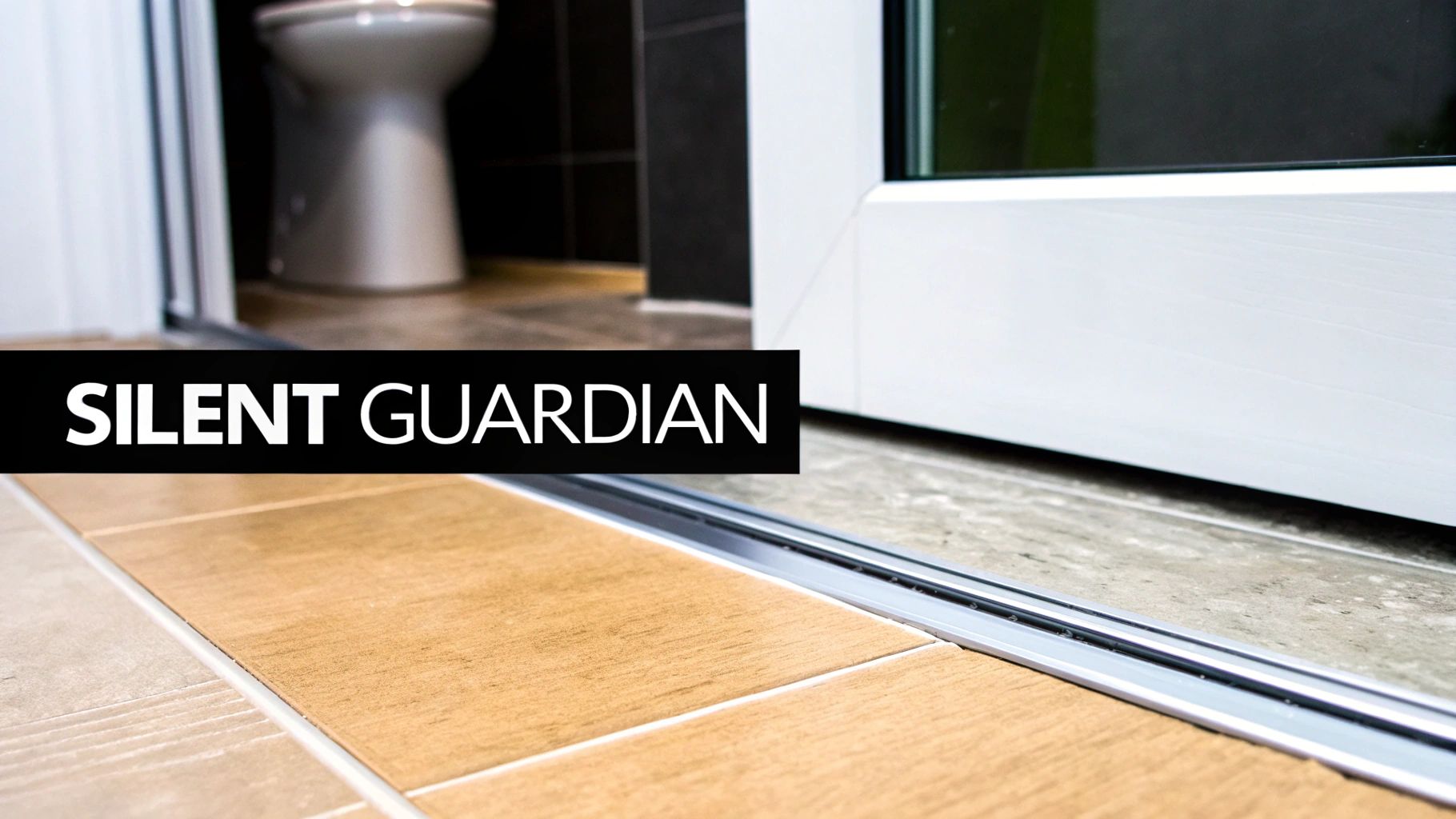
It might look like a minor detail, but a failed water stop is one of the most common triggers for messy and expensive building disputes right across New South Wales.
Picture your shower floor as a shallow basin, specifically designed to hold and direct litres of water every single day. The water stop is simply the raised edge of that basin. Its one job is to ensure every last drop heads towards the drain instead of sneaking off into your walls or the floor structure beneath.
If this crucial element is missing, damaged, or just installed incorrectly, water has an open invitation to track under the tiles, bypassing the waterproofing membrane entirely. This kind of slow, creeping leak can go unnoticed for years, quietly eating away at the integrity of your property.
The Hidden Dangers of a Bad Installation
The fallout from a missing or non-compliant water stop is almost always severe and costly. Understanding what’s at stake is the first step to appreciating why this little component is so heavily scrutinised during building inspections and legal battles.
The typical problems we see are:
- Structural Damage: Constant dampness rots timber floor joists and wall frames, literally weakening the skeleton of your home.
- Mould and Mildew Growth: Escaped water creates the perfect dark, damp environment for toxic mould to thrive, which can cause serious health problems.
- Damage to Adjoining Rooms: Water doesn’t stay put. It seeps through walls, wrecking carpets, skirting boards, and plasterboard in rooms next door.
- Tile Failure: Once moisture gets under your tiles, the adhesive bond breaks down. Soon enough, you’ll see tiles lifting, cracking, or sounding hollow and “drummy”.
In our 35 years of hands-on experience, a faulty water stop is the prime suspect in the most destructive and expensive wet area defects we investigate. This isn’t just a minor flaw; it’s a complete failure of the waterproofing system’s core purpose.
This guide will walk you through exactly why this simple barrier is a make-or-break element in any bathroom. We’ll cover everything from Australian compliance standards to spotting the signs of failure, giving you the knowledge you need to protect your property from a potential financial nightmare.
Of course. Here is the rewritten section, crafted to sound like an experienced human expert in the building industry.
Water Stops and the Australian Standards: What You Need to Know
To really get your head around water stops, you have to stop thinking of them as just another bit of metal trim. Instead, think of them through the lens of Australian building law. These aren’t just a “good idea” for your shower; they’re a non-negotiable part of the rulebook, mandated by the National Construction Code (NCC) and spelled out in Australian Standard AS 3740: Waterproofing of domestic wet areas.
Essentially, a water stop is a physical dam. Its job is to contain water inside the designated shower area, working hand-in-glove with the waterproof membrane and the floor’s gradient (or ‘fall’). The fall does the heavy lifting, directing most of the water towards the drain. The water stop is the last line of defence, catching any stray water that tries to make a run for it across the bathroom floor.
This system is absolutely critical in modern hobless or “walk-in” showers. With no traditional step-over hob to hold water back, a properly installed water stop is the only thing preventing a flood every time you turn on the tap. Without it, water can easily creep under walls and into adjoining rooms, causing untold damage.
Breaking Down the Rules in AS 3740
Building codes can feel a bit like reading a legal document, but the core rules for water stops are pretty simple. The standards don’t just say if you need one; they dictate precisely how it must be installed. Two concepts are key here: the vertical leg height and its position relative to the finished floor level.
“Finished floor level” is just industry-speak for the top surface of your tiles. The “vertical leg” is the upright part of the L-shaped water stop angle. For the installation to be compliant, this vertical leg has to stick up a certain height above the tiles.
Let’s look at the must-haves:
- At the Shower Opening: A water stop is mandatory at the entrance to the shower recess. No exceptions.
- Hobless Shower Height: For any shower without a hob, the top of the water stop’s vertical leg must finish at least 5 mm above the finished tile level. It might not sound like much, but that tiny 5 mm lip is incredibly effective at stopping water from sheeting across the floor.
- Under the Shower Screen: The water stop must be positioned directly underneath the shower screen, forming a continuous, unbroken barrier.
The Australian Standards aren’t just friendly suggestions; they are the minimum legal requirements. A water stop installed even a couple of millimetres too low is a defect and fails its primary job of containing water.
The All-Important 1500 mm Rule for Walk-in Showers
One of the most specific—and often misunderstood—rules applies to those popular open-ended, walk-in style showers. In Australia, and particularly across New South Wales, this rule has become a massive focus in building compliance, largely because getting it wrong leads to a world of waterproofing pain and costly NCAT disputes.
The National Construction Code (NCC) 2022 is crystal clear on this. For an unenclosed shower, the water stop must run for a minimum horizontal distance of 1500 mm from the shower rose. You can dig into the specifics yourself on the Australian Building Codes Board’s official NCC guidelines website.
That 1500 mm isn’t a number plucked from thin air. It’s based on years of observing the typical spray pattern from a modern shower head, creating a “splash zone” that has to be fully contained. The water stop has to run continuously for that entire length to stop water from simply wrapping around the edge of the shower screen.
Common Water Stop Materials
While the function is always the same, you’ll see a few different materials used for water stops. The choice usually comes down to the bathroom’s design and the builder’s preference, but the most important thing is that the material is compatible with the waterproofing membrane.
| Material Type | Common Application | Key Characteristics |
|---|---|---|
| Aluminium Angle | The go-to, most common and cost-effective option. | A simple L-shaped profile installed before tiling. It needs to be securely bonded to the substrate and fully integrated with the membrane. |
| Stainless Steel Angle | Seen in high-end or architectural builds. | Offers much better corrosion resistance and a premium look, but it costs more. Functionally, it does the same job as aluminium. |
| Proprietary Systems | Pre-formed systems with integrated flanges. | These are more advanced kits designed to work with specific waterproofing products, often giving you a more reliable seal at tricky junctions. |
At the end of the day, it doesn’t matter which material you use if the installation is shoddy. The water stop has to be mechanically fixed and chemically bonded to the floor substrate. Then, the waterproofing membrane must be applied over it and dressed carefully up the vertical leg. Get that right, and you create a seamless, monolithic barrier that water simply can’t get through, keeping your bathroom bone dry for years.
Why Shower Water Stops Fail and How to Spot Them
A perfectly designed water stop is useless if it’s installed poorly. When this small but crucial barrier fails, it’s not usually a sudden flood. Instead, it’s a slow, stealthy leak that can rot your house from the inside out long before you even know there’s a problem.
Getting to the bottom of why they fail is key for both homeowners and building consultants. A failed water stop basically means the dam has a hole in it. The biggest culprits aren’t faulty products; they’re almost always mistakes made during installation. These little errors create tiny escape routes for water, completely bypassing the waterproofing system and making it worthless.
The Number One Culprit: Incorrect Installation Height
The most common and easiest stuff-up to spot is getting the height wrong. The Australian Standards are crystal clear on this: the top edge of the water stop must finish at least 5 mm above the finished tile level. No exceptions.
When it’s installed too low, or even worse, flush with the tiles, it might as well not be there at all.
Think of it like a shallow baking tray. If you fill it to the very brim, the slightest nudge sends water spilling everywhere. A water stop that’s too low does exactly the same thing. Water simply sheets over the top and escapes the shower, making a mockery of the entire waterproofing system. For an inspector, this is a glaring, undeniable defect.
This diagram breaks down how the National Construction Code (NCC) rules translate into that non-negotiable 5mm height requirement.
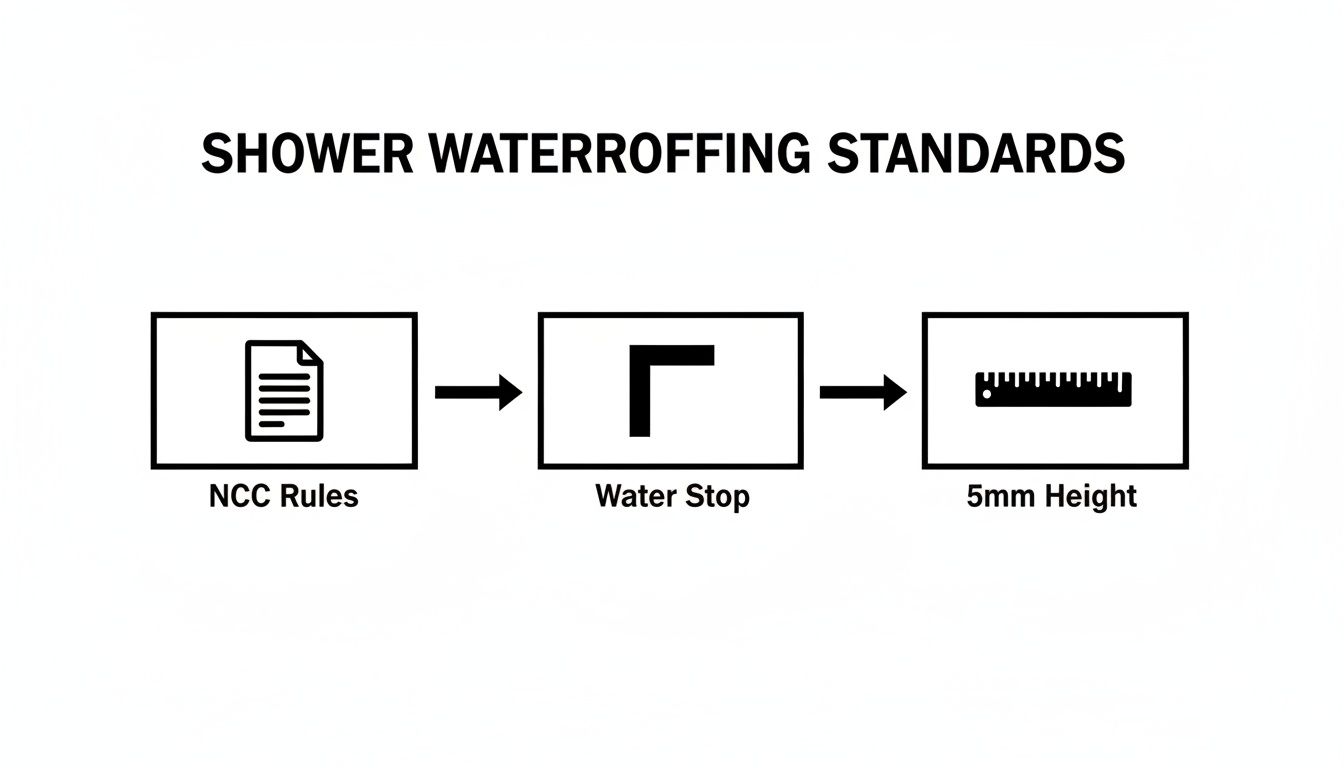
It’s a simple visual, but it drives home the point that just having a water stop isn’t enough. It has to meet the exact height standard to do its job.
Poor Sealing and Shoddy Membrane Integration
A water stop isn’t a standalone feature; it has to be perfectly fused with the waterproofing membrane. The membrane sheet needs to be carefully dressed up and over the vertical part of the angle, creating a single, unbroken waterproof barrier.
This junction is where things often go wrong. Here are the usual suspects:
- Bond Breakers: If the installer doesn’t clean the water stop properly, any dust, grime, or moisture left behind will stop the membrane from sticking. This creates a weak spot just waiting to fail.
- Lazy Detailing: Rushing the job often leads to tiny gaps or pinholes in the membrane, especially right in the tricky corner where the floor meets the water stop angle.
- Damage on Site: Water stops go in early in the building process. This leaves them exposed to damage from other tradies. A dropped hammer or a carelessly placed ladder can easily puncture the membrane at this critical point, and you’d never even know until the rot sets in.
From what we see out in the field, the junction where the waterproofing membrane meets the water stop is the system’s Achilles’ heel. It’s the most difficult part of the job to get right, and consequently, it’s where most leaks start.
To help you visualise where things go wrong, we’ve put together a table summarising the most common failure points.
Common Water Stop Failure Points and Their Consequences
| Failure Point | Common Cause | Resulting Damage |
|---|---|---|
| Water Stop Height | Installed less than 5mm above the finished floor tiles. | Water overflows the barrier, saturating screed and subfloor. |
| Membrane Adhesion | Surface not cleaned before membrane application (dust, debris). | Membrane peels away, creating a direct path for water leakage. |
| Junction Detailing | Gaps or pinholes left in the membrane at the floor/wall junction. | Slow, persistent seepage into wall cavities and adjacent rooms. |
| Physical Damage | Punctures from other trades during construction. | A hidden leak point that causes structural rot over time. |
Understanding these specific points makes it much easier to know what to look for during an inspection or if you suspect a leak.
The Financial Fallout of a Leaky Shower
These failures aren’t just technical defects; they’re a ticking financial time bomb for homeowners. In NSW, disputes over wet areas often end up at NCAT, and a faulty water stop is frequently the star witness.
Industry data shows that leaking showers are a massive problem, contributing to 25-30% of all residential insurance claims for water damage. The average payout for these claims often tops $10,000 per incident, and that’s before you factor in the stress and disruption.
Catching these problems early is everything. If you’re not a building expert, it’s still worth knowing how to detect water leaks in your home, as the same principles apply. Learning to spot the early warning signs—like crumbling grout, lifting tiles, peeling paint, or a musty smell—can be the difference between a simple fix and a catastrophic repair bill.
Your Practical Shower Inspection Checklist
Suspecting a problem with your shower’s waterproofing is one thing, but proving it is another kettle of fish. Before you pick up the phone to call an expert, you can do a bit of detective work yourself to see what’s really going on. This checklist will walk you through a methodical inspection of your shower’s waterstop, helping you spot the tell-tale signs of a problem.
Think of yourself as an investigator gathering clues. The goal isn’t to jump to conclusions, but simply to document what you see. A calm, methodical approach gives you the information you need to decide what to do next—whether that’s having a firm word with your builder or bringing in a professional.
Step 1: Visual and Physical Checks
First things first, let’s use the best tools you’ve got: your eyes and your hands. A simple visual sweep can often uncover the most glaring and common defects with water stops in showers. You won’t need any fancy gear for this part, just a keen eye and maybe a tape measure.
Start by looking at the junction where the shower screen meets the floor. Can you see a metal angle sitting under the screen? If you can, grab your tape measure and check its height from the top of the tiles. According to the Australian Standard AS 3740, this angle must be at least 5 mm above the finished floor level. If it’s any lower, that’s a clear-cut defect.
Next, get a closer look at the grout and silicone around the shower base. You’re looking for:
- Cracking or crumbling grout lines: This can be a sign of building movement or, more likely, that the grout is saturated with water.
- Peeling or mouldy silicone seals: Pay special attention to where the floor meets the walls, as this is a classic failure point.
- Hollow-sounding or “drummy” tiles: Gently tap the tiles. If they sound hollow, it often means the tile adhesive has failed, usually because of moisture getting underneath.
Finally, cast your eyes to the areas just outside the shower. Check the skirting boards, door architraves, and any adjacent carpet for water stains, swelling, or discolouration. These are the classic calling cards of a slow leak.
Step 2: Performing a Basic Flood Test
A visual check is a great starting point, but a simple functional test can confirm if water is actively escaping. A controlled “flood test” mimics heavy shower use and can reveal leaks that aren’t otherwise obvious. A word of caution here: only do this if you can contain the water and keep a close watch on it.
First, block the shower drain. A good-quality plug works best, but a wet cloth packed tightly into the waste outlet will also do the trick. The idea is to temporarily stop water from draining away.
Now, run the shower for a few minutes. Let the water pool on the shower floor right up to the base of the waterstop angle, but don’t let it go over the top. Let it sit there for about 15-20 minutes while you keep a hawk eye on the entire perimeter of the shower. Look for any water seeping out from under the shower screen or at the wall junctions.
This simple test is the fastest way to see if the waterstop is doing its job as a dam. If you spot water tracking outside the shower area, you have definitive proof that the containment system has failed.
Step 3: Documenting Your Findings
If you’ve found potential issues, your next job is to document everything. Clear, well-lit photos are your most powerful evidence. When a defect is confirmed, a proper report is non-negotiable, and this is where an expert’s eye makes all the difference. For a comprehensive assessment that will stand up in a dispute, getting an independent building inspection provides the certified proof you’ll need.
When you’re taking photos, make sure you capture:
- A wide shot of the entire shower to provide context.
- Close-up shots of any cracks, mould, or water stains you’ve found.
- A photo with your tape measure clearly showing the height of the waterstop.
- Pictures of any water that escaped during your flood test.
Organise these photos and add a few brief, factual notes explaining what each one shows. This little evidence file will be incredibly valuable, giving you a solid foundation for whatever action you take next.
When you first spot a leaking shower, the thought of confronting your builder can be stressful enough. But what happens when that chat goes nowhere and the problem isn’t fixed? That’s when you’re forced down the path of a formal building dispute, which in New South Wales often ends up at the NSW Civil and Administrative Tribunal (NCAT).
If you find yourself in this situation, success boils down to one critical thing: evidence. Your gut feeling that the shower is leaking won’t cut it. You have to prove why it’s leaking and show that the cause is a clear failure to follow the mandatory Australian Standards. This is where a faulty or non-compliant water stop becomes the undeniable smoking gun in your case.
Armed with clear proof of a defect like a failed water stop, the entire dynamic of the dispute changes. It’s no longer an emotional “he said, she said” argument. It becomes a straightforward, fact-based case that shifts the conversation from, “I think you built it wrong,” to “Here is the specific clause in AS 3740 that your work has breached.”
The Crucial Role of an Expert Witness Report
In any building dispute, an Expert Witness Report is your single most powerful weapon. This isn’t just a quick summary of an inspection; it’s a formal, legally structured document put together by a qualified building consultant. Its job is to give the Tribunal an independent, objective breakdown of the building defect.
A solid report accomplishes three key things for your NCAT claim:
- It Identifies the Defect: The expert gets right to the point, identifying the exact failure, like a water stop that’s been installed flush with the tiles instead of the required 5 mm above.
- It Links the Defect to the Standards: This is the most critical part. The report will quote the specific, non-negotiable clauses from the National Construction Code (NCC) and AS 3740 that have been ignored.
- It Recommends a Solution: It doesn’t just point out the problem; it details the exact rectification work needed to make the shower compliant and provides a realistic cost estimate for the repairs.
This document takes a technical building failure and translates it into the clear, simple language of the law. It makes it incredibly easy for an NCAT member to see that a breach of contract has occurred. If you’re new to this world, getting your head around the typical process of NCAT home building disputes can give you a much-needed roadmap for the journey ahead.
An Expert Witness Report strips all the subjectivity out of the argument. The builder can’t just say ‘it’s good enough’ when an independent expert has laid out, in black and white, exactly how their work fails to meet the minimum legal requirements for water stops in showers.
Building Your Case with Evidence
A strong report is built on a foundation of irrefutable photographic evidence. An expert doesn’t just tell the story of the defect; they show it, with each photo carefully chosen to make the non-compliance impossible to deny.
Here’s the kind of visual evidence an expert will gather to document a failed water stop:
- The Context Shot: A wide photo of the entire shower, establishing the location and overall layout for the Tribunal.
- The Defect Shot: A close-up of the water stop at the shower entrance, with a ruler or digital calliper held against it, clearly showing it is either flush with the tiles or well below the 5 mm threshold.
- The Consequence Shot: Photos of the resulting damage—bubbling paint on an adjacent wall, swollen architraves, or a moisture meter giving a high reading in a supposedly dry area.
This visual proof is then woven into the report’s text, creating a powerful and convincing narrative.
Example of Report Wording (Anonymised):
“Finding 3.1: The water stop angle installed beneath the shower screen at the shower entrance is non-compliant. As evidenced in Photograph 7, the vertical leg of the angle finishes flush with the finished floor level of the tiles. This is a direct breach of AS 3740-2021, Clause 5.6.5.3, which mandates the vertical leg must finish a minimum of 5mm above the finished floor level. This defect is the direct cause of water escaping the shower enclosure, leading to the water damage observed in the adjacent hallway (Finding 2.4).”
Language this clear and factual leaves absolutely no room for argument.
Understanding Rectification Costs
Fixing a failed water stop is almost never a small job. Because the defect lies deep beneath the tiles, a proper repair is invasive and can’t be solved with a bit of extra silicone. The expert’s report will include a cost estimate for the full scope of works, which is essential for your claim.
Below is a table outlining what homeowners in NSW might expect to pay.
Typical Rectification Costs for Water Stop Failures in NSW
This table gives a general overview of the estimated costs for common water stop repairs, helping property owners understand the potential financial impact of these defects.
| Repair Type | Description of Work | Estimated Cost Range (AUD) |
|---|---|---|
| Minor Localised Repair | Involves removing a few rows of tiles to access and replace the water stop, then re-waterproofing the junction and re-tiling. | $2,500 – $4,500 |
| Full Shower Rebuild | The whole shower is stripped back—tiles, screed, and membrane. A new water stop is installed, and the entire shower is re-waterproofed and re-tiled. | $7,000 – $15,000+ |
| Extensive Structural Repair | This includes a full rebuild plus repairing water-damaged timber subfloors, wall frames, and plasterboard in adjoining rooms. | $15,000 – $30,000+ |
These figures show just how critical it is to get the installation right the first time. They also highlight why pursuing a claim for a non-compliant water stop is often a financial necessity for homeowners. With a robust expert report in hand, you can walk into the dispute process knowing you have the evidence needed to achieve a fair outcome.
Getting the Installation Right: Your Leak-Proof Blueprint
Let’s be honest: preventing a leak is always a thousand times better than fixing one. For anyone taking on a bathroom renovation, getting the water stops in showers installed perfectly from day one is the single best way to dodge future headaches, surprise costs, and frustrating disputes.
A truly watertight shower isn’t about one magic product; it’s a complete system where every single component plays its part. This means choosing the right materials, being obsessive about surface preparation, and making sure the water stop and the waterproofing membrane are bonded together flawlessly. Think of this as your quality control manual for a shower built to last for decades.
Choosing Your A-Team: The Right Water Stop and Membrane
First things first, you need to select materials that actually work together. While a simple aluminium angle is the go-to choice for a water stop, it has to be suitable for being buried in a tile screed bed and, crucially, be compatible with your chosen liquid waterproofing membrane.
And on that note, picking the best waterproofing for bathrooms is just as important. It’s the backbone of your entire wet area. Make sure any membrane you use meets Australian Standard AS/NZS 4858, and follow the manufacturer’s instructions to the letter—especially when it comes to how thick you apply it and how long you let it cure. The bond between the water stop and the membrane is non-negotiable.
The Make-or-Break Moments: Critical Installation Points
The difference between a bulletproof installation and a future failure comes down to meticulous prep work and application. These are the checkpoints where you cannot afford to cut corners:
- Surface Prep is Everything: The floor slab or substrate underneath the water stop must be perfectly clean, bone-dry, and free from any dust, oils, or loose debris. Any little bit of contamination acts as a ‘bond breaker,’ stopping the membrane from sticking properly and creating a hidden path for water to sneak through.
- Lock It Down: The water stop angle needs to be mechanically fixed and bonded to the substrate. This stops it from moving an inch while the tilers do their work, which could easily tear the waterproof seal you’ve so carefully created.
- Seamless Integration: Your waterproofing membrane has to be applied over the horizontal leg of the water stop and then run up the vertical leg, creating one continuous, unbroken seal. This junction is the system’s weakest link, so it demands absolute precision.
The connection where the water stop meets the waterproofing membrane is the most critical junction in the entire system. A gap the size of a pinhole is all it takes for water to bypass everything, making the whole setup useless.
With so much riding on getting it right, it’s often worth getting an expert to cast an eye over the waterproofing before any tiles go down. A professional can spot issues an untrained eye would easily miss, a process we explain in our guide on what a building consultant does. Think of it as a crucial quality assurance check.
In a water-conscious country like Australia, proper waterproofing isn’t just good practice; it’s a must. Especially in NSW, compliant shower waterstops are an absolute imperative, statistically proven to reduce the kind of defects that spark battles between builders and homeowners. With research showing 67% of Aussies shower for over five minutes, using up to 135 litres each time, you can see why a robust barrier is so vital to keep that volume contained.
Of course. Here is the rewritten section, crafted to sound like an experienced human expert.
Your Shower Water Stop Questions Answered
Even after getting your head around the technical side of things, a few common questions always seem to pop up. Here are the straight answers to the queries we hear most often from homeowners, builders, and even lawyers trying to make sense of a building dispute here in NSW.
Is a Water Stop Actually Required by Law in NSW?
Yes, absolutely. A properly installed water stop isn’t just a ‘nice to have’; it’s a mandatory requirement under the National Construction Code (NCC) and Australian Standard AS 3740.
The rules get even tighter for those sleek, modern hobless or ‘walk-in’ showers. The standards are very specific about the water stop’s height and exactly where it needs to sit in relation to the shower screen. This is all designed to make sure water stays where it belongs. Skipping a water stop or getting the installation wrong is a major compliance failure and one of the most common defects we see sparking disputes.
Can I Just Add a Water Stop to My Leaky Shower?
Trying to retrofit a water stop into an existing shower is almost always a bad idea and rarely works without pulling things apart. You might be tempted to stick a metal angle on top of the tiles as a quick fix, but this does very little. It won’t be connected to the waterproof membrane underneath, so water will simply track under the angle and continue its journey outwards. It’s a band-aid on a bullet wound.
To do it right, the process nearly always involves:
- Carefully removing the tiles at the shower entrance.
- Installing a compliant water stop that’s properly bonded to the floor substrate.
- Re-waterproofing that entire junction before any new tiles go down.
It’s always best to get an expert building consultant to diagnose the real source of the leak first. They can then specify the correct, compliant way to fix it for good.
My Builder Said the Slope of the Floor Is Enough. Do I Still Need One?
This is a classic line, and it’s completely wrong. While having the right ‘fall’ or slope in the floor is critical to guide water towards the drain, it’s a totally separate requirement from the water stop. Think of the floor fall as the general flow of traffic, and the water stop as the crash barrier.
The Australian Standards are crystal clear: both the floor fall and the water stop must work together as a system. Relying only on the floor’s slope to contain water in an unenclosed shower is non-compliant and a serious defect that frequently leads to costly water damage outside the bathroom.
What Sort of Evidence Do I Need for an NCAT Claim?
If you’re heading to the NSW Civil and Administrative Tribunal (NCAT), you can’t just say “it leaks.” You need clear, objective evidence. This means high-quality photos showing the problem—like water pooling outside the shower door or an incorrectly installed water stop—and copies of any emails or letters between you and your builder.
But the most crucial piece of the puzzle is an independent Expert Witness Report from a qualified building consultant. This report is the foundation of your case. It will break down the non-compliance by referencing the exact clauses in the NCC and Australian Standards, detail the necessary rectification work, and provide a clear breakdown of the costs. It turns your complaint into a factual, evidence-based claim.
If you’re stuck in a building dispute over a leaking shower or shoddy workmanship, don’t leave it to chance. The team at Awesim Building Consultants provides independent, NCAT-compliant Expert Witness Reports backed by over 35 years of hands-on construction experience. We deliver the hard evidence you need to build a strong case and achieve a fair resolution. https://www.awesim.com.au

Related Posts
Waterproof Membrane Failure: How Inspectors Find the Cause
Waterproof membrane failure is diagnosed by tracing the water entry point, reviewing design documents, exposing the membrane for visual inspection,
Read More »
Cornice Cracking: How to Tell If the Damage Is Serious
Cornice cracking is one of the most common concerns Australian homeowners raise, and the hard part is not spotting the
Read More »
Digital Construction Consultant Australia: What They Do
A digital construction consultant in Australia manages the technology-driven side of building projects: BIM coordination, clash detection, asset data handover,
Read More »