
Cost of a Scott Schedule: A 2026 NSW Guide

TL;DR: In NSW, the cost of a scott schedule typically ranges from $1,000 to $10,000 or more, with simple schedules at $1,000 to $3,000 and detailed schedules at $3,000 to $10,000. The final cost depends on the dispute’s complexity and scope, and that’s what drives whether the spend is modest or substantial.
You’re usually looking into this at the worst possible time. The build has gone off track, the defects list keeps growing, lawyers are asking for costings, or NCAT has directed that a Scott Schedule be prepared. At that point, your first question is often the same. What will this cost me?
That’s the right question, but it’s only half the issue. The more important question is what you’re buying. A Scott Schedule isn’t just a spreadsheet with numbers beside defects. In practice, it’s a structured costing document that can either support your claim properly or weaken it before the matter gets moving.
After decades in building and construction, and many years dealing with litigation support, the pattern is consistent. Cheap schedules often look cheap because key work has been skipped. No proper inspection. No genuine rectification methodology. No link between the alleged defect, the standard breached, and the claimed cost. That’s where the hidden cost sits.
A professional schedule costs more upfront, but it usually saves money where it matters. It narrows the issues, helps lawyers run the case more efficiently, and gives the Tribunal something usable.
What is a Scott Schedule and Why is it Used in NCAT
If you’ve just been told to prepare a Scott Schedule, the term can sound more legal than practical. It is very practical. A Scott Schedule is a table that organises each disputed item in one place so everyone can see the alleged defect, the rectification position, and the cost claimed for it.
Think of it as the dispute’s working ledger. Instead of arguing in broad terms about “poor workmanship” or “unfinished works”, the schedule breaks the matter into itemised issues. One row per issue. One clear description. One costing position. One response from the other side.

In NSW building disputes, that structure matters because NCAT wants cases narrowed and organised. Under NCAT Procedural Direction 3, Scott Schedules are used to set out the disputed building items in a consistent format. If you want a plain-English primer on the document itself, this NSW guide to what a Scott Schedule is in a building dispute is a useful starting point.
What the schedule does in real terms
A good Scott Schedule does three jobs at once:
- It itemises the claim clearly so each defect stands on its own.
- It shows the costing method rather than throwing in a lump sum.
- It gives the respondent a target to answer item by item.
That last point is often overlooked. A vague defects list invites a vague defence. A properly prepared schedule forces precision.
Practical rule: If a defect can’t be clearly described, tied to evidence, and costed with a rectification method, it usually isn’t ready to sit in a Scott Schedule.
Why NCAT uses it
NCAT uses Scott Schedules because they turn a messy dispute into something the Tribunal can work through. The standard format typically includes the item, description, applicant’s position, respondent’s reply, expert opinion, estimated cost, and a place for the decision maker’s comment. That’s why the document carries so much weight in building matters.
It also sits alongside expert evidence. In many disputes, the schedule and the expert report work together. The report explains the building issue. The schedule translates that issue into a claimable item with a rectification cost.
Lawyers increasingly use digital tools to organise briefs, evidence and drafting workflows before the expert costing stage. For firms exploring that side of case preparation, this overview of AI tools for lawyers is a practical resource.
Key Factors That Determine the Cost of a Scott Schedule
The cost of a scott schedule in NSW isn’t random. It rises or falls based on the amount of technical work needed before the schedule can be signed off and used properly. According to Awesim’s NSW cost guide for Scott Schedules, the typical range is $1,000 to $10,000 or more, with simple schedules at $1,000 to $3,000 and detailed schedules at $3,000 to $10,000. That same guide notes the main drivers are dispute complexity, consultant experience, and location across Sydney, New England, or rural NSW.
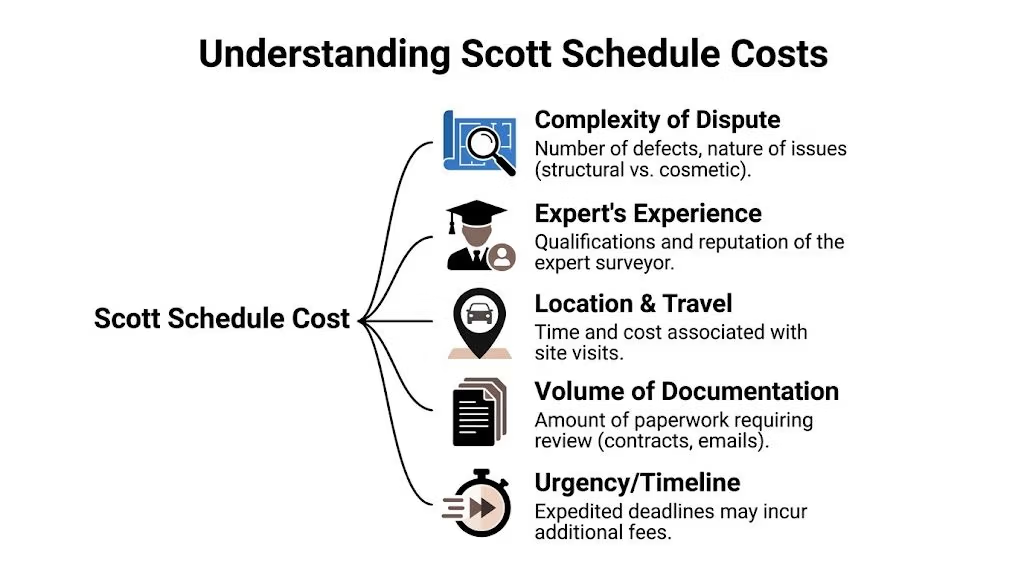
Complexity changes everything
A short list of straightforward defects is one thing. A long schedule involving waterproofing, movement cracking, incomplete works, drainage and alleged non-compliance is another.
For a dispute involving 20 to 30 defects, preparation can take 2 to 4 weeks according to the verified data from the same Awesim source. That time goes into inspection, photographs, measurements, review of documents, defect analysis and costing. If the items are technically linked, one mistake in scope can flow through multiple rows in the schedule.
Here’s what drives complexity in practice:
- Nature of the defect: Cosmetic issues are usually simpler to assess than structural or water ingress claims.
- Causation overlap: If several complaints arise from one construction failure, the scope needs careful separation.
- Access and sequencing: Rectification costings must reflect how trades would carry out the work.
Site work and document review affect price
Many clients assume the cost is mostly drafting. It isn’t. The drafting is only reliable if the underlying investigation is sound.
A proper schedule commonly requires:
- Inspection of the property
- Review of plans, specifications, contracts and variations
- Photographic cross-referencing
- Measurement and quantity assessment
- Obtaining or checking quotations
If any of that is missing, the schedule may still exist as a document, but it won’t carry much weight.
A cheap fee often means someone has priced the typing, not the building analysis.
Experience and location matter
An experienced building consultant usually prices differently from someone who only knows the form but not the trade realities behind it. The schedule has to make practical sense. If the scope says “replace waterproofing”, the person preparing it needs to understand what demolition, substrate preparation, reinstatement and access involve.
Location also changes cost. Metropolitan work is generally easier to service than regional work where travel, logistics and inspection time are heavier. Even where the document format stays the same, the effort behind it doesn’t.
Urgency usually costs more
NCAT deadlines don’t always leave much room. If the matter is already listed and your legal team needs a schedule urgently, the consultant may need to reprioritise inspections, reviews and drafting.
That doesn’t mean urgency should be avoided if it’s necessary. It does mean late engagement often costs more than early engagement, and the quote should be read in that context.
Typical Scott Schedule Costs and Examples in NSW
Readers usually want examples, not theory. That’s sensible, because the cost of a scott schedule only makes sense when you match the fee to the dispute type.
For a typical 20 to 30 item residential defect case involving water ingress and workmanship breaches, applicant experts derive costs from Australian Standards-compliant scopes, and the financial quantum of the claim can total $50,000 to $150,000, with consultant preparation fees often falling into a fixed range of $8,000 to $15,000 tied to complexity according to Cook & Kelly’s explanation of Scott Schedules.
Three common dispute types
The table below gives a practical NSW snapshot.
| Dispute Scenario | Typical Defect Count | Estimated Preparation Cost |
|---|---|---|
| Simple residential workmanship dispute | Small number of items | $1,000 to $3,000 |
| Standard residential defect dispute | 20 to 30 items | $8,000 to $15,000 |
| Detailed multi-item dispute | Extensive item list | $3,000 to $10,000 or more |
Simple residential workmanship dispute
This is the lower end. The defects are usually limited, visible and easier to isolate. Common examples include isolated finishing defects, incomplete minor items, or straightforward workmanship complaints where the scope of rectification is obvious.
In that situation, the work behind the schedule is lighter. There may still need to be an inspection and evidence review, but the number of moving parts is lower. That’s where fees in the simpler range can make sense.
Standard residential defect dispute
This is the matter many homeowners and solicitors deal with most often. There are multiple defects across different trades, the parties disagree on scope, and at least some items involve consequential work. Water ingress disputes often sit here because rectification isn’t just about treating the symptom. It requires identifying a compliant repair method.
If the claim value is substantial, the schedule can’t be treated as an admin task. It becomes part of the evidence strategy.
At this level, the schedule often needs detailed cost reasoning and careful wording so each item is claimable and defensible.
Detailed multi-item dispute
At the upper end, the schedule gets expensive because the dispute itself is expensive to analyse. These matters can involve a long defects list, technical overlap between items, difficult access, competing expert opinions, or multiple affected areas.
The hidden trap in these disputes is under-scoping. A low quote can be attractive until the schedule comes back thin, unclear or unusable. Then the legal team either works around a weak document or pays someone else to redo it properly.
That’s why examples matter. The same term, “Scott Schedule”, can cover a short defects list or a heavily worked costing document for a large claim. The fee reflects which one you need.
Understanding Fee Structures Hourly vs Fixed Price
How the fee is structured matters almost as much as the amount. A quote might look acceptable at first glance, but the charging model tells you where the risk sits.
Verified data from Kerin Benson Lawyers on why Scott Schedules are used states that claimant success was 65% versus 48% when specialised building experts were used for quantum costing, and that their fixed-fee models of $6,000 to $12,000 often provide better ROI than lawyer-prepared versions billed at $400 to $600 per hour, which can rise to over $10,000.
Hourly billing
Hourly billing has one clear advantage. It can suit a matter where the scope isn’t known yet.
But there’s a trade-off. The client carries the uncertainty. If the documents are disorganised, the defects list keeps changing, or counsel asks for multiple revisions, the cost keeps moving.
A few practical drawbacks often show up:
- Budget uncertainty: you won’t know the final fee early.
- Inefficiency risk: every additional review or conference adds cost.
- Harder comparisons: two hourly quotes are difficult to compare because the final work volume is unknown.
Fixed fee
Fixed fees work better when the consultant understands building disputes well enough to scope the job properly from the start. For clients, that usually means clearer expectations about inspections, deliverables and turnaround.
A fixed quote doesn’t mean corners are cut. It means the scope has been priced with discipline. If you’ve ever compared specialist service pricing in another field, the same principle applies. This guide to understanding transcription service costs shows how pricing structure often says as much about process control as the dollar figure itself.
Commercial view: When the dispute already carries legal costs, a fixed-fee technical document is often easier to manage than an open-ended drafting exercise.
Which model works better
For most homeowners and many solicitors, fixed pricing is easier to work with because it supports budgeting. It also tends to align better with a building consultant’s role. The task is usually defined. Inspect, analyse, cost, and prepare the schedule.
Where related expert evidence is also required, clients often compare the schedule cost with the wider litigation support budget. In that context, the pricing framework for a building expert witness report is often relevant because the two documents are frequently prepared together.
What to Expect in Your Scott Schedule Deliverable
A proper deliverable should be more than a worksheet with figures typed into columns. Under the Scott Schedule reference summarising NCAT Procedural Direction 3, the required format includes Item, Description, Applicant’s Position, Respondent’s Reply, Expert Opinion, Estimated Cost, and the Decision Maker’s Comment, with cross-referencing of evidence. That source also notes that, in 2025 projections, this structure is expected to resolve 65% of building disputes faster.

The anatomy of a usable schedule
At minimum, you should expect a clear tabular document with each disputed item separated and numbered consistently. That consistency matters because the schedule has to line up with the pleadings, the defect report, the photographs and any later expert conference process.
A solid schedule usually includes:
- Item number linked to the defect list or report
- Description of defect written with enough precision to identify the issue
- Applicant’s position setting out the alleged breach or required rectification
- Respondent’s reply leaving room for the opposing position
- Expert opinion where applicable
- Estimated cost based on a real methodology
- Decision maker’s comment for Tribunal use
What supports the table
The stronger schedules are backed by material that explains where the figures came from. That can include photographs, notes from inspection, references to Australian Standards, quantities, scope assumptions and quotations. Without that support, the table becomes vulnerable because the number looks asserted rather than reasoned.
That’s also where many DIY attempts fail. People focus on filling in the columns, but the value sits behind the columns.
Signs the deliverable is weak
A weak schedule often has one or more of these problems:
- Descriptions are vague, such as “bad tiling” or “water issue”
- Costs are lump sums with no breakdown or methodology
- Items overlap so the same work is claimed twice in different wording
- Evidence isn’t cross-referenced to reports, photos or standards
The Tribunal can only work with what’s put in front of it. If the schedule is unclear, the case becomes harder to run and harder to decide.
For homeowners, that means confusion. For lawyers, it means avoidable time spent repairing a document that should already have been fit for purpose.
How to Reduce Costs and Get Accurate Quotes
You can’t eliminate the cost of a scott schedule if the dispute is complex, but you can stop the fee from rising for the wrong reasons. Most avoidable cost comes from poor preparation before the consultant is engaged.
Get your material in order first
Before asking for a quote, gather the documents the consultant will need to understand the dispute properly. That usually includes the building contract, plans, specifications, variations, defect lists, photographs, relevant emails, previous reports and any quotations already obtained.
Do one more thing that saves a lot of time. Prepare a clean list of the defects you say are in dispute. Don’t try to write the schedule yourself. Just identify the complaints clearly and separate one issue from another.
A useful file set usually has these features:
- Chronology is organised: documents are in date order where possible.
- Photos are labelled: location and issue are obvious.
- Duplicates are removed: repeated email chains and repeated images waste review time.
Be realistic about what the consultant has to do
Clients sometimes think a quote should only cover “putting it into the table”. That’s not how a defensible document is created. If site inspection, measurements, evidence review and costing methodology are needed, that work belongs in the fee.
The best way to keep the quote accurate is to be direct about the scope from the start. If there are access issues, say so. If the matter is urgent, say so. If another expert has already inspected, say so. Clear instructions help the consultant price the work once instead of revising the quote later.
Ask the right questions before you accept the quote
A useful quote should tell you what is included, not just the final number. Ask whether it covers inspection, review of existing reports, costings, drafting, and any reasonable amendments after solicitor review.
If you’re looking at providers, one practical option is Awesim Building Consultants, which prepares Scott Schedules, site investigations and expert witness material for NSW building disputes. The main point, though, is to compare like with like. A lower fee is only cheaper if the scope is comparable.
Good value isn’t the lowest price. It’s the fee that gets you a document your legal team can actually use without reworking it.
When the schedule is done properly, the spend is easier to justify. You’re not paying for a form. You’re paying for compliance, technical judgment, and a costing document that can stand up in a live dispute.
If you need a Scott Schedule that is properly inspected, costed and aligned with NSW dispute requirements, contact Awesim Building Consultants. For enquiries, email admin@awesim.com.au or call 1800 293 746.

Related Posts

NCAT Consumer Division: Steps From Lodgement to Hearing
Most people who end up at the NCAT Consumer and Commercial Division do not arrive there by choice. They arrive
Read More »
Statutory Warranty NSW: What Builders Must Fix and for How Long
Statutory warranty NSW obligations exist precisely for the moment a builder stops returning calls. A crack appears in the render.
Read More »
Home Building Act NSW: Key Clauses Every Owner Should Know
The Home Building Act 1989 (NSW) sets the rules for residential building work in New South Wales. It requires licensed
Read More »