
Scott Schedule Report for NCAT: A 2026 Guide

The letter from NCAT lands in your inbox or mailbox, and somewhere in the directions you see the words Scott Schedule. For many, that is the moment the dispute stops feeling like a building argument and starts feeling like legal paperwork.
That reaction is normal.
Homeowners usually think, “I’ve already got photos and a defects list. Why do I need another document?” Builders often read it as a trap. Solicitors know it matters, but they still need the technical detail in the right format if they want the case to run properly. A scott schedule report for ncat sits right in the middle of those competing pressures.
The good news is that it is not mysterious once you understand what it is designed to do. It is a disciplined way to break a messy dispute into separate items, put each party’s position beside the other, and force the evidence to match the claim. That is exactly why it carries so much weight in home building matters.
Navigating Your NCAT Building Dispute
A typical dispute starts the same way. The owner says the bathroom leaks, the balcony ponds, the doors do not close properly, and the builder says some items are maintenance, some are outside scope, and some are exaggerated. Everyone talks in broad terms. Nobody is talking about the same defect in the same way.
That is where the Scott Schedule changes the job.
Instead of arguing about “poor workmanship” as one big complaint, NCAT expects the issues to be separated and organised item by item. One row for the balcony waterproofing. One row for the roof flashing. One row for the frame movement crack. Once that happens, the case becomes manageable.
Why this document matters early
The practical value is not theoretical. Since the widespread adoption of Scott Schedules under NCAT’s Procedural Direction 3, the average resolution time for home building disputes in New South Wales has dropped by 42%, and a properly prepared schedule has increased the average rectification order value by 52%, from $32,000 to $48,640 per case, by forcing precise, evidence-based claims (Awesim data and discussion).
That result makes sense on the ground. A tribunal member can only work with what is in front of them. If your case is vague, repetitive, emotional, or badly costed, you make the decision harder. If it is structured, referenced, and tied to actual defective work, you give the tribunal something usable.
What clients usually get wrong at the start
Most parties turn up with one of these:
A defect list with no structure
Useful as a starting point, but not enough for NCAT.A stack of photos with no explanation
Photos do not prove much on their own unless someone identifies what they show, why it matters, and what standard is affected.A quote bundle with no link to the alleged defect
A price without a clearly described rectification scope usually causes more argument, not less.
If you are still sorting material from emails, PDFs, photos and reports, a workflow that helps organise construction records can save time before the schedule is drafted. Tools built for construction use cases can help pull scattered project documents into a cleaner record set for review.
A Scott Schedule is not extra paperwork for the sake of paperwork. It is the working document that turns a complaint into a case.
With over 35 years on the tools and more than 15 years dealing with litigation support, the pattern is clear. The parties who treat the schedule as the foundation document usually present a cleaner case. The parties who treat it as an afterthought usually spend the rest of the matter trying to recover lost ground.
What Is a Scott Schedule in an NCAT Dispute
Think of a Scott Schedule as a shared dispute spreadsheet. It is not just your list of complaints, and it is not just the other side’s denial. It is a comparative document that lets NCAT see each disputed item in one line of sight.

The simplest way to understand it
Each row deals with one issue.
For example:
- defective waterproofing to ensuite shower
- lack of fall to balcony
- cracking to cornice junction
- non-compliant balustrade height
- incomplete paint finish to internal walls
Each column then records what each side says about that item.
That is why this document is so effective. It stops parties from speaking past each other. The owner says what is wrong. The builder responds to that exact item. Proposed rectification goes in writing. Cost goes in writing. References go in writing.
It is more than a defects list
A defects list is one-sided. It tells the reader what one party says is wrong.
A scott schedule report for ncat is different because it is built for comparison. It shows:
- the item in dispute
- the factual allegation
- the response
- the proposed rectification method
- the competing costs
- the references that support each position
That side-by-side format is the reason tribunal members, experts, insurers and solicitors rely on it. It narrows the argument.
What NCAT uses it for
Under Procedural Direction 3, the schedule is used to manage home building disputes in a way that is orderly and evidence-based. It helps the tribunal identify which items are disputed, which items are partly agreed, and which items can be resolved without a full fight at hearing.
In practice, it also becomes the document that experts work from during inspection, review, conferencing and joint reporting. If the schedule is sloppy, the rest of the process is usually sloppy too.
A short explainer can help if you want to see the concept in plain language before drafting starts.
What it is not
It is not the place for long emotional submissions.
It is not a substitute for an expert report where one is needed.
It is not a running commentary about who behaved badly during the job.
And it is not effective when someone uses broad phrases like “builder did poor work throughout”. That sort of wording tells NCAT almost nothing.
Good Scott Schedules separate opinion from fact. They identify the work, the defect, the standard, the remedy, and the cost.
If you keep that in mind, the document becomes far less intimidating. It is a structured way to present technical disagreement so NCAT can deal with it item by item.
The Structure of a Compliant Scott Schedule
A compliant Scott Schedule is built with discipline. Every row should deal with one discrete issue, and every column should answer a specific question. If you mix scope issues, quality issues and cost issues in the same cell, the document becomes hard to follow very quickly.
Under NCAT’s Procedural Direction 3, each defect entry must have a detailed description, include hyperlinked photographic evidence, and provide itemised cost estimates benchmarked against industry standards like the Rawlinsons Australian Construction Handbook 2025 rates. One example given for Sydney is rectifying non-compliant waterproofing on a Class 2 balcony at $450 to $650 per m² (Contracts Specialist discussion of PD3 requirements).
Key columns for effective dispute resolution
Below is the structure most parties should expect to work with.
| Standard Scott Schedule Column Structure for NCAT | ||||||
|---|---|---|---|---|---|---|
| Item No. | Defect / Claim Description | Claimant’s Position (with references) | Respondent’s Position (with references) | Claimant’s Proposed Rectification & Cost | Respondent’s Proposed Rectification & Cost | Tribunal Member’s Finding |
This looks simple, but each column has a job.
Item number and defect description
The item number keeps the case organised across reports, photos, submissions and hearing notes. If your photo bundle says “balcony issue” and your expert report says “Item 12 waterproofing defect”, you are creating confusion that does not need to exist.
The defect description needs to be specific. Not “faulty balcony”. Better is: defective balcony waterproofing to the northern edge, with inadequate fall causing ponding and moisture ingress to the adjacent internal wall.
That level of detail matters because it tells the tribunal three things straight away:
- where the problem is
- what the problem is
- what consequence flows from it
Claimant and respondent positions
These columns are where people often waste space.
The claimant’s position should not read like a statement of grievance. It should identify the defective work, the relevant standard or contractual requirement, the evidence relied on, and the consequence. The respondent’s position should then admit, deny, or partly admit with a clear explanation.
Useful entries usually include:
- references to photos
- references to plans or specifications
- references to Australian Standards or NCC clauses where relevant
- references to inspection findings
- a short explanation of cause and effect
What does not work is a bare denial such as “not agreed”. That gives NCAT nothing to assess.
Rectification method and cost
A proper schedule does not stop at saying something is wrong. It states what has to be done to fix it.
That means the rectification scope should be practical and sequenced. For instance, if a waterproofing system is non-compliant, the entry should identify whether tiles need removal, substrate preparation is required, membrane installation must be redone, and finishes reinstated.
Costing should then follow the actual scope. It should be itemised, not guessed.
If the scope is vague, the price is unreliable. If the price is unreliable, the schedule loses force.
For readers who need a working layout, this Scott Schedule template shows the format practitioners commonly use in NCAT matters.
What a strong entry looks like in practice
A strong row usually has these features:
One issue only
Do not combine balcony fall, membrane failure, and balustrade non-compliance in one line.Evidence cross-reference
Link the entry to photos, plans, reports and any relevant standards.Method before money
Explain the proposed fix before attaching a cost.Plain language
Use trade language where needed, but write so a tribunal member can follow it without guessing.
What weak entries look like
Weak entries usually fall into one of these traps:
- “Defective tiling throughout”
- “Builder to rectify all water issues”
- “As per report”
- “Costs to be advised”
Those phrases tell the tribunal that the document has not been properly prepared. They shift the burden onto someone else to figure out what the item means. That is exactly what a Scott Schedule is meant to avoid.
The Scott Schedule Process from Start to Finish
Once NCAT directs that a Scott Schedule be prepared, the matter moves from general complaint into structured case management. At that point, timing, version control and evidence discipline start to matter almost as much as the technical merits.
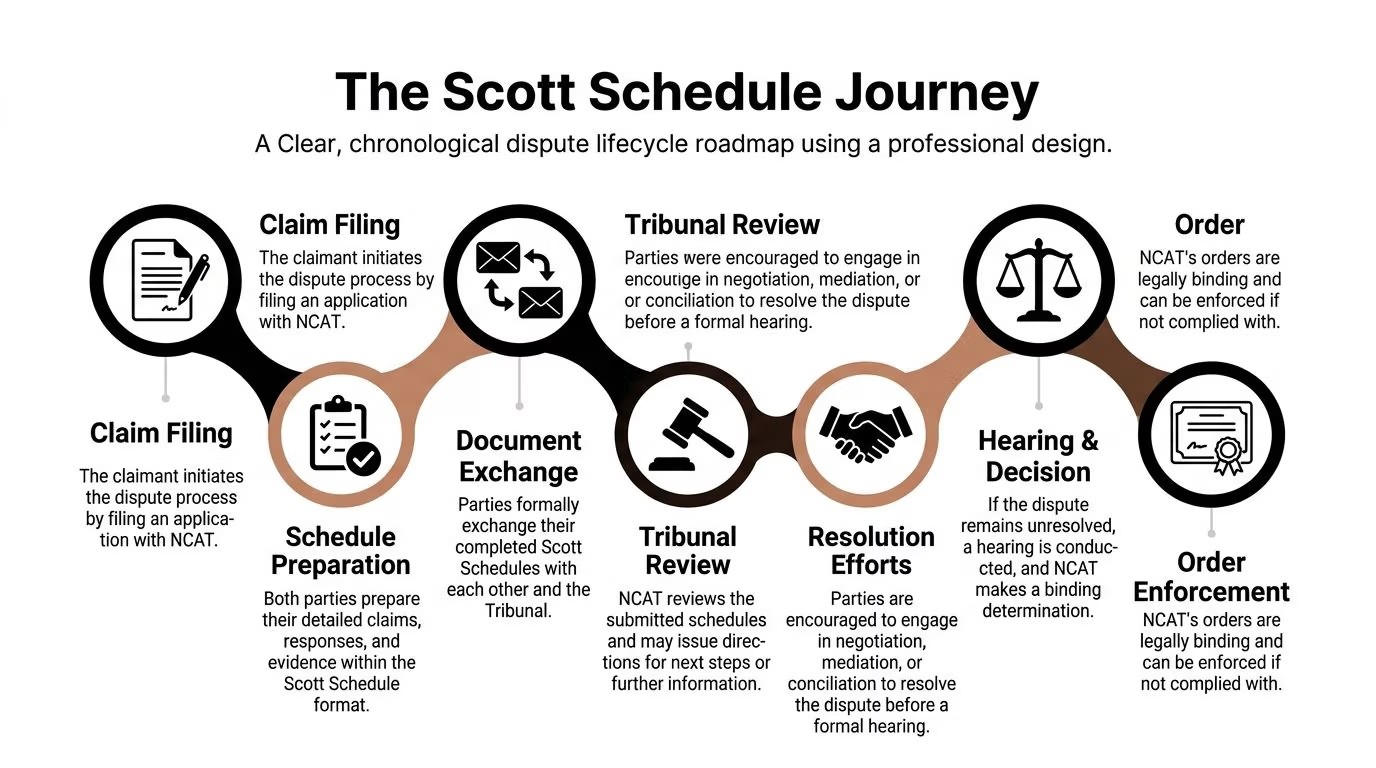
The usual path the document follows
The process is usually straightforward in principle, but parties often make it messy in practice.
NCAT issues directions
The tribunal orders a Scott Schedule and sets deadlines for service and filing.The first draft is prepared
Usually the claimant populates the initial items, descriptions, allegations, evidence references, rectification scopes and costings.The other party responds
The respondent fills in the response columns, stating what is admitted, denied, or contested in scope or price.The schedule is exchanged
Both sides serve the document in the form directed by NCAT.Experts work from the schedule
If experts are engaged, the schedule often becomes the item-by-item platform for inspection and comparison.Issues narrow before hearing
Agreed items can fall away. Partial admissions become clearer. The hearing can focus on what is in dispute.The tribunal uses it at hearing and in reasons
A well-prepared schedule gives NCAT a direct working document during the determination process.
What each party should do at each stage
The claimant needs to be disciplined first. The opening version sets the tone for the entire document. If it is inflated, repetitive, or careless, the respondent will attack the structure before the substance.
The respondent should not use the response column as a dumping ground for legal argument. A direct response is more effective. Admit what should be admitted. Dispute what is disputed. Put forward a competing scope and cost where appropriate.
For solicitors and consultants, version control becomes critical once multiple drafts start circulating. It helps to follow a simple document naming protocol and keep a changelog. If your matter is being revised by several people, these Top 10 Document Version Control Best Practices are a sensible reference point.
Most avoidable schedule disputes are not about law. They are about unclear drafting, missing references, and people working off the wrong version.
How experts use the schedule
In matters involving expert evidence, the schedule often becomes the backbone of the inspection and any conclave process. Experts can work item by item instead of talking in broad themes.
That has a practical benefit. It forces agreement and disagreement to be recorded in a disciplined way. On some items, both experts may agree the work is defective but disagree on scope. On others, they may agree there is no defect at all. The schedule makes that visible.
A worked sequence can help if you are trying to understand how the drafting develops from the initial complaint into a hearing-ready document. These step-by-step Scott Schedule examples show the progression clearly.
Where the process usually breaks down
The process usually goes off track when:
- the claimant files a broad list instead of itemised issues
- the respondent delays or provides bare denials
- costings are attached without a matching scope
- experts receive inconsistent versions
- photos are not labelled to match the item numbers
Once that happens, everyone spends time cleaning up the document instead of using it to narrow the dispute.
A good schedule does not remove disagreement. It puts the disagreement in a form NCAT can work with.
Common Mistakes When Preparing a Scott Schedule
Most poor schedules fail for ordinary reasons, not complicated ones. They are vague, unsupported, late, or argumentative. The damage from those mistakes is considerable.
NCAT annual reports indicate over 15% of home building matters involve procedural defaults related to documents like Scott Schedules, with 40% of those defaults leading to adverse orders. Failure to comply can result in claims being struck out or adverse inferences being drawn by the tribunal, and that risk falls heavily on unrepresented parties (practical guidance on NCAT procedural compliance).

Mistake one using vague descriptions
“Roof defective.”
That is not enough. It does not identify the location, the manifestation, the likely cause, or the consequence.
A stronger entry identifies the exact area and issue. Missing tiles to the southern roof plane causing water ingress at the bedroom ceiling below is the kind of description NCAT can work with.
Mistake two treating photos as self-explanatory
A schedule with dozens of photos and no proper link between image and defect wastes everyone’s time. The tribunal should not have to guess which photograph supports which item.
Label images to match item numbers. Add short captions. Make sure the written description and the image show the same issue.
Mistake three putting in a price without a scope
This is one of the most common problems in owner-prepared schedules. A party attaches a builder’s quote and assumes that is enough.
It is not.
If the quote says “balcony repairs” and the schedule says “non-compliant balcony waterproofing”, NCAT still needs to know exactly what work is included. Strip-out? Waste removal? Screed correction? Membrane? Tiling? Access? Protection? Reinstatement? If those steps are not clear, the cost has limited value.
Mistake four arguing instead of responding
A Scott Schedule is not the place for long accusations about conduct, delay, personality or motive. Those issues may matter somewhere else in the case, but the schedule works best when it stays item-specific.
Bad response: “The applicant has been unreasonable throughout and has failed to maintain the property.”
Better response: “Denied. No defect observed at inspection. Moisture staining appears consistent with maintenance failure rather than defective waterproofing.”
Mistake five missing the deadline and hoping for indulgence
Parties get into serious trouble if this occurs. A late schedule can disrupt the hearing timetable, delay expert work and weaken confidence in your case management.
If extra time is needed, deal with that early and properly. Do not wait until the due date has passed.
A rushed schedule usually creates more cost than it saves. Every unclear item comes back later as argument, amendment or cross-examination.
Mistake six forgetting the expert’s role
Experts are there to assist the tribunal with specialised knowledge. They are not there to advocate. If the schedule starts reading like a submission drafted to win points rather than a technical document grounded in observation and reasoning, its value drops.
That is one reason practitioners should understand the obligations attached to independent expert evidence. The Expert Witness Code of Conduct Schedule 7 is worth reviewing before an expert signs off on schedule content or adopts it within a report.
The fix is usually simple
Most of these problems can be corrected by applying a straightforward discipline:
- identify one issue per row
- describe it precisely
- link evidence to that item
- state the remedy clearly
- cost the remedy properly
- file it on time
That is not glamorous work. But it is the work that makes the schedule usable.
Practical Tips for Homeowners Builders and Lawyers
Different parties need different tactics. The same document serves three audiences at once, but each one uses it for a different purpose.
For homeowners
Specificity is your friend.
If you are the owner, your job is not to tell NCAT that the whole build was terrible. Your job is to identify each defective or incomplete item clearly enough that someone else can inspect it, assess it and price it.
Keep your records in order:
- contracts and variations
- plans and specifications
- dated photographs
- defect notices
- emails about complaints and access
- invoices and quotes
Do not overclaim. An inflated schedule often weakens the items that are demonstrably strong.
For builders
A defensive schedule is not always a good schedule.
If an item is plainly defective, a blanket denial can make the rest of your responses look unreliable. It is often smarter to admit the part that should be admitted, then confine the dispute to scope, causation, responsibility or cost.
Useful builder responses usually do one of these:
- accept the defect but dispute the claimed rectification method
- accept some work but deny broader replacement
- deny the item and identify an alternative cause
- dispute the amount because the scope is excessive
That approach shows the tribunal you are engaging with the issue, not avoiding it.
Builders who answer each row with a reasoned technical position tend to look more credible than builders who deny everything outright.
For lawyers
The schedule is not just an evidentiary document. It is also a case management tool.
A good one helps with client advice, settlement discussions, expert briefing and hearing preparation. A bad one multiplies work because counsel, expert and client all end up trying to reinterpret the same unclear item differently.
When briefing consultants or experts, make sure the schedule aligns with the pleadings, the report scope and the documentary brief. If those three things do not match, inconsistencies appear very quickly.
What all three groups should remember
The most effective schedules usually share the same practical qualities:
Consistency
The item number, the photo set, the report reference and the costing should all match.Restraint
Only include items you can properly identify and support.Usable language
Write for a tribunal member who needs clarity, not for the other side’s ego.Repair logic
State what has to be done practically, not just what sounds persuasive on paper.
A scott schedule report for ncat works best when the document reads like a technical roadmap, not a running dispute diary.
How Awesim Consultants Deliver NCAT-Ready Reports
Preparing a Scott Schedule properly usually starts long before the document itself is drafted. Effective preparation begins at inspection.
The process is usually straightforward when done properly. Inspect the site carefully. Identify each alleged defect item by item. Match each item to the available records, plans, photos and standards. Work out whether the issue is defective work, incomplete work, movement, maintenance, variation, damage, or something outside scope. Then build the schedule so the evidence, rectification method and costing all line up.
That is where practical construction experience matters. Someone who has spent decades on sites will usually spot very quickly whether a claim is valid, overstated, wrongly described, or costed in a way that does not reflect how the repair would be carried out.
Awesim Building Consultants prepares NCAT-facing building reports, expert witness material and Scott Schedules for home building disputes across NSW. The work typically involves on-site defect identification, evidence mapping, item-by-item schedule drafting, and technical support for solicitors, homeowners and builders dealing with tribunal directions.
The key point is not presentation. It is defensibility.
A schedule has to stand up when the other side challenges the description, the cause, the method, or the price. If the underlying inspection is weak, the drafting will not save it. If the technical reasoning is sound, the schedule becomes far more useful in negotiation, expert discussion and hearing preparation.
If you need help with an NCAT matter, the practical next step is to arrange a proper inspection and get the disputed items framed correctly from the start through Awesim Building Consultants.
NCAT Scott Schedule FAQs
Can I prepare a Scott Schedule myself
Yes, but only if you can separate each issue clearly, support it with evidence, and present a sensible rectification scope and cost. Many self-prepared schedules fall down because the items are too vague or the costing is unsupported.
What if the other party does not complete their side properly
NCAT can draw adverse inferences or make directions about non-compliance. Keep your own document clear, complete and on time, then raise the deficiency through the proper procedural channel.
Is a Scott Schedule the same as an expert report
No. They can work together, but they are not the same document. The schedule is a comparative item-by-item dispute document. An expert report gives the technical opinion behind the position.
Should every defect go into the schedule
Only include items that are in dispute and can be described properly. Padding the schedule with weak items usually makes the strong items harder to run.
What makes a schedule persuasive
Clear defect descriptions, reliable evidence links, practical rectification methods, and costing that matches the actual work required.
If you are dealing with an NCAT building dispute and need a Scott Schedule that is technically sound, clearly drafted and ready for scrutiny, Awesim Building Consultants can assist with inspections, expert reporting and schedule preparation across NSW.

Related Posts

Scott Schedule Template: What Columns a NSW Claim Needs
What Is a Scott Schedule? Why the Column Structure Matters The Core Columns in a NSW Scott Schedule Template Column
Read More »
Brick Veneer Construction Defects: A Site Inspector’s View
What Brick Veneer Construction Actually Is The Most Common Brick Veneer Construction Defects Cracking in the Brickwork Missing or Blocked
Read More »
Liquidated Damages in Construction: How NSW Contracts Work
What Are Liquidated Damages in Construction? Why Contracts Use Them How Liquidated Damages Work in NSW Building Contracts Standard Contracts
Read More »