
Quantum Meruit Australia: A Builder’s Guide to Claims
You're halfway through a build, the owner has stopped answering messages, and the last payment hasn't landed. The contract feels shaky, the numbers don't line up, and everyone is pointing at different paperwork. That's the point where quantum meruit Australia stops being a legal phrase and starts being the practical question: what is the fair value of the work, materials, and benefit already supplied?
For builders and homeowners in NSW, the answer usually turns on evidence, timing, and how the work was valued. The law doesn't treat quantum meruit as a shortcut to the contract price. It treats it as a way to recover the reasonable value of work where contract recovery is unavailable or limited, and that distinction is where many claims win or fail.
Understanding Quantum Meruit in Australian Construction Law
A builder finishes a bathroom renovation, the owner says the contract was never properly signed, and the payment dispute turns ugly. The builder knows the labour, tiles, fixings, and supervision all went into the job, but the paperwork is now the battleground. That is the kind of dispute where quantum meruit becomes relevant, because it asks what the work was worth in reality, not just what the parties hoped the contract would say.
Plain meaning in building terms
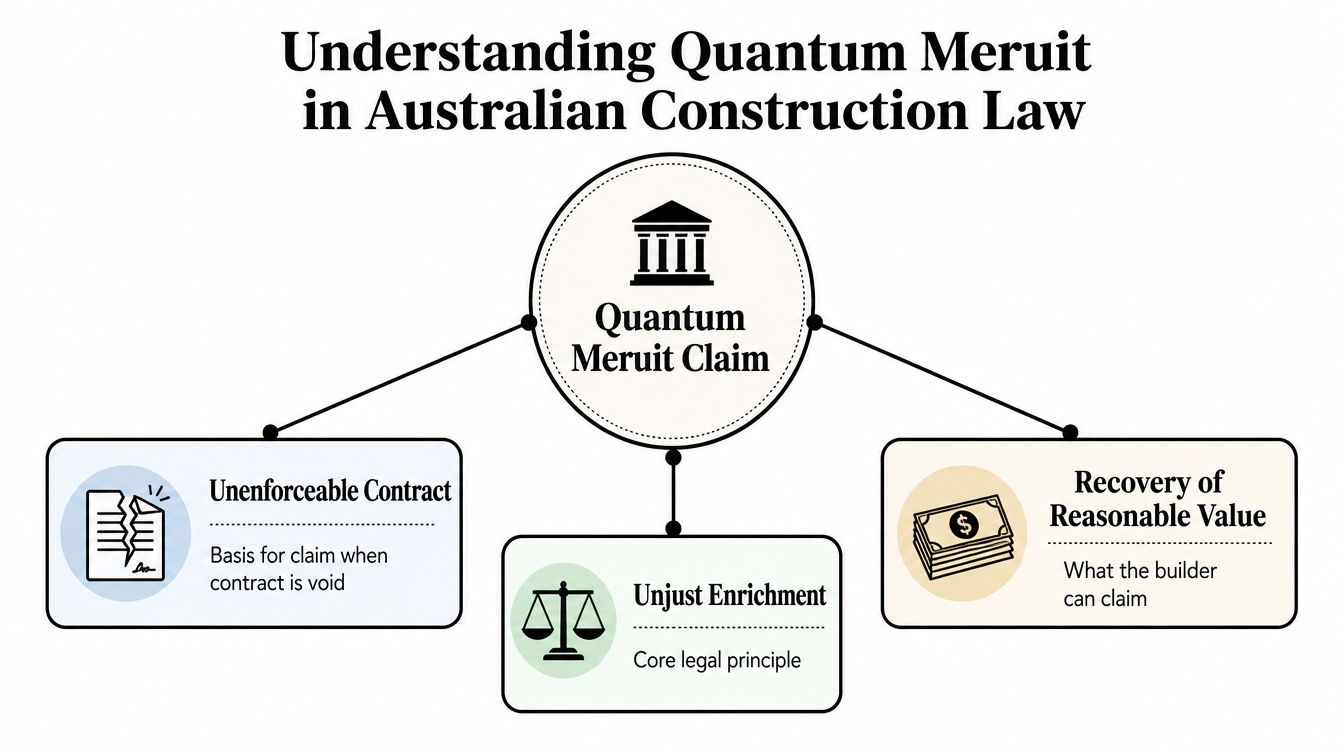
The phrase means “as much as he deserves”, but in construction disputes that shorthand can be misleading. It is not a reward for effort, and it is not a free pass to claim the full contract sum. In Australian practice, it is a restitutionary remedy based on unjust enrichment, which means the focus is on the value received by the other party and the reasonable value of what was supplied, rather than contractual entitlement. That is why Australian authorities say the claimant must show the work or materials were provided, the benefit was received and accepted, and the amount claimed reflects fair market value, not just a hoped-for invoice total, as outlined in the Australian legal commentary on the doctrine Klein Legal's explanation of quantum meruit in Australian law.
Why builders and owners both need to understand it
Builders often meet quantum meruit after a contract falls apart, a variation was never priced cleanly, or the owner argues the work went beyond scope. Homeowners run into it when they've had benefit from work but the contract is challenged as unenforceable or incomplete. In either case, the dispute usually moves away from slogans like “I finished the job” and towards proof of what was done, what it was worth, and what benefit the owner kept.
Practical rule: if the claim is going to rest on quantum meruit, the evidence has to show value, not just dissatisfaction.
For a practical bookkeeping angle, the Nexist guide for builders is useful because quantum meruit claims are easier to understand when the job costs have been tracked properly from the start. That accounting discipline matters later, especially when a tribunal wants a trade-by-trade view of the work rather than a loose lump sum.
The Legal Foundation and Key High Court Precedent
Australian law on quantum meruit changed sharply after the High Court's 2019 decision in Mann v Paterson Constructions Pty Ltd (HCA 32). The Court held that a builder cannot use quantum meruit for work already completed where a contractual right to payment had accrued, and any restitutionary recovery for partly completed work is generally capped by the contract price or the relevant stage price. That decision materially narrowed the remedy in building disputes and is now the central authority Australian practitioners rely on in terminated residential and commercial contracts Bird & Bird's discussion of the High Court decision.
What the High Court actually changed
Before that case, quantum meruit was sometimes treated as a broader fallback when a building contract was terminated. After the decision, courts take a much stricter line. If the builder already had an accrued contractual right to payment, the court will usually not let that work be recast as a restitutionary claim just because the relationship later broke down. A later legal update from Keating Chambers describes the same restrictive approach, including the point that the contract price can act as a cap on recovery Keating Chambers legal update on quantum meruit.
Why accrued rights matter
This distinction trips people up because the contract and quantum meruit can't be treated as the same thing. A contractual claim looks to what the parties agreed. A quantum meruit claim looks to the value of the benefit retained when the contractual route is unavailable or ineffective. In practice, if a stage was complete and payment had already become due, the builder usually can't throw that into a restitution claim and expect the court to ignore the contract structure.
The six-year timing issue
Australian building claims usually face a six-year limitation period for debt or liquidated demand-style recovery, calculated from when the work was completed and payment became due Merlo Law's guide to quantum meruit and limitation periods. That timing issue matters because a claim that was once arguable can become stale if the records are left too long. The same source also notes that courts look to market rate, actual costs, and the benefit received when assessing amount, which is consistent with the way tribunals and courts test fair value in construction disputes.
A good way to think about it is this, the law asks whether the claim belongs in contract, restitution, or nowhere at all. If it belongs in restitution, the claimant still has to prove what the benefit was worth.
Essential Elements and How Quantum Meruit Relates to Contracts
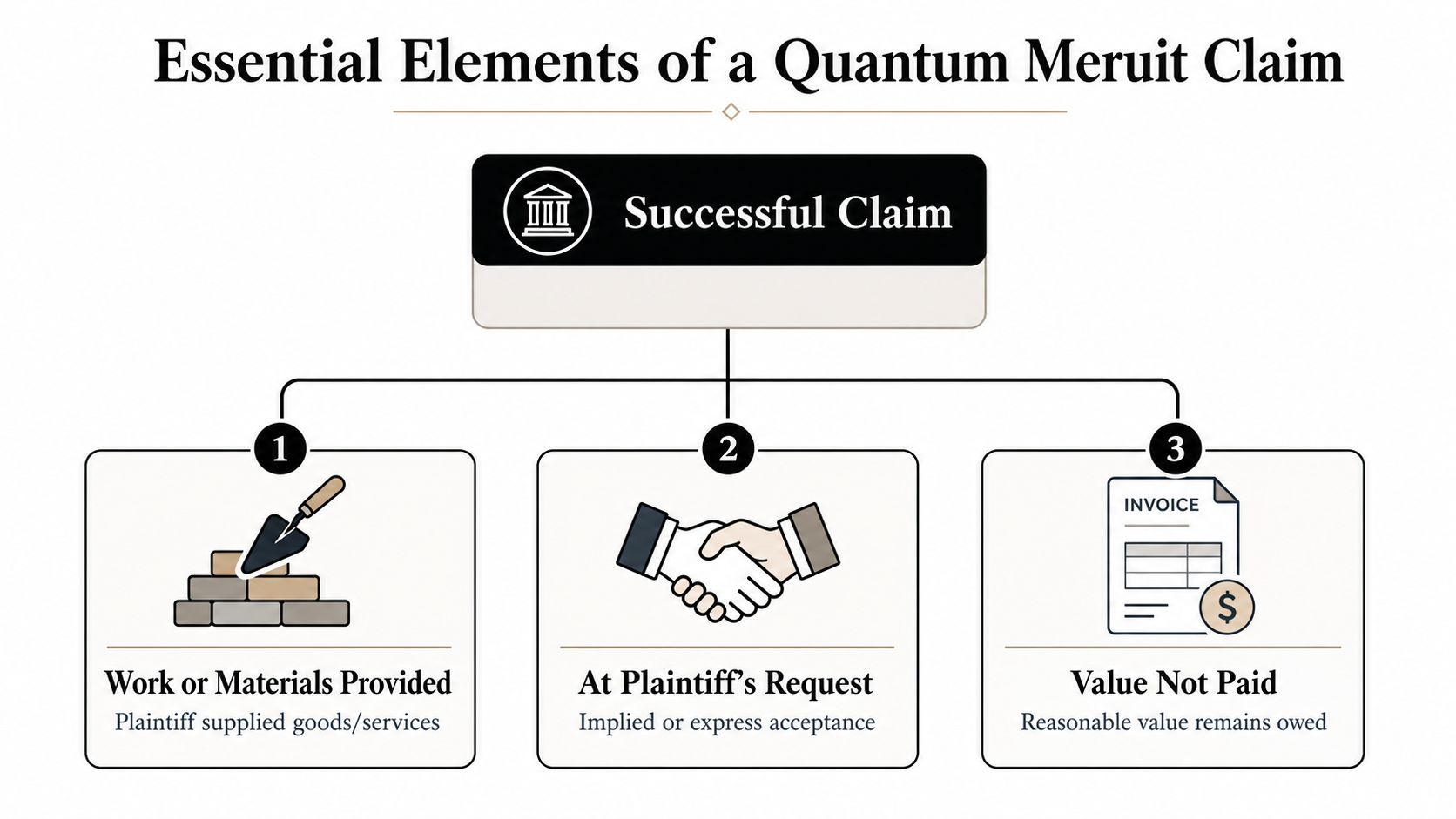
A quantum meruit claim in construction usually rises or falls on three questions. Did the claimant provide work or materials, did the other side receive the benefit, and is the amount claimed the fair value of that benefit. Those questions sound simple, but each one needs evidence that can survive scrutiny in a dispute over a build, a renovation, or a termination.
The basic proof required
The claimant has to show that the work or materials were supplied. They also need to prove the other party received and accepted the benefit, which can be express acceptance or acceptance shown by conduct. Then the claimed amount has to reflect fair and reasonable market value, not just a contract price label or a frustrated expectation of profit.
The tribunal is not asking what the builder hoped to earn. It's asking what the owner actually received.
Australian commentary also notes that courts assess market rates, any previously agreed pricing, and the nature and duration of the work when quantifying the claim BSM Law's construction law guide to quantum meruit. That means a claim supported by invoices alone is weaker than one backed by trade records, progress claims, delivery dockets, site diaries, and a sensible breakdown of labour and materials.
How it differs from a contract claim
A contract claim starts with the bargain. Quantum meruit starts with the benefit. That difference is key in NSW disputes where the written contract may be uncertain, unenforceable, or incomplete. In those cases, the claimant still can't leap straight to the contract price as if nothing happened. The court or tribunal will ask what value was conferred and whether that value fits within the limits of the contract structure or, where the contract is ineffective, within the fair value of the work.
A practical NSW example
A subcontractor finishes work, but the principal says the variation approvals were never finalised. If the subcontract still has an accrued payment right for completed stages, the contractor's recovery may stay inside the contract framework. If the contract is unenforceable under the Home Building Act 1989 (NSW), a builder may still recover on quantum meruit, but must prove the actual benefit conferred rather than rely on the contract sum MinterEllison's discussion of the quantum in quantum meruit. That is where the evidence becomes decisive, because the tribunal needs a real valuation, not a broad assertion that “the job was worth more”.
NSW Building Disputes and NCAT Considerations
NSW building disputes often turn on documents that were never designed for litigation. Progress claims are incomplete, variations were discussed over text messages, and site records live in scattered emails. In NCAT, that mess has to be organised into something a tribunal member can follow quickly, because the core issue is not whether the job was stressful, it's whether the evidence proves the value of the benefit received.
Where quantum meruit fits in NSW matters
In NSW, a builder whose contract is found unenforceable under the Home Building Act 1989 (NSW) may still recover on quantum meruit, but the claim has to prove the actual benefit conferred rather than rely on the contract sum MinterEllison's quantum meruit overview. That matters in residential disputes, where a tribunal will want to see the work, the materials, and the practical benefit to the owner. It also matters when a contract has been terminated and the parties argue over whether the builder had already accrued a right to payment.
Why NCAT cares about structure
NCAT does not reward loose narratives. It responds to clearly presented evidence, organised schedules, and expert opinions that separate one component of the claim from another. That's why a Scott Schedule is so useful in building cases, it helps align the claim, the response, and the competing valuation in a single document that can be compared line by line.
The NSW NCAT guidance page is a useful reference point for parties who need to understand the forum itself, especially when a matter is already moving from negotiation into formal dispute resolution.
What usually changes the outcome
The party who can show measurable benefit, with dates, descriptions, and a clear valuation basis, usually has the stronger case. The party relying on broad assertions usually has the weaker one. In practice, that means you want contemporaneous progress claims, variation records, photographs, invoices, and a sensible explanation of why the work has a particular value in the market.
NCAT decisions tend to turn on proof of value, not just proof that work happened.
If the records are thin, a tribunal can still hear the case, but the claim often becomes harder to quantify. If the records are organised, the same dispute becomes easier to test, which is exactly what the tribunal needs in a contested quantum meruit building claim.
Evidence, Valuation and the Role of Expert Witnesses
A quantum meruit claim can fall apart at the valuation stage even when the work itself is not in dispute. A tribunal may accept that labour and materials were supplied, then reject the amount claimed because the evidence does not explain how that figure was reached. In NSW building disputes, that gap often decides the outcome, especially where the issue is the reasonable value of work already provided rather than the cost of fixing defects.
What a strong valuation needs
A credible assessment usually starts with a trade breakdown. The report should separate labour, materials, hire equipment, deliveries, and onsite and offsite costs, because that is how the value of the work can be tested against the actual job. A lump-sum opinion without detail is easier to challenge, while a trade-based analysis shows exactly how the figure was reached.
That level of detail matters in construction disputes because the tribunal is not asking whether the project felt expensive. It is asking what value the other party received and which parts of the claim support that value. If a builder submits a broad total with no breakdown, the decision-maker has to do too much guessing.
Awesim Building Consultants, with over 35 years of estimating the costs of building and construction, prepares site investigations, Building & Construction Expert Witness Reports, and Scott Schedules for dispute work in NSW. For a claim of this kind, that sort of evidence helps separate the work into parts that can be checked line by line, which is exactly what a tribunal needs when the parties disagree about value.
Why experts carry weight
An expert does not decide the case, the tribunal does. A well-prepared report still gives the tribunal a method for testing the claim in a way that is grounded in the job records. It can separate work already covered by a contract stage, work outside the agreed scope, and items that were never properly valued at the time.
The Awesim Quantum Meruit Report service page and the NCAT building expert witness report guide both point to the same practical need, a written expert assessment that explains the reasonable value of building work completed in a dispute. That sort of report becomes especially useful when the parties disagree about market rates, labour hours, material allowances, or whether the claimed benefit really matches what was delivered.
How to make evidence easier to use
A tribunal member should not have to infer what a page means. Label each trade, date each variation, tie each photo to the part of the claim, and keep the schedule consistent with the narrative. A clear paper trail works like a set of marked plans on site, it lets the decision-maker follow the claim without having to reconstruct the job from fragments.
Where the evidence is organised, the report can show the benefit in a clean sequence and the valuation becomes easier to assess. Where the records are mixed together, the claim becomes harder to test, even if the underlying work was real. That is why documentation, trade breakdowns, and expert reports can make or break a quantum meruit case in NSW tribunals.
If a payment issue also involves a separate debt path, parties may need to pay Ring Hot Water securely while the valuation dispute is being worked through.
Practical Steps to Make or Defend a Quantum Meruit Claim
If you think quantum meruit may apply, start with the contract and the payment history, not the argument. Check whether a contractual right to payment had already accrued before termination, because that can shut the door on a restitutionary claim for some completed work. Then identify what work was supplied, what benefit the other side kept, and what records prove the value.
Steps for a claimant
- Collect the job trail. Keep the signed contract, variations, progress claims, invoices, photos, site diaries, delivery dockets, and messages that show the work was requested or accepted.
- Separate the trades. Break the claim into labour, materials, hire equipment, deliveries, and onsite and offsite costs so the valuation can be tested properly.
- Check the timing. Work completed long ago may fall into limitation issues, so date the completion and payment due points clearly.
- Get an expert valuation. A report that deals with the actual benefit conferred is stronger than a general letter saying the work was extensive.
Steps for a respondent
A homeowner or principal defending the claim should challenge the valuation, not just the emotion behind it. That means checking whether the builder is trying to recover for work already covered by an accrued contractual right, whether the work was accepted, and whether the valuation uses market rates that make sense for the scope.
If payment has to be made through a secure administrative process, the pay Ring Hot Water securely page is an example of how businesses sometimes present payment pathways clearly. In a dispute, the lesson is simpler, clear payment records and clean reconciliation reduce confusion later.
Why documentation wins arguments
A dispute rarely improves because someone argues harder. It improves when the paperwork gets sharper. The cost plus building contract example page is useful because it reinforces a basic point, once costs become disputed, the parties need a structured breakdown, not guesses.
Useful rule of thumb: if you can't show the work in a trade-by-trade format, expect the valuation to be attacked.
For many builders and owners, the right move is to get the records organised before the dispute hardens. Once that happens, the claim or defence becomes easier to explain and harder to distort.
Conclusion and When to Seek Expert Help
Quantum meruit in Australia is not a backup plan for sloppy contracts. It's a narrow remedy that turns on benefit, value, timing, and evidence, and the High Court has made clear that accrued contractual rights still matter. In NSW building disputes, the parties who organise their records early, use proper trade breakdowns, and present clear expert evidence usually have a better path through NCAT or court.
That is where experienced building consultants become useful. Awesim Building Consultants has over 35 years of estimating construction costs, and its work in site investigations, Expert Witness Reports, and Scott Schedules is geared to the kind of evidence quantum meruit claims need. If you're facing a dispute over unpaid work, an unenforceable contract, or a contested valuation, the right report can make the difference between a claim that reads well and a claim that proves fair value.
If you need help with a quantum meruit dispute, Awesim Building Consultants can assess the work, prepare a trade breakdown, and produce NCAT-ready documentation for NSW building matters. Visit Awesim Building Consultants to review the available services, including quantum meruit reports, or contact the team at admin@awesim.com.au or 1800 293 746 to discuss your claim or defence.

Related Posts

Building Handover Inspection: What to Check Before You Sign
A building handover inspection, also called a practical completion inspection (PCI), is your last chance to identify defects before you
Read More »
Retaining Wall Defects: Inspection, Evidence, and NSW Claims
Retaining wall defects range from visible cracking and leaning to hidden drainage failures that build dangerous hydrostatic pressure. In NSW,
Read More »
Building Maintenance Schedule: What Owners Must Document
A building maintenance schedule must document every asset, its required service frequency, the person responsible, and a timestamped record from
Read More »