
Building Handover Inspection: What to Check Before You Sign

A building handover inspection records the condition of accessible work near practical completion and identifies items needing attention. Review the contract, approved documents and completion requirements before the inspection. Handover does not automatically end all defect rights; any payment or acceptance decision should be assessed against the contract and applicable law.
Signing at handover without a thorough inspection is one of the costliest mistakes a new home buyer can make. Once you accept the keys and release final payment, your ability to compel the builder to fix defects shrinks considerably. This guide walks you through every stage of the process, from gathering your documents to scheduling a re-inspection, in the order you will actually need it.
What Is a Building Handover Inspection (and Why It Matters)?
A building handover inspection, or practical completion inspection, is a formal on-site review carried out when the builder declares the work substantially complete and invites you to take possession. It is not a courtesy walk-through. It is the contractual checkpoint at which you assess whether the finished work matches what you paid for, and your primary opportunity to compel the builder to fix defects at no cost to you.
The legal significance is considerable. In NSW, a new home build contract typically requires the builder to achieve practical completion before final payment is released. Defects identified at this stage are the builder's responsibility to rectify. Defects you miss, or accept by signing without noting, become your problem.
The statistics are sobering. According to Fieldpie's 2026 report, over 85% of construction defects discovered after handover could have been identified during the practical completion inspection. That means the vast majority of post-handover disputes, many of which end up in formal proceedings, were preventable at this stage.
The financial stakes are equally real. Hidden defects in the Melbourne property market can affect between 5 and 10% of a property's total value when not addressed at inspection. That figure reflects Melbourne specifically, but it illustrates the scale of exposure any buyer faces when defects go undetected at handover.
A well-constructed new home in Sydney still typically produces 40 to 80 defect items during a practical completion inspection. For less carefully built properties, that number climbs. The inspection is not a formality. It is the mechanism that protects your investment.
What Documents Should You Have Ready Before the Inspection?
Arriving on site without the right documents means you cannot verify whether the builder has delivered what was contracted. Gather the following before the inspection date:
- The signed contract for the build, including all schedules and variations. This is the baseline against which you measure everything on site. If a variation was agreed in writing, confirm it has been carried out. If a variation was requested verbally but never documented, that is a separate problem to address.
- The approved architectural and engineering plans. Check room dimensions, window positions, structural elements, and any site-specific engineering requirements. Builders occasionally substitute materials or deviate from drawings without notifying the client.
- The specification documents. These detail the agreed finishes, fixtures, fittings, and materials. If the contract specifies a particular tile, tapware brand, or insulation type, you need the specification in hand to confirm it was installed.
- All approved variations in writing. Verbal agreements carry no weight at this stage. If you agreed to a change mid-build, confirm it is documented and that the work reflects it.
- The building permit and any relevant inspection certificates. In NSW, mandatory stage inspections are required under the Home Building Act 1989. Confirm those inspections occurred and that the certificates are available.
- A copy of the builder's defect liability period clause. Know how long the builder is contractually obliged to return and fix defects after handover. In NSW, the statutory warranty period for major defects is six years.
Review these documents the evening before the inspection, not on site. You want to arrive ready to check, not to read.
Building Handover Inspection Checklist: Exterior and Structure
Start outside. The exterior and structural elements are where the most consequential defects hide, and they are also the easiest to overlook when interior finishes are competing for your attention. Bring a torch, a spirit level, and a notepad. Work systematically around the perimeter before stepping inside.
The following items form the core of an exterior and structural check:
- Roof covering and ridge capping. Check for cracked, displaced, or missing tiles. On a metal roof, look for unsealed penetrations, inadequate fixings, and any visible deflection in the sheeting. Ridge capping must be fully bedded and pointed.
- Roof drainage. Gutters should be correctly graded toward downpipes with no sagging or reverse fall. Downpipes must be fully connected and discharge to an approved stormwater point, not onto the soil adjacent to the footings.
- Fascias and bargeboards. Check for gaps at joins, inadequate paint coverage at end grain, and any timber that has already begun to split or bow.
- External cladding and brickwork. Look for cracking in mortar joints, spalled bricks, gaps at window and door reveals, and any cladding panels that are not flush or fully fixed. Weep holes in brickwork must be present and unobstructed.
- Damp-proof course (DPC). The DPC must be visible and must not be bridged by soil, garden beds, or paving that has been laid too high against the wall.
- Driveway and paths. Concrete should be free of significant cracking, and surface drainage must fall away from the building. Control joints, where required, should be present and correctly spaced.
- Fencing and retaining walls. Check that fencing is plumb, that gates open and close freely, and that any retaining walls are structurally sound and adequately drained. A retaining wall without drainage behind it will eventually fail.
- Site drainage and stormwater. Confirm that the finished ground levels fall away from the building on all sides. Ponding adjacent to the structure is a defect, not a landscaping issue.
- Garage door and external doors. Test operation, check weather seals, and confirm that door frames are square and that locks engage cleanly.
A methodical exterior check is the first line of defence against defects that can affect between 5 and 10% of a property's total value when not caught at inspection.
Building Handover Inspection Checklist: Interior Room by Room
Once the exterior is documented, move inside. Work from the ceiling down and move clockwise through each room. This prevents doubling back, and it stops the visual noise of a new home from pulling your attention to finishes before you have checked the structure above them.
Bring your torch for inside corners, ceiling junctions, and inside cupboards. A spirit level is useful for checking benchtops, shelving, and door frames. Take photographs of every defect as you go, with something in frame for scale.
Work through each room using this checklist:
Ceilings and cornices
- Check for cracking at cornice joins and at ceiling sheets. Hairline cracks at plasterboard joins are common; cracks that run diagonally or follow a straight line across a sheet may indicate structural movement.
- Look for paint holidays, uneven texture, and any areas where the ceiling sheet has not been adequately fixed and is showing nail pops or deflection.
Walls and paint
- Stand at a low angle to a wall and look along the surface in raking light. This reveals runs, sags, missed patches, and uneven texture that are invisible in flat light.
- Check that all wall penetrations for power points, switches, and plumbing are neatly finished and that no gaps remain around them.
Doors and windows
- Open and close every door. It should swing freely, latch without force, and sit square in its frame. Check that door stops are fitted and that handles and locks operate correctly.
- Test every window for operation, check that fly screens are present where specified, and confirm that all glazing is free of chips, scratches, and installation damage.
Wet areas: bathrooms, laundry, and kitchen
- Inspect all tiling for hollow tiles (tap lightly with a coin), cracked tiles, and grout that is incomplete or already cracking at movement joints. For well-constructed new homes in Sydney, inspectors typically list 40 to 80 defects during the practical completion inspection, and wet area tiling accounts for a significant share of those items.
- Check silicone at all junctions: bath-to-wall, shower screen to floor, and vanity to wall. Silicone must be continuous, properly tooled, and free of voids.
- Run every tap and showerhead. Check water pressure, confirm hot water is reaching each outlet, and watch for any drips at supply connections under vanities and sinks.
- Flush every toilet and confirm the cistern refills correctly.
- In the kitchen, check that all drawers and cabinet doors are aligned and operate smoothly, that benchtops are level and free of chips at cut-outs, and that the splashback is fully adhered.
Built-in appliances and systems
- Test every kitchen appliance: oven, cooktop, rangehood, and dishwasher. Confirm that appliance manuals and warranty cards have been left on site.
- Test all light switches and power points. A non-contact voltage tester is useful here, though a phone charger will confirm whether a point is live.
- Locate and test smoke alarms. In NSW, interconnected photoelectric smoke alarms are required in new builds.
Floors
- Walk every floor surface and listen for hollow spots, squeaks, or movement in timber and laminate floors. These indicate inadequate substrate preparation or insufficient adhesive.
- Check tile floors for lippage between adjacent tiles and confirm that floor wastes in wet areas are flush with the finished floor level and drain freely.
For a broader understanding of how defects are formally documented and categorised in NSW disputes, the building defect report resource explains the standards used in evidence-based reporting, including how the 30 to 150 items typically found at inspection are classified and presented.
What Are Your Rights Around Final Payment and Rectification?
Under a standard NSW residential building contract, final payment is linked to practical completion. The builder is entitled to claim final payment once the work is substantially complete, but that does not mean you are obliged to pay if defects or incomplete items remain. The distinction between the two categories matters here.
Incomplete work is work that was contracted but has not been carried out at all, or has been only partially done. A missing towel rail, unpainted skirting, or an unconnected rangehood are examples. These items mean practical completion has not been achieved, and you are entitled to withhold final payment until they are addressed.
Minor defects are items that are present but not built to the required standard. A cracked tile, a door that does not latch, or paint with visible runs are defects rather than incomplete work. In NSW, a builder can still claim practical completion even where minor defects exist, but the builder remains obligated to rectify them.
According to Fieldpie's 2026 report, over 85% of construction defects found after handover could have been identified at the practical completion inspection. That figure underlines why the inspection itself is the right moment to assert your rights, not after you have already signed.
Do not sign the handover documentation or release final payment until your defect list has been formally submitted and you have agreed in writing on how and when items will be rectified. If the builder disputes your list or refuses to acknowledge items, the matter may need to escalate. For NSW-specific guidance on formal dispute processes, the NSW Building Disputes: Fair Trading and NCAT Guide sets out the options available to you.
Note that the rights described here apply to NSW. Statutory warranty periods and contractual obligations vary across Australian states and territories.
How to Submit Your Defect Report and What Happens Next
A verbal list of defects carries no weight. Everything must be in writing, submitted before you sign anything, and kept on record. Follow these steps in order:
Compile your defect list from your inspection notes and photographs into a single written document. Number each item, describe it clearly, state its location, and attach the relevant photograph. Avoid vague language: "cracked tile in ensuite shower, second row from floor, left-hand wall" is useful; "some tiles look wrong" is not.
Submit the defect report to the builder in writing, by email or registered post, before signing the handover documentation or releasing the final payment [S3]. Confirm receipt. The submission date matters if the matter later becomes a formal dispute.
Agree a rectification timeline in writing before you hand over any payment. The builder should confirm which items they accept, when work will begin, and when it will be complete. Do not accept a verbal commitment.
Once the builder advises that rectification is complete, schedule a re-inspection to verify that every item on your list has been properly resolved [S4]. Check each item against your original photograph. A defect that has been painted over rather than repaired is not rectified.
If items remain unresolved after the agreed timeline, or if the builder disputes your list, you have several options in NSW: contact NSW Fair Trading, lodge a complaint under the Home Building Act, or seek independent assessment to support a formal claim.
Keep every document, every email, and every photograph. If the matter escalates to NCAT or another formal proceeding, the paper trail from the inspection onwards is the foundation of your case.
When Should You Hire an Independent Building Inspector in NSW?
For straightforward new builds, a careful owner-conducted inspection using a thorough checklist will catch most visible defects. There are situations, though, where an independent professional adds clear value.
Consider engaging an independent building inspector when the build is complex, when you have reason to doubt the quality of workmanship, or when the builder is already disputing items before handover. A professional inspector brings calibrated tools, knowledge of the NCC (formerly the Building Code of Australia), and familiarity with the defect patterns that commonly appear in NSW residential construction.
The scale of snag reporting in new homes is not a local anomaly. A survey cited by ResearchOnline found that 95% of customers reported snags in new homes, based on 2009 UK data. That figure reflects a different jurisdiction, but it shows how consistently new builds produce defect lists, regardless of market or era.
Where a dispute has already arisen, or where defects are concealed, structural, or involve waterproofing, an independent forensic inspection produces the kind of evidence-based documentation that carries weight in formal proceedings. Awesim Building Consultants is a building consultancy that prepares expert reports and forensic inspections for matters before NCAT, the NSW District Court, and the Supreme Court, with operations across NSW since 1996.
For complex or disputed handover matters, professional assessment is not an optional extra. It is the practical starting point.
Prices and plan limits verified as of October 2026.
FAQs
What is the biggest red flag in a home inspection?
Uneven or cracked flooring, diagonal cracking at window and door corners, and any sign of moisture in walls, ceilings, or subfloor spaces are the most serious indicators. These can point to structural movement, waterproofing failure, or drainage defects. A single crack in a cornice is rarely significant. A crack that runs diagonally across a wall, or that has opened and closed over time, warrants professional assessment before you sign anything.
How much does a building inspection typically cost in Australia?
Inspection fees vary depending on the size of the property, its location, the scope of the inspection, and the qualifications of the inspector. There is no fixed industry rate. A basic inspection of a small dwelling in a regional area will cost considerably less than a forensic inspection of a large home in Sydney. The more useful question is what the inspection is for: a routine pre-handover check carries a different scope and fee structure than an expert witness report prepared for formal proceedings.
What is the difference between practical completion and final completion?
Practical completion is the point at which the builder declares the work substantially done and invites you to take possession. Minor defects may still exist. Final completion, sometimes called final certificate, occurs after the defect liability period has ended and all outstanding items have been rectified. The distinction matters because your rights and payment obligations differ at each stage. Final payment is typically linked to practical completion, not to the resolution of every last defect.
Can a builder refuse to fix defects found at handover?
A builder cannot lawfully refuse to rectify defects that fall within the scope of the contract and the statutory warranties under the Home Building Act 1989 in NSW. In practice, disputes arise over whether an item constitutes a defect, whether the builder caused it, or whether the contract covers it. If a builder refuses to acknowledge or rectify a valid defect, the owner can contact NSW Fair Trading, seek an independent assessment, or lodge a formal complaint. Persistent refusal may result in proceedings before NCAT.
How long does a building handover inspection take?
A thorough inspection of a standard three-to-four bedroom home typically takes two to four hours. Larger or more complex properties take longer. Rushing the inspection to meet a builder's schedule is one of the most common mistakes buyers make. If the builder is pressuring you to sign on the day, ask for more time. You are entitled to inspect the property properly before releasing final payment, and no reasonable contract requires you to sign without adequate opportunity to do so.
Conclusion
A building handover inspection is the point at which your contractual rights are strongest and the builder's obligation to fix defects is clearest. Once you sign and release final payment, that position weakens. Identifying defects before handover, documenting them in writing, and agreeing a rectification timeline before handing over any money is the sequence that protects your investment.
Before your inspection date, gather your contract, plans, and specifications. On the day, work from the roof down and room by room, photograph every defect, and submit your list in writing before signing anything. If the build is complex, if defects are concealed or structural, or if the builder is already disputing items, an independent professional assessment is the practical next step.

Related Posts

Waterproof Membrane Failure: How Inspectors Find the Cause
Waterproof membrane failure is diagnosed by tracing the water entry point, reviewing design documents, exposing the membrane for visual inspection,
Read More »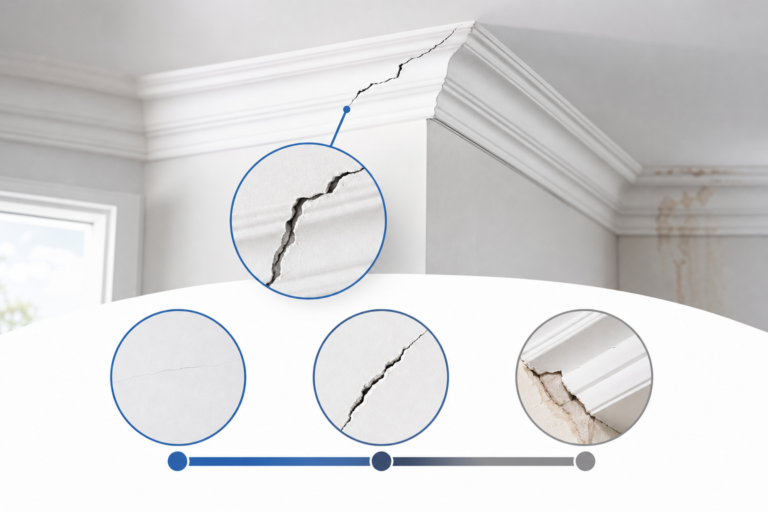
Cornice Cracking: How to Tell If the Damage Is Serious
Cornice cracking is one of the most common concerns Australian homeowners raise, and the hard part is not spotting the
Read More »
Digital Construction Consultant Australia: What They Do
A digital construction consultant in Australia manages the technology-driven side of building projects: BIM coordination, clash detection, asset data handover,
Read More »