
Embodied Carbon in Buildings: A Practical NSW Guide
A lot of NSW projects look tidy at tender stage. The drawings are signed off, the energy note reads well, and everyone feels the design is under control. Then a late substitution lands, a steel or concrete specification shifts, finishes are downgraded, and the project picks up a heavier carbon profile that nobody documented properly.
That's where embodied carbon in buildings stops being an abstract sustainability phrase and becomes a real compliance, procurement and dispute issue. In practice, the question is no longer only “does this building operate efficiently”, but “what did we lock into the structure, the materials, the supply chain and the future maintenance cycle”.
Why Embodied Carbon in Buildings Now Matters in NSW
A common NSW job starts with clean drawings and ends in a dispute over what changed. The builder prices one set of products, the client asks for value engineering, and the substitute looks equivalent on paper. On site, though, the replacement can alter the carbon profile, and that change is often invisible unless someone checks the material data, the boundary assumptions and the specification trail.
That matters because embodied carbon has moved from a side issue into mainstream building performance. GlobalABC's life-cycle framing treats embodied emissions as coming from extraction, manufacturing, transport, construction and end-of-life stages, and the Buildings and Cities review notes that for new, energy-efficient buildings embodied carbon can make up about 50% of life-cycle carbon and can exceed 50% in some cases (journal-buildingscities.org). As operational energy falls through efficiency and electrification, the materials story carries more weight, not less.
For NSW owners, builders, strata managers and lawyers, that changes what belongs in briefs, tenders and disputes. A specification gap, a late substitution or an undocumented variation can change the project's carbon profile and weaken the evidence behind it. Whole-of-life carbon accounting now sits inside design decisions, procurement review and expert analysis, not just a green rating exercise.
Practical rule: if the substitution changed the product, the boundary or the quantities, it changed the carbon story too.
The shift has also changed how the issue is treated in practice. Embodied carbon became a mainstream building-performance metric in the 2020s, when whole-life carbon accounting started to shape comparisons between low-carbon design options (journal-buildingscities.org). In NSW, that puts carbon in the same room as compliance, defect management and contract administration.
What Embodied Carbon in Buildings Means
A project can look well built at handover and still carry a heavy carbon burden hidden in its materials. That burden sits in the steel, concrete, timber, finishes, transport, site activity and the replacements that come later. For owners, builders, strata managers and lawyers in NSW, that matters because the carbon story is tied to specification, procurement, substitution and proof.
The parts of the receipt
Embodied carbon covers the greenhouse gas emissions and removals linked to creating, maintaining and eventually disposing of building materials. In practical terms, it includes material production, transport, construction-related emissions, and material-related emissions from maintenance, repair, replacement and refurbishment. A project that measures only the construction stage is leaving part of the picture out, and that can matter in both compliance reviews and dispute work.
A useful way to separate the categories is this:
- Upfront emissions come from extraction, manufacturing, transport and onsite construction.
- In-use material emissions come from parts that are replaced or renewed over time.
- End-of-life emissions come from demolition, disposal and any remaining material processing.
That distinction is not academic. A late substitution, a missing product declaration or a vague scope note can change the result enough to affect tender comparisons, variation claims and expert evidence. In a Scott Schedule, those gaps often show up as arguments about what was specified, what was installed and whether the carbon claim still matches the built work.
For non-specialists, the practical point is simple. Embodied carbon is the total of the materials and processes behind the finished building, and the answer depends on what was counted, what was left out and where the boundary was drawn. A building energy consultant can help align those boundaries with the project brief and the evidence trail, which is why teams often seek specialist advice on building energy consulting before claims, substitutions or disputes harden into positions.
How Embodied Carbon Is Measured in Australian Projects
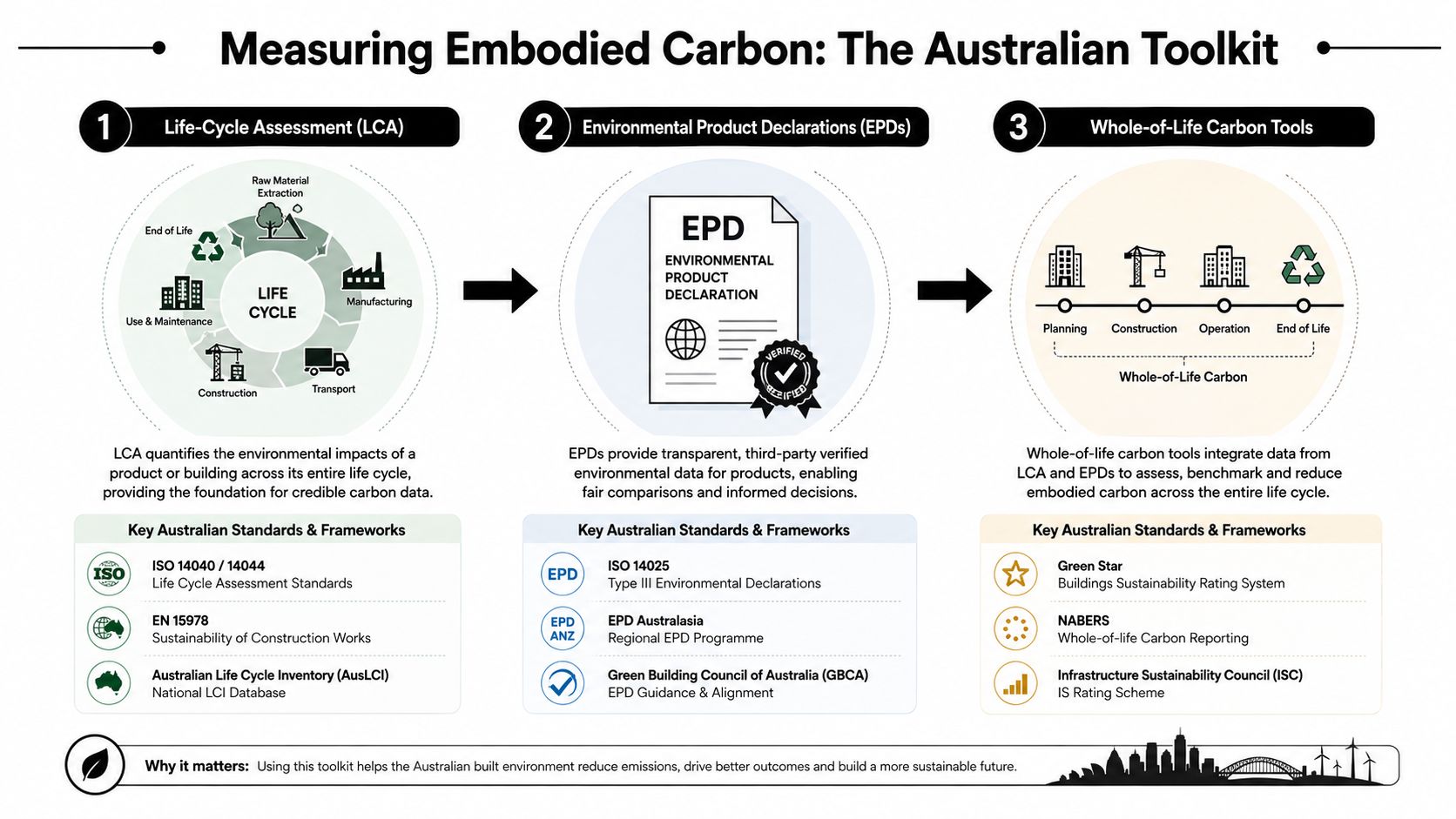
A measurement that will stand up in a dispute starts with life-cycle assessment, or LCA. The practical task is to map the materials, define the stages, then calculate the emissions in a way that can be defended later. Problems begin when teams compare two projects, two products or two suppliers without confirming that the same boundary was used.
Australian project teams often rely on Environmental Product Declarations, or EPDs, because they provide quantified cradle-to-gate or cradle-to-grave emissions data for materials and help compare concrete, steel, timber and other products on a like-for-like basis (ScienceDirect article on EPD use in Australia). The catch is that the result only holds if the product boundary, the declared unit and the stage coverage line up. A polished brochure claim is not the same thing as a comparable carbon declaration.
Why local data quality still matters
NSW guidance recognises several data-quality tiers, from actual construction data and estimated quantities through to element-level and asset-level carbon intensity benchmarks. That matters because not every project has strong Australian-specific data, and not every estimate deserves the same weight in procurement or expert evidence (NSW Infrastructure embodied-carbon measurement technical guide).
The issue on site is whether the numbers can be tested. A concrete mix change, a substitution in the façade package, or a scope note that leaves out fit-out can move the result enough to change tender comparisons and later dispute positions. In that setting, the carbon model is only as reliable as the data trail behind it.
A practical review for Australian practice found gaps in standardising LCA, integrating LCA with BIM and life-cycle cost analysis, adapting methods to changing project conditions and accounting for natural hazard impacts (NIST review). For practitioners, the point is straightforward. If a supplier cannot explain the method, the boundary or the data quality, the claimed reduction should be treated cautiously.
A building energy consultant can help align those boundaries with the project brief and the evidence trail, especially where energy and compliance inputs are already being coordinated through one consultant relationship.
A carbon number without a method is just marketing.
The better questions are usually the plain ones. What stages were included? Were maintenance and replacement counted? Is the claim based on a product declaration, a whole-building model or an imported benchmark? If those answers are missing, the number needs to be treated cautiously.
A Stepwise Process for Assessing Embodied Carbon on a Project
The cleanest way to handle embodied carbon on a NSW project is to treat it like any other design-control issue. Set the target first, then test the design, then lock the product evidence as early as possible. If the team waits until after procurement, the carbon result is already being driven by substitutions rather than intent.
A practical workflow
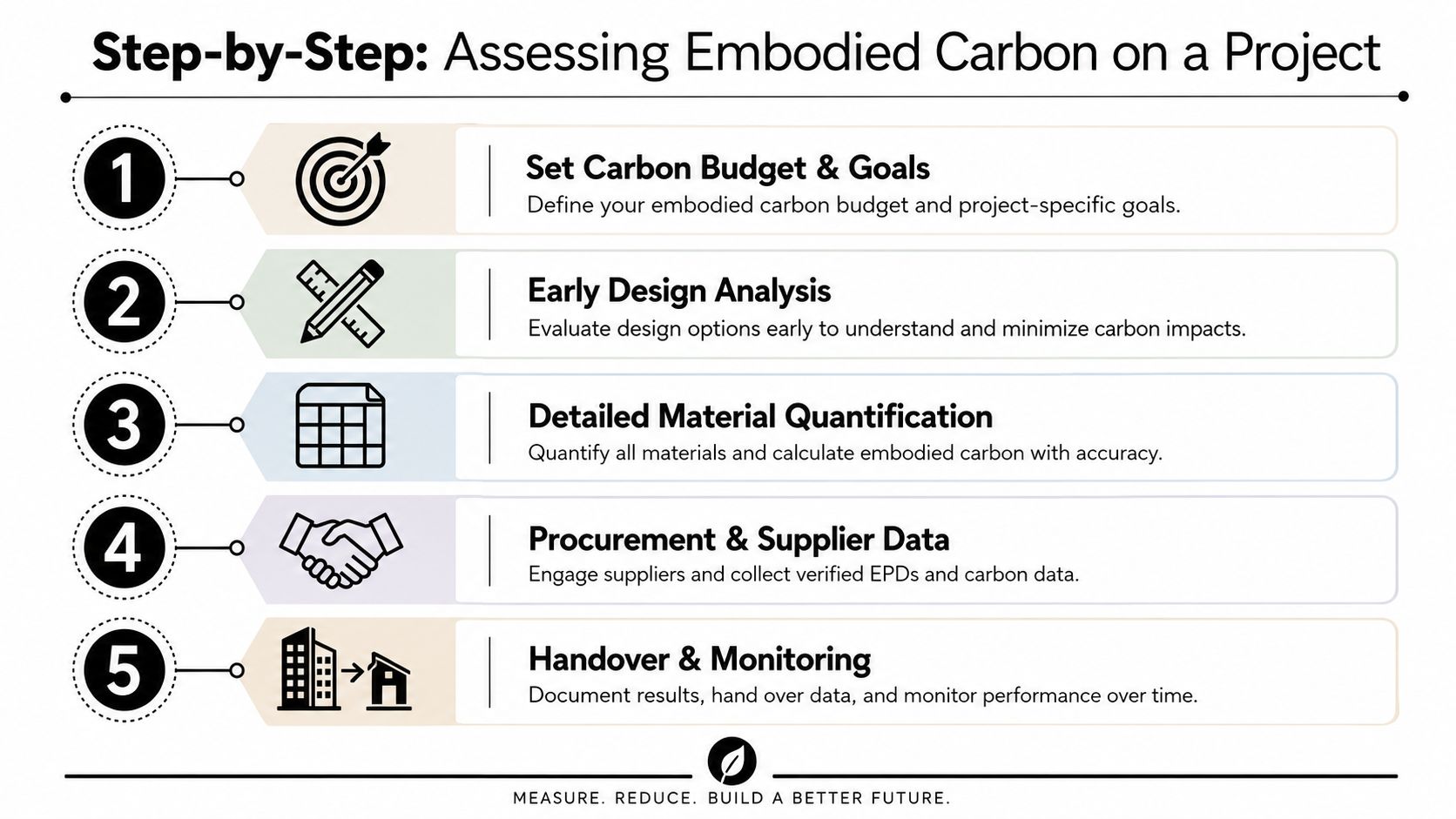
- Set the target early. A project benchmark helps everyone know whether the design is moving in the right direction.
- Choose the boundary. Define whether the assessment covers upfront stages only or whole-of-life impacts.
- Quantify the materials. Track structure, envelope, finishes and fit-out separately, because they do not carry the same carbon weight.
- Collect product evidence. Ask for EPDs or equivalent documentation before the item is locked in.
- Track changes. Every substitution, variation or redesign should be checked against the carbon model.
The value of this sequence is that it creates an audit trail. If a concrete grade changes, a finish package is swapped, or a timber element is replaced with steel, the team can see what moved and why. That documentation matters in procurement because it separates a genuine design refinement from a carbon-worsening substitution.
What to document
A disciplined file should record the design basis, the system boundary, the quantities, the product declarations and the reason for each major change. That is also where team coordination matters. The person modelling carbon needs current quantities, and the person procuring products needs to know which declarations are comparable.
For projects that are also managing broader sustainability or circularity objectives, a useful external reference is the DPP Grid product-as-a-service guide. It's a practical reminder that procurement decisions can shape both material ownership and material impact over the life of the asset.
You can also use the same discipline to keep a clean paper trail around design and compliance topics that often sit beside carbon questions. Sustainable building consultant trends and benefits in 2026
The point is not to create bureaucracy for its own sake. The point is to make sure carbon decisions are visible before they become disputes.
High-Impact Ways to Reduce Embodied Carbon in Buildings
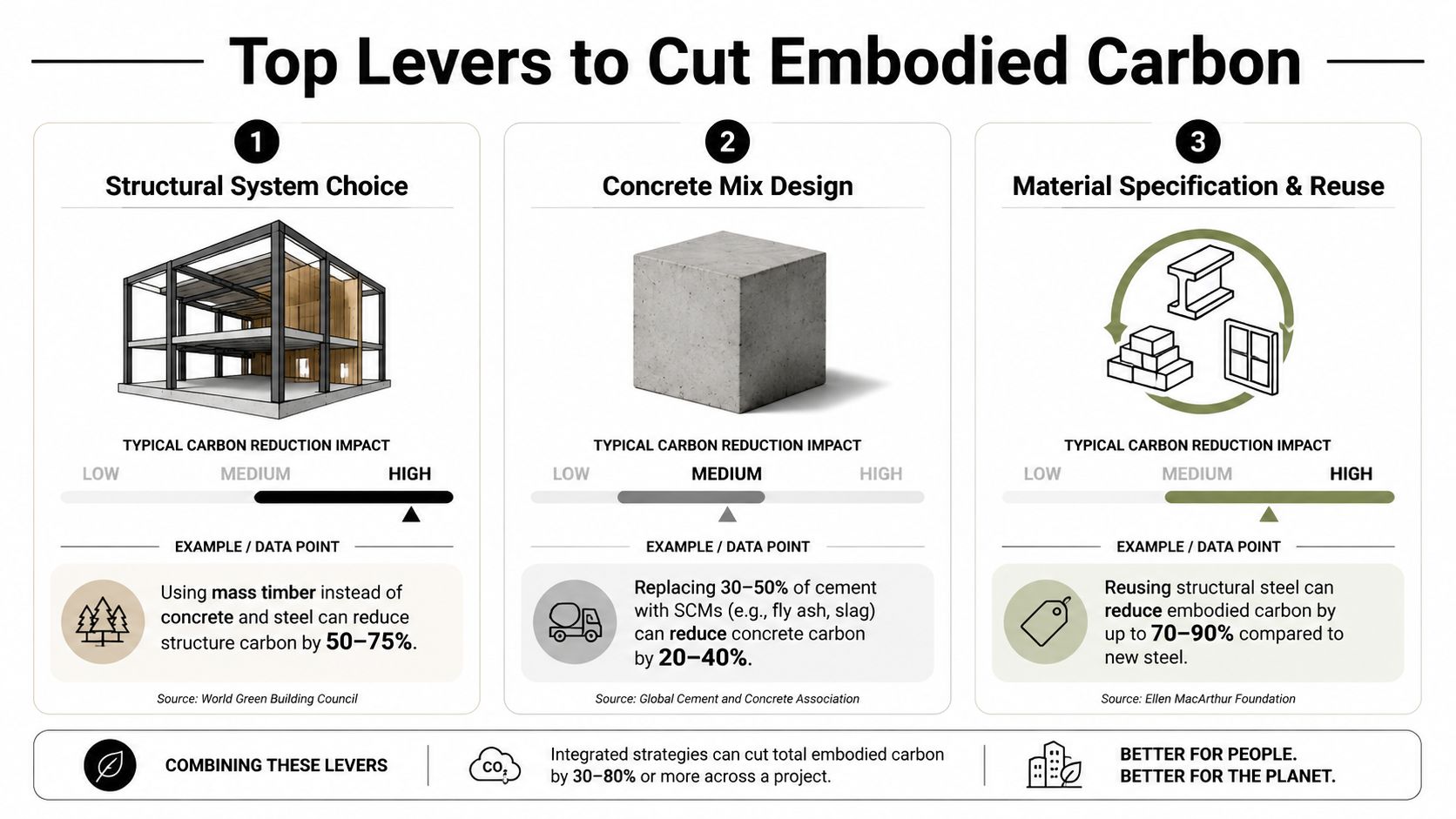
A good embodied-carbon result usually comes from a few early decisions, not a long list of small adjustments at the end. The structural system, concrete specification and material reuse do most of the work, and each one brings its own trade-offs in cost, program and constructability. On NSW jobs, I see the same pattern in disputes, the carbon position is usually won or lost before the first pour, and it is often tied to what was specified, not what was discussed in meetings.
Concrete needs particular attention because cement is the most carbon-intensive part of concrete production. Structural-engineering guidance notes that Portland cement typically makes up only 10%–20% of a typical concrete mix by mass but can account for 75%–90% of concrete's embodied-carbon impact, and that cement kilns alone contribute about 4%–5% of global greenhouse-gas emissions (IStructE and Arup embodied-carbon concrete guidance). For NSW projects, that is why mix design, cement substitution and structural optimisation deserve close attention from the start.
How the options compare
- Structural choice. Timber can perform well where the design, exposure conditions and span requirements suit it. A Western Sydney University review reports that timber structures can deliver about 68% embodied-carbon savings versus concrete structures, but the outcome depends on the system boundary and whether biogenic carbon storage is credited.
- Concrete mix design. Supplementary cementitious material choices and structural efficiency can lower carbon without changing the whole building system, which is often easier to adopt on constrained projects and easier to defend in procurement.
- Material reuse. Reused or re-specified materials can cut demand for new production, but they need careful verification so the procurement trail remains defensible if a claim is later challenged.
That timber figure still needs caution. The same Western Sydney University review reports embodied carbon values for timber structures ranging from about -445.6 to 333.5 kg CO2-e/m2 depending on system boundaries and carbon storage treatment, which shows how quickly headline claims can change once the accounting method changes. In practice, that matters in expert reports and Scott Schedules, because a substitution that looks better in one model can look very different when the boundary is tightened or the assumptions are tested.
Circular procurement works best when it is assessed through a lifecycle lens rather than as a one-off purchase decision. The most reliable savings usually come from structural rationalisation, smarter concrete specification and reuse where the evidence trail is solid, and the DPP Grid product-as-a-service guide is a useful reference when a project is weighing ownership, reuse and end-of-life responsibility.
Internal review also matters. A clear design and sustainability check helps test whether a preferred option is supportable, or whether it will create a later argument about substitutions, equivalence or compliance. Sustainable building consultant trends and benefits in 2026 is a practical reminder that the consulting role is now tied to both carbon performance and document control.
Specifying and Verifying Embodied Carbon Claims in Australia
A carbon claim can look tidy in a brochure and still fall apart once the contract, the specification and the substitution trail are read together. I have seen this happen on NSW jobs where the boundary was too narrow, the dataset did not match the installed product, or the comparison was never really like-for-like.
The safest approach is to write the carbon requirements into the specification and tender documents from the start. State the LCA method, the system boundary, the reporting format, the product declaration standard and what must happen if a contractor offers an equivalent product. If the substitute has no comparable EPD, treat it as a procurement and compliance issue, because that is where the risk sits.
What to ask for
- Method statement. Ask which LCA approach was used and whether the same approach applies to every product being compared.
- Boundary disclosure. Confirm whether the claim covers cradle-to-gate, cradle-to-grave, or another defined scope.
- Comparable evidence. Require EPDs or equivalent data for major materials, especially where the substitution affects structure, envelope or fit-out.
- Change control. Require the carbon impact of substitutions to be recorded before approval, not after installation.
A 2024 technical review found persistent gaps in standardising practice, integrating LCA with BIM and life-cycle cost analysis, adapting methods to dynamic conditions and accounting for natural hazards. The awesim.com.au summary of Australian standards becoming free is a useful reminder that procurement teams will face more pressure to keep their evidence trail clean and current. The strongest files are the ones that keep method, quantities and evidence aligned from the outset.
Practical rule: if two products cannot be compared on the same boundary, they should not be sold as equivalent carbon choices.
Legal and procurement teams need to stay alert as well. A polished claim can still mislead if it ignores replacements, uses a narrow scope or hides a major assumption. For NSW projects, the test is whether the claim survives contract scrutiny, variation assessment or dispute.
The carbon file should also be built for later examination. Construction teams are already being pushed toward more product-level evidence and clearer procurement expectations, so the records need to support that standard from day one, not after the fact.
Embodied Carbon in Inspections, Expert Reports and Scott Schedules
Embodied carbon is becoming relevant to inspections because substitutions leave physical and documentary fingerprints. A material change can alter durability, compliance, performance and the carbon profile at the same time, which means it can sit inside a broader building dispute even if no one used the word “carbon” during the job.
That is why site investigations need to look beyond visible workmanship. If a specification called for one product and the installed product is different, the consultant should check whether the substitute was approved, whether the data was comparable and whether the change affected the evidence trail. Those questions matter in Expert Witness Reports and Scott Schedules, because they turn a vague sustainability argument into a concrete, auditable issue.
What usually matters in a dispute
- Specification gaps. If the contract did not define the acceptable carbon evidence, the substitution trail can become messy fast.
- Undocumented variations. A changed product with no revised declaration is hard to defend later.
- Compliance overlap. Carbon issues often sit beside workmanship, defect and performance questions, so they need to be captured in the same factual matrix.
For lawyers and builders, the lesson is that embodied carbon is not just a planning or marketing topic. It can become part of the evidence around substitution, compliance, misrepresentation or the reasonableness of a variation. For consultants, the task is to keep the report factual, method-based and tied to the documented project record.
Awesim Building Consultants have 35+ years in Building & Construction, with over 15+ years providing litigation support to home owners, builders and lawyers. We provide site investigations, Building & Construction Expert Witness Reports and Scott Schedules.
The biggest advantage of treating carbon properly in a dispute file is clarity. A well-documented substitution can be reviewed quickly. A poorly documented one can consume time because the assumptions, quantities and product data all need to be rebuilt from scratch.
Next Steps for NSW Projects and Building Disputes
If you're planning a project, reviewing a design or dealing with a dispute, the first move is simple. Check what was specified, what was installed and what evidence exists for any substitution. Then ask whether the carbon claim was based on a defensible method, not just a persuasive label.
A useful checklist is short:
- Confirm the boundary. Make sure the assessment covers the stages that matter for the decision.
- Collect product evidence. Keep the EPDs, declarations and substitution approvals together.
- Record changes early. Don't leave the carbon impact of a variation until the end.
- Match the claim to the use. Procurement, compliance and expert evidence each need different levels of detail.
For NSW projects, that approach keeps embodied carbon in the right lane. It becomes a whole-of-life, contractually documented metric instead of a one-off calculation that disappears after tender.
Awesim Building Consultants have 35+ years in Building & Construction, with over 15+ years providing litigation support to home owners, builders and lawyers. We provide site investigations, Building & Construction Expert Witness Reports and Scott Schedules.
If you're dealing with a NSW building issue where embodied carbon, substitutions or specification gaps may matter, speak with Awesim Building Consultants about the facts, the documentation and the dispute pathway. Visit Awesim Building Consultants to arrange site investigations, Expert Witness Reports or Scott Schedules, and get practical help that stands up to scrutiny.

Related Posts
Scott Schedule Template: What Columns a NSW Claim Needs
What Is a Scott Schedule? Why the Column Structure Matters The Core Columns in a NSW Scott Schedule Template Column
Read More »
Brick Veneer Construction Defects: A Site Inspector’s View
What Brick Veneer Construction Actually Is The Most Common Brick Veneer Construction Defects Cracking in the Brickwork Missing or Blocked
Read More »
Liquidated Damages in Construction: How NSW Contracts Work
What Are Liquidated Damages in Construction? Why Contracts Use Them How Liquidated Damages Work in NSW Building Contracts Standard Contracts
Read More »