
A Homeowner’s Guide to the NSW Security of Payment Act
Nothing stops a construction project dead in its tracks faster than a payment dispute. It’s a surefire way to dial up the stress for everyone involved, from the homeowner right through to the builder and their subbies.
But there’s a powerful tool designed specifically for this scenario: the Building and Construction Industry Security of Payment Act 1999 (NSW). Think of it as an express lane for resolving payment issues and keeping the cash—and the project—flowing.
Navigating Payment Disputes in NSW Construction

The NSW Security of Payment Act isn’t about lengthy, drawn-out court battles. It’s a rapid-resolution mechanism built to get contractors, subcontractors, and suppliers paid on time for the work they’ve actually done. Simple as that.
At its core, the legislation gives you a statutory right to claim progress payments and sets up a fast-track process to recover money you’re owed. This completely flips the script on traditional disputes. The onus is now squarely on the person paying the bill to respond promptly—if they don’t, they can find themselves liable for the full amount you’ve claimed.
With 35+ years in Building & Construction, we’ve seen this Act in action time and time again. For the last 15 years, Awesim Building Consultants has specialised in providing litigation support to home owners, builders and lawyers, helping them navigate these exact kinds of challenges. We know what works and what doesn’t.
Why This Legislation Matters
In an industry where cash flow is king, the last thing you need is to get bogged down in the slow, grinding gears of the conventional legal system. The Act cuts through all that with strict, non-negotiable timelines.
Knowing your rights and responsibilities is the first step to protecting your bottom line. The benefits are clear:
- Speedy Resolution: Adjudication delivers a decision in a matter of weeks, not the years it can take in court.
- Cost-Effectiveness: You sidestep the astronomical costs that come with traditional litigation.
- Enforced Payments: An adjudicator’s decision is legally binding. It carries the same weight as a court judgment and can be enforced just as forcefully.
It’s also worth remembering that when payment issues arise, all parties need to be aware of the potential risks of personal guarantees that might have been signed. The consequences of not meeting your obligations can be severe.
In this guide, we’ll walk you through the practical steps to make the Act work for you and show you how solid litigation support can strengthen your case. If you’re tangled up in a more complex situation, you can see how we help with a whole range of building and construction disputes.
What the NSW Security of payment Act Really Means
Let’s cut through the jargon. At its heart, the NSW Security of Payment Act—or SOPA, as it’s known in the industry—is a rapid-fire tool designed for one simple reason: to make sure people who do construction work or supply materials in NSW get paid on time.
Think of it this way. The traditional court system is like Sydney’s peak-hour traffic—slow, frustrating, and incredibly expensive. You can get stuck for months or even years. The Security of Payment Act, on the other hand, is the express lane. It was built to bypass all that congestion and get you from an unpaid invoice to cash in the bank, fast.
It’s not about fighting out every single detail of a complex contract dispute. It’s about keeping the cash flowing so that projects can continue and businesses don’t go under waiting for money they’ve rightfully earned. This legislation creates a powerful, parallel path to payment that sits alongside your contract, with a set of strict, non-negotiable deadlines that everyone has to follow.
Who Is Covered by the Act?
You might think SOPA is just for the big players, but its reach is incredibly broad. It’s designed to protect the entire contracting chain, from the head contractor at the top right down to the smallest supplier.
The protections generally extend to:
- Head Contractors working directly for a property owner or developer.
- Subcontractors of all kinds—plumbers, electricians, concreters, carpenters, you name it.
- Suppliers providing materials, plant, or equipment for a construction project.
- Consultants like architects, engineers, project managers, and surveyors.
The Act applies to both commercial and residential projects, though there are a few specific rules for residential jobs where the homeowner lives (or plans to live) in the property. Before you can leverage your rights under the Act, it helps to have a solid grasp of the essential elements of contract law, which is the foundation every construction agreement is built on.
Key Concepts You Must Understand
To make the Act work for you, a few key terms are non-negotiable. Getting these right is the difference between getting paid and having your claim thrown out.
Payment Claim
First up is the Payment Claim. This isn’t just any old invoice. It’s a formal request for payment that must be in writing, clearly state what work or materials it’s for, specify the amount you’re claiming, and—this is the crucial part—include a specific statement that it is made under the Building and Construction Industry Security of Payment Act 1999. Without that magic sentence, you’re not using the Act.
Payment Schedule
Next is the Payment Schedule. If you receive a Payment Claim, you have a very tight window—just 10 business days—to respond with this document. Your Payment Schedule must say exactly how much you intend to pay (the ‘scheduled amount’). If you plan to pay less than the full amount claimed, you must explain exactly why, with detailed reasons for every dollar you’re withholding.
Having spent over 35 years in construction and 15 years in litigation support, I’ve seen it countless times: a contractor receives a claim, gets busy, and misses the 10-day deadline. The result? They become legally liable for the entire claimed amount, no matter how inflated or incorrect it might be. That deadline is unforgiving.
Adjudication
Finally, there’s Adjudication. This is the fast-track dispute resolution process at the core of the Act. If you can’t agree on a payment, either party can apply for adjudication. An independent expert—the adjudicator—is appointed to make a rapid, binding decision on what is owed. It’s a quick and relatively low-cost way to get a resolution without stepping into a courtroom.
To give you a clearer picture of how these roles interact, the table below breaks down the main players and their duties.
Key Roles and Responsibilities Under the NSW SOPA
This table defines the main parties involved in a SOPA claim and summarises their primary rights and obligations.
| Party | Role | Primary Responsibility | Key Right |
|---|---|---|---|
| Claimant | The party seeking payment (e.g., subcontractor, supplier) | To serve a valid Payment Claim that meets all legislative requirements. | To receive prompt payment or a detailed Payment Schedule in response. |
| Respondent | The party who received the Payment Claim (e.g., head contractor, homeowner) | To respond with a valid Payment Schedule within 10 business days. | To dispute all or part of a claim, but only if reasons are provided in the schedule. |
| Adjudicator | An independent, expert third party | To assess the claim and response and make a binding determination on the amount owed. | To demand documents and information from both parties to reach a decision. |
| Authorised Nominating Authority (ANA) | An organisation that appoints adjudicators (e.g., Adjudicate Today) | To nominate a qualified adjudicator upon receiving an application. | To manage the administrative process of adjudication impartially. |
Understanding where you fit within this framework is the first step to protecting your cash flow and ensuring you’re treated fairly on any NSW construction project.
This is where the rubber meets the road. The claim and response process under the NSW Security of Payment Act is a structured, time-sensitive dance where every single step matters. Getting it wrong can cost you dearly, but getting it right puts you in the strongest possible position to get paid.
Let’s walk through the critical timeline, step by step, from the perspective of both the person making the claim (the claimant) and the one receiving it (the respondent).
Step 1: Issuing a Valid Payment Claim
It all kicks off with the Payment Claim. This isn’t just any old invoice; it’s a formal document that triggers the Act’s strict deadlines. For it to have any power, a Payment Claim absolutely must meet a few key criteria.
A valid claim has to:
- Be in writing and addressed to the correct person or company (the respondent).
- Clearly identify the construction work or related goods and services it’s for.
- State the precise amount you’re claiming.
- Crucially, it must include the magic words: “This is a payment claim made under the Building and Construction Industry Security of Payment Act 1999”.
That last point is non-negotiable. Forget that sentence, and your claim is dead in the water as far as the Act is concerned. It loses all its legislative teeth and becomes just another invoice, leaving you without access to the rapid adjudication process.
Think of it this way: a subbie emails an invoice for “$25,000 for framework installation as per contract stage 3” but forgets that vital declaration. If the builder disputes it, the subcontractor is stuck in the slow, grinding lane of a standard contractual argument. But by simply adding that one sentence, they switch to the fast-track, forcing the builder to provide a formal, timely response.
Step 2: The Respondent’s Critical 10-Day Window
As soon as a valid Payment Claim lands in your inbox or on your desk, the clock starts ticking. You have exactly 10 business days to issue a formal Payment Schedule in response. This deadline is probably the most unforgiving part of the entire Act.
A Payment Schedule is your official, written reply. In it, you must state how much of the claimed amount you plan to pay (this is called the “scheduled amount”). If you intend to pay less than the full amount claimed, you are required to provide rock-solid, detailed reasons for withholding every single dollar.
Over our 15 years in litigation support, the single most common and devastating mistake we see is respondents missing this 10-day deadline. If you fail to serve a Payment Schedule in time, the Act deems you liable for the entire claimed amount. The claimant can then go directly to court for a summary judgment, and you’ll have virtually no leg to stand on.
Vague excuses won’t fly here. Just writing “work is defective” is completely useless. You have to get specific, and this is where solid evidence becomes your best friend.
Substantiating Your Response with Expert Evidence
If you’re holding back payment because of defects, unfinished work, or other problems, you have to back it up in your Payment Schedule. Your reasons need to be clear, detailed, and, ideally, supported by independent evidence.
This is the exact point where an independent Expert Witness Report can be a game-changer. A detailed report from a seasoned consultant does a few powerful things:
- Identifies and Documents Defects: An expert will inspect the site and document every defect, referencing the National Construction Code (NCC) and relevant Australian Standards.
- Quantifies Rectification Costs: The report gives you a clear, independent valuation of what it will actually cost to fix the problems you’ve identified.
- Provides Credible Evidence: This immediately elevates your argument from a messy “he said, she said” squabble to an evidence-based position an adjudicator can take seriously.
For example, instead of a weak reason like “The waterproofing is faulty,” a Payment Schedule backed by an expert report would state something like: “Withholding $15,000 for defective waterproofing in the main bathroom, which fails to comply with AS 3740-2010. Rectification costs are detailed in the attached expert report from Awesim Building Consultants, dated [Date].”
This level of detail doesn’t just strengthen your case for adjudication; it often forces a more reasonable negotiation, helping you sidestep the next formal step altogether.
How Adjudication and Enforcement Works
So, what happens when a Payment Schedule doesn’t sort things out, or worse, you don’t even receive one? This is where the NSW Security of Payment Act really shows its teeth with its next step: adjudication.
Don’t think of this as a full-blown court battle. It’s not. Adjudication is a fast-tracked, independent review process designed to get a decision made quickly and, most importantly, get cash flowing again. It’s built for speed, cutting straight through the delays that plague traditional litigation.
To get the ball rolling, you need to lodge an adjudication application. Time is critical here—the deadlines are strict and change depending on whether you received a Payment Schedule. This application goes to an Authorised Nominating Authority (ANA), which is a private body that appoints a qualified, neutral adjudicator to look at the dispute. This ensures the person making the call is both impartial and actually understands the construction industry.
The flowchart below gives you a bird’s-eye view of the simple claim-and-response rhythm that’s supposed to happen first.
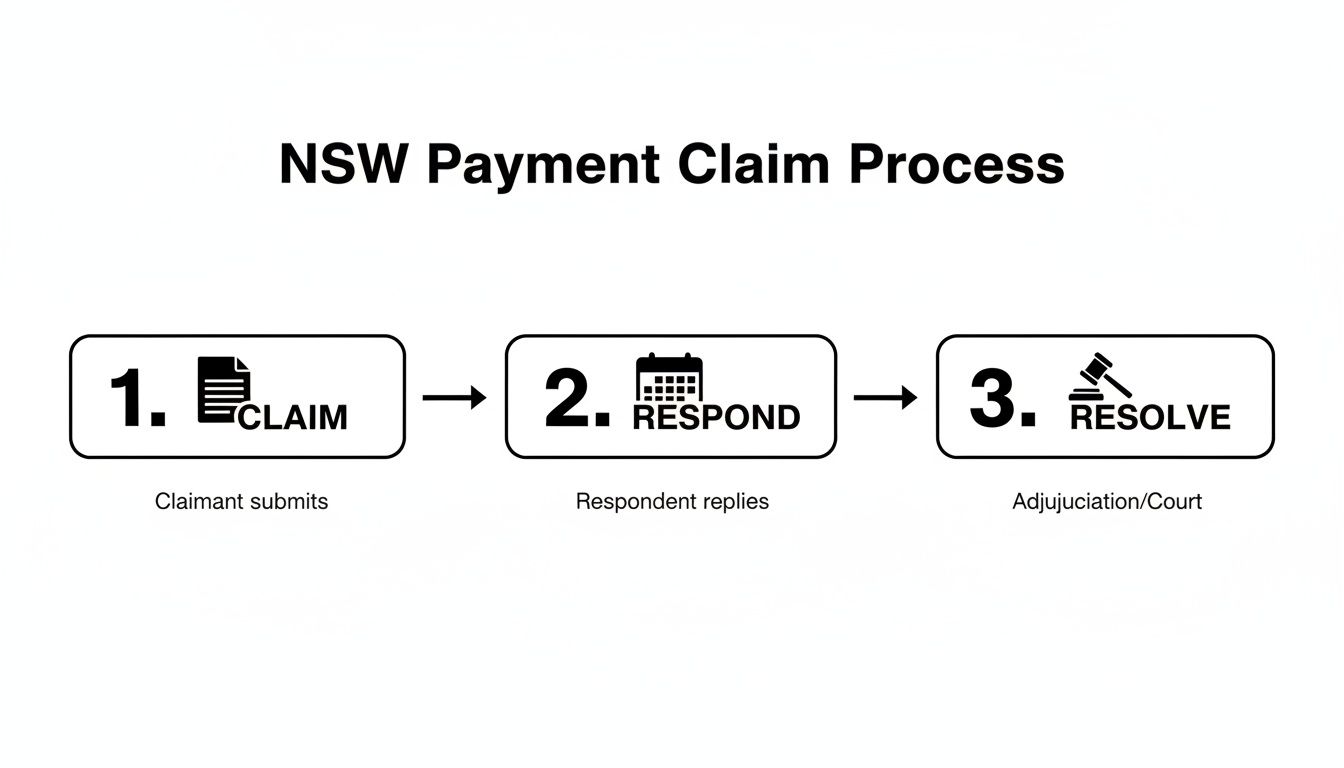
It’s this simple two-step dance that forms the foundation of the whole system. When the response step fails, that’s your cue to move on to adjudication.
The Adjudicator’s Role and Decision
Once an adjudicator is on the case, their job is to make a call based only on the documents put in front of them. There’s no courtroom drama, no cross-examinations, and no long-winded hearings. It’s all done “on the papers.”
The adjudicator will dig into:
- The nuts and bolts of the construction contract.
- The original Payment Claim and all the evidence you attached.
- The Payment Schedule, including the reasons provided for not paying.
- Any other submissions or expert reports from either side.
After more than 15 years providing litigation support, we’ve seen time and again that the quality of these documents makes or breaks a case. A clearly argued submission, backed by a credible expert witness in construction, can be the thing that tips the scales. The adjudicator has to make their decision within 10 business days of getting the response, which keeps the whole process moving at pace.
Their decision is legally binding, acting as a powerful interim solution. Both parties have to follow the determination, even if they’re planning to fight it out in court down the track. This is the Act’s core philosophy in action: “pay now, argue later.”
Enforcing an Adjudicator’s Decision
Getting a favourable adjudication determination is a huge win. But what if the other side digs their heels in and still won’t pay? This is where the Act’s enforcement powers truly shine, providing a clear path to turn that paper decision into actual money in your bank account.
If you haven’t been paid by the due date, you can ask the ANA for an adjudication certificate. This piece of paper is your golden ticket. You can take it to a court—like the Local or District Court—and have it registered as a judgment debt. Once that’s done, it has the full force of a court order.
With a registered judgment, you unlock the entire arsenal of legal enforcement tools. You’re no longer just asking to be paid; you’re demanding it with the full weight of the judicial system behind you.
This means you can start taking serious action to recover what you’re owed, including:
- Garnishee Orders: Forcing a third party who owes the debtor money (like their bank or a major client) to pay you directly instead.
- Writs of Levy of Property: Seizing and selling the debtor’s assets to cover the debt.
- Examination Notices: Compelling the debtor to reveal their financial situation so you can find out what assets they have.
This robust system is a game-changer, especially for the smaller claims common in residential construction. It gives subcontractors and homeowners a way to get a final result without being buried in prohibitive legal fees. The data on recovery rates tells a clear story: the smaller the claim, the higher the chance of success. Research shows low-value claims (under $100k) have an 85% success rate, with 61% getting paid in full. Compare that to high-value claims over $500k, where only 4% see a 100% recovery. You can dig deeper into how the Act supports smaller players by looking at the Security of Payments Act NSW statistics. This makes the Act a true powerhouse for homeowners and small contractors across NSW.
Checklists for Preparing Your Claim or Response
Success under the NSW Security of Payment Act really boils down to preparation. Whether you’re lodging a payment claim or defending one, your argument is only as strong as the paper trail behind it. A messy, poorly documented case is just asking to be thrown out.
With over 35+ years in the Building & Construction industry and more than 15 years providing litigation support, I’ve seen what works and what doesn’t. A methodical, evidence-first approach not only gives you the best shot at adjudication but often forces a quicker, better settlement—saving you a world of time, stress, and money.
Watertight Payment Claim Checklist
If you’re the one making the claim, your job is to present a case that’s undeniable. The goal is to leave absolutely no room for doubt about the work you did or the money you’re owed. Don’t even think about sending that claim until you have your ducks in a row.
Here’s the essential evidence you need to build a rock-solid case:
- The Contract: Get the signed contract, every single variation (approved in writing!), and any emails or letters that help clarify the scope of work.
- Proof of Work: This is crucial. Pull together your site diaries, timesheets, progress reports, and a library of clear, dated photos or videos showing the work is done and done right.
- Financial Records: You need all the relevant invoices, the purchase orders you raised for materials, and the receipts from suppliers that back up your claimed amount.
- Communication Log: Collate every email, text message, and set of meeting minutes related to the project. Pay special attention to anything that discusses progress, payments, or approvals.
When you’ve gathered all this, you can justify every dollar you’re claiming. It makes it incredibly difficult for the other side to find a legitimate reason not to pay.
Effective Response Checklist
On the flip side, if you’ve just been served with a payment claim, your focus is entirely different. You need to articulate clear, justifiable reasons for every cent you plan to withhold. Vague complaints like “shoddy work” are completely useless in this process. You have to be specific, objective, and back it up with hard evidence.
Your response checklist must include:
- Detailed Defect Documentation: Get your phone out immediately. Photograph and video every single alleged defect. The more detail, the better—get close-ups, wide shots, and videos that show the problem in context.
- Reference Australian Standards: Pinpoint exactly which part of the National Construction Code (NCC) or the relevant Australian Standard the work fails to meet. This shifts your argument from a subjective opinion (“I don’t like it”) to a factual, compliance-based issue.
- Professional Building Inspection: This is often the game-changer. An independent Expert Witness Report gives you an expert, unbiased assessment that documents the defects and puts a real dollar figure on the cost to fix them. It’s the most powerful tool you have for justifying a withheld amount.
- Written Correspondence: Dig up any emails, site instructions, or letters where you previously flagged concerns about the quality of the work with the claimant. This shows you didn’t just invent the problem when the invoice arrived.
This level of meticulous preparation is absolutely vital, especially as more and more subcontractors use the Act to get paid. Back in the 2016/17 financial year, subcontractors filed over two-thirds of all adjudication applications in NSW. That’s a massive shift, and it shows why head contractors and homeowners have to have their evidence locked down. You can read more about these NSW security of payment statistics from April 2018 to see why robust documentation isn’t just a good idea—it’s non-negotiable.
Handling Complex Defect Disputes
When a dispute gets messy and involves a long list of complex defects, just presenting your evidence clearly can feel overwhelming. This is exactly where a Scott Schedule becomes one of the most valuable tools in your arsenal.
A Scott Schedule is a structured, tabular document that lists each disputed item one by one. It provides columns for the claimant’s position, the respondent’s response, and often a space for the adjudicator or judge to make their findings.
It takes a sprawling, chaotic argument and organises it into a logical, easy-to-follow format. By breaking the dispute down into individual line items, it forces both sides to address specific issues with specific evidence. This makes it far easier for an adjudicator to weigh up the merits of each point.
If you’re staring down a multi-faceted dispute, you can check out our guide on how a Scott Schedule works to bring some much-needed clarity and professionalism to your case, whether at NCAT or adjudication.
When You Need an Expert Witness on Your Side

While the NSW Security of Payment Act is built for speed, disputes are rarely simple. Arguments over the quality of workmanship, incomplete construction, or non-compliance with Australian Standards often spiral into a messy “he said, she said” battle.
This is exactly when bringing in a professional building consultant as an expert witness in construction goes from being a good idea to a strategic necessity.
An expert witness is there to provide an objective, evidence-based assessment that cuts through all the noise. Their job is to translate complex building issues into a clear, factual, and authoritative argument that an adjudicator can actually understand and rely on. This is especially vital when you’re preparing a Payment Schedule and need to justify withholding payment because of legitimate defects.
Without credible evidence, your reasons for not paying are just opinions. With a robust expert report, they become facts.
The Power of an Independent Report
A powerful Expert Witness Report is far more than a simple list of problems. It’s a detailed, methodical document built on a foundation of deep industry knowledge and impartial analysis, designed to stand up to intense scrutiny.
With over 35+ years of hands-on building experience, we know precisely what to look for. Our reports are backed by more than 15 years of litigation support expertise and are structured to give your case the weight it deserves.
A high-calibre report will always involve:
- A meticulous on-site inspection to document all alleged defects with photographic and video evidence.
- Precise references to the National Construction Code (NCC) and relevant Australian Standards that have been breached.
- A detailed and justifiable costing for all necessary rectification work.
- Clear, unambiguous language that is fully compliant with NCAT and court requirements.
A well-prepared expert report can be the deciding factor in an adjudication. It gives the adjudicator a clear, credible roadmap to understanding the technical merits of the dispute, often making the difference between winning and losing.
From Disagreement to Undeniable Evidence
A solid expert report transforms a subjective disagreement into an objective, evidence-based position. For a homeowner, it provides the leverage needed to prove work is defective. For a builder, it can validate the quality of their work or accurately quantify the cost of fixing issues caused by others.
This kind of detailed reporting is crucial for anyone trying to navigate the rapid adjudication process under the NSW Security of Payment Act. If your dispute involves technical building matters, you can learn more about our litigation support services and how a detailed Scott Schedule can bring clarity to your case.
Don’t leave the outcome to chance—make sure your position is backed by undeniable proof.
Frequently Asked Questions
When you’re dealing with the NSW Security of Payment Act, a lot of specific questions pop up. After more than 35+ years in this industry and 15 years providing litigation support to home owners, builders and lawyers, we’ve heard just about all of them. Here are some of the most common ones we tackle.
Can a Homeowner Use the Act Against a Builder?
Yes, but it’s a very specific ‘yes’. The Act was built primarily to protect contractors and suppliers, ensuring they get paid for their work.
For residential projects, a homeowner can only leverage the Act if they’re essentially acting as a developer or if the construction is tied to their business. On the flip side, a builder or subcontractor can always use the Act to claim payment from a homeowner for legitimate work. The lines can get blurry, so getting professional advice is the only way to know for sure if your specific contract falls under the Act’s umbrella.
What Happens If I Miss the 10-Day Deadline?
Missing the 10-business-day deadline to issue a Payment Schedule is probably the single biggest mistake you can make. It’s a game-changer, and not in a good way.
If you let that deadline slip, you automatically become liable for the entire amount claimed by the other party. No ifs, no buts. The claimant can then take that debt straight to an adjudicator or the courts to enforce payment, and your grounds for defence will have shrunk to almost nothing. This strict timeline isn’t a bug; it’s a core feature of the legislation designed to keep things moving.
Is an Adjudicator’s Decision Final?
An adjudicator’s decision is binding, but it’s technically an interim measure. Think of it as a ‘pay now, argue later’ system. The whole point is to get cash flowing again quickly, so both parties are legally required to comply with the determination straight away.
While the decision is enforceable just like a court order, it doesn’t stop either party from pursuing the matter further in a court or tribunal like NCAT for a full hearing. But if you want to challenge the adjudicator’s decision itself, you can only do so on very narrow grounds, like proving a major error in how they handled their jurisdiction.
Having provided litigation support for over 15 years, we’ve seen countless times how critical solid expert evidence is. An adjudicator’s decision often comes down to the quality of the documents in front of them, which makes a clear, factual Expert Witness Report absolutely invaluable.
Does the Act Cover Disputes About Poor Workmanship?
It does, but in an indirect way. The NSW Security of Payment Act absolutely allows a builder or homeowner to cite poor workmanship or defects as a valid reason for withholding payment in their Payment Schedule.
The catch is, you can’t just vaguely mention it. You need to be specific, identifying each defect and putting a genuine, calculated cost against rectifying it. This is exactly where an independent Expert Witness Report becomes your most powerful tool. It provides credible, third-party evidence that gives your claims real weight during adjudication and massively strengthens your position.
Navigating payment disputes demands clarity, precision, and the right evidence. At Awesim Building Consultants, our 35+ years of hands-on experience mean you get expert, evidence-based support for your case. Whether you need an NCAT-compliant Expert Witness Report or a detailed Scott Schedule, we provide the litigation support required to secure a fair outcome. Contact us today to discuss your situation at https://www.awesim.com.au.

Related Posts

Waterproof Membrane Failure: How Inspectors Find the Cause
Waterproof membrane failure is diagnosed by tracing the water entry point, reviewing design documents, exposing the membrane for visual inspection,
Read More »
Cornice Cracking: How to Tell If the Damage Is Serious
Cornice cracking is one of the most common concerns Australian homeowners raise, and the hard part is not spotting the
Read More »
Digital Construction Consultant Australia: What They Do
A digital construction consultant in Australia manages the technology-driven side of building projects: BIM coordination, clash detection, asset data handover,
Read More »