
Expert Witness Building Report for NSW Disputes

When a building job goes off the rails, the immediate thought isn’t, “I need an expert witness building report.” They’re usually staring at cracked walls, leaks, movement, incomplete work, or a builder-client relationship that has broken down completely. By that point, stress is high, paperwork is scattered, and everyone has a different version of what happened.
That’s where a proper report matters. In NSW, the tribunal process doesn’t run on frustration or suspicion. It runs on evidence, technical reasoning, and documents that can stand up under scrutiny. A well-prepared expert witness building report turns a messy dispute into a structured case. It identifies defects, explains causation, links findings to the National Construction Code and Australian Standards, and sets out rectification in a form NCAT can effectively use.
For homeowners, builders, and solicitors, the challenge is usually the same. You need to know what the defects are, whether they’re actionable, how serious they are, what likely caused them, and how to present that clearly without overstating the case. That’s the practical side of expert work, and it’s very different from a routine inspection.
Your First Step in a Building Dispute
If you’re already in dispute, the first step isn’t to gather more opinions from friends, trades, or online forums. It’s to get an independent view of the building work in issue, documented properly and tied to the standards that apply.
In NSW, residential building disputes are common. Over 5,000 applications are lodged annually for residential building disputes in NCAT according to this NSW building dispute overview. That volume tells you something important. NCAT sees these matters every day, and casual defect lists don’t carry much weight.
A useful first move usually involves three things:
- Lock down the documents. Gather the contract, plans, specifications, variations, emails, text messages, invoices, photos, previous inspection reports, and any defect lists already exchanged.
- Preserve the site condition. Don’t rush into broad rectification unless safety requires it. Once work is altered, key evidence can disappear.
- Frame the actual dispute. Is it defective work, incomplete work, delay, water ingress, cracking, poor set-out, non-compliance, or all of the above?
Practical rule: The earlier an expert is instructed, the easier it is to inspect original conditions and separate cause from consequence.
Clients often think the report is only needed once the hearing date is close. In practice, a report is often most valuable much earlier. It can help clarify whether a claim is worth pursuing, whether a response is defensible, and whether a negotiated outcome is realistic before costs escalate.
That’s the right mindset. An expert witness building report isn’t just a tribunal document. It’s the working map for the dispute itself.
What an Expert Witness Building Report Actually Is
An expert witness building report is a technical and evidentiary document prepared for a legal dispute. Its job is not merely to say what looks wrong. Its job is to assist the tribunal by providing an independent opinion based on inspection, documents, relevant codes and standards, and the expert’s experience.
The easiest way to understand it is this. The expert acts as a translator between the building site and the tribunal room. Defects, workmanship issues, moisture paths, structural movement, tolerances, and sequencing problems all need to be turned into plain, supportable findings that a Member, solicitor, or barrister can test.
A lot of confusion comes from mixing this up with a standard building inspection.
Expert report versus ordinary inspection
| Feature | Standard Building Inspection | Expert Witness Building Report |
|---|---|---|
| Primary purpose | General condition advice for an owner or purchaser | Independent opinion for a dispute, hearing, or negotiation |
| Audience | Usually the client alone | Tribunal, court, solicitors, parties, and sometimes a single joint process |
| Focus | Visible issues and broad risk commentary | Defects, causation, compliance, rectification scope, and evidentiary support |
| Use of standards | Often general references only | Specific references to NCC, BCA provisions, and Australian Standards where relevant |
| Legal duty | To the client under inspection scope | Paramount duty to the tribunal as an expert |
| Format | Consumer-style report | Structured report suitable for pleadings, evidence, and cross-examination |
| Photos and records | Usually illustrative | Must be organised, scaled where needed, and tied to findings |
| Opinion on cause | Often limited or excluded | Core part of the report where evidence supports it |
| Rectification detail | Broad or preliminary | Should be clearly described and costed where required |
| Tribunal suitability | Often unsuitable on its own | Prepared specifically for dispute resolution |
What the report must do
A proper expert witness building report usually answers questions like these:
- What is the defect. Is there actual non-compliance, poor workmanship, damage, movement, or deterioration?
- Where is it located. Each issue needs to be identified clearly so there’s no ambiguity.
- What standard applies. That may be the NCC, the BCA, contract documents, manufacturer instructions, or a specific Australian Standard.
- What caused it. Design, construction method, sequencing, materials, maintenance, drainage, movement, or multiple factors.
- What rectification is appropriate. Not cosmetic patching where replacement is required, and not overreach where a lesser repair is sufficient.
A report that only says “defective” without showing why usually doesn’t get very far.
That distinction matters to both sides. Homeowners need a report that’s persuasive because it’s disciplined. Builders need a report that separates genuine defects from allegations that don’t hold up technically. Solicitors need a document that can survive attack.
Anatomy of an NCAT-Compliant Report
A strong report reads like a blueprint. Every section has a job, and if one part is weak, the whole document can become vulnerable.
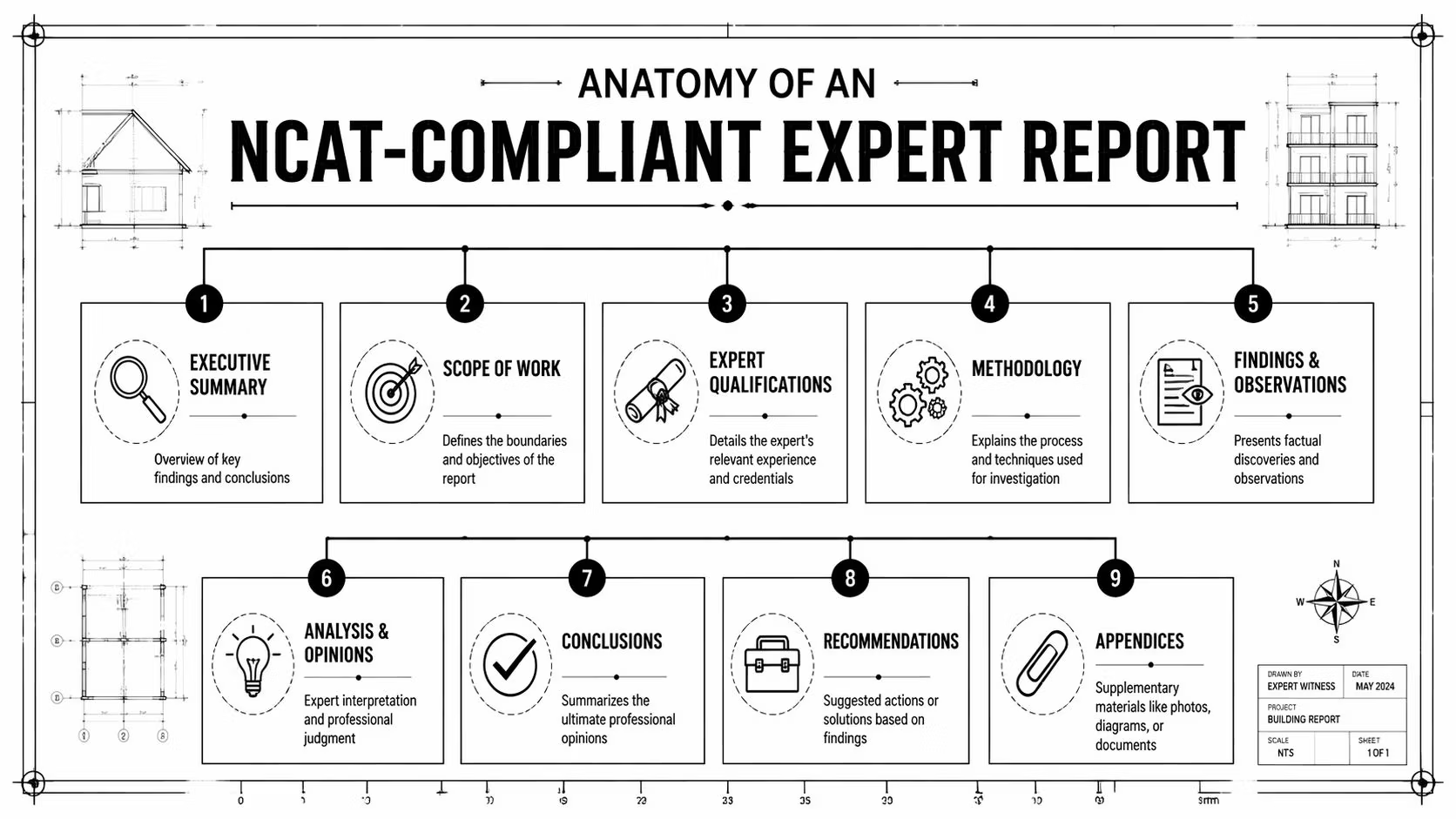
Scope and instructions
The opening needs to define what the expert was asked to do. That includes who instructed the expert, the property address, the date of inspection, documents reviewed, and the specific issues in dispute.
If the scope is vague, the report will often drift. A clear scope also protects everyone involved. It tells the tribunal what was and wasn’t investigated, whether invasive inspection occurred, and what assumptions were necessary.
For solicitors and owners preparing instructions, well-organised report templates and structured documentation can help keep the brief focused and complete. The format may come from another professional field, but the underlying discipline is the same. Good reports depend on orderly inputs.
Qualifications and methodology
This part isn’t filler. NCAT needs to know why the expert is qualified to express the opinion offered. That means relevant building and construction experience, not just generic credentials.
Methodology should also be spelled out. For example:
- Site inspection of nominated areas and adjoining elements
- Photographic recording with references tied to findings
- Document review of plans, specifications, contracts, and correspondence
- Assessment against standards including relevant clauses where applicable
- Limitations such as no destructive testing or restricted access
A good report separates observed fact from professional opinion. “Moisture staining observed at the internal face of the balcony door jamb” is a fact. “Likely caused by membrane termination failure and inadequate falls” is opinion. Both can be valid, but they mustn’t be blended carelessly.
Findings that link to standards
To avoid the shortcomings seen in many reports, an effective report must explicitly reference specific clauses from Australian Standards, such as AS 3700, and support defect claims with scaled photographs and costed defects as required by NCAT Procedural Direction 3, as outlined in guidance on strong expert witness reporting.
That requirement changes how findings should be written. Instead of saying a brick wall is “not compliant”, a proper report should identify the construction element, the observed defect, the standard relied on, and the practical implication.
For example, a masonry issue may need a reference to AS 3700. A timber framing issue may need AS 1684. The report should connect the physical evidence to the technical requirement and then to the consequence, such as water entry, movement, corrosion, or reduced serviceability.
Opinions and rectification
The opinion section should answer the hard questions directly. Is the issue defective work, fair wear and tear, maintenance-related deterioration, or a consequence of another failure? Is full replacement necessary, or can partial rectification achieve compliance and durability?
This is also where costed defects often come in. In NCAT matters, the schedule and report need to be practical enough for orders to be framed around them.
The best expert opinions are usually the least dramatic. They’re precise, limited to what can be supported, and very difficult to shake.
Appendices and supporting material
The back of the report matters as much as the front. Useful appendices often include:
- Photographs cross-referenced to defect numbers
- Plans or mark-ups showing locations
- Moisture readings or test records where relevant
- Document lists showing what was reviewed
- Scott Schedule material if prepared alongside the report
A report that is technically sound but poorly organised can still become hard to use. NCAT-compliant work needs both substance and structure.
Meeting the Evidentiary Bar for NCAT
A building opinion only helps if NCAT can rely on it. That’s why impartiality is not a soft concept. It’s the foundation of expert evidence.
In NSW construction disputes, analysis of 150+ cases found that impartial expert reports swayed tribunal decisions in 82% of instances, particularly where the report used objective quantification that aligned with NCAT evidence rules, according to this review of NSW expert witness reporting.
The expert’s duty isn’t to the client
Clients sometimes expect the expert to “support their side”. That expectation causes problems fast. An expert witness doesn’t act as an advocate. The expert’s duty is to provide an independent opinion within their area of expertise, even where parts of that opinion don’t help the instructing party.
That principle sits behind the Expert Witness Code of Conduct. If you’re involved in an NCAT matter, it’s worth reading the NSW Expert Witness Code of Conduct guide closely. It explains why the report must stay objective, transparent, and properly reasoned.
What gets challenged
In cross-examination, weak points usually aren’t dramatic technical mysteries. They’re basic failures such as:
- Overstatement where the expert goes beyond what was observed
- Missing assumptions that were relied on but never disclosed
- Advocacy language that reads like submissions rather than evidence
- Poor record keeping on photos, notes, measurements, or site access
- Unclear distinction between fact, inference, and opinion
Where conferences, interviews, or technical meetings are involved, accurate records matter. If discussions need to be captured clearly for legal review, properly prepared legal transcription services can help preserve what was said rather than what someone later remembers.
A credible expert doesn’t need to sound certain about everything. They need to be clear about what they know, what they infer, and what they can’t conclude on the available evidence.
How a report earns weight
The reports that carry weight in NCAT usually share the same traits. They’re measured in tone, specific in references, and careful about limits. They don’t inflate every defect into a catastrophe, and they don’t minimise genuine defects out of convenience either.
That balance is what makes an expert useful to the tribunal.
How to Instruct and Work With Your Expert
A week before hearing, a solicitor sends through 400 pages of emails, a handful of blurry photos, and asks for “a report on all defects.” That usually leads to delay, extra cost, and a report that needs narrowing after the inspection. A better result starts much earlier, with a disciplined brief and a clear inspection plan.

Start with a proper brief
An expert is not there to sort a disorganised file into a case theory. The instruction needs to identify the property, the parties, the stage of the dispute, and the questions that actually require expert opinion. In NSW matters, that often means separating defect allegations from delay complaints, payment disputes, scope changes, and general frustration between the parties.
Good instructions usually include:
- Contract documents such as plans, specifications, variations, inclusions, and relevant approvals
- Dispute documents including notices, email chains, text messages, meeting minutes, and complaint letters
- Photos and videos that are dated and, if possible, tied to the location shown
- Earlier reports from builders, certifiers, engineers, strata consultants, or insurers
- Access information covering who will attend, what areas are locked, whether services are live, and whether destructive inspection has already occurred
If the matter may need a Scott Schedule, say so at the start. That changes how defects are grouped, described, and cross-referenced. In NCAT, that step is often overlooked until late in the process, which creates rework.
Prepare the site before inspection
The inspection should answer technical questions, not spend half the day clearing storage boxes, chasing keys, or trying to work out which stain on the ceiling is the one in dispute.
Make the affected areas accessible. Have someone available who knows the property. If there are strata or community title issues, arrange access through the owners corporation, building manager, lot owner, and occupant before the inspection date. Rural matters need even more planning. Access tracks, outbuildings, stormwater paths, water supply, boundary drainage, and BAL-related construction details can all affect what needs to be inspected and how long it will take.
Order matters. If demolition, drying works, or temporary patching are planned, the expert should inspect before that evidence disappears.
Be precise about the questions
Broad instructions usually produce broad answers. Focused questions produce evidence that is easier to use.
Ask questions like:
- Is the balcony waterproofing installed in a way that meets the relevant standard and manufacturer requirements?
- What is the likely cause of the internal water ingress observed below the balcony door?
- Is the slab cracking consistent with shrinkage, footing movement, poor joint layout, or another identified cause?
- What rectification work is required, and is full replacement necessary or would partial rectification be appropriate?
Those questions help the expert stay within their role. They also help the tribunal. NCAT does not need a report that tries to write the parties’ submissions. It needs a clear opinion on the technical issues in dispute.
A short explainer on the broader dispute process can also help clients understand where the report fits in the sequence.
Work with the expert, but do not script the outcome
Clients and solicitors should review a draft for factual accuracy. Check names, addresses, dates, room references, document lists, and whether the instructed questions were answered. Point out if a photo has been mislabeled or a drawing revision has been missed.
Do not ask the expert to harden an opinion that the evidence does not support. That is where reports start to lose value. A measured opinion, with stated limits and clear reasoning, is far more useful than an aggressive one that cannot survive scrutiny.
Where fees are a concern, it helps to understand what usually drives them before the brief is finalised. This guide on the cost of a building expert witness report gives a practical breakdown of the work involved.
Awesim Building Consultants is one example of a firm that prepares site investigations, expert witness reports, and Scott Schedules for NSW disputes. The point is not the name. The point is choosing someone who understands NCAT procedure, can inspect methodically, and can present technical findings in a form the tribunal can use.
Choosing the Right Expert Timelines and Fees
Fees and timelines depend on the dispute, not just the property size. A small bathroom leak can become technically complex if the issue involves membrane continuity, drainage falls, concealed damage, and arguments about maintenance versus workmanship. A large new build can be relatively straightforward if the dispute is limited and access is good.
That’s why the cheapest quote is often a poor guide. If the expert misses the core issue, omits a critical standard, or produces a report that needs major revision, the apparent saving disappears quickly.
What affects cost and timing
Common cost drivers include document volume, number of defects in issue, testing requirements, travel, urgency, and whether the matter needs a Scott Schedule as well as a narrative report.
Regional work adds another layer. Rural inspections can add 30% to 50% to the time and cost, especially where the dispute involves Bushfire Attack Level compliance under AS 3959, according to this discussion of rural expert witness reporting. That isn’t just a travel problem. Rural matters often involve access constraints, different site exposures, outbuilding issues, and less consistent photographic records from earlier stages of the work.
If you want a more detailed breakdown of what tends to drive pricing, this guide on the cost of a building expert witness report is a useful starting point.
Questions worth asking before you engage anyone
A credible expert should be comfortable answering direct questions. Ask things like:
- What sort of disputes do you regularly inspect. Residential defects, strata issues, structural concerns, incomplete work, waterproofing, storm damage?
- Do you prepare reports specifically for NCAT. General inspection experience isn’t enough on its own.
- How do you handle causation. Some consultants identify symptoms but avoid the harder analysis.
- What standards do you typically rely on. Listen for specific references, not vague talk.
- Do you prepare Scott Schedules. In NSW, that can be central to the dispute process.
- What are your assumptions and limitations if access is restricted. The answer should be practical and candid.
- Have you worked in regional or rural NSW if the matter is outside metro areas.
If an expert promises to “win the case”, keep looking. A serious expert talks about evidence, scope, limitations, and process.
Trade-offs clients should understand
Fast reports cost more when the brief is urgent. Broad-scoped reports cost more than focused ones. Invasive testing may improve certainty but can increase expense, coordination, and delay. Single joint appointment may reduce duplication, but it may not suit every dispute.
Those trade-offs should be discussed before the inspection, not after the draft lands.
Your Next Step to a Clear Resolution
A sound expert witness building report is not a formality. It’s the document that gives structure to the dispute. It distinguishes real defects from assumptions, ties findings to the standards that matter, and gives NCAT something practical to work with.
The difference between a standard inspection and expert evidence is substantial. So is the difference between a generic defect list and a report that can withstand scrutiny. In NSW matters, the details matter. Scope, code references, causation, impartiality, supporting photographs, and Scott Schedule discipline all affect whether the evidence helps or falls away.
With more than 35+ years in building and construction and 15+ years providing litigation support to homeowners, builders, and lawyers, the practitioner’s view is simple. Clear reporting resolves more disputes than argument does.
If you need an expert witness building report, a site investigation, or a Scott Schedule for an NSW dispute, email admin@awesim.com.au or call 1800 293 746.
Frequently Asked Questions
Once a matter is on foot, the questions become more specific. Clients usually want to know what NCAT will expect, what documents carry weight, and where disputes commonly go off track in NSW matters.
| Question | Answer |
|---|---|
| What is a Scott Schedule in a building dispute? | It is a defect schedule that sets out each issue line by line so the parties, their experts, and the Tribunal can deal with the same item in the same order. In NSW building matters, it often becomes the working document for the whole case. If the schedule is vague, duplicated, or poorly described, the dispute becomes harder to manage. |
| Do I always need a Scott Schedule for NCAT? | Not in every matter, but in many NSW residential building disputes, yes. NCAT regularly expects the issues to be narrowed and organised this way, especially where there are multiple alleged defects, competing scopes of work, or disagreement about rectification cost. |
| Can my usual pre-purchase or maintenance inspection report be used instead? | Usually not by itself. Those reports are written for a different purpose. They may identify visible concerns, but they often do not set out causation, the applicable standard, the extent of damage, or the reasoning expected of an expert in litigation. |
| What if the other side’s expert disagrees with my expert? | That is common. NCAT does not decide these matters by counting experts. It looks closely at the reasoning, the site observations, the standards relied on, the quality of photographs and notes, and whether the expert has stayed within their actual area of expertise. |
| Should I appoint my own expert or use a single joint expert? | It depends on the issues in dispute. A single joint expert can save time and cost where both sides are genuinely trying to narrow the case. Separate experts are often more appropriate where liability, scope, sequencing of works, water ingress, structural movement, or rectification methodology are contested. |
| Will the expert need to attend NCAT? | Possibly. Some matters settle after exchange of evidence. Others require expert conclaves, joint reports, or oral evidence. Any report should be prepared on the basis that the author may need to explain and defend it in person. |
| What if access to parts of the building is limited? | The report should say exactly what could and could not be inspected. That matters a great deal in roof spaces, subfloors, boundary locations, occupied rooms, and rural properties where distance, weather, services, or terrain affect access. Hidden defects should be identified as possible concerns, not presented as confirmed findings without inspection or testing. |
| Can an expert report help settlement even if the matter doesn’t go to hearing? | Yes. A clear report often narrows the dispute well before a final hearing. That is particularly true where one party has alleged broad defect categories, but the expert evidence reduces the case to a smaller number of identifiable items with realistic rectification options. |
If you need practical, NCAT-focused help with an Awesim Building Consultants report, Scott Schedule, or site investigation in Sydney, New England, or rural NSW, get in touch by email at admin@awesim.com.au or call 1800 293 746.
Related Posts

NCAT Consumer Division: Steps From Lodgement to Hearing
Most people who end up at the NCAT Consumer and Commercial Division do not arrive there by choice. They arrive
Read More »
Statutory Warranty NSW: What Builders Must Fix and for How Long
Statutory warranty NSW obligations exist precisely for the moment a builder stops returning calls. A crack appears in the render.
Read More »
Home Building Act NSW: Key Clauses Every Owner Should Know
The Home Building Act 1989 (NSW) sets the rules for residential building work in New South Wales. It requires licensed
Read More »