
Understanding NSW Security of Payment Act 1999
In the New South Wales construction game, cash flow is king. Getting paid on time isn’t just a nicety; it’s the lifeblood that keeps a project—and your business—alive. That’s where the Building and Construction Security of Payment Act 1999 (NSW) comes in. This vital piece of legislation is designed for one primary purpose: to make sure you get paid for the work you do, fast. It creates a rapid, low-cost method for contractors, subcontractors, and suppliers to recover money they’re owed, all built around a simple “pay now, argue later” philosophy.
Why the NSW Security of Payment Act Is Your Most Important Tool

We’ve all heard the horror stories. You’ve poured weeks of hard work into a job, hit a major milestone, and then… radio silence on your invoice. The payment gets held up over some minor disagreement, and suddenly you’re stuck. Before this Act existed, your only real option was to head to court—a slow, draining, and incredibly expensive process that could easily sink a smaller business. The whole industry was caught in a culture of late payments, creating a painful domino effect that trickled all the way down the supply chain.
A New Framework for Fair Payment
The Building and Construction Security of Payment Act 1999 (NSW) was introduced to blow that old system up. It gives you a statutory right to claim progress payments, and what’s in your contract can’t override it. Think of it as a safety net, guaranteeing a fair and prompt process for getting the money you’ve earned.
Its core mission is powerful in its simplicity: to ensure anyone who performs construction work or supplies related goods and services gets paid on time. And this isn’t just for the head contractor and the client; it protects everyone from the big players down to the smallest subcontractor.
So, how does it do it? The Act sets up a clear, non-negotiable process based on three key pillars:
- Rapid Resolution: It sidesteps the courts, offering a fast-track adjudication process designed to get a decision in weeks, not years.
- Statutory Rights: It creates powerful rights and obligations that stand on their own, separate from the terms of your construction contract.
- Strict Timelines: The process runs on a tight schedule. The deadlines for making claims and responding to them are set in stone and must be followed to the letter.
The Act operates on a ‘pay now, argue later’ principle. Its primary purpose is to ensure that a claimant receives a prompt payment for work done, preserving their cash flow while any underlying contractual disputes can be resolved separately.
Your Guide Through the Process
At first glance, the Act can look a bit intimidating. But getting your head around its core principles is one of the most important things you can do to protect your business. Whether you’re a homeowner trying to navigate a dispute, a builder who needs to make a claim, or a lawyer advising a client, this guide will walk you through it step by step.
With over 35+ years in Building & Construction and more than 15 years providing litigation support to home owners, builders and lawyers, we at Awesim Building Consultants have seen it all. We bring a deep, practical understanding of both the construction site and the legal process, helping our clients prepare the rock-solid documentation needed for a successful outcome. If you’re facing a payment disagreement, a great starting point is our overview on navigating building and construction disputes.
So, Who and What Does the Act Actually Cover?
The Building and Construction Security of Payment Act 1999 (NSW) is a game-changer, but only if your specific situation falls under its umbrella. Before you can even think about making a claim, you have to be sure the Act applies to the work you’ve done and your role on the project. And it’s not just for the classic builder-homeowner scenario; its net is cast much wider than most people realise.
At its heart, the Act was created to tackle the construction industry’s biggest headache: getting paid late, or not at all. It establishes a powerful legal right to progress payments that sits entirely outside your contract, giving you a way out of those notoriously unfair ‘pay-when-paid’ clauses that used to trap so many contractors. Major updates in 2019 beefed up these protections even further, slashing maximum payment terms to just 20 business days for new contracts and forcing principals to hold retention money in trust. You can get more of the nitty-gritty on these crucial changes over at contractsspecialist.com.au.
Are You a Claimant or a Respondent?
To kick things off, you need to figure out where you stand. The Act boils it down to two main players: the claimant (the one who’s owed the money) and the respondent (the one who has to pay up). These definitions were deliberately made broad to capture the whole tangled web of relationships you find on any given construction site.
A claimant is pretty much anyone who has done construction work or supplied related goods and services under a contract. This could be:
- Head Contractors: The main builder engaged directly by the property owner.
- Subcontractors: The sparkies, plumbers, and chippies brought on by the head contractor.
- Suppliers: The businesses providing the concrete, timber, or light fittings.
- Equipment Hirers: The companies leasing out the cranes, excavators, and scaffolding.
- Consultants: The professionals steering the ship, like architects, engineers, surveyors, and project managers.
The respondent is simply the other party in that relationship—the one who received the work or supplies and is on the hook to pay for them.
What Counts as “Construction Work”?
The Act’s definition of “construction work” and “related goods and services” is incredibly broad, and for good reason. It’s designed to cover just about everything that happens on a project, not just putting up four walls and a roof.
A good rule of thumb is this: if it involves changing the land or a structure on it, it’s almost certainly covered. This means it applies to everything from massive commercial towers down to small jobs at home.
For example, the Act covers:
- Residential Renovations: A homeowner getting a builder in for a kitchen extension.
- Commercial Fit-Outs: A business hiring a contractor to overhaul their office space.
- Infrastructure Projects: Any work on roads, bridges, tunnels, or utilities.
- Supply Contracts: A concrete company delivering a load of ready-mix to a site.
- Professional Services: An architect drafting the plans or an engineer signing off on the structural design.
The key thing to remember is that the Act covers the work being done, not just the project’s label. From digging the very first trench to applying the final coat of paint—and even the expert advice that made it all happen—every one of these activities can be protected by the Act.
The All-Important “Reference Date”
Now for the most critical piece of the puzzle: the “reference date”. This is the single most important concept you need to get your head around. It’s the specific date that gives you the legal right to make a payment claim under the Act. If you don’t have a valid reference date, your claim is dead in the water before it even starts.
A reference date is simply the date on or from which you can claim a progress payment. Most contracts will spell this out clearly (e.g., “the 25th day of each month”). But what if your contract says nothing? The Act has your back. It provides a default date: the last day of the month when you first did the work, and the last day of every month after that.
This is the entire engine of the Act. It guarantees you a right to claim payment at regular intervals, no matter what a restrictive contract might try to impose. It keeps the cash flowing and stops projects from being held hostage by payment disputes. Here at Awesim, with our 15+ years of litigation support, we’ve seen countless disputes turn on whether this one crucial date was correctly identified.
Getting the Payment Claim and Payment Schedule Right
So, you’ve confirmed the Building and Construction Security of Payment Act 1999 (NSW) applies to your project, and you’ve got a valid reference date. Now we get to the core mechanics of the Act – the formal, time-sensitive exchange of documents that forces payments to keep moving and brings disputes into the open, fast.
Think of it as a strict legal tango. The two key moves are the Payment Claim and the Payment Schedule. Getting these steps right isn’t just a good idea; it’s everything. One misstep, like missing a deadline by a single day, can have immediate and severe consequences for either party.
This flowchart shows the critical sequence, from doing the work to hitting that all-important reference date which kicks off the whole process.
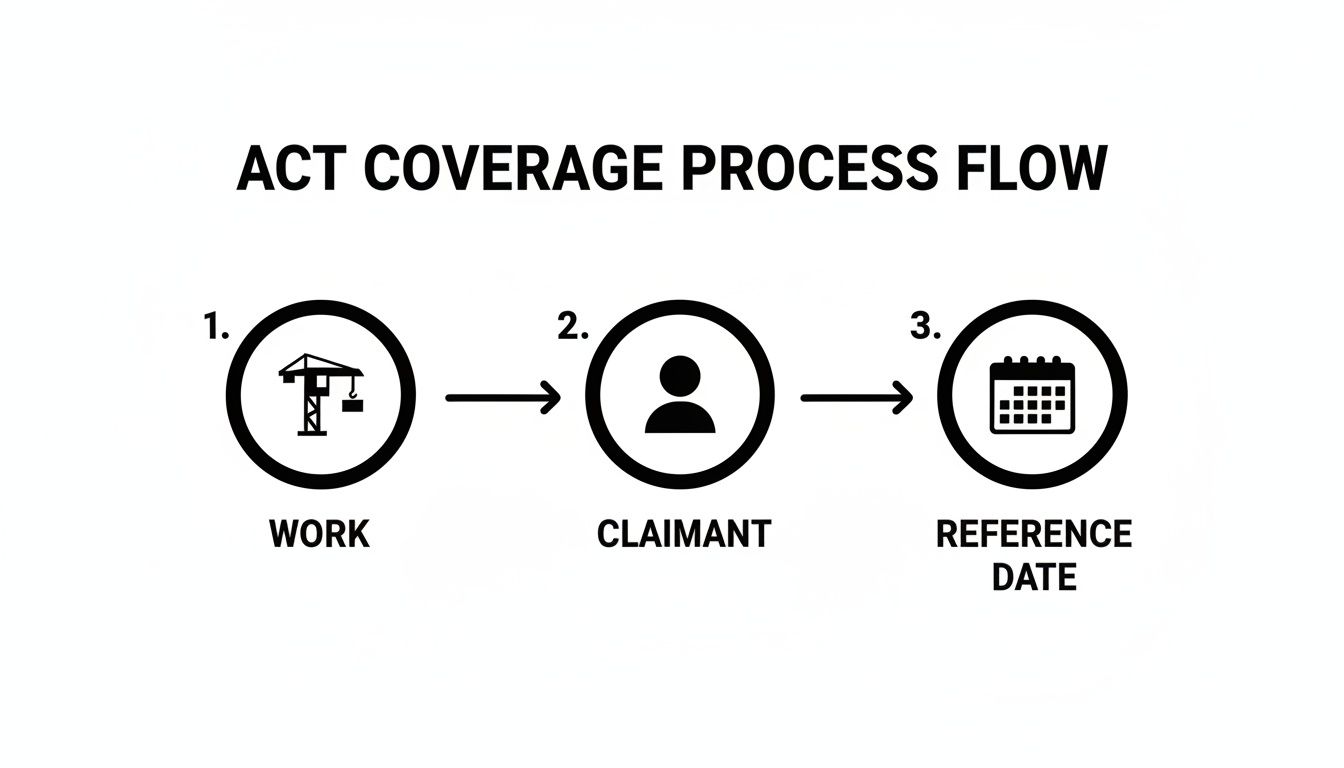
Understanding this flow is crucial. The reference date is the trigger that gives a claimant the right to fire the starting gun on the entire payment claim procedure.
What Makes a Payment Claim Valid?
The process begins when the claimant serves a Payment Claim on the respondent. This is no ordinary invoice. For it to have legal teeth under the Act, it must hit a few specific marks.
A valid Payment Claim must:
- Clearly identify the work: You have to describe the exact construction work or related goods and services your claim covers. Vague descriptions just won’t fly.
- State the amount claimed: The claim needs to specify the precise dollar amount you’re asking for.
- Include a supporting statement: This is a non-negotiable declaration confirming you’ve paid all the subcontractors you engaged for their work.
- Endorse the claim under the Act: The document must carry the magic words: it has to explicitly state that it is a payment claim made under the Building and Construction Industry Security of Payment Act 1999.
A simple “tax invoice” won’t cut it. Without the specific endorsement, “This is a payment claim made under the Building and Construction Industry Security of Payment Act 1999”, your claim is powerless under the Act and can be easily brushed aside.
Proper service is just as important. You have to deliver the claim to the respondent as set out in your contract or by post, fax, or in person to their usual place of business. With our 15+ years in litigation support, we at Awesim have seen far too many claims fall over simply because they weren’t served correctly.
The Respondent’s Crucial 10-Day Window
Once a valid Payment Claim is served, the clock starts ticking for the respondent. They have a strict 10-business-day deadline (or less, if your contract says so) to issue a Payment Schedule. This is perhaps the single most critical deadline in the entire process.
A Payment Schedule is the respondent’s formal reply. In it, they must state how much of the claim they plan to pay (the “scheduled amount”).
If they intend to pay less than the full amount, they have to spell out every single reason why. For instance, if they’re holding back money because of alleged defects, they must list each defect, explain why it justifies withholding payment, and put a dollar value on it.
To help you keep track of these tight turnarounds, here’s a quick summary of the key deadlines.
Security of Payment Act NSW Key Timelines
| Action | Responsibility | Strict Deadline |
|---|---|---|
| Serve Payment Claim | Claimant | Within 12 months of the work being carried out |
| Provide Payment Schedule | Respondent | Within 10 business days of receiving the Payment Claim |
| Pay Scheduled Amount | Respondent | By the due date for payment |
| Make Adjudication Application | Claimant | Within 10 business days of receiving the Payment Schedule |
| Make Adjudication Application (if no Payment Schedule) | Claimant | Within 20 business days of the due date for payment |
These timelines are rigid, and missing them can completely derail your position.
What Happens if You Don’t Respond in Time?
This is where the Act really bares its teeth. If a respondent fails to serve a Payment Schedule within that 10-business-day window, they become liable for the entire amount claimed in the Payment Claim.
Let that sink in. By not responding on time, the respondent loses their right to raise a defence, argue about a single item, or complain about the quality of the work in this forum. The claimed amount automatically becomes a statutory debt that is due and payable, no matter how genuine their counter-arguments might be. Our guide on the payment of security act nsw explores these obligations in more detail.
This seemingly harsh outcome is entirely by design. It’s what forces respondents to engage with claims quickly and transparently, stopping them from just ignoring invoices to buy time. It’s the core mechanism that underpins the Act’s “pay now, argue later” philosophy, keeping cash flowing and businesses solvent while the finer points of a dispute are sorted out down the track.
Navigating Disputes with the Adjudication Pathway
So, what happens when you’ve done everything right—served a valid Payment Claim—but the response is a disappointment? Maybe the Payment Schedule only offers a fraction of what you’re owed. Or worse, you get complete radio silence.
This is precisely where the Building and Construction Security of Payment Act 1999 (NSW) flexes its muscles. The Act provides a powerful lifeline: the adjudication pathway.
Adjudication is the Act’s purpose-built, rapid-fire dispute resolution system. It’s designed to get an independent expert—an adjudicator—to make a fast, binding decision on your payment dispute. The whole process is set up to deliberately sidestep the traditional court system, which, as many in the industry know all too well, can be painfully slow and eye-wateringly expensive.
The entire point is to get cash flowing again. It keeps projects moving and, frankly, keeps businesses alive. It’s a game-changer, swapping years in court for an enforceable outcome in a matter of weeks.
Adjudication vs. Traditional Litigation
Putting adjudication up against a court battle is like comparing a 100-metre sprint to a marathon. A court case can drag on for months, sometimes years, all while legal bills pile up and threaten to bring a small business to its knees. Adjudication, on the other hand, is engineered for pure speed.
This rapid-response mechanism is one of the standout successes of the Building and Construction Industry Security of Payment Act 1999 (NSW). Instead of the 12 months or more that drawn-out court cases can average, adjudication typically delivers an enforceable outcome in just 6-10 weeks. This incredible efficiency gives everyone, from subcontractors to head contractors and consultants, the power to claim what they’re owed without facing crippling delays.
Kicking Off the Adjudication Process
To get the ball rolling, the claimant (that’s you) has to lodge an adjudication application. You don’t just send this anywhere; it goes through an Authorised Nominating Authority (ANA). These are independent bodies accredited by the NSW Government specifically to appoint adjudicators and manage the process.
The application is basically your entire case on paper. It must include your original Payment Claim and every piece of evidence you have to back it up. You have to think of it like presenting your final argument to a judge, except it’s all done in writing and on a very tight deadline.
Your application needs to clearly show:
- What work was completed and is being claimed for.
- The basis for the amount you’ve claimed (your calculations and contract terms).
- Why the respondent’s reasons for not paying are incorrect or invalid.
An adjudicator can only make a decision based on the information put in front of them. They don’t go out and conduct their own investigations. This means the quality and clarity of your evidence isn’t just important—it’s everything. Your application has to be rock-solid, comprehensive, and persuasive from the get-go.
The Role of Evidence and Expert Reports
Once an adjudicator is appointed, their job is to review the submissions from both sides—the claimant’s application and the respondent’s response. They are hunting for clear, factual evidence to figure out the true value of the work done and whether payment is due.
This is where professional, evidence-based documentation becomes your most powerful asset. Vague claims or emotional arguments simply won’t cut it. An adjudicator needs cold, hard facts, and this is where Awesim Building Consultants’ 15+ years of litigation support gives our clients a decisive edge.
A well-constructed Expert Witness Report delivers an independent, technical assessment of the work in dispute. It can verify that work complies with Australian Standards, put a real cost on rectifying alleged defects, and offer an impartial, expert opinion on complex construction issues.
For claims involving many different items, a detailed Scott Schedule is also a must-have. This document methodically lists every single disputed item, the claimant’s argument, the respondent’s counter-argument, and leaves a clear column for the adjudicator’s findings.
These documents turn a messy, he-said-she-said argument into a clear, itemised case. They give the adjudicator the organised, factual evidence needed to make a fair and fast determination. If you’re heading into a dispute, knowing how to structure your case is critical. You might find our expert guidance on handling building and construction disputes helpful.
Ultimately, an adjudicator’s decision, known as a ‘determination’, is legally binding. It can be enforced just like a court judgment, giving you a powerful and swift path to getting paid.
Common Mistakes and How to Enforce Your Rights

Winning an adjudication under the Building and Construction Security of Payment Act 1999 (NSW) is a huge milestone, but it doesn’t automatically put money in your bank account. An adjudicator’s determination is a powerful document, but it isn’t self-enforcing. Getting paid is the real goal, and that requires taking specific, formal steps to make it happen.
This is exactly where many claimants fall over, often right after successfully navigating the complexities of the Act. Turning that piece of paper into actual payment means shifting from the rapid adjudication system into the formal court process. Knowing how to do this—and what common pitfalls to sidestep—is absolutely critical.
From Adjudication Certificate to Court Judgment
Once an adjudicator finds in your favour, the first thing you need to do is request an adjudication certificate from the Authorised Nominating Authority (ANA). This certificate officially states the amount you’re owed and the date it was due. Think of it as your golden ticket to enforcement.
With this certificate in hand, you can then file it at a relevant court, like the Local or District Court of NSW. This is a crucial administrative step that registers the certificate as an enforceable court judgment. At that point, it carries the full weight and authority of a court order.
Taking Action to Get Paid
Once you have a registered judgment, you unlock the court’s full suite of enforcement tools to recover the debt. If the other party still won’t pay up, you’re no longer just asking—you’re compelling payment with the backing of the law.
Your main enforcement options include:
- Garnishee Order: This is a court order sent to a third party that owes money to the respondent (like their bank). The order forces that third party to pay the money directly to you instead of to them.
- Writ for the Levy of Property: This authorises a court sheriff to seize and sell the respondent’s assets—things like vehicles, equipment, or even real estate—to satisfy the judgment debt.
These are incredibly powerful tools that turn the adjudicator’s decision into a financial reality. But they all depend on the initial claim and adjudication process being handled flawlessly from the get-go.
Common Mistakes That Can Derail Your Claim
Even with a rock-solid case, simple procedural errors can sink your claim before it even gets to enforcement. With over 35+ years in the building industry, we’ve seen the same costly mistakes trip people up time and time again.
The Act’s strict deadlines and procedures aren’t just suggestions; they are absolute. A minor slip-up, like serving a document a day late or to the wrong address, can invalidate your entire claim, no matter how strong it is.
Here are the most frequent—and devastating—pitfalls to avoid:
- Missing Strict Deadlines: Failing to serve a Payment Schedule within 10 business days or missing the narrow window to file an adjudication application are the most common and fatal errors.
- Incorrect Service of Documents: Serving a claim to a site office instead of the registered business address specified in the contract can render it invalid. Always double-check the contract’s notice provisions.
- A Weak or Vague Payment Schedule: As a respondent, just saying “the work is defective” is nowhere near enough. You must detail each alleged defect and assign a specific cost to it. If you don’t, your reasons for withholding payment will be thrown out.
- Failing to Endorse the Claim: Forgetting to include the words, “This is a payment claim made under the Building and Construction Industry Security of Payment Act 1999” makes the claim completely unenforceable under the Act.
Navigating the Building and Construction Security of Payment Act 1999 (NSW) demands precision. At Awesim Building Consultants, our deep, hands-on experience gives homeowners, builders, and lawyers the litigation support needed to avoid these traps. We ensure your documentation is robust and your case is built on solid ground from day one, which you can learn more about by exploring why to use Awesim Building Consultants.
How Awesim Building Consultants Can Strengthen Your Claim
Navigating the Building and Construction Security of Payment Act 1999 (NSW) isn’t just a legal game. It requires a deep, practical understanding of what actually happens on a building site. This is exactly where Awesim Building Consultants comes in—we bridge the gap between a legal argument and the on-the-ground reality, turning a contested claim into a powerful, evidence-backed case.
With over 15 years of focused experience in litigation support, we know precisely what adjudicators and tribunals need to see. Our foundation is built on 35+ years of hands-on building experience, which gives us an almost intuitive ability to dissect technical disputes. We don’t just see a disagreement over an invoice; we see the non-compliant flashing detail, the incorrectly applied waterproofing membrane, or the variation that clearly falls short of the National Construction Code.
From Disagreement to Documented Fact
Success under the Act often comes down to one thing: clear, independent evidence. A meticulously prepared Expert Witness Report from our team provides exactly that. Whether the dispute is about defective work, the true value of a variation, or a failure to meet Australian Standards, our reports deliver the impartial, technical proof needed to make your claim or defence stick.
For disputes with many moving parts, a Scott Schedule is an absolute game-changer. We take this often-intimidating document and use it to transform a complex, messy argument into a clear, item-by-item breakdown that adjudicators and NCAT members can easily follow. It brings order to the chaos, isolating the key issues and presenting your case with undeniable clarity and authority.
An Expert Witness Report or Scott Schedule translates your dispute into the language of evidence. It replaces ‘he said, she said’ with a factual, independent analysis that gives an adjudicator the confidence to rule in your favour.
Your Strategic Partner in Dispute Resolution
Think of us as a strategic partner for homeowners, builders, and law firms who need to get through these challenging processes without leaving money on the table. Our deep understanding of both construction practice and the legal hoops you need to jump through brings much-needed clarity to your case. When you engage us, you’re not just getting a report; you’re gaining an authoritative voice that can decisively prove your position.
It’s this unique mix of site-based knowledge and litigation savvy that really makes the difference. You can find out more about our approach and what sets us apart by reading about why to use Awesim Building Consultants.
Your Questions, Answered
Got a question about the Building and Construction Security of Payment Act 1999 (NSW)? You’re not alone. This is a complex piece of legislation, but we’ve boiled down some of the most common queries we hear from homeowners, builders, and even lawyers.
Can I Still Make a Claim if We Only Had a Handshake Deal?
Yes, you can. A verbal agreement is still an agreement. The Act covers all construction contracts in NSW, whether they’re meticulously written, entirely verbal, or a mix of both.
As long as you can show there was a clear agreement for you to do construction work (or supply related goods and services) in exchange for payment, you’re protected.
I’m a Homeowner Building My House. Does the Act Apply to Me?
This is a really important exception. The Act does not apply to contracts with a “resident owner.”
Put simply, if you’re an individual who lives in (or is building to live in) the single-dwelling home where the work is happening, you can’t be on the receiving end of a claim under this Act. Homeowners building their dream home are carved out.
That said, the builder you hired can still use the Act to make claims against their own subcontractors working on your project.
Is My Claim Too Small (or Too Big) for the Act?
Nope. There are no dollar limits. Whether you’re chasing a small final payment or a massive, multi-million-dollar progress claim, the Act has your back.
The process is designed to be the same regardless of the amount, making it a viable option for disputes of every size.
What About Variations and Delay Costs? Can I Claim for Those?
You certainly can, but there’s a catch: your contract has to allow for them. You can’t just pluck a number out of thin air.
You’ll need to properly value these items and have solid evidence showing why you’re entitled to be paid. An adjudicator will look closely at your contract terms and all your supporting documents.
A vague line item for “delay damages” with no real proof behind it is a surefire way to have that part of your claim thrown out.
What if I Don’t Agree with the Adjudicator’s Decision?
This is where the Act shows its teeth. The grounds for appeal are incredibly narrow. You can’t challenge a decision just because you disagree with the adjudicator’s conclusions or their reading of the contract.
Your only real shot is to go to the Supreme Court and argue there was a “jurisdictional error.” This means proving something fundamental went wrong, like the adjudicator wasn’t qualified or the contract wasn’t a construction contract in the first place.
This strict finality is a core feature, not a bug. It reinforces the Act’s whole philosophy: “pay now, argue later.”
Getting your head around the Building and Construction Security of Payment Act 1999 (NSW) takes a blend of legal know-how and on-the-ground construction experience. With over 35+ years in the industry and 15+ years dedicated to litigation support for home owners, builders and lawyers, Awesim Building Consultants provides the expert reports and advice you need to build a rock-solid case.
Visit us at https://www.awesim.com.au to see how we can help you navigate your dispute.

Related Posts

Water Damage in Homes: How to Track Down the Source
Water damage in a home rarely announces itself at the source. A stain on the ceiling, a musty smell in
Read More »
Waterproofing Membrane Types: Which Fails Most in NSW Bathrooms
Waterproofing failure is the single most common serious defect found in NSW apartments, and the type of membrane used, along
Read More »
Building Certifier NSW: Role, Limits, and When You Need More
A building certifier in NSW is a registered professional who issues construction certificates, conducts critical stage inspections, and grants occupation
Read More »