
Building and Construction Security of Payment Act NSW
If you’ve ever been stuck in a construction payment dispute, you know how frustrating it can be. The Building and Construction Security of Payment Act NSW is the legal framework designed to cut through that frustration. At its core, it’s a powerful tool that gives contractors, subcontractors, and suppliers a fast-track way to get paid for the work they’ve done.
Think of it as the construction industry’s express lane for payment recovery. It was created to stop the endless delays and costly court battles that used to be the only option.
What Is the Security of Payment Act and Why Does It Matter?

Before this Act came along, the industry was plagued by a serious cash flow problem. Picture this: a subcontractor finishes a massive job, invoices for it, and then… crickets. The head contractor holds onto the payment, leaving the sub in a financial black hole. Their only path forward was often slow, expensive, and soul-crushing litigation.
The Building and Construction Industry Security of Payment Act 1999 (NSW)—often just called SOPA—was designed to fix this exact scenario. It was born out of a real crisis in the 1990s, where crippling payment delays were forcing good businesses to either walk away from money they were owed or risk going under. The old system was broken.
The Core Purpose of the Act
The Act’s mission is incredibly simple: keep the money flowing down the contractual chain. It’s not about settling every single contractual argument forever; it’s about making sure that disputes over payment don’t bring projects to a grinding halt or send businesses broke.
It works on a straightforward principle that every tradie can understand.
The Act is built on a “pay now, argue later” philosophy. It separates the immediate need for payment from the bigger, more complex contractual fights, prioritising cash flow to keep the industry moving.
This whole system is designed for speed and is built around three key steps:
- The Payment Claim: The person who did the work serves a formal claim for what they’re owed.
- The Payment Schedule: The person who received the claim has to respond within a very tight timeframe, stating exactly what they’ll pay and why.
- Adjudication: If there’s still a dispute, an independent adjudicator steps in to make a fast, binding decision.
Why This Matters for You
While the process sounds simple, the devil is in the detail. Navigating the building and construction security of payment act nsw is a bit like a game of chess—one wrong move, one missed deadline, and your entire claim could be thrown out. This is where real-world experience becomes your greatest asset.
With over 35 years in the trenches of the Building & Construction industry and over 15 years providing litigation support to home owners, builders, and lawyers, we at Awesim Building Consultants know how to make this Act work for you. We help you prepare airtight claims, gather the right evidence, and follow the procedures to the letter, giving you the best shot at getting paid.
If you’re facing a payment issue, you can learn more about how we help with resolving building and construction disputes.
Who Is Protected by the Act
One of the biggest misunderstandings about the Building and Construction Security of Payment Act NSW is that it’s just for the big players – the head contractors and their main subcontractors. That’s not the case at all. The Act was deliberately designed to cast a wide net, protecting almost everyone who brings a construction project to life in New South Wales.
Think of it as a safety harness for cash flow, available to nearly every participant on a job site. It doesn’t matter if you’re pouring the slab, drawing up the plans, or delivering the materials. If you’ve performed construction work or supplied related goods and services under a contract, you’re almost certainly covered. This broad scope is the very heart of the Act, recognising that a project is a complex ecosystem where everyone needs to be paid on time to keep things moving.
More Than Just Builders and Subcontractors
The Act’s definition of “construction work” is intentionally massive. It goes well beyond the bricks and mortar to include a whole host of professional services and supplies. This means the same powerful protections extend to:
- Consultants: Architects, engineers, surveyors, and project managers providing their expertise, designs, or management services.
- Suppliers: The businesses providing everything from structural steel and concrete to the custom-made windows and specialised joinery.
- Plant and Equipment Hirers: Companies leasing out the essential machinery that makes a site run, like cranes, excavators, or scaffolding.
So, if a landscape architect drafts the plans for a new commercial development and their invoice isn’t paid, they can absolutely make a claim under the Act. The same goes for a supplier who delivers a custom kitchen package for a renovation – they have a direct path to secure payment from the builder.
The core principle is simple: if your work or your goods are part of the construction process, you have a statutory right to get paid promptly. The Building and Construction Security of Payment Act NSW is the tool you use to enforce it.
Non-Negotiable Rights
Here’s a critical point: you can’t sign away your rights under the Act. It’s non-negotiable. Any clause in a contract that tries to sidestep, exclude, or water down the Act’s rules is completely void. This is a powerful safeguard that stops stronger parties from bullying smaller businesses into accepting unfair payment terms.
The Security of Payment Act NSW is a blanket law for the industry, covering contractors, subcontractors, suppliers, consultants, and owners involved in both commercial and residential projects. Its reach is extensive, meaning anyone from an architect to a surveyor can issue a payment claim. To get a better sense of its full scope, you can explore more about its application across NSW.
Are There Any Exceptions?
While the Act is incredibly broad, there is one major exception to keep in mind. It generally doesn’t apply to a construction contract made directly with a homeowner who lives in, or plans to live in, the property being worked on.
But even this exception has its limits. A subcontractor working on that exact same residential project can still use the Act to claim payment from the head contractor who engaged them. And if the homeowner is an investor or developer, they aren’t exempt either. Getting these details right is crucial, and having solid, NCAT-compliant documentation is often the key to enforcing your rights if a dispute arises.
The Step-by-Step Payment Claim Process
The Building and Construction Security of Payment Act runs on a very tight, non-negotiable schedule. Everything kicks off with a Payment Claim, the formal document that starts the clock ticking. Getting this first step right is absolutely critical—even a small mistake can sink your entire claim before it even begins.
Think of the Payment Claim as firing the starting pistol in the SOPA race. It’s not just another invoice; it’s a specific legal document with mandatory requirements. Once it’s served, the recipient is forced to respond within a strict timeframe, triggering the Act’s powerful “pay now, argue later” mechanism.
Crafting a Valid Payment Claim
For a Payment Claim to hold any weight under the Act, it has to meet four key conditions. It needs to be a crystal-clear document that spells out exactly what you’re owed and why, leaving zero room for doubt.
Here’s the breakdown of what your Payment Claim must include:
- It must be in writing and addressed to the person or company who owes you the money.
- It must clearly identify the construction work or related goods and services the payment is for.
- It must state the specific amount of the payment you are claiming.
- It must include a crucial endorsement stating it is made under the Act.
That last point is where so many people trip up. If you forget this specific wording, your invoice is just an ordinary invoice, not a powerful Payment Claim that gives you access to the Act’s protections. For tools that can help formalise these initial demands, a dedicated payment request page can be a useful way to structure your communications.
To be compliant, your claim must include this exact sentence:
“This is a payment claim made under the Building and Construction Industry Security of Payment Act 1999 NSW.”
This is your golden ticket. Without this precise statement, you can’t proceed to adjudication if the other party disputes the debt or flat-out refuses to pay.
The diagram below shows the key industry players who are protected and can make a claim under the Act.
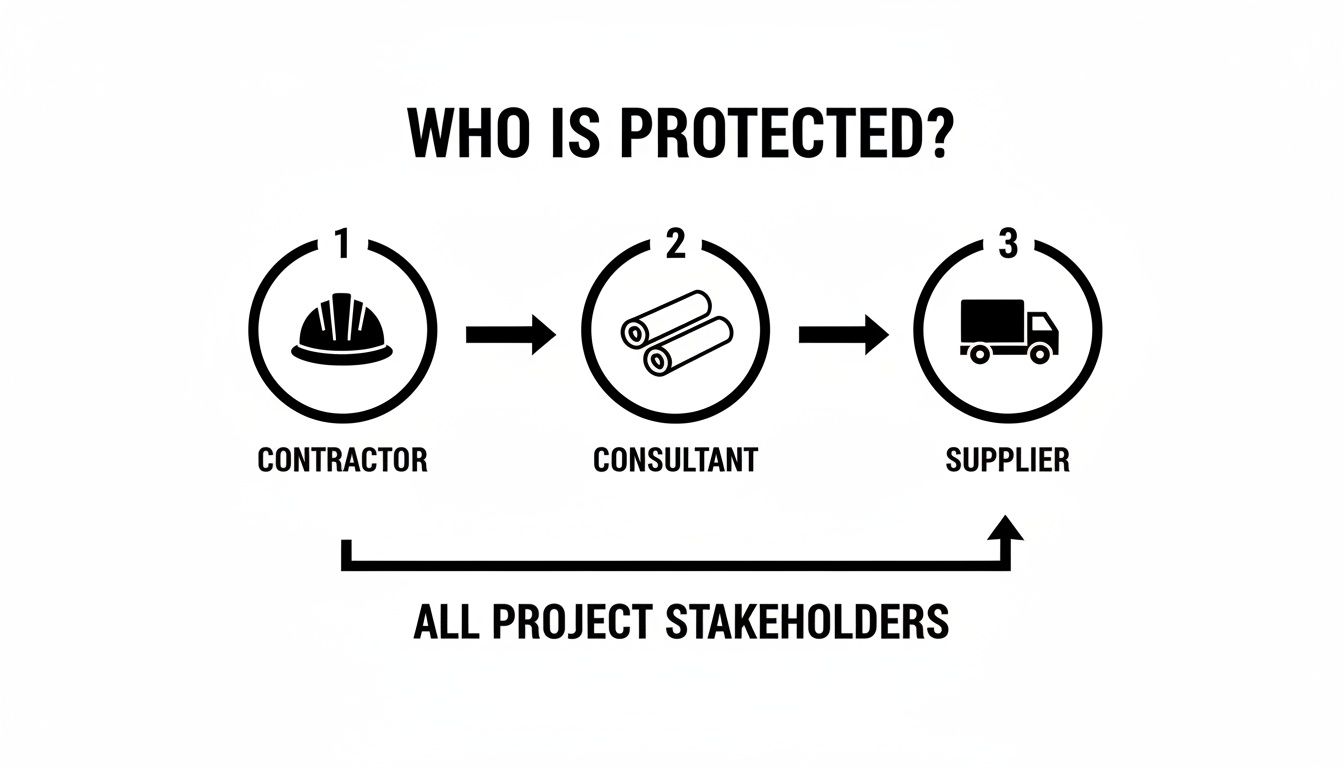
As you can see, contractors, consultants, and suppliers all have access to the Act’s protections, which is vital for keeping cash flowing across the entire project ecosystem.
The Respondent’s Obligation: The Payment Schedule
Once a valid Payment Claim lands on their desk, the ball is firmly in the recipient’s court. They have a strict, non-extendable deadline to respond with a formal document called a Payment Schedule.
This response must be provided within 10 business days of receiving the Payment Claim, or by an earlier date if one is set out in your construction contract. This deadline is absolute. Missing it, even by one day, brings on severe consequences and is one of the costliest mistakes a respondent can make.
A proper Payment Schedule must do three things:
- Identify the Payment Claim it’s responding to.
- State the amount of payment, if any, that the respondent plans to make (this is called the “scheduled amount”).
- If the scheduled amount is less than what you claimed, the schedule must detail all the reasons why.
And “disputed works” just won’t cut it. The reasons need to be specific, detailed, and comprehensive.
The table below summarises these critical, unforgiving timelines.
Critical Timelines for SOPA Claims and Responses
This table outlines the mandatory timeframes for each stage of a Security of Payment claim in NSW, highlighting the consequences of non-compliance.
| Action | Responsibility | Statutory Deadline | Consequence of Missing Deadline |
|---|---|---|---|
| Serve Payment Claim | Claimant (e.g., Contractor) | Within 12 months of work completion or as per contract | Claim may become invalid |
| Serve Payment Schedule | Respondent (e.g., Principal) | 10 business days after receiving Payment Claim (or as per contract) | Respondent becomes liable for the full claimed amount |
| Apply for Adjudication | Claimant | 10 business days after receiving Payment Schedule | Right to adjudicate is lost for that claim |
| Lodge Adjudication Response | Respondent | 5 business days after receiving Adjudication Application | Respondent is barred from presenting their case in adjudication |
Understanding and sticking to these dates is non-negotiable; missing them essentially means an automatic loss.
The fallout from failing to provide a Payment Schedule within that 10-day window is brutal. If no schedule is issued, the respondent is automatically liable to pay the entire amount claimed on the due date. They forfeit their right to raise any counter-arguments or defences in an adjudication. The claimant can then either recover the full amount as a debt in court or apply for an adjudication where the respondent is barred from even lodging a response.
This strict liability is exactly why getting expert guidance is so vital. With our 15+ years of litigation support experience, we at Awesim make sure both claims and responses are procedurally flawless, helping you avoid these kinds of costly automatic losses.
Understanding the Adjudication Process
So, what happens when you’ve done everything right—submitted a valid payment claim—but the response you get back is a disputed payment schedule? Or worse, you get no response at all?
This is where the Building and Construction Security of Payment Act NSW offers a powerful solution: adjudication. Forget the idea of a drawn-out, expensive court battle. Adjudication is a fast-tracked, affordable process designed to get a binding decision quickly, so your cash flow—and your project—doesn’t grind to a halt.
Think of an adjudicator less like a judge in a courtroom and more like an expert referee. Their sole job is to review the evidence from both sides and make a swift, interim decision based on the facts presented. The entire process is built for speed, often wrapping up in just a few weeks.
How to Start the Adjudication Process
Getting the ball rolling on adjudication means you have to be on top of your timelines. The moment you receive a payment schedule you disagree with, a clock starts ticking. You typically have only 10 business days to prepare and lodge an adjudication application with an Authorised Nominating Authority (ANA).
Your application is your formal case. It has to be in writing and must include a copy of your original payment claim and the payment schedule you received. But here’s the crucial part: it must also contain all your submissions. This means all the arguments, evidence, and documents that prove why you’re entitled to the amount you’ve claimed.
The tight timeframes of adjudication mean you have one shot to present your case comprehensively. You cannot introduce new arguments or evidence later in the process, so your initial application must be complete, well-organised, and compelling.
This is a high-pressure deadline where many claims stumble without expert preparation. The quality of what you submit is everything.
The Importance of Clear and Compelling Evidence
An adjudicator has to make a fast decision, which means they rely on clear, concise, and perfectly structured evidence. They simply don’t have time to wade through messy paperwork or try to connect the dots on a confusing claim. Your submission needs to tell a crystal-clear story, backed by solid proof.
What does good evidence look like?
- The construction contract and any relevant emails or correspondence.
- Daily site diaries, photographs, and videos that document the work performed.
- Invoices, receipts, and detailed records of all costs you’ve incurred.
- Expert reports that can independently assess the quality of work or put a clear value on variations.
Remember, NSW contractors have a 12-month statutory window from the last day they carried out work to lodge a payment claim. This timeline, coupled with the strict 10 business days respondents have to issue a payment schedule, highlights why meticulous record-keeping from day one is non-negotiable. Missing these deadlines can have serious legal consequences, as you can discover in more detail on the securityofpaymentsact.com.au website.
How Awesim Building Consultants Can Strengthen Your Application
This is exactly where an expert touch can make all the difference. With over 15 years of experience in litigation support, we at Awesim Building Consultants are specialists in translating complex construction disputes into the clear, factual language that adjudicators need to see. We build robust submissions that leave no room for doubt.
Our services are designed to give your application maximum punch:
Expert Witness Reports: We deliver independent, detailed assessments of workmanship, defects, or project delays. All our reports are presented in a clear, NCAT-compliant format that presents technical facts simply. Our experience can be a game-changer when it comes to resolving building disputes.
Scott Schedules: We are masters at creating meticulously organised Scott Schedules. This format breaks down every single disputed item, presenting your claim, the respondent’s argument, and our expert assessment in a clean, side-by-side table. Adjudicators value this format highly because it dramatically simplifies their review process.
When you bring Awesim on board, you’re not just getting a bundle of documents. You’re getting a powerful, persuasive case built on a foundation of deep industry knowledge and procedural rigour. This significantly strengthens your position and gives you the best possible chance of a successful outcome.
How to Enforce an Adjudication Decision

Winning an adjudication is a huge step, but let’s be honest—it’s not the finish line. The real goal is seeing that money land in your bank account. So, what happens when the other party gets the adjudicator’s decision and still digs their heels in, refusing to pay? This is where the Security of Payment Act shows its teeth.
An adjudicator’s decision isn’t just a polite suggestion; it’s a legally binding determination. The Act gives you a clear and direct pathway to turn that piece of paper into paid invoices, ensuring the entire process has real-world consequences and isn’t just a theoretical exercise.
Turning a Decision into a Judgment Debt
Your first and most powerful move is getting an adjudication certificate from the Authorised Nominating Authority (ANA) that managed your case. This document is your golden ticket, officially stamping the adjudicator’s decision and the exact amount you’re owed.
With this certificate in hand, you can march it straight into a relevant court (like the Local or District Court, depending on the dollar value) and register it as a judgment debt. This is a complete game-changer.
By registering the adjudication certificate, you are transforming the adjudicator’s decision into a legally enforceable court judgment. This unlocks the court’s entire arsenal of debt recovery tools for you to use.
The respondent gets no say in this. They can’t argue against the registration. The court’s role here is purely administrative—it simply rubber-stamps the certificate’s authority under the Act. Once that happens, the debt is no longer a simple contractual dispute; it’s now an official order from the court.
Powerful Debt Recovery Tools at Your Disposal
Once you have a court judgment, you’re no longer just asking to be paid. You are now in a position to compel payment. A range of powerful legal mechanisms suddenly becomes available.
These methods include:
- Garnishee Order: This is a court order sent directly to a third party holding money for the debtor—most often, their bank. The bank is legally forced to freeze the debtor’s funds and pay the money straight to you to clear the debt.
- Writ for the Levy of Property: This authorises a court sheriff to seize and sell the debtor’s assets, like company vehicles or machinery, to pay what you’re owed.
- Statutory Demand: If the debtor is a company, you can serve them with a statutory demand. If they fail to pay up within 21 days, the law presumes the company is insolvent. This gives you grounds to apply to the court to have it wound up and liquidated.
These aren’t minor inconveniences; they are serious, high-stakes actions that can bring a non-paying business to its knees. That alone is often enough to motivate them to settle the debt immediately.
Your Right to Suspend Work
The Act doesn’t just give you court-based options. It hands you another powerful lever right on the construction site: the right to suspend work. If the respondent fails to pay the adjudicated amount by the deadline, you can legally down tools and suspend all work or supply of goods and services.
To make it official, you must give the respondent two business days’ written notice of your intention to suspend.
This right is a statutory protection, meaning you can’t be penalised for breach of contract for taking this action. Better still, you are entitled to claim any costs or losses you rack up because of their failure to pay. Often, the simple threat of a complete work stoppage is all it takes to get an invoice paid and the project moving again.
Navigating these final enforcement steps needs a sharp eye for legal procedure. With over 15 years of litigation support experience, Awesim Building Consultants provides the strategic clarity you need to push through to a successful financial outcome.
Avoiding Common Mistakes on Your Claim
The Building and Construction Security of Payment Act NSW is a seriously powerful tool. Think of it like a high-performance engine; it can get you paid fast, but you have to operate it exactly by the book. The slightest slip-up, one tiny procedural mistake, can completely derail your claim. You’re left right back where you started, without your money.
Unfortunately, this is where a lot of otherwise solid claims fall apart. It’s the procedural traps—a missed deadline, a missing phrase, or weak evidence—that can make a perfectly good claim completely powerless. Knowing what these common pitfalls are is the first, most important step to building a case for payment that can’t be shaken.
The Pitfall of an Invalid Claim
One of the most common—and totally avoidable—mistakes is sending a document that you think is a payment claim, but legally, it isn’t. Just sending a standard invoice for “work done” won’t cut it. It doesn’t trigger the Act’s protections. Without the right wording, it’s just another piece of paper with no special legal weight behind it.
To be valid, your claim absolutely must include the statement: “This is a payment claim made under the Building and Construction Industry Security of Payment Act 1999 NSW.” If you forget that one sentence, you lose all access to the fast-track adjudication process for that specific claim. Simple as that.
Another classic error is getting the timing wrong. You can’t just issue a claim whenever you feel like it. You have to serve it on or after the reference date in your contract. If your contract doesn’t specify one, the Act defaults to the last day of the month. Serve it too early or too late, and your claim is invalid right out of the gate.
The Catastrophe of a Missed Deadline
The timelines in the Act aren’t suggestions. They’re concrete, absolute, and unforgiving. Miss a deadline by a single day—or even a single hour—and the consequences for your case can be catastrophic.
For claimants, that means you have just 10 business days to lodge your adjudication application after you receive a payment schedule you don’t agree with. There are no extensions. No second chances.
For respondents, the pressure cooker is even hotter. If you fail to provide a proper payment schedule within 10 business days of getting a claim, you become liable for the entire claimed amount. You lose your right to argue your side or present any counter-arguments in adjudication. It’s a procedural knockout, and there’s almost no coming back from it.
Think of the Act’s deadlines like a train schedule. The train leaves at a precise time, with or without you. If you miss it, you can’t just run and jump on; you have to wait for the next opportunity, which in a dispute could be costly or non-existent.
The Weakness of Insufficient Evidence
Even if you tick every procedural box perfectly, you can still come up short at adjudication if your evidence is weak, messy, or just plain unconvincing. An adjudicator has very little time to get across your dispute. They won’t piece together a messy puzzle for you. It’s your job to hand them a clear, logical, and well-supported argument that proves what you’re owed.
Common evidence failures we see all the time include:
- Vague Descriptions: Simply listing “variations” or “delay costs” with no detailed breakdown won’t fly.
- Lack of Proof: You have to back up every dollar you claim with contracts, emails, site diaries, photos, and invoices.
- Poor Organisation: A jumbled mess of documents makes it impossible for an adjudicator to follow your logic.
This is exactly where having an expert in your corner becomes invaluable. With over 35+ years of hands-on Building & Construction experience, we at Awesim Building Consultants are specialists in translating complex building disputes into clear, compelling evidence. We prepare the detailed, meticulous reports needed to substantiate every part of your claim, whether it’s for variations, delays, or defective work. Our deep expertise in creating NCAT-compliant Expert Witness Reports and Scott Schedules gives you the solid, factual foundation you need to build an unshakeable case and navigate the process successfully.
Common Questions About the Security of Payment Act
When you’re dealing with payment disputes, a lot of questions pop up. It’s completely normal. Based on our years of experience helping clients navigate the Building and Construction Security of Payment Act NSW, here are some of the most common queries we get, with straightforward answers to give you some clarity.
Can I Use the Act in a Dispute with My Home Builder?
This is a big one, and for most homeowners, the answer is no. The Act has a specific exemption for residential building contracts where the homeowner either lives in or plans to live in the property. The idea is to protect everyday homeowners from the Act’s incredibly fast and binding process.
But that doesn’t mean the Act is irrelevant on a residential site. Far from it. The head builder can absolutely use the Act to make a claim against the property developer. And, just as importantly, any subcontractor or supplier on that same job can use it to claim payment from the head builder they’re working for. Our experience in resolving building and construction disputes covers all sides of these complex matters.
What if I Disagree with the Adjudicator’s Decision?
It’s tough news, but the grounds for challenging an adjudicator’s decision are razor-thin. You can’t appeal just because you don’t like the outcome or you think the adjudicator misinterpreted the evidence. The whole system is designed for speed and finality, not for drawn-out legal battles.
The only real path to an appeal is if there’s been a serious jurisdictional error – meaning the adjudicator failed to follow the fundamental rules set out in the Act. If you genuinely believe a major legal mistake was made, you need to get urgent legal advice about applying for a judicial review in the Supreme Court.
Does My Payment Claim Need to Be a Tax Invoice?
Not at all. While it’s common practice to issue a tax invoice and use that as your payment claim, it isn’t a requirement under the Act. To be valid, your claim document simply needs to tick four boxes.
It must be in writing, clearly identify the construction work or related goods and services it relates to, state the amount you’re claiming, and—this is the critical part—it must include the magic words: ‘This is a payment claim made under the Building and Construction Industry Security of Payment Act 1999 NSW’.
As long as your document meets those simple criteria, it’s a valid claim that kicks the Act’s powerful timelines into gear.
Navigating the complexities of the building and construction security of payment act nsw requires precision and an expert eye. With over 35+ years of Building & Construction experience and over 15 years in litigation support for home owners, builders, and lawyers, Awesim Building Consultants provides the robust expert reports and strategic guidance you need to build a successful claim. Contact us to make sure your case is built on a solid foundation.

Related Posts

Water Damage in Homes: How to Track Down the Source
Water damage in a home rarely announces itself at the source. A stain on the ceiling, a musty smell in
Read More »
Waterproofing Membrane Types: Which Fails Most in NSW Bathrooms
Waterproofing failure is the single most common serious defect found in NSW apartments, and the type of membrane used, along
Read More »
Building Certifier NSW: Role, Limits, and When You Need More
A building certifier in NSW is a registered professional who issues construction certificates, conducts critical stage inspections, and grants occupation
Read More »