
Building Expert Witness Report: NCAT & NSW Guide
You’ve already paid for the report, the photos look neat, and the conclusion sounds confident. Then you get to NCAT and realise the member can’t follow how the expert got from the site observations to the opinions, or how the defects line up item by item. That’s the gap that catches owners, builders, and even lawyers out, a building expert witness report can be technically right and still be useless if it isn’t built for tribunal use.
The reports that survive scrutiny in NSW don’t just describe what’s wrong. They show the issues in dispute, the facts and assumptions relied on, the methodology, and the reasons for each opinion, with the property address, contract, plans, specifications, variations, correspondence, photos, and a neutral summary of the dispute tied together so the evidence can be traced back to contemporaneous records. That structure matters because the report often becomes the technical foundation for defect claims, workmanship disputes, and compliance arguments, especially where NCAT or court proceedings are on foot.
Why Most Building Expert Witness Reports Fail at NCAT
A homeowner rings after a directions hearing, frustrated because the expert’s report was meant to settle the matter. Instead, the Tribunal wants to know which photo supports which defect, which standard was applied, and whether the expert inspected the area or just repeated the client’s complaint. The report looked polished, but it was written like a submission, not an independent technical analysis.
The usual failure point is traceability
NCAT members need to see the chain from site observation to code reference to reasoned opinion. If that chain is broken, the report may sound persuasive and still fail to carry weight. Guidance for NSW disputes stresses that the report should be structured as an evidence-based document, not an advocacy piece, and should identify the facts, assumptions, methodology, and reasons behind each opinion, with defect-by-defect reasoning tied to the National Construction Code and Australian Standards where relevant (effective report guidance for NSW disputes).
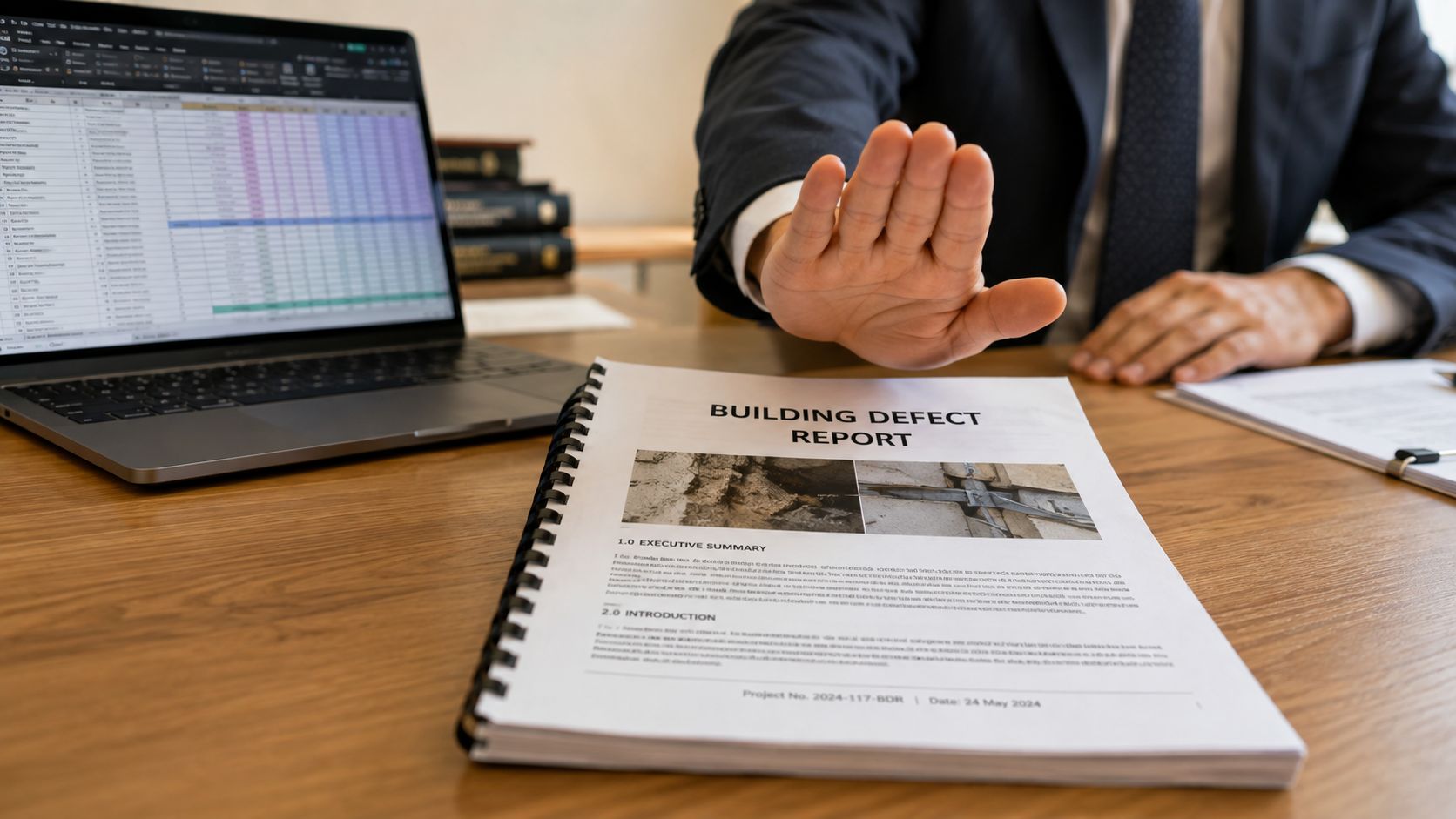
A tribunal member doesn’t need a stronger opinion. They need a clearer pathway from the evidence to the opinion.
Why advocacy language backfires
The fastest way to weaken a report is to make it sound like the expert has chosen a side. In NSW, expert evidence is expected to be independent, and the report has to separate facts from opinions, disclose assumptions and limitations, and point to the material relied on. That discipline is part of the broader Australian expert framework, where disclosure obligations and transparent methodology carry real weight in adversarial proceedings (expert reporting and disclosure practices).
A report can be technically accurate and still be tribunal-inadequate if it doesn’t speak the language of proof. That’s the practical lesson in NSW disputes, the tribunal is not asking, “What’s the most damning interpretation?” It’s asking, “What can I safely rely on?”
For a practical template, the structure used in this Australian expert witness report guide is far closer to what NCAT wants than a generic inspection note.
Required Structure and Contents of an NCAT-Compliant Report
A usable report starts with the basics and builds in a clean hierarchy. NCAT-focused guidance expects the expert’s qualifications, the exact instructions received, the inspection method, the factual findings, the technical basis for each opinion, and a signed compliance declaration where required. That’s not decorative paperwork, it’s how the tribunal checks independence, scope, and reliability.
The report has to show its own authority
The first pages should tell the reader who the expert is, what they were asked to do, and what they did. A good report states the qualifications, the scope of instructions, the documents reviewed, and any limits on access or testing. It should also distinguish between what was observed, what was measured, and what was inferred from the evidence.
That level of precision matters in NSW because the report often has to satisfy both procedural compliance and technical scrutiny. Comparable guidance on NCAT evidence says each disputed item should record the exact location, what was seen or measured, the extent of the defect, the likely cause if supportable, the standard, code, drawing, or specification relied on, and the rectification work required (NCAT expert evidence requirements).
A clean structure is easier to defend
A properly structured building expert witness report commonly includes the following components:
- Expert qualifications, so the tribunal can see the basis for expertise.
- Instructions received, so the scope is clear.
- Documents and materials reviewed, so the evidence trail is visible.
- Inspection methodology, so the opinion isn’t a black box.
- Factual findings, recorded before opinions begin.
- Analysis and opinions, linked back to the facts.
- Limitations and assumptions, stated plainly.
- Conclusions and recommendations, with rectification scope where needed.
- Appendices, including photos, marked-up plans, and supporting records.
A report that reads well in a conference room still has to read well under cross-examination.
Why the report should be built around disputed items
The strongest reports use defect-by-defect identification, because that’s how disputes are argued. Each item should carry the same internal logic, location, observation, extent, cause, benchmark, and rectification. That format reduces ambiguity and helps the tribunal follow the technical case without guessing.
A useful comparison point is the way roof inspection reports are organised in other dispute settings, including Western Washington roof inspection reports. The jurisdiction is different, but the practical lesson is the same, a report is most useful when it is organised around observable defects, not broad commentary.
Admissibility Standards and the Expert Witness Code of Conduct
In NSW, the report isn’t just judged on whether the building opinion makes sense. It’s also judged on whether the expert has met the procedural obligations that make the evidence usable. For Land and Environment Court matters, the governing framework under the Uniform Civil Procedure Rules 2005 requires the expert to be independent, to acknowledge the paramount duty to assist the court impartially, and to do that in writing (expert witness code conduct context).
Independence is a working requirement, not a slogan
The Expert Witness Code of Conduct under Schedule 7 of the UCPR requires the expert to stay independent and to assist the decision-maker, not the person paying the fee. In practical terms, that means the report must identify the facts and data considered, the documents relied on, the examinations or tests performed, and the reasons for each opinion. Comparable procedural guidance also notes that prior cases and compensation arrangements may need to be disclosed, which is part of the evidentiary discipline expected in adversarial forums (expert report best practices).
The tribunal looks for discipline, not theatre
NCAT materials and tribunal practice expect expert evidence to be objective and independent, with a signed compliance declaration and a clear separation between fact and opinion. That is why a report that feels “forceful” can still be weak. If the reader can’t tell what was inspected, what was assumed, and what was tested, the opinion becomes vulnerable.
Practical rule: if an opinion can’t be traced back to a photograph, a measurement, a note, or a document, it’s not ready for NCAT.
The report has to survive the next step
Cross-examination, expert conferencing, and procedural scrutiny all reward transparency. The modern building expert witness report has moved beyond a defect list. It needs transparent methodology, document auditing, and reasoned opinions that can be defended when the other side starts asking pointed questions.
If you want to compare format and disclosure points against a NSW-focused checklist, this NCAT code of conduct reference is a useful benchmark. The point isn’t to make the report longer. It’s to make each line defensible.
Evidence Collection and Photography Standards for Building Defects
A clean report starts on site, long before the writing starts. If the inspection notes are vague, the photos are unlabelled, or the measurements aren’t tied to a location, the report has no solid base. That’s why the best NSW building reports are built from a disciplined site process, not a quick walk-through with a camera.
The tribunal also cares about what wasn’t inspected. If access was restricted, if destructive testing wasn’t done, or if moisture readings were limited to certain areas, that needs to be said. A report that hides those limits looks stronger than it is.
Photograph like you expect the image to be challenged
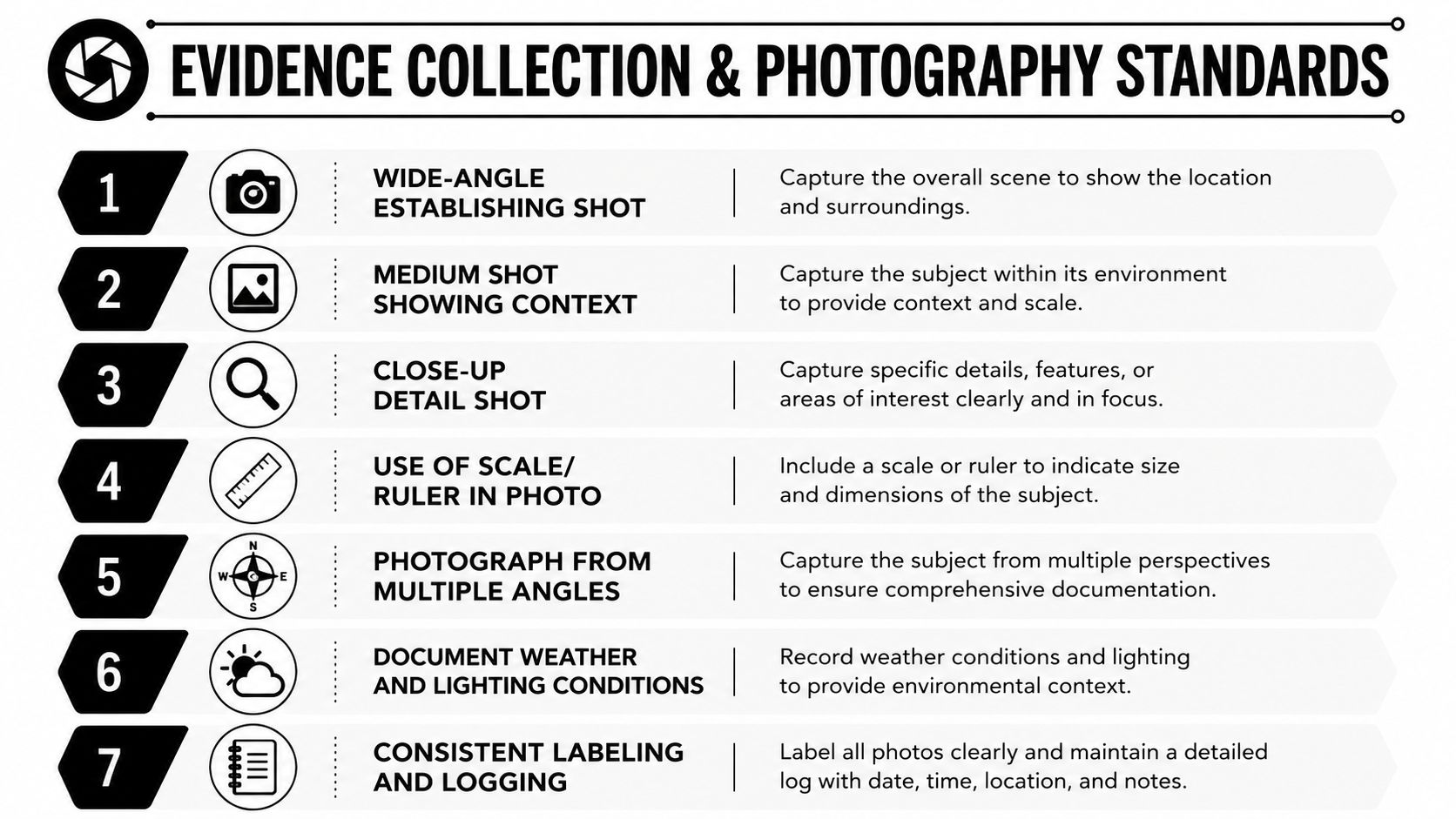
Use a sequence that shows the defect in context, then in detail. Wide shots establish location, mid-range shots show the relationship to nearby elements, and close-ups capture the defect itself. Add a scale or ruler where measurement matters, and repeat the shot from multiple angles if the defect is affected by light, reflection, or shadow.
Site notes should read like field evidence
A strong inspection record includes the address, area, date, weather, access conditions, measurements, test results, and the specific component inspected. It also records whether the defect was visible, whether it was measured, and whether the condition could have changed after the inspection. Those details matter because they let the tribunal see the factual foundation rather than a cleaned-up summary.
For homeowners trying to document issues before an expert is engaged, this NSW defects checklist is a practical companion to a formal inspection.
Weather history can strengthen causation
Water ingress, roof leaks, and storm damage claims often turn on timing. Correlating site observations with Bureau of Meteorology event data can help show whether the defect lines up with recent rainfall or a broader weather event rather than simple maintenance neglect. That kind of correlation is especially relevant in NSW, where severe weather is a major driver of building damage disputes, and the Insurance Council of Australia reported that ex-Tropical Cyclone Alfred generated over 95,000 claims across Queensland and northern New South Wales (insurance claims from ex-Tropical Cyclone Alfred).
If the report can’t explain the weather context, it may struggle to explain the cause.
A short video can help set expectations
The inspection process also benefits from a practical visual reference, especially when parties are trying to understand how evidence is assembled for dispute work.
For a deeper look at how evidence is gathered and explained in building disputes, call Eagle Restoration for help is a useful example of how inspection context can support a technical narrative, even though the jurisdiction differs from NSW.
Writing Effective Report Language and Avoiding Advocacy
The wording in a report matters because NCAT members read for credibility, not performance. A report that sounds angry, one-sided, or overconfident can lose weight even when the underlying defect is real. The best language is measured, specific, and tied to evidence.
Weak language versus stronger language
| Weak or Advocacy Language | Strong Evidence-Linked Language | Why It Matters | |
|---|---|---|---|
| “The builder clearly botched the work.” | “The installation does not appear to comply with the observed detail, because the flashing stops short of the interface shown in the photo and the adjacent finish shows evidence of moisture entry.” | The second version states the observation, then links it to a technical conclusion. | |
| “This defect is a serious breach.” | “The defect is inconsistent with the specification and the observed finish, and it should be rectified in accordance with the relevant drawing and standard.” | NCAT needs the benchmark, not a value judgment. | |
| “The owner’s complaint is obviously correct.”“The complaint is supported by the visible cracking pattern, the measured levels, and the photographed separation at the junction.”The tribunal can test evidence, not slogans. | |||
| “The work is unacceptable.” | “The work falls short of the stated standard because the measured condition does not match the accepted tolerance or the contract document relied on.” | This keeps the report on technical ground. |
Facts first, opinion second
The clearest reports keep observation and opinion separate. A paragraph can describe what was seen, measured, or tested, then the next paragraph can explain what that means technically. That structure helps the tribunal follow the logic without having to unpack the writer’s assumptions.
A similar discipline is used in expert witness work more broadly, where experts are expected to disclose the data considered, the methods used, and the reasons for each conclusion rather than blending everything into a single argumentative narrative (NCAT-style expert reporting discipline).
Keep the benchmark visible
A defect isn’t just a defect because someone says so. It becomes a tribunal issue when it can be linked to a contract document, the NCC, an Australian Standard, or a cited industry requirement. If the report says “non-compliant” but doesn’t say with what, the opinion is too thin.
A good rule is simple. Every opinion should answer three questions in plain language, what was seen, what standard or document applies, and why the conclusion follows. That keeps the report useful for NCAT members and for solicitors who need to draft around it.
Costs Timelines and Tips for Instructing an Expert
The money and timing side of a dispute can be as important as the defect itself. A report that arrives too late, or a brief that’s too vague, usually costs more in the end because the expert has to chase missing documents or redo the analysis. A strong instruction package saves time and makes the final report tighter.
What drives the scope
Pricing depends on the size of the property, the number of disputed defects, the complexity of the building work, and whether a Scott Schedule is needed alongside the main report. An initial inspection for an NCAT construction dispute has been listed at $800 to $2,000 for the initial inspection stage depending on project scale (initial inspection pricing). Beyond that, the final fee usually tracks the amount of evidence to review and the depth of analysis required.
Timelines move with the quality of the brief
If the expert gets the contract, plans, specifications, variations, correspondence, photos, and orders up front, the job usually moves faster. If the brief comes in piecemeal, the report slows down because the expert has to keep checking whether a defect is within scope. Urgent matters and Tribunal deadlines can compress that process further, which is why early instruction often pays off.
A good brief is specific
A useful instruction should include:
- The dispute type, such as defects, incomplete works, variations, water ingress, or compliance issues.
- The documents available, including contract, drawings, specifications, photos, and correspondence.
- The question to be answered, such as causation, rectification, or compliance.
- Any access issues, such as occupied premises or limited site entry.
- The intended use, whether for settlement, filing, or hearing preparation.
Clear instructions lead to tighter opinions. Vague instructions usually produce vague reports.
Early engagement helps strategy
An expert engaged early can help narrow the live issues before the dispute hardens. That matters because a report may be used for mediation, not just hearing preparation, and a concise technical position often helps both sides understand what’s genuinely in dispute. Where a Scott Schedule is likely, early scoping also avoids inconsistency between the report and the itemised claim.
How Awesim Building Consultants Supports Your Dispute
Awesim Building Consultants works with 35+ years in Building & Construction, with over 15+ years providing litigation support to home owners, builders, and lawyers. That mix matters in NSW disputes because a report has to be grounded in site reality and still read clearly in NCAT.
The practical service list is straightforward. Awesim provides site investigations, Building & Construction Expert Witness Reports, and Scott Schedules, including dispute-focused documentation for NCAT and court use. The work is framed around the issues that matter in building disputes, defect location, technical cause, rectification scope, and a structure that members can follow without wading through advocacy.
That approach is useful when the case needs to be managed before it becomes a hearing problem. A report that is organised around defects, standards, and rectification can support settlement discussions, joint expert meetings, and Scott Schedule exchange without forcing everyone to reinvent the evidence trail. In practice, that saves time and reduces the risk of a technically sound report being rejected because the presentation was poor.
Awesim also sits in the space where NSW property disputes need both the building detail and the procedural discipline. That’s the difference between a report that describes damage and one that’s built to be used.
If you’re dealing with a defect dispute, a workmanship argument, or a compliance issue in NSW, Awesim Building Consultants can assess the site, prepare a tribunal-ready report, and help organise the evidence into a format NCAT can use. Visit Awesim Building Consultants to discuss your dispute, or call 1800 293 746 or email admin@awesim.com.au to arrange the next step.
Related Posts
Waterproof Membrane Failure: How Inspectors Find the Cause
Waterproof membrane failure is diagnosed by tracing the water entry point, reviewing design documents, exposing the membrane for visual inspection,
Read More »
Cornice Cracking: How to Tell If the Damage Is Serious
Cornice cracking is one of the most common concerns Australian homeowners raise, and the hard part is not spotting the
Read More »
Digital Construction Consultant Australia: What They Do
A digital construction consultant in Australia manages the technology-driven side of building projects: BIM coordination, clash detection, asset data handover,
Read More »