When a building dispute hits a stalemate in Sydney, what you need is a clear, impartial, and evidence-based path forward. This is precisely the role of a building expert witness report. It’s a formal, detailed analysis of construction issues, specifically prepared to help a court or tribunal understand the technical facts of your case. Think of it as the most important tool in your toolkit for resolving disputes in NSW.
Your Guide to Building Expert Witness Reports in Sydney
Consider an expert witness report a technical translator for legal proceedings. When you’re facing disagreements over defects, non-compliance, or potential contract breaches, this report cuts through the noise. It presents complex construction details in a structured, unbiased format that a body like the NSW Civil and Administrative Tribunal (NCAT) can rely on to make informed decisions.
At Awesim Building Consultants, we bring a deep well of practical knowledge to every report we produce. Our foundation is built on over 35 years of hands-on experience in Building & Construction, backed by more than 15 years providing litigation support to homeowners, builders, and lawyers throughout Sydney and regional NSW. This unique blend of experience ensures our reports are grounded in real-world construction realities, not just theory.
The Core Purpose of an Expert Report
A compliant building expert witness report serves several critical functions in a dispute. It's crucial to understand that its purpose is to provide an objective analysis, not simply to "win" a case for one side. An expert's primary duty is to the tribunal, obligating them to present factual and impartial information.
The table below summarises the key roles that a building expert witness report plays in a formal dispute context.
Key Functions of a Building Expert Witness Report
| Function | Description for Homeowners, Builders & Lawyers |
|---|---|
| Identifies Defects | Pinpoints and documents specific building defects, ranging from minor workmanship flaws to major structural failures. |
| Establishes Cause | Analyses evidence to determine the root cause of the defect, such as incorrect installation, faulty materials, or design errors. |
| References Standards | Connects each identified defect to the relevant Australian Standards, the National Construction Code (NCC), and manufacturer specifications. |
| Proposes Rectification | Outlines sound and appropriate methods for repairing the defects, providing a clear scope of work for rectification. |
This process ensures that all parties—homeowners, builders, and their legal teams—can move forward with a shared understanding of the technical issues.
Ultimately, the report transforms a "he said, she said" argument into an evidence-based discussion. It creates the clarity needed for a fair and efficient resolution.
As legal processes become more complex, tools like AI legal software are emerging to assist with various documentation tasks. The findings in our expert reports are often further organised into a Scott Schedule, a document that methodically lists each disputed item for the tribunal. We are equipped to guide you through this entire process; you can see how we manage this from start to finish on our Scott Schedule preparation services page.
Navigating the Legal Rules for NCAT Reports
When a building dispute in Sydney lands in a formal hearing, the rules of the game change completely. A simple builder’s quote or an informal assessment just won’t cut it as evidence. This is where you need to understand the very specific legal framework that governs expert reports, especially within the NSW Civil and Administrative Tribunal (NCAT).
An expert witness report is much more than just a professional opinion; it's a formal piece of evidence written specifically to help the Tribunal. It’s best to think of the expert not as a hired gun for your team, but as a neutral, technical translator for the court. Their job is to take complex building issues—like why a retaining wall is failing or what defines a waterproofing defect—and break them down into clear, impartial facts the Tribunal can understand and rely on.
This role is tightly controlled by legal standards. The most important one is NCAT's Procedural Direction 3. This direction, with its latest update effective from 7 April 2025, outlines the mandatory rules for any building expert witness report Sydney lawyers or homeowners submit for Home Building Act cases where the dispute is over $30,000. With over 15 years providing litigation support, our entire process is built around mastering these exact requirements.
The Expert’s Duty to the Tribunal
The single most critical principle for an expert report is the expert’s paramount duty. This isn’t just a nice idea; it’s a strict legal command.
An expert witness has an overriding duty to assist the Tribunal impartially on matters relevant to the expert’s area of expertise. This primary duty to the Tribunal overrides any obligation to the person from whom the expert has received instructions or by whom the expert is paid.
What this really means is that our first responsibility is to the truth and to the Tribunal—not to the client who is paying the bill. This commitment to impartiality is precisely what gives a properly written expert report its power and credibility. If an expert acts like a biased advocate or a "cheerleader" for their client, they risk having their entire report thrown out, which can be disastrous for a case.
Getting your head around this concept is vital. It’s why you must choose an expert with proven litigation experience; they know their role is to be an objective, independent source of truth for the court.
The Expert Witness Code of Conduct
To make sure this impartiality is upheld, NCAT demands that all experts follow the Expert Witness Code of Conduct. This is laid out in Schedule 7 of the Uniform Civil Procedure Rules, and following it is not optional.
The report must include a clear statement confirming the expert has read the code and agrees to be bound by it. This is a formal declaration that holds the expert accountable to their legal duties. We have a deep well of experience ensuring every single report is fully compliant, and you can get into the details by reading our guide on the Expert Witness Code of Conduct Schedule 7.
Some of the key rules from the code include:
- Stating all assumptions: The expert has to clearly identify any facts or assumptions they used to form their opinions.
- Listing qualifications: The report must detail the expert’s qualifications and experience to prove they are the right person to be commenting on the matter.
- Acknowledging all materials: The expert must list every document and piece of material they were given and used to prepare the report.
- Providing clear reasons: Every opinion must be supported by a logical, transparent thought process that connects the evidence directly to the conclusion.
For those navigating a legal dispute, having a wider perspective on the professional world in which these reports exist can be helpful. Resources like this Law Firms and Attorneys industry overview can shed light on the operational context. At the end of the day, a report that doesn't meet these tough legal and procedural standards isn't just a waste of money—it can actively harm your case.
The Anatomy of a Compliant Expert Witness Report
So, what actually goes into a court-ready building expert witness report? It’s a world away from a simple inspection summary. Think of it as a highly structured, evidence-based document specifically designed to be picked apart by lawyers and the Tribunal. Knowing what’s inside helps take the mystery out of the process and sets clear expectations for what you get.
I often compare it to a detailed report from a medical specialist. It doesn't just say, "there's a problem." It lays out the patient's history (your instructions), the diagnostic methods used (our methodology), the precise diagnosis (the defect), the underlying cause, and the supporting evidence (like test results). Finally, it provides a clear treatment plan (the rectification scope) and its cost. Each section logically flows into the next, building a robust and defensible conclusion.
The Foundational Components
Any report that’s going to hold up in NCAT must start with a solid foundation. Before getting into the nitty-gritty of the defects, it has to clearly establish the who, why, and what of the investigation.
These opening sections aren't just a formality; they're required by the Expert Witness Code of Conduct to ensure complete transparency. They always include:
- The Expert's Qualifications: This is where we establish our credibility. The section details our relevant licences, qualifications, and, most importantly, our 35+ years in Building & Construction and 15+ years in litigation support. It proves we have the specialised experience to give an expert opinion.
- The Letter of Instruction: This is the formal brief we receive from you or your solicitor. It sets out the specific questions the report needs to answer, which precisely defines the scope of our investigation.
- Executive Summary: This is a concise, high-level overview of our key findings and opinions. It’s written to allow a Tribunal member or lawyer to quickly grasp the report's main conclusions before diving into the full analysis.
The Core of the Analysis: Defect by Defect
This is the real heart of the building expert witness report Sydney legal teams depend on. It’s a painstaking, item-by-item investigation of every single alleged defect. It's never enough to just say, "the wall is cracked." A compliant report has to connect all the dots with solid evidence and clear reasoning.
For every defect we assess, the analysis follows a strict, repeatable structure:
- Observation: We provide a detailed description of the defect, backed up by high-resolution, annotated photos and precise measurements.
- Referenced Standards: The report must pinpoint the exact clause from the National Construction Code (NCC), a relevant Australian Standard (like AS 3740 for waterproofing), or a manufacturer's installation guide that has been breached.
- Opinion on Cause: We give our professional opinion on why the defect happened. Was it the result of poor workmanship, a design flaw, or faulty materials?
- Proposed Rectification: A clear, practical scope of works is laid out, detailing exactly what needs to be done to fix the defect properly and bring it up to code.
Example in Practice: An expert finds a 3mm wide, jagged crack running diagonally from a window corner. The report would include photos and measurements of the crack, then cite the Guide to Standards and Tolerances to show it exceeds acceptable limits. The opinion might conclude the cause is an undersized lintel, leading to a proposed rectification that involves installing a new, correctly sized lintel to provide proper structural support.
Costings and Formal Declarations
Once the defects are identified and the solutions are outlined, the report needs to put a number on the financial impact. The costs involved in these disputes can be substantial, which is why this section is so critical within Australia's $150 billion construction industry. For a typical residential building dispute in Sydney, a comprehensive expert report can cost between $1,500 and $4,000+, depending on the number and complexity of the issues.
The report will provide detailed cost estimates for all the proposed rectification works. These aren't just back-of-the-envelope guesses. They're calculated using current labour rates, material costs, and industry data to give the Tribunal a realistic financial assessment of the damages. To get a better feel for how these sections are put together, you might find it useful to check out our overview of an expert witness report template for Australia.
The report is then finalised with the mandatory expert declaration. This is a signed statement where the expert formally confirms they have read, understood, and agree to be bound by the Expert Witness Code of Conduct. By signing, we affirm that our primary duty is to the Tribunal, not the party who engaged us. This signature is the final seal of compliance, making the document ready for any legal proceeding.
How to Commission Your Expert Witness Report
Getting a building expert witness report in Sydney started might feel like a huge task, but it’s actually a very logical, step-by-step process. When you understand the main stages, it takes the mystery out of it and gives you the confidence to engage an expert, whether you're a homeowner, builder, or lawyer. The whole point is to move from a frustrating dispute to a place of clarity, armed with a document built on solid evidence.
Think of it like seeing a specialist doctor. You wouldn't just show up and demand a diagnosis. You'd start with a consultation to talk through your symptoms and history, which allows the specialist to figure out the best way to examine you. The process for an expert witness report is much the same—it follows a methodical path to make sure the final document is thorough, accurate, and ready for legal scrutiny.
The Initial Consultation and Scope Definition
The journey always begins with an initial consultation. This first meeting is where you or your lawyer will sit down with the building consultant to go over the details of the dispute. This is more than just a casual chat; for the expert, it’s a fact-finding mission. We use this time to get a handle on the project's history, the specifics of the alleged defects, and what you’re ultimately trying to achieve.
During this stage, our job is to listen carefully and ask the right questions to nail down the exact scope of the report. Are we dealing with a single leaking balcony, or is it a list of a dozen different problems in a new home? Getting this clarity from the start ensures the final report is laser-focused on the issues at the heart of the dispute.
Crafting the Letter of Instruction
Once we’ve all agreed on the scope, the next step is to make it official with a Letter of Instruction. This is a formal document, typically put together by your solicitor, that clearly lists the specific questions you need the expert to answer. It essentially becomes the brief for our entire investigation and is a required part of any compliant report.
A well-written Letter of Instruction is absolutely critical. It steers the expert’s investigation and ensures their work directly addresses the legal questions NCAT needs answers to. With over 15 years of experience providing litigation support, we help our clients frame the right questions to get the most powerful and relevant opinions.
This diagram breaks down the commissioning process, showing how it flows from that first phone call all the way to the site inspection.
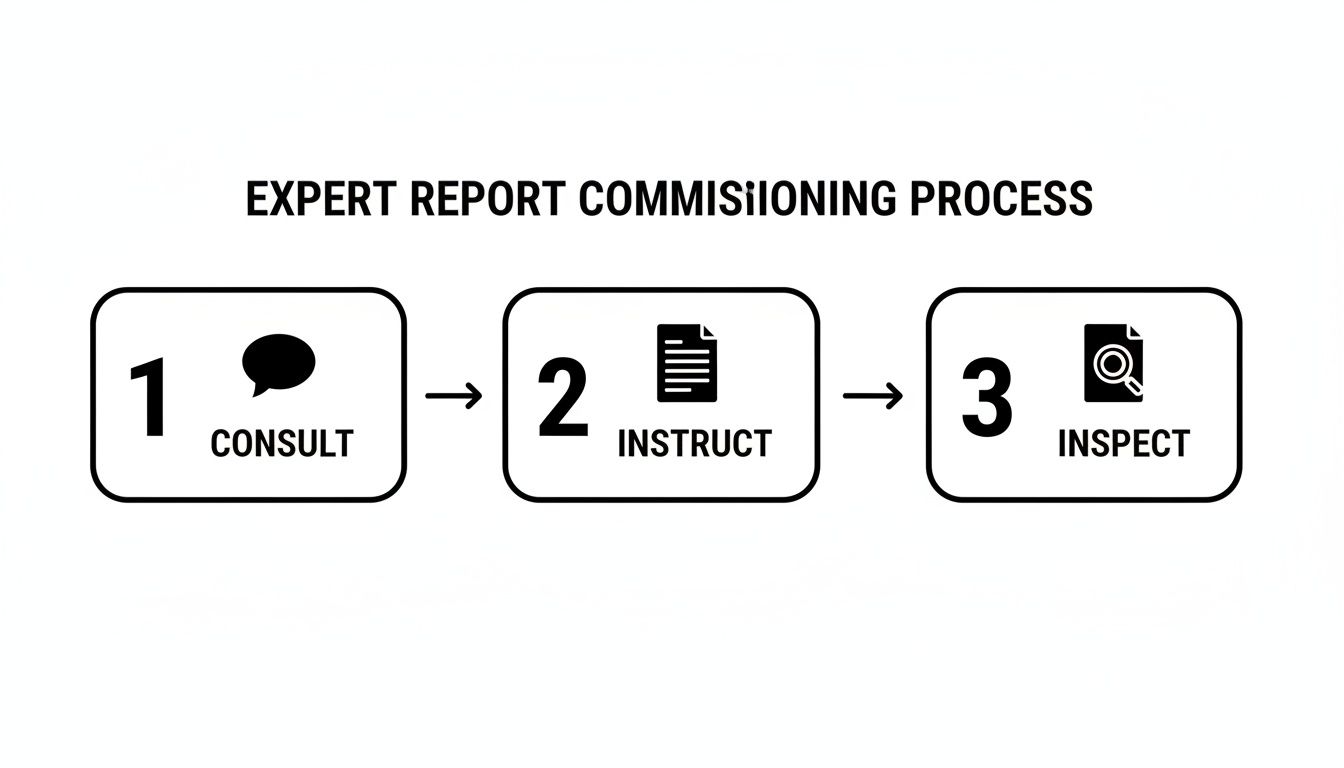
As you can see, the process moves logically from defining the problem to gathering the evidence needed to form an expert opinion.
The On-Site Inspection and Analysis
This is where the real hands-on work begins. The on-site inspection is a meticulous, physical examination of the property. The expert will go through each alleged defect one by one, taking detailed measurements, capturing high-resolution photos, and collecting all the physical evidence required.
It’s vital that you provide the expert with all relevant documents before this visit. This usually includes:
- The building contract and any approved variations
- Architectural plans and engineering drawings
- All key communications like emails and site diary entries
- Any previous inspection reports or quotes for rectification
Having all the paperwork upfront allows the expert to connect what they see on-site with the project's original plans and specifications. This comprehensive approach is what elevates a simple opinion into impartial, credible evidence.
After the inspection, the drafting begins. The expert will analyse all the evidence gathered, cross-referencing it against the National Construction Code, relevant Australian Standards, and the documents you provided. This is how we form our professional opinions on the cause of defects, compliance, and the best way to fix them. It's often the most time-consuming part of creating a building expert witness report Sydney tribunals will rely on. The findings are often organised into specific legal formats; you can learn more by checking out our detailed Scott Schedule preparation services. Once this is complete, the final report is compiled and delivered, ready for you to submit.
Choosing the Right Building Expert in Sydney

When you're facing a building dispute, picking the right expert is probably the most important move you'll make. This isn't just about hiring a seasoned builder; the "expert" in an expert witness report has a very specific legal meaning. The person you choose can literally make or break your case at NCAT.
You need someone with a very particular blend of skills, not just a general understanding of construction. Think of it like this: if you need complex heart surgery, you don't go to your local GP. You find a specialist surgeon. The same logic applies here.
Beyond Building Experience
Deep, hands-on building experience is the non-negotiable starting point. But for an expert witness, it's just that—a start.
An effective expert must have a completely different set of skills layered on top. At Awesim, our 35+ years of practical Building & Construction experience are backed by over 15 years focused entirely on providing litigation support to homeowners, builders, and lawyers. That second part is the crucial difference.
This background in litigation means we know the rules of evidence inside and out. We understand the unique pressures of the legal process and, most importantly, how to translate complex building issues into clear, concise language the Tribunal can rely on.
The Essential Vetting Checklist
When you're looking for someone to prepare your building expert witness report in Sydney, you need to be methodical. Use this checklist to vet any potential candidates and make sure they meet the strict standards required by the court.
- Deep Construction Knowledge: Do they have decades of proven, hands-on experience in the specific type of construction your dispute involves?
- Proven Litigation Expertise: Can they point to years of specific experience preparing expert reports and supporting legal cases?
- NCAT Procedural Fluency: Do they have a rock-solid, working knowledge of NCAT's Procedural Direction 3 and the Expert Witness Code of Conduct?
- Relevant Qualifications and Insurance: Are they a fully licensed builder? Do they hold current professional indemnity insurance that specifically covers expert witness work?
- Clear Communication Skills: Can they explain a complicated structural defect in simple terms, both on paper and in person?
A genuine expert must tick every one of these boxes. For both homeowners and lawyers, a great place to begin your search is with a professional who operates as a dedicated Sydney building consultant focused on dispute resolution.
Red Flags to Watch For
Knowing what to avoid is just as critical as knowing what to look for. Certain comments or behaviours are immediate red flags that should tell you to walk away, as they can seriously damage your case.
An expert who guarantees you a "win" or promises to be your "hired gun" has fundamentally misunderstood their role. Their first and only duty is to be an impartial assistant to the Tribunal, not an advocate for your side.
This is a point that cannot be overstated. An expert who is perceived as biased risks having their entire report thrown out by the Tribunal. If that happens, you’ve lost your cornerstone piece of evidence, not to mention a significant amount of time and money.
Choosing your expert carefully isn't just a box to tick; it's an investment in the strength and integrity of your entire case.
Your Questions About Expert Witness Reports Answered
If you’re heading into a building dispute, you’re bound to have questions about the process, the costs, and what the law requires. We get calls every day from homeowners, builders, and lawyers trying to navigate the system, so we’ve put together answers to the most common queries we hear.
With over 15 years of experience focused on litigation support, we’ve seen it all and know how important clear, straightforward information is.
How Much Does a Building Expert Witness Report Cost in Sydney?
The cost really comes down to the complexity of the dispute. For a more straightforward case with a single, clear-cut defect, you might be looking at a cost of around $1,500 to $2,500.
However, for bigger, more involved cases with multiple defects, structural problems, or a detailed Scott Schedule, the cost can quickly climb to between $4,000 and $10,000 or even more. We always provide a detailed fee proposal after our initial chat, so you know exactly what to expect. No hidden surprises.
Can I Just Use My Builder’s Report for NCAT?
In short, no. A regular building inspection or a builder’s quote won't hold up as evidence in the NSW Civil and Administrative Tribunal (NCAT). For a report to be admissible, it must strictly follow the Expert Witness Code of Conduct, as set out in NCAT Procedural Direction 3.
The most important rule is that an expert’s primary duty is to the Tribunal, not to the person who hired them. This ensures the expert remains impartial, a standard we are absolutely committed to in all our litigation work.
How Long Does It Take to Get an Expert Witness Report?
This depends on how complex your case is and our current workload. Typically, we can schedule a site inspection within one to two weeks of being engaged.
Once the inspection is done, drafting a standard report usually takes about 10 to 15 business days. If the case involves stacks of documents or requires specialist testing, it will naturally take longer. It’s always best to get an expert involved as early as you can to make sure you don’t miss any deadlines set by the Tribunal.
What Is the Difference Between an Expert Report and a Scott Schedule?
Think of them as two parts of the same puzzle. The expert witness report is the detailed narrative. It identifies the building defects, explains what caused them, points to the relevant building codes, and lays out the costs for rectification.
A Scott Schedule, on the other hand, is a specific document used by the court that organises all those findings into a simple table. It lists every single disputed item, with columns for what the claimant is arguing, what the respondent says in reply, and finally, the expert’s independent opinion on each point. At Awesim, we prepare both documents regularly for NCAT proceedings. You can learn more about how they fit together on our Scott Schedule preparation services page.
With over 35 years of hands-on Building & Construction experience and more than 15 years providing litigation support, Awesim Building Consultants provides the independent, evidence-based expertise you need to navigate building disputes in Sydney and regional NSW. If you require a compliant expert report for NCAT or legal proceedings, contact us today to discuss your case. Visit us at https://www.awesim.com.au.