
Construction Claims Expert: A Guide for NSW
You’ve got defective work on one side, a builder saying the owner changed the scope on the other, and everyone’s already talking past each other. That’s usually the point where a construction claims expert becomes useful, because the dispute is no longer about opinions over the fence line, it’s about what can be proved from the records, the site, and the contract documents.
In NSW, that distinction matters. NCAT building disputes are built around structured evidence, not casual commentary, and the expert who turns up with a tidy folder, dated photos, and a coherent defect analysis usually has a very different reception from the one who arrives with broad assertions and no chain of proof. Independent, technically grounded documentation is what gives a claim any chance of surviving tribunal scrutiny, especially where the issues are defects, incomplete works, variations, delay, or quantum meruit.

What a Construction Claims Expert Actually Does in NSW
A homeowner rings after months of delay and a shower that still leaks. A builder calls from the other side of the same job, annoyed that the defect list reads more like a negotiation tactic than a genuine technical assessment. That is where a construction claims expert earns their keep, not by taking sides, but by turning a messy dispute into a document set that can stand up in NSW process.
The role is narrower than most people think
A building inspector can tell you what he or she sees on site. A claims expert has to go further and connect that observation to cause, compliance, scope, and loss. In NSW, that often means working with defect evidence for NCAT, where residential building disputes sit within the tribunal’s established jurisdiction and expert material has to match procedure rather than read like a marketing brochure, as discussed in Awesim’s overview of building consultant roles in inspections and defects.
That difference shows up quickly when the argument turns to whether work is merely untidy or non-compliant. It also shows up when a party raises incomplete works, a variation that was never priced properly, or a quantum meruit claim where formal paperwork is thin. In those files, the expert is not there to “win” the argument, they’re there to test whether the claim has a proper technical foundation.
Practical rule: if the report can’t be traced back to site evidence, contract documents, and a clear defect or delay mechanism, it won’t travel well in NCAT.
What the work usually involves on a live dispute
The day-to-day job is hands-on. It starts with a site inspection, then moves into a review of the contract, photos, emails, approvals, variation papers, and programme material. From there, the expert tests whether the alleged defect is real, whether the workmanship departs from the expected standard, and whether the claimed delay or cost outcome follows from the facts rather than from frustration.
On NSW residential matters, that often means looking at Australian Standards, the National Construction Code, and the practical reality of how the work was built. The result should be a report that can assist a tribunal member or lawyer without needing translation, and that can be attached to a Scott Schedule if the dispute has multiple items.
For parties who want a deeper technical lens on the consultant’s role, the construction-lien resource at Olson & Sons lien help is useful background on how disputes become claim files in other jurisdictions, even though NSW procedure is different.
Why independence matters more than confidence
NCAT and court processes reward objectivity, not theatre. A claims expert who sounds like an advocate usually damages the file, because expert evidence guidance expects the witness to remain impartial and avoid selecting between competing versions of events. The useful expert is the one who says what the records support, what they don’t support, and what still needs to be checked.
That’s why site photographs, contemporaneous notes, and a logical sequence matter so much. They let the expert separate workmanship issues from contract disputes and turn a heated argument into a technical assessment a tribunal can use.

How to Choose the Right Expert for Your Dispute
Choosing the wrong expert usually costs more than the report fee. A weak opinion can force a second inspection, a rewrite of the report, or a cross-examination that exposes gaps the client should have fixed before the matter reached NCAT. The right expert is not the loudest voice, it is the one who stays within the evidence and still explains the technical issues clearly.
A building dispute in NSW often turns on whether the expert understands the work as it was carried out, not just how it should have been done on paper. That means looking for someone who can read the site, the contract documents, and the record trail without drifting into advocacy.
Start with experience that matches the dispute
The first question is simple. Has the expert handled disputes like yours, on houses, townhouses, renovations, or strata work in NSW? Hands-on building experience matters because a person who understands how work is sequenced on site is better placed to spot whether a defect is isolated, systemic, or caused by an earlier trade.
You also want someone who understands the Home Building Act 1989, NCAT procedure, and the Expert Witness Code of Conduct. That combination matters because the report is not just a technical note, it becomes part of a tribunal file that may be tested under pressure.
If the expert cannot explain how they approach inspections, how they separate facts from opinion, and how they handle disagreement between parties, keep looking. The good ones can tell you exactly how they test the records before they reach conclusions.
Ask the questions that expose weak consultants
A proper screening conversation should sound practical, not promotional. Ask whether they have given evidence in NCAT, whether they prepare both Expert Witness Reports and Scott Schedules, and whether they are comfortable dealing with defect claims, delay claims, or variation disputes. A specialist who can do all three usually has a more usable workflow than a generalist who only does surface-level inspections.
Ask who writes the report, who attends the inspection, and who will stand behind the opinions if the matter is challenged. In NSW disputes, that detail matters more than marketing. A consultant who prepares reports but cannot defend them under questioning is a poor fit for a contested claim.
It also helps to ask how they manage objectivity. The expert should not sound like a client’s mouthpiece, and they should be willing to say when the file is incomplete or when the evidence does not support a strong position. That honesty is what makes the eventual report harder to attack.
Good sign: the expert talks first about records, scope, and proof, not about “helping” you beat the other side.
If you want a practical benchmark for the role itself, it helps to become an expert witness UK and compare that standard with the discipline NCAT expects in NSW.
Geographic reach and turnaround still matter
NSW disputes are not all in Sydney. Work can sit in regional centres, coastal towns, and rural areas where access, travel time, and the condition of the site all affect the inspection. An expert who can cover Sydney, the New England region, and rural NSW saves time, but only if they still produce tribunal-ready work.
Turnaround matters too, but speed without discipline helps nobody. If the report is rushed, the Scott Schedule is poorly matched to the defects, or the inspection notes are thin, the other side will exploit that weakness. A careful consultant will tell you what can be confirmed now, what needs more records, and where the file is still exposed.
A credible expert can turn a site inspection into a report that reads cleanly, and if the dispute is heading to NCAT, they can structure the same material so it fits the forum. For a useful reference on what makes that appointment process more reliable, see Awesim’s guide to choosing an expert witness for an NCAT building dispute.
Evidence and Documentation Your Expert Will Need
A strong expert doesn’t create evidence out of thin air. They organise what already exists, test what’s missing, and show whether the claim can survive scrutiny. That’s why the documents in the file matter just as much as the site itself.
What actually survives scrutiny
The most persuasive material is contemporaneous. That means dated photos, site diaries, email chains, variation requests, payment claims, subcontractor records, invoices, and programme documents that show what happened and when. Construction-claims literature also stresses preserving the contractor’s own records, lower-tier subcontractor records, invoices, job-cost ledgers, financial statements, bid estimates, workup sheets, and project documents from the design consultant or agency, because that is the evidentiary base for proving causation and loss as set out in the construction claims record guidance.
That same logic applies in residential disputes. If the folder contains only a short complaint and a few blurry photos, the expert can still inspect the work, but the claim will be fragile. If the file includes dates, locations, work items affected, and the correspondence trail, the expert can tie each alleged event to a specific defect, delay, or variation.
Why chronology beats narrative
A good claim file reads like a timeline, not a speech. Each event should be pinned to a date, a location, and a scope item. That structure helps the expert test whether the alleged defect appeared when the owner says it did, whether the delay lines up with the programme, and whether the claimed cost has a factual pathway back to the work.
Rule of thumb: if you can’t connect the issue to a date and a work item, you probably can’t defend it well.
For quantum meruit, variation disputes, and incomplete works, the same discipline applies. The expert needs to see what was agreed, what changed, what was done, and what was paid. A loose folder of texts and verbal recollections won’t do that job.
Productivity loss and the measured mile
Where productivity loss is part of the claim, the methodology has to be defensible. Industry guidance treats the measured mile as the preferred pricing method and says it should cover at least 10% of the total work so the comparison period is meaningful per the construction claims methodology guidance. If that higher-tier data isn’t available, broader methods may be used, but only as a fallback.
That’s also where programme files matter. Productivity and delay analysis often needs schedule data from tools such as Primavera P6 or Microsoft Project, because the expert has to test the sequence against actual progress rather than rely on memory. Industry guidance on productivity claims also requires proof of liability, causation, and resultant injury, so the claim can’t stop at “the job ran late” as outlined in the productivity claims paper.
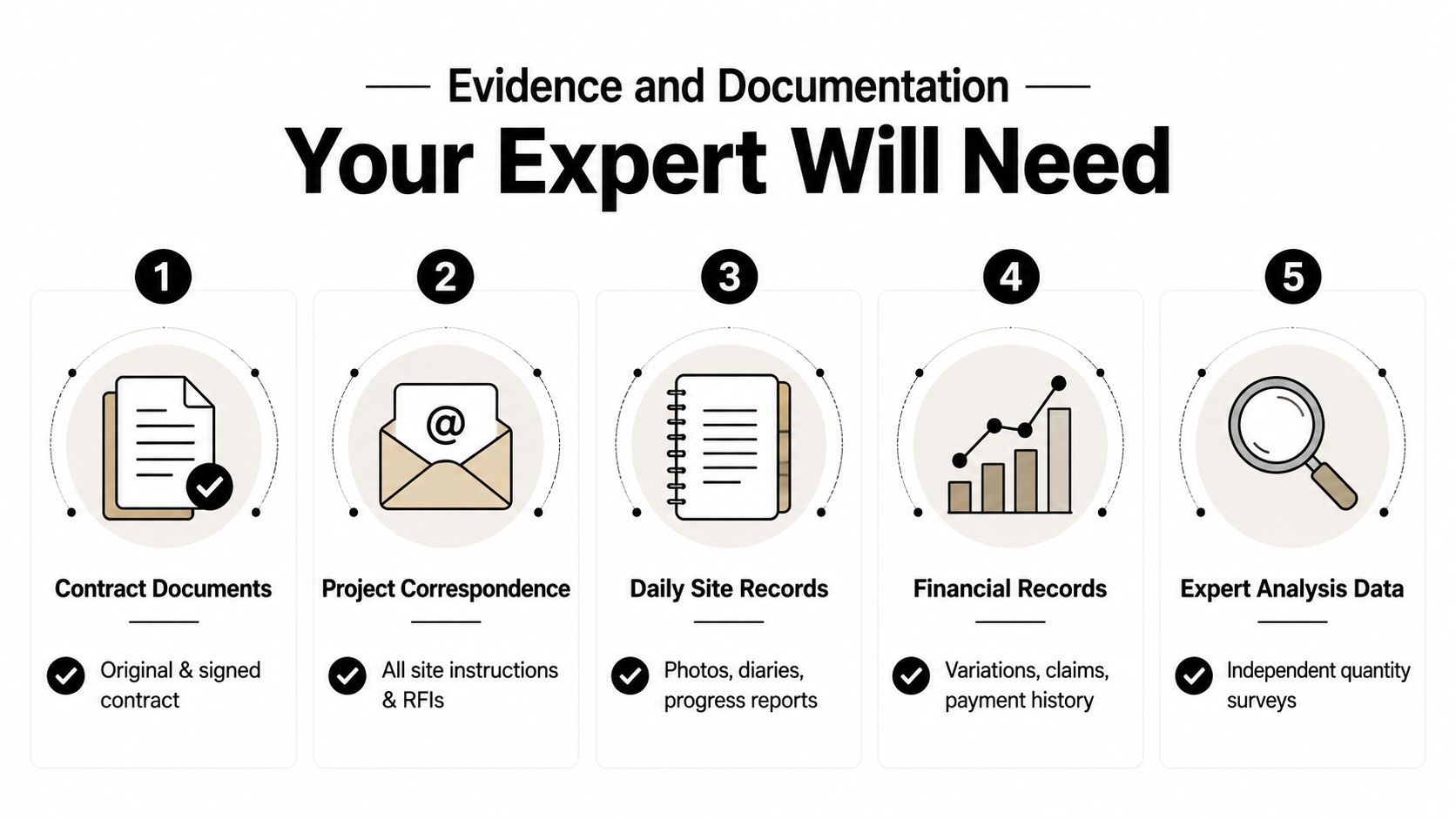
A practical way to organise the file is to split it into five groups.
- Contract documents: Keep the signed contract, scope, plans, specifications, and any formal amendments together.
- Project correspondence: Save all instructions, RFIs, approvals, and variation emails in date order.
- Daily site records: Gather photos, diaries, progress reports, and inspection notes that show how the work unfolded.
- Financial records: Include payment claims, variation pricing, invoices, and ledger extracts that show the money trail.
- Expert analysis data: Hold programme files, quantity take-offs, and any independent measurement material the expert will need to test the claim.
For teams that are drowning in paperwork, document processing tools can help sort the material before the expert arrives. A practical example is the workflow style shown in insurance document automation examples, which is relevant because the same principle applies here, organise first, analyse second.
How Expert Reports and Scott Schedules Work in NCAT Proceedings
NCAT does not reward bloated reports. It rewards reports that are structured, readable, and tied to the issues the tribunal has to decide. A strong Expert Witness Report should tell the member what was inspected, what was found, what standard was applied, what should be rectified, and what that work is likely to involve.
What the report has to do
The report should read like evidence, not advertising. That means independent findings on defects, workmanship, compliance with the National Construction Code and Australian Standards where relevant, and a clear explanation of rectification scope. If the report wanders into blame without proof, or tries to score points for one side, it loses its value fast.
The expert also has to stay within the boundary of objectivity. Expert-evidence guidance says the witness should not choose between competing versions of the facts or make judicial findings. In practice, that means the report should identify what is seen, what is measured, and what remains uncertain, then leave the legal conclusions to the tribunal.
Practical insight: the best NCAT report is the one a member can read once and understand without asking a lawyer to translate the language.
Where Scott Schedules fit
A Scott Schedule becomes critical when there are multiple defects, multiple response positions, or multiple cost issues. It is the itemised table that lets the claimant, the respondent, and the expert put their views next to each other in one place. For complex residential matters, that structure stops the dispute from dissolving into scattered arguments across dozens of documents.
In NSW tribunal work, the schedule has to align with procedural directions, not just be a spreadsheet with comments. That means each item should be clearly identified, the alleged defect should be described in plain language, the respondent’s position should be recorded, and the expert’s findings should sit beside them. For a clear explanation of the format used in NSW matters, see Awesim’s Scott Schedule guide for NSW tribunals.
How the process usually runs
The report is usually prepared after the site review and document analysis, then exchanged so the parties can respond. If the matter stays live, the Scott Schedule becomes the working document for hearing preparation and often for settlement discussions. That is why it pays to have the file clean early, because a good schedule can focus the dispute and reduce noise before the final hearing.
For readers who want a broader view of the tribunal-side workflow, the process is also captured in this NCAT proceedings video, which mirrors the practical sequence of report preparation, review, schedule creation, and hearing use.
Why formatting matters more than people expect
Judges and tribunal members do not want to hunt through prose for the one defect item they need. A clean schedule, clear headings, and consistent item numbering make the evidence usable. A sloppy report, by contrast, can hide the strongest point in a wall of text and make the whole file harder to trust.
Timelines, Fees and Red Flags to Watch For
Fee and timing discussions should be blunt. A good expert costs money, but a poor expert costs time, credibility, and sometimes the whole case. The right question is not whether the quote is cheap, it’s whether the work is detailed enough to survive NCAT scrutiny.
Typical engagement phases
| Phase | Typical Duration | Key Activities |
|---|---|---|
| Initial review | A short early stage after engagement | Check the brief, scope the dispute, identify missing records |
| Site investigation | Depends on access and complexity | Inspect defects, take photos, test conditions, compare against documents |
| Draft report preparation | After the inspection and file review | Prepare findings, structure the reasoning, draft defect and compliance analysis |
| Client or legal review | Before finalisation | Resolve factual errors, check terminology, confirm annexures and schedules |
| Final report and Scott Schedule | Aligned to tribunal needs | Issue the compliant report, itemise defects, refine the schedule for hearing use |
What changes the cost
Complexity drives the price. A small defect dispute on one bathroom is not the same as a multi-item renovation with missing records, delayed trades, and competing claims about variations. Site access also changes the workload, especially if the building is occupied, partially complete, or spread over more than one lot.
Urgent matters usually need faster turnaround, which means less time for follow-up document chasing and more pressure on the initial brief. If the client hasn’t gathered emails, programme files, or payment records, the expert has to spend extra time reconstructing the file before any meaningful opinion can be formed.
Red flags that should stop the appointment
An expert who guarantees a result is a problem. So is one who sounds persuasive but can’t explain the evidence chain. If the consultant has no hands-on building experience, no NCAT familiarity, or no understanding of the Expert Witness Code of Conduct, the report may look polished but still fail under cross-examination.
Another warning sign is a report that jumps straight to conclusions without testing causation. In NSW claim work, the expert has to work through liability, causation, and resultant injury before any loss figure makes sense, and skipping that analysis leaves the client exposed. A marketing-style report can be worse than no report at all, because it creates confidence without proof.
Your Next Steps for Resolving a Building Dispute
Start with the file, not the argument. Save every dated photo, email, quote, variation, and payment record you have, then make a simple timeline of what happened, where, and when. Once the chronology is in place, appoint an expert who has genuine site experience, understands NCAT, and can produce an Expert Witness Report and Scott Schedule that fit the tribunal, not just a conversation in the driveway.
Awesim Building Consultants works with homeowners, builders, lawyers, insurers, and strata clients across Sydney, the New England region, and rural NSW, with 35+ years in building and construction and over 15+ years providing litigation support. If your dispute is headed toward NCAT, or you need a site investigation, building defect report, or Scott Schedule prepared properly, get the advice in early.
Awesim Building Consultants can inspect the work, test the records, and prepare the kind of expert evidence that NSW disputes require. If you need help with a building defect, delay, variation, or Scott Schedule matter, visit Awesim Building Consultants or get in touch by email at admin@awesim.com.au or call 1800 293 746.
Related Posts

Strata Report: What Buyers Need to Read Before Signing
A strata report is the document that surfaces hidden obligations before you are legally committed to a purchase. A strata
Read More »
Inspection of Structures: What to Check Before You Buy
An inspection of structures examines a property's load-bearing elements, including foundations, walls, beams, roof framing, and floor systems, to identify
Read More »
Water Damage in Homes: How to Track Down the Source
Water damage in a home rarely announces itself at the source. A stain on the ceiling, a musty smell in
Read More »