
Scott Schedule Explained (NSW Tribunal Guide) – 2026
You open the NCAT order, read the words Scott Schedule, and the stress level goes up immediately. In that moment, it’s often unclear whether a spreadsheet, an expert report, a defect list, or all three rolled into one is being requested. Homeowners worry they’ll leave something out. Builders worry one bad line item will be taken as an admission. Solicitors and strata managers usually know the document matters, but they still need the technical content to be right.
That concern is justified. In NSW building disputes, the Scott Schedule often becomes the working document everyone keeps coming back to. If it’s clear, specific, and properly referenced, the dispute becomes easier for the Tribunal to follow. If it’s vague, bundled, or poorly costed, the whole case can lose shape.
This guide gives a practical Scott schedule explained NSW tribunal guide from the viewpoint of someone who works with building evidence, not just paperwork. The rigid format isn’t there to make life difficult. It exists because NCAT needs each alleged defect broken down into a form that can be tested, answered, and ruled on.
Your Guide to Navigating NCAT Building Disputes
A typical scenario goes like this. A homeowner has a list of concerns spread across emails, photos, diary notes, and an inspection report. A builder has responses scattered through variation claims, completion arguments, and denial of defect allegations. NCAT then orders a Scott Schedule, and suddenly both sides need to convert a messy history into a single disciplined document.
That’s where people either gain clarity or lose control.
A good Scott Schedule forces each party to stop arguing in generalities. Instead of saying “the bathroom is defective”, the issue gets narrowed to something the Tribunal can work with: one defect, one location, one rectification proposal, one cost position, one response. That is a much safer place to run a dispute from than broad accusations and broad denials.
Awesim Building Consultants have 35+ years in Building & Construction, with over 15+ years our providing litigation support to home owners, builders and lawyers. That depth matters because a Scott Schedule only works when the building logic and the legal presentation line up. If you’re still trying to get your bearings on the overall process, this step by step guide to NCAT building disputes in NSW helps place the schedule in context.
The document looks administrative. In practice, it’s forensic.
What Is a Scott Schedule and Why Does NCAT Require It
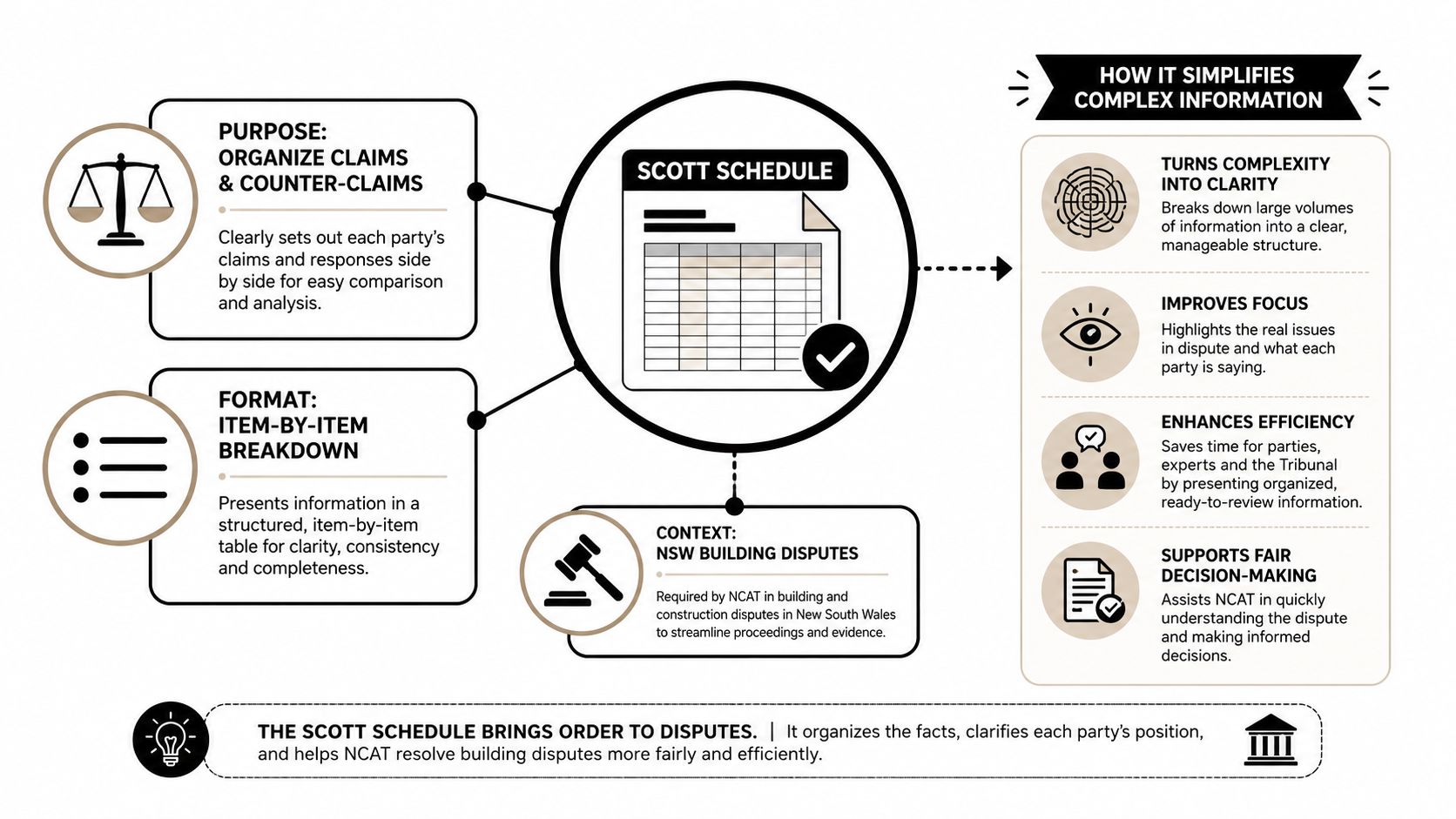
Think of a Scott Schedule as the dispute’s itemised ledger. It takes a long and often emotional building conflict and converts it into a row-by-row comparison that the Tribunal Member can test.
NCAT requires it because building disputes rarely fail for lack of opinion. They fail because the issues aren’t separated cleanly enough for determination. One side says the works are incomplete. The other says they’re complete but compliant. Then somebody adds rectification pricing that includes unrelated items. Without a structured schedule, scope, workmanship, and cost all get mixed together.
Why the format matters
The clearest statement of purpose comes from this discussion of Scott Schedule logic and language in NCAT disputes: the Scott Schedule serves as the foundational document for effective NCAT dispute resolution, where its primary function is to segregate scope, quality, and quantum issues. This separation is essential for accurate judicial determination in complex construction disputes, allowing the Tribunal Member to make itemised rulings rather than general assessments of an entire claim.
That point is often missed by parties preparing their first schedule. They treat it like an administrative summary. It isn’t. It is the structure that stops three different questions from being collapsed into one:
| Issue | What the Tribunal needs to know |
|---|---|
| Scope | Is there actually a defect, omission, or incomplete item? |
| Quality | If work exists, does it meet the required standard? |
| Quantum | What does proper rectification cost? |
When those questions stay separate, the case becomes easier to decide. When they’re merged, the respondent can deny one part of a row and create confusion across the whole item.
When NCAT leans on it most heavily
The schedule becomes especially important where there are multiple alleged defects, competing expert views, or disagreement over rectification costs. It gives both sides the same frame to respond in. The claimant can’t hide behind broad allegations, and the respondent can’t rely on broad denials.
If you’re deciding whether your matter has reached that point, this page on when you need a Scott Schedule for NCAT is a useful companion.
A Tribunal Member doesn’t want to hunt through emails, mark-ups, and competing quotes to work out what item 14 actually is. The Scott Schedule brings the argument into one line of sight.
The Mandatory Structure of an NCAT Scott Schedule
A compliant schedule must follow NCAT’s required format. This isn’t the sort of document you can improvise because you’re good with spreadsheets. The structure exists so every row can be read, answered, and ruled on in a consistent way.
What every row has to capture
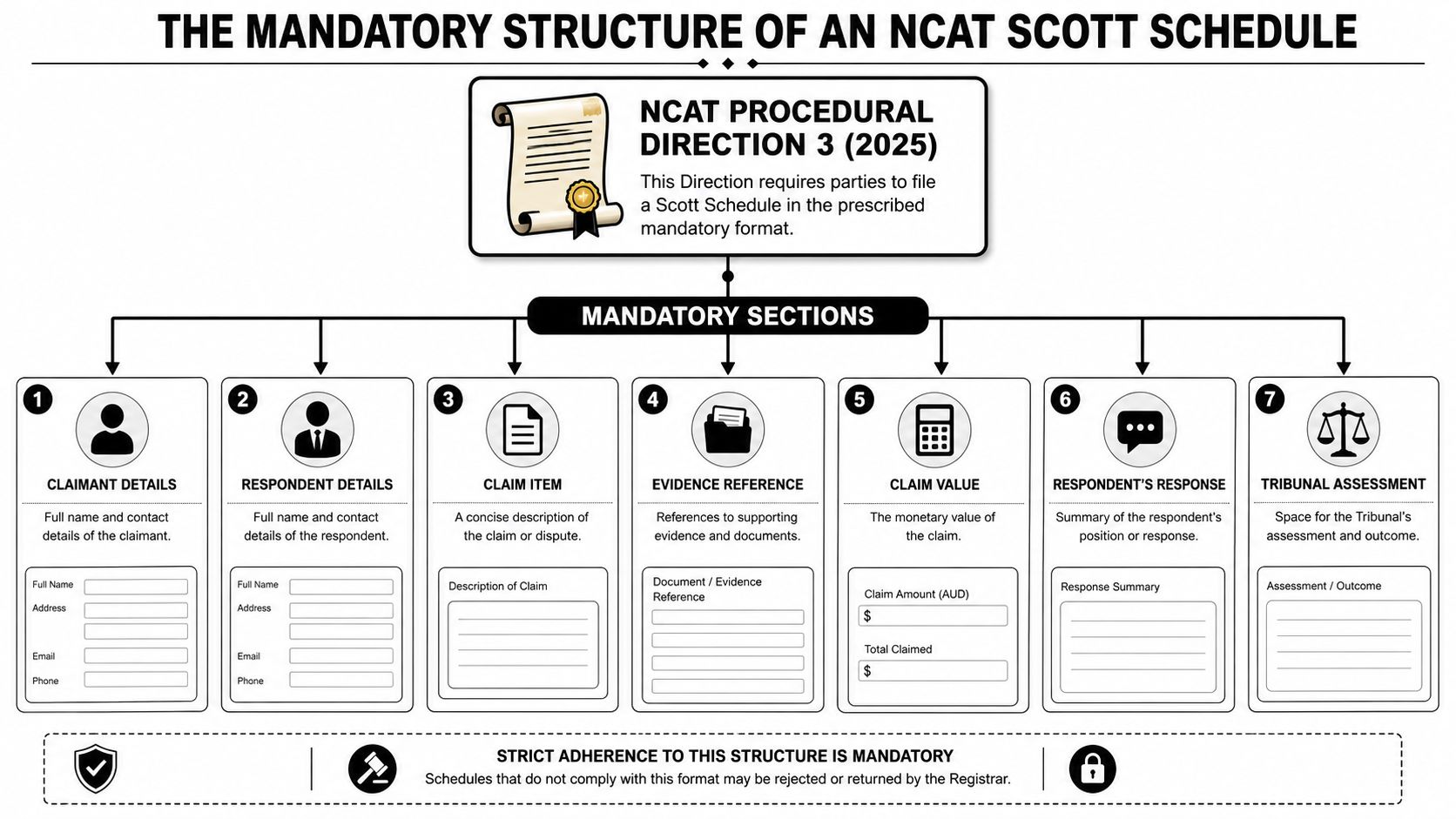
As set out in this guide to the NSW Scott Schedule form, a Scott Schedule in NSW is a structured tabular document mandated by NCAT Procedural Direction 3 (2025), requiring each row to address specific data points: defect description, location, supporting evidence, proposed rectification, and claimed cost. This format forces both Claimant and Respondent to answer identical questions for every defect, creating a standardised comparison for the Tribunal.
That requirement is why vague entries don’t hold up well. “Poor tiling to bathroom” is not enough. The row needs enough detail that another person can identify the precise issue, locate it, see the supporting evidence, understand the proposed remedy, and test the cost.
The working column logic
Different practitioners describe the structure slightly differently, but the logic remains the same. A compliant NCAT schedule uses an 8-column structure that includes item identification, each party’s position, each party’s costing, an expert evidence reference, agreement status, and the Tribunal’s determination, as explained in this NCAT expert evidence overview.
A practical way to read those columns is this:
- Item and defect description. This is the unique identifier and the exact issue in dispute.
- Homeowner or claimant position. What is alleged, and what remedy is sought.
- Builder or respondent response. Admission, denial, alternative explanation, or different scope.
- Claimant cost. The amount claimed for rectification of that specific item.
- Respondent cost. The builder may enter a cost, or $0 if the defect or responsibility is denied, as noted in the earlier discussion of the standard NCAT format.
- Evidence reference. This must point back to the actual supporting material.
- Agreement status or joint expert position. Useful for isolating what is and isn’t contested.
- Tribunal finding. The dedicated space for itemised determination.
What works and what doesn’t
What works is precision. One row should deal with one issue. The wording should be neutral and technical, not argumentative. The evidence reference should point to a page, annexure, or photo number that another person can immediately check.
What doesn’t work is using the schedule like a pleading, a witness statement, or a complaints register.
A quick comparison helps:
| Approach | Result |
|---|---|
| One defect per row | The response is easier to test |
| Specific location | Site issue can be identified quickly |
| Direct evidence reference | Tribunal can verify the item efficiently |
| Bundled allegations | Scope becomes muddy |
| Inflated narrative | The actual defect gets buried |
| Unlinked cost claim | Quantum becomes vulnerable |
For a closer look at the expected layout, the NCAT Scott Schedule format guide is worth reviewing before drafting starts.
How to Prepare a Compliant Scott Schedule Step by Step
Preparation starts on site, not on a laptop. If the investigation is sloppy, the schedule will be sloppy. By the time you open the template, most of the work should already be done.
Start with evidence that can survive scrutiny
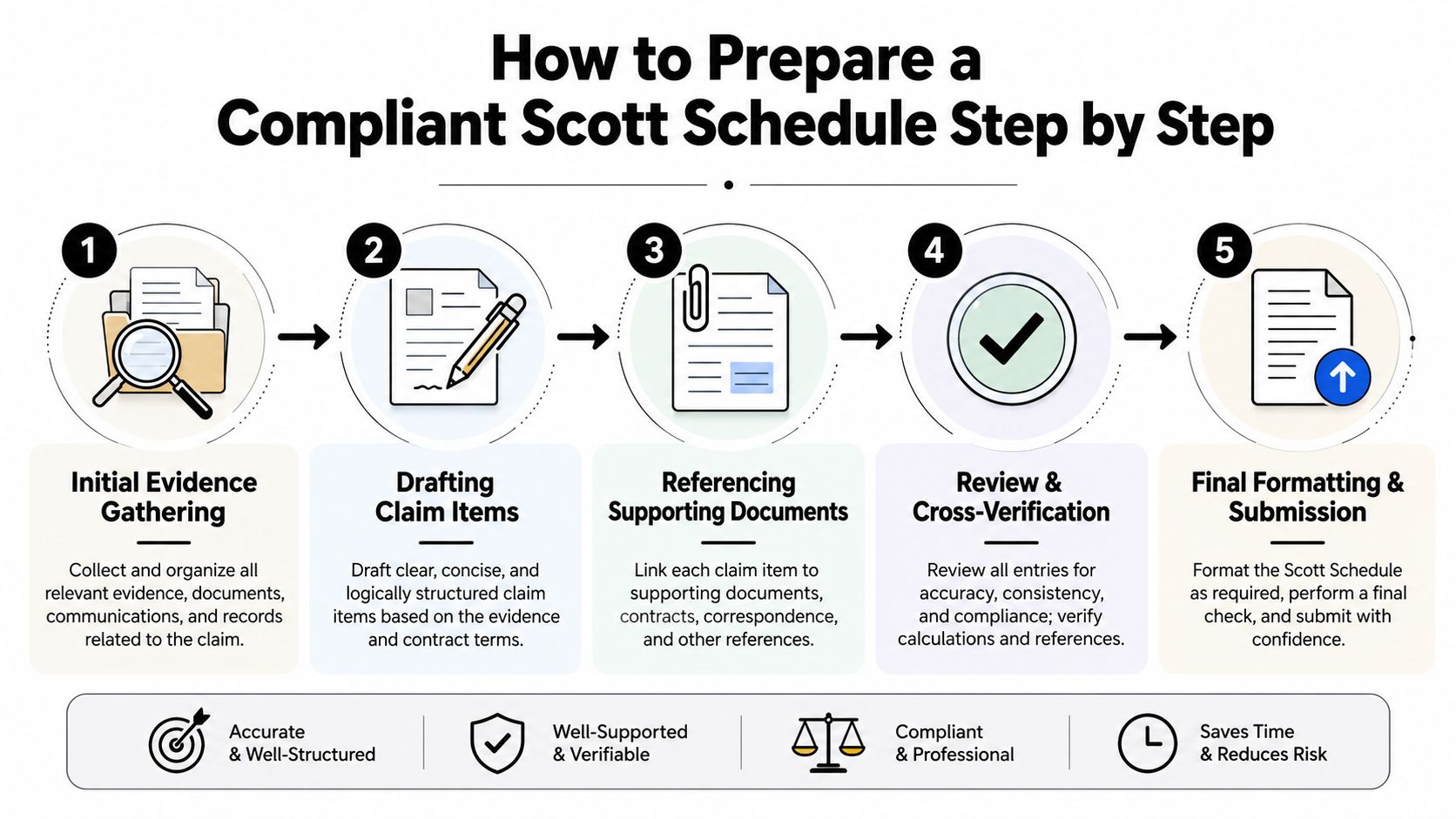
Under NCAT Procedural Direction 3 from 7 April 2025, every defect entry in a Scott Schedule must include a detailed description, hyperlinked photographic evidence, and itemised cost estimates benchmarked against specific industry standards such as the Rawlinsons Australian Construction Handbook 2025 rates, rather than vague estimates.
That single requirement changes the whole drafting approach. A schedule can’t be built from rough notes and broad opinions. Each item needs a file trail.
Use this order of work:
- Inspect the property methodically. Move area by area and identify each discrete issue separately.
- Record the exact location. “Ensuite” isn’t enough if the issue is limited to the shower hob return or the eastern wall junction.
- Take photographs that prove the point. Include overview shots and close-ups.
- Tie each item to the technical basis. If the issue is non-compliance, identify the relevant standard, specification, or contract requirement.
- Obtain itemised costing support. Broad lump sum numbers are hard to defend.
If you also deal with broader compliance paperwork, resources like Wistec for Australian compliance can help clarify how disciplined documentation practices support later dispute work.
Draft one issue at a time
The best schedules are written almost clinically. Each row should answer a small set of practical questions.
- What is wrong. Describe the alleged defect in plain technical language.
- Where is it. Be precise enough that a third party can stand in the right spot and inspect it.
- What supports it. Reference the photo, report page, annexure, or measurement.
- How should it be fixed. State the rectification method at an appropriate level of detail.
- What is the claimed amount. Make sure the figure ties back to a cost source.
Here is the style to aim for in a sample entry:
| Field | Example style |
|---|---|
| Defect description | Floor tiling at shower entry falls towards bathroom floor rather than towards waste |
| Location | Main bathroom, shower entry at western edge |
| Evidence reference | Expert report page reference, annexure photo reference, site level reading |
| Proposed rectification | Remove affected tiles and substrate as required, rectify falls, re-waterproof affected area, retile |
| Claimed cost | Itemised amount linked to costing sheet |
Cross-reference before filing
Many schedules frequently fall apart. The row may look fine until someone tests the references. Then the photo number is wrong, the page doesn’t support the conclusion, or the costing sheet bundles several unrelated works.
Practical rule: If a row can’t send the reader straight to the exact evidence, it isn’t finished.
A disciplined final review should check:
- Every row against the expert report
- Every annexure reference against the annexure itself
- Every photo hyperlink
- Every cost against the correct item
- Every description against the actual allegation being made
Later in the process, visual explanations can also help clients and lawyers understand how the schedule operates in practice:
Common Mistakes That Can Weaken Your NCAT Case
The most damaging mistake is usually not a dramatic one. It’s often a drafting shortcut that looks harmless at first.
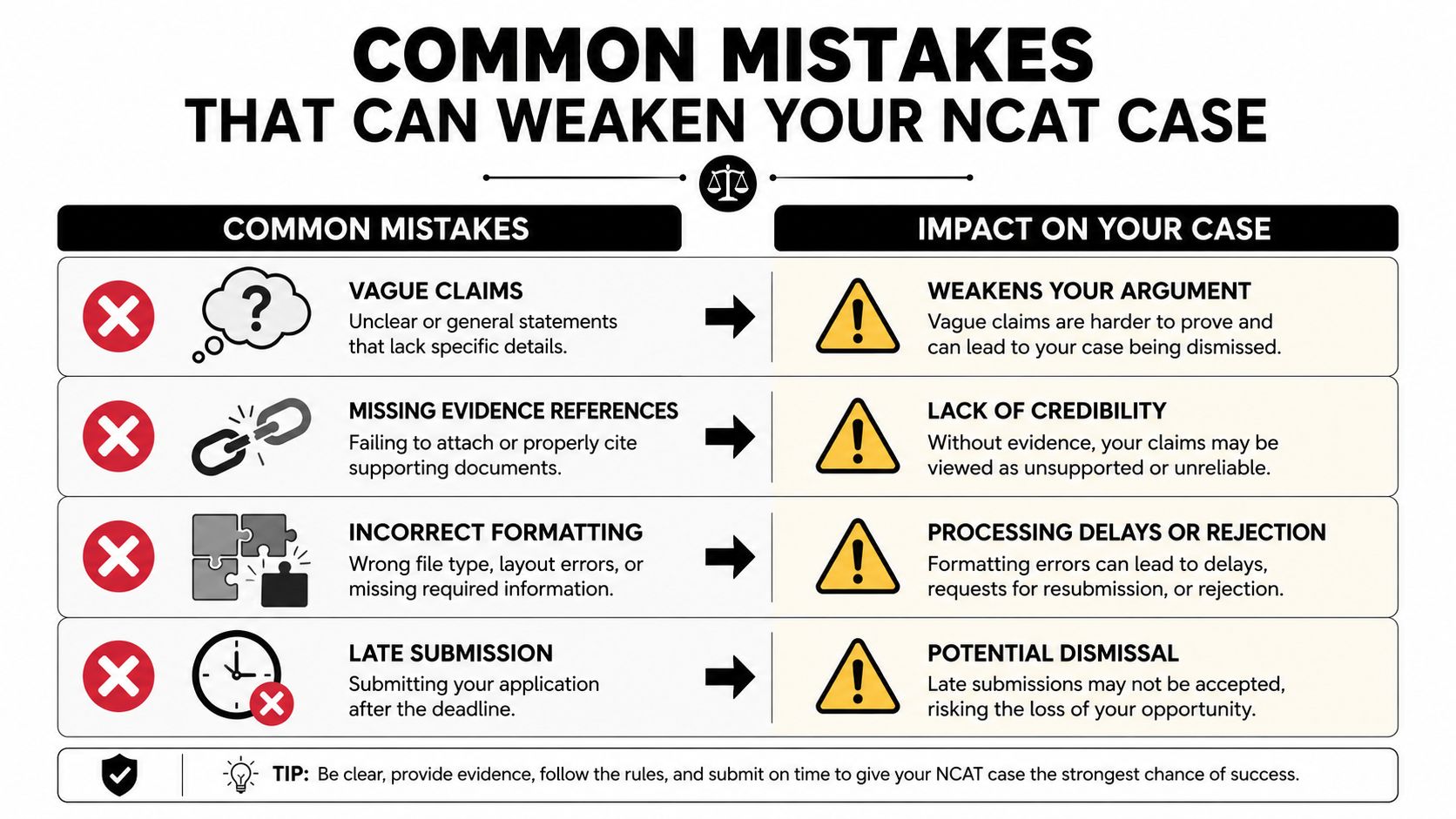
The worst example is bundling. A party puts several different failures into one row because they occur in the same room or involve the same trade. That might feel efficient. In practice, it weakens the claim.
The granularity problem
The sharpest warning comes from this analysis of how Scott Schedules strengthen construction dispute cases: a critical nuance often missed is ‘item granularity’. Best practice explicitly requires segregating ‘scope,’ ‘quality,’ and ‘quantum’ issues into distinct rows to prevent Tribunal Members from lumping multiple defects together. Failure to do this allows a respondent to deny a single row containing multiple distinct failures, thereby invalidating the entire claim scope for that item.
That’s exactly what happens in real disputes. One row says the bathroom tiling is defective because of poor falls, lippage, grout inconsistency, waterproofing failure, and finish quality. The respondent then admits only a trivial aesthetic issue or denies one part, and the whole row becomes harder to determine cleanly.
Mistakes that repeatedly cause trouble
Some errors show up again and again:
- Vague descriptions. “Defective carpentry” tells the Tribunal very little.
- Missing technical basis. If you allege non-compliance, the item should be anchored to something measurable or observable.
- Weak evidence references. A bundle of photos with no direct link to the row is frustrating to use.
- Unclear costing. If one amount covers several trades and several rooms, the number becomes vulnerable.
- Wrong template or formatting. Even good technical content can run into procedural trouble if the presentation is not compliant.
A shorter, sharper schedule is usually stronger than a sprawling one packed with overlap.
Don’t try to win the case inside the defect description. Identify the issue cleanly, support it properly, and let the evidence do the heavy lifting.
The Awesim Advantage How Expert Reports Strengthen Your Schedule
A Scott Schedule is only as reliable as the material behind it. The form itself doesn’t create proof. It organises proof.
That’s why the strongest schedules are usually built on a proper site investigation and an expert report that identifies the defect, explains the likely cause, references the technical basis, outlines rectification, and supports the costing. Without that foundation, a row can look tidy while still being weak.
Awesim Building Consultants provide site investigations, Building & Construction Expert Witness Reports and Scott Schedules. In practical terms, that means the technical inspection and the tribunal-facing document can be aligned from the beginning instead of patched together later. That’s often where cases improve. The defect wording matches the observed condition. The evidence references point to the right material. The proposed rectification reflects what the issue requires.
Why expert content changes the quality of the schedule
A homeowner can often identify that something looks wrong. A builder can often explain why they disagree. But NCAT usually needs more than competing assertions. It needs a structured technical basis.
A useful expert-backed schedule tends to do three things well:
- It isolates the issue. The item is framed narrowly enough to be determined.
- It explains the basis. The defect isn’t just asserted. It is tied to observed facts and supporting material.
- It keeps costing disciplined. Quantum is linked to the specific item, not absorbed into a general allowance.
If you’re comparing options, it also helps to review related material on expert evidence and similar pages dealing with building disputes, defect reporting, and NCAT-ready documentation so the schedule doesn’t get prepared in isolation.
Filing Your Schedule and Next Steps
Once the schedule is complete, the job becomes procedural. This part matters more than people expect. A sound schedule filed incorrectly, filed late, or filed in the wrong format can create avoidable problems.
The key point is straightforward. NCAT Scott Schedule compliance guidance notes that NCAT Procedural Direction 3 mandates strict formatting conformance requiring Scott Schedules to use the approved template exclusively. Failure to use the current approved format risks rejection, and legal counsel should review compliance 2–3 weeks before submission.
A practical filing checklist
Before filing, check the following:
- Approved template only. Don’t redesign the schedule because another layout looks cleaner.
- Pagination and formatting. Keep the document easy to follow.
- Service requirements. Make sure the other side receives what NCAT ordered.
- Reference integrity. Test annexures, page references, and links before the document leaves your hands.
What usually happens after filing
After service and filing, the respondent will usually complete their response columns if that hasn’t already occurred. In some matters, a joint expert process follows, and the agreement status or expert position becomes more important. The schedule may then be updated to reflect points agreed, points still in dispute, and the narrowed issues for hearing.
That is why a disciplined first version matters. A poor schedule creates confusion all the way through. A well-built one helps every later step run more cleanly.
If you need practical help with a current matter, email admin@awesim.com.au or call 1800 293 746.
If you need help preparing a tribunal-ready Scott Schedule, an expert report, or a site-based defect investigation, Awesim Building Consultants can assist with practical building evidence for NSW disputes. Email admin@awesim.com.au or call 1800 293 746 to discuss the matter.

Related Posts

Water Damage in Homes: How to Track Down the Source
Water damage in a home rarely announces itself at the source. A stain on the ceiling, a musty smell in
Read More »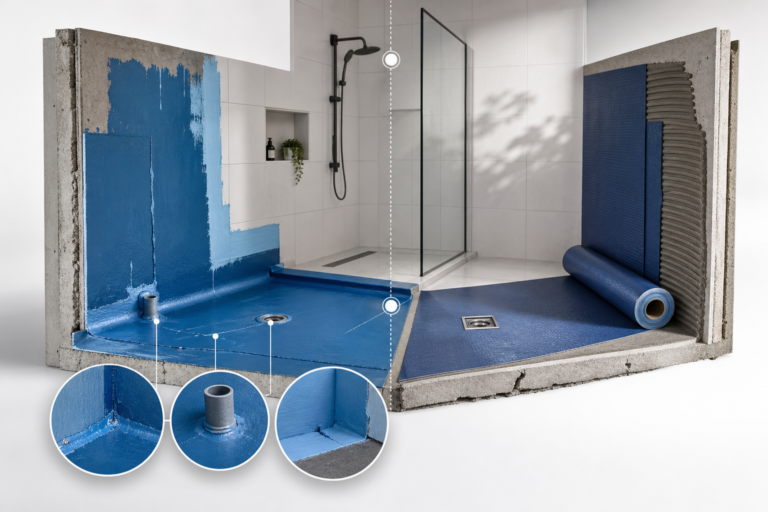
Waterproofing Membrane Types: Which Fails Most in NSW Bathrooms
Waterproofing failure is the single most common serious defect found in NSW apartments, and the type of membrane used, along
Read More »
Building Certifier NSW: Role, Limits, and When You Need More
A building certifier in NSW is a registered professional who issues construction certificates, conducts critical stage inspections, and grants occupation
Read More »