
Quantum Meruit Claim in NSW: A Practical Guide

You can be halfway through a job, invoices unpaid, variations argued over, and the paperwork still doesn't line up with what was done. That's when a quantum meruit claim starts to matter in NSW building work. It's the fallback route when the contract won't carry the claim cleanly, or when the owner has taken the benefit of work that was never properly priced or documented.
When a Quantum Meruit Claim Becomes the Only Path to Payment
A builder finishes a residential job and the paperwork does not hold together. The written contract is thin, the variations were handled on-site and by text, and the final invoice is being disputed. The owner says the extras were never agreed. The builder says the work was asked for, completed, and it left the house in a better state than before.
That is the sort of NSW domestic building dispute where quantum meruit starts to matter. It is usually a fallback, not a first choice. A properly drafted contract and compliant variation paperwork still carry more weight when they exist, which is why early contract review matters, including practical guidance on building contract review before you build.
For builders who are already in dispute, the next question is usually whether the claim can still be framed through a payment pathway like security of payment in NSW, or whether the facts have drifted so far that quantum meruit is the only realistic path.
Why the doctrine exists
Quantum meruit exists because the law does not like one side keeping a benefit without paying for it where the bargain is missing, uncertain, or incomplete. In Australian construction disputes, it is most often used where there is no enforceable contract price, the price term is uncertain, or the work went outside the agreed scope, with the claim framed around the reasonable value of services rendered rather than the contract sum.
That pattern shows up often in residential work because disputes usually begin with good intentions and end with poor records. The builder thinks the extra labour was obvious. The owner thinks the extras were part of the original job. Quantum meruit sits in the middle and asks a harder question, what was objectively earned?
Practical rule: if the paperwork does not clearly support a contractual claim, the evidence has to prove the value of the work itself.
For owners, that means the invoice is not the whole story. For builders, it means internal costings will not carry the day unless they line up with objective market evidence. The remedy is restitutionary, so the focus is on the retained benefit, not on wishful pricing or a contractor's private spreadsheet.
A builder who wants to recover on this basis still needs records that let someone else test the claim later. Site diaries, texts, emails, photographs, progress claims, and invoices all matter, but they need to connect the request, the work done, and the value claimed. In practice, that is the difference between a theory and a recoverable sum.
What Quantum Meruit Actually Means and the Legal Elements Behind It
At its simplest, quantum meruit means “as much as is deserved”. In practice, it means payment for the reasonable value of work done or materials supplied. A useful analogy is groceries taken from a shelf when no price was agreed, the store still expects payment for what was taken, but only for the goods supplied, not for some invented figure after the fact.
The legal elements are straightforward to state and hard to prove well. The claimant needs to show a benefit was conferred, the work was requested or accepted, there was no enforceable contract price for that work, and the amount claimed reflects the market value of what was provided. Australian construction commentary also notes that a quantum meruit claim is generally constrained by the contract price ceiling unless it would be unconscionable to do so, and the assessment is driven by reasonable value, not the contractor's internal costs or wishful pricing (Construction Law Made Easy).
The evidence has to match the theory
In NSW practice, the winning evidence usually looks ordinary, not dramatic. Site diaries, email trails, text messages, delivery dockets, time records, and photographs all help show that the work was done and the other side took the benefit. If the owner accepted the work knowing payment was expected, that point becomes much easier to run.
The claim lives or dies on contemporaneous records.
A claimant who can't show request, acceptance, and value usually struggles. A claimant who can show all three, with neutral evidence, has a far better path to recovery. That is why quantum meruit is never just a legal label, it's an evidentiary exercise.
Quantum Meruit Versus a Contractual Claim and Why the Choice Matters
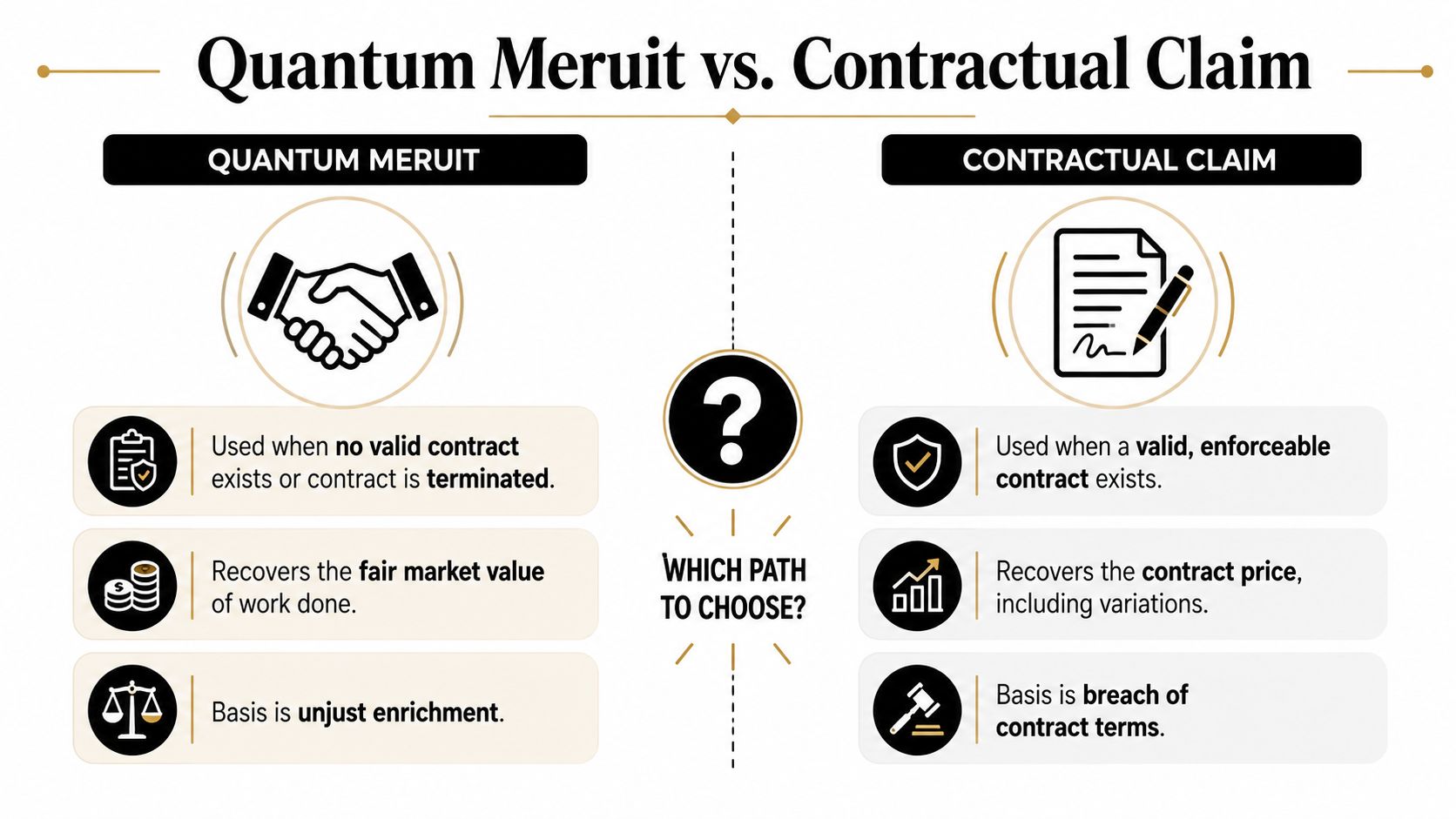
A defectively documented variation can change the whole recovery path. If a valid contract exists and sets the payment structure, quantum meruit is generally capped by the contract rate for the relevant work, and the claimant still has to prove value by objective benchmarks such as labour inputs, materials, and prevailing market rates. That is the first strategic fork in the road.
If the variation clause was followed properly, a contractual claim is usually cleaner. If the paperwork is defective, the price term is uncertain, or the work was outside scope, quantum meruit becomes the fallback. In NSW domestic disputes, that difference is decisive because builders often assume “extra work” automatically means “extra payment”, when the question is whether the claim fits the contract machinery or has to stand on restitution.
The practical choice is rarely glamorous. It comes down to paperwork quality, proof of request, and whether the owner can say, with some force, that the work sat within the original bargain. A builder who can tie disputed extras to a contractual mechanism should usually do that first. A builder who can't, and who still wants payment for work that was clearly accepted, may need quantum meruit as the fallback. That is why I tell clients to get the contract reviewed early, before the file turns into a dispute about labels instead of money, as set out in Awesim's contract review guidance.
In Australian construction disputes, quantum meruit is most often used where there is no enforceable contract price, the price term is uncertain, or work was performed outside the agreed scope, and the claim is framed around the reasonable value of services rendered rather than the contract sum. That is why the cause of action matters as much as the number. When the contract pathway is open, it usually gives the cleaner argument. When it is closed, the evidence has to do the work, and that is where a careful claim file, backed by contemporaneous records and valuation material, makes the difference between a theory and a recoverable sum.
Bringing a Quantum Meruit Claim in NSW and NCAT Procedure
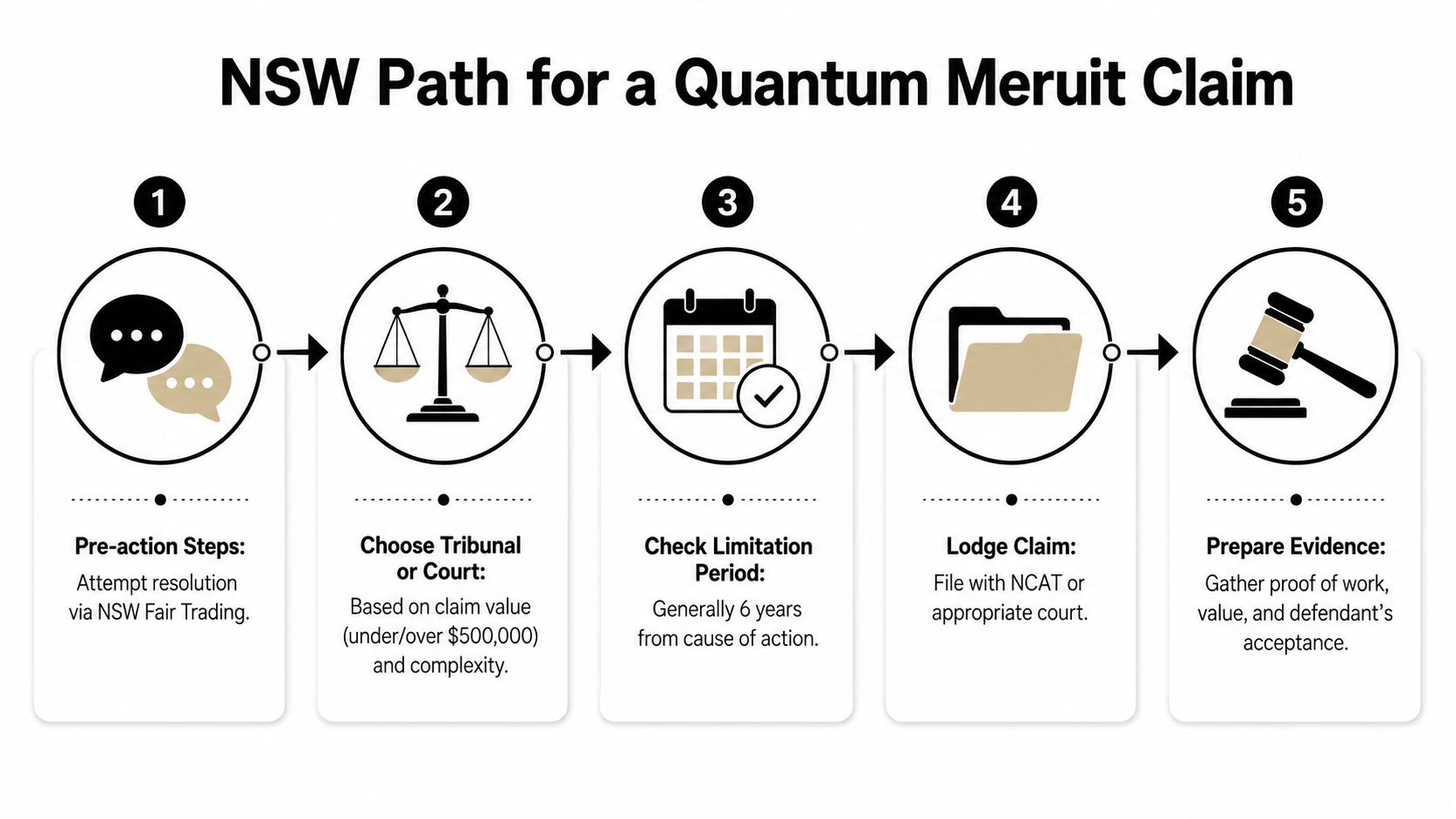
A NSW building dispute usually needs a calm pre-action step before anyone files. If the matter is capable of resolution through NSW Fair Trading, that's where the first practical push belongs. After that, the forum choice depends on the size and complexity of the dispute, with NCAT often used for building matters and the courts used where the claim is larger or more procedurally complex.
What travels well into NCAT
NCAT wants the dispute put in a way that can be followed without guesswork. A claimant should be ready with a clear chronology, the work claimed, the basis for payment, and the records showing that the work was done and accepted. Valuation material matters here because the tribunal still has to decide what the work was worth, not just what was billed.
Where a valid contract exists and sets the payment structure, the claim will usually be tested against the contract rate for the relevant work, so the evidence has to be objective and practical. That means labour inputs, materials, and prevailing market rates, not an after-the-fact internal cost sheet dressed up as proof.
Practical rule: procedure gets the claim heard, evidence gets the claim paid.
Limitation issues also need attention early. Claimants shouldn't wait for paperwork to gather dust while the dispute hardens. The best file is the one built from contemporaneous records, because that is what survives cross-examination and tribunal scrutiny.
What an order can look like
In building matters, the available remedy is usually a monetary order for the reasonable value proved, and in some cases interest may also be sought depending on the forum and the way the claim is framed. The point is simple, the forum can only order what the evidence supports. If the valuation evidence is thin, the award will usually be thin too.
For residential owners and builders, the numbers have to be built carefully, and that is exactly when a specialised report starts to matter. A quantum meruit claim isn't won by outrage, it's won by disciplined proof.
A Practical Quantum Meruit Example and How the Numbers Are Built
A builder is engaged to complete a granny flat extension in NSW. The deal starts with a partly written contract, the owner asks for extra work verbally during the job, and several items never make it into proper paperwork. The project finishes, the final invoice is disputed, and both sides agree on one thing, the work happened, but they disagree about what it was worth.
That is the point where the file has to do the work. Site notes show the extra framing, waterproofing, and fit-out work. Photos show the stage of completion. Supplier invoices and hire records show what was brought to site. The figure is then assembled trade by trade, labour, materials, plant hire, deliveries, and on-site and off-site costs.
A claim with gaps is common in NSW residential disputes. The job is often real, the variation was often requested, but the paperwork is thin or defective, so the valuation exercise has to carry more weight than it would in a clean contractual claim. NSW Fair Trading and NCAT will still look for a clear path from the work done to the amount claimed, and that path is usually built from contemporaneous records rather than hindsight.
How an expert builds the figure
A proper quantum meruit valuation does not start with what the builder hoped to earn. It starts with what the market says the work was worth at the time. Labour is valued by the relevant trade rate, materials by supply evidence, equipment by hire records, and overheads by the work connected to the task.
The report has to separate recoverable work from items that do not belong in the claim. A variation that was requested on site may still need careful proof if it was never documented properly. A disputed provisional item may need to be measured against what was supplied and installed, not what the invoice later said. For builders who want a practical read on keeping a job commercially organised from day one, the UK construction startup guide is useful background.
Awesim Building Consultants works in this space with over 35 years of estimating the costs of building and construction, and has 15+ years providing litigation support to homeowners, builders, and lawyers. Their Quantum Meruit Report service on the Awesim quantum meruit report page is aimed at this kind of valuation exercise, where the dispute turns on reasonable value rather than a simple unpaid invoice. The report has to read like evidence, not advocacy, because NCAT members and court decision-makers are far more interested in how the number was built than how strongly it is argued.
That is where the trade-off sits. A builder may have done more work than the paperwork shows, but only the work that can be traced, measured, and priced in a defensible way is likely to be recovered. In practice, the claim rises or falls on whether the records, the site reality, and the valuation method line up cleanly.
The Role of an Expert Witness Report in a Quantum Meruit Claim
An independent expert doesn't argue the law, and that's the point. The expert gives the tribunal or court a structured view of what the work was worth, item by item, without borrowing the contractor's optimism. In a quantum meruit claim, that usually means a trade breakdown covering labour, materials, hire equipment, deliveries, and on-site and off-site costs.
Why the report carries weight
The best reports are plain, dated, and traceable. They identify what was completed, what was incomplete, what can be measured, and what can be benchmarked against market rates. They also explain the assumptions, because in these disputes the assumptions are often what the other side attacks first.
That is different from a Scott Schedule, which is a procedural document used to organise competing allegations and responses in NCAT matters. A quantum meruit report is about value. A Scott Schedule is about issue management. They can sit beside each other, but they do different jobs.
Expert insight: a report that mirrors the site reality will usually travel better than a report that reads like a submission.
Awesim's background is relevant here because this kind of valuation depends on years of pricing judgement, not just arithmetic. With over 35 years in building and construction and more than 15+ years of litigation support for homeowners, builders, and lawyers, the practical focus is on turning disputed work into a measurable schedule that can be used in NCAT or court.
An expert report also helps expose the weak points early. If the builder can't prove an item was requested, accepted, or completed, the report should not pretend otherwise. That honesty often makes the rest of the claim stronger, because the core issue becomes what can be recovered.
A Practical Checklist for Owners, Builders and Lawyers
A quantum meruit dispute usually turns on the paper trail, not the argument at the hearing. If the contract is incomplete, the variation paperwork is defective, or the payment position was left unclear, the first task is to collect every record that shows what was done, who asked for it, and when the other side knew payment was expected. Keep the texts, emails, photos, delivery dockets, invoices, diary notes, and any written variation forms, even where the forms were not properly signed off.
Valuation evidence should be commissioned early where the issue is reasonable value rather than a straightforward debt. A proper report needs to separate labour, materials, hire equipment, deliveries, onsite costs, and offsite costs, because that is the level of detail NCAT, a court, or the other side's expert will test. If those components are mixed together, the claim becomes harder to defend and easier to attack.
The procedural path should be checked as soon as the dispute becomes live. NSW Fair Trading may still be worth trying if there is room to resolve the matter, but once positions harden the next step is to decide whether the claim belongs in NCAT or in court, based on complexity, amount in dispute, and the quality of the evidence available. In NSW residential work, that decision often comes down to whether the records can prove value, not just whether the work was done.
Builders usually lose ground when they wait until hearing preparation to discover the numbers do not support the story. Owners often assume an unpaid invoice proves value, but an invoice alone rarely answers what the work was worth. Solicitors get the best result when they bring in an independent expert before the pleadings lock the dispute into a narrow position.
If the dispute is already live, review Awesim Building Consultants' quantum meruit report service and speak directly with the team about the records you have. You can email admin@awesim.com.au or call 1800 293 746.
Frequently Asked Questions on Quantum Meruit in NSW
Can a builder recover for extras if the variation paperwork is defective? Sometimes, but not automatically. Australian commentary notes that quantum meruit is not available where an express contract covers the subject matter, and builders may be blocked from claiming it for variations if statutory variation requirements were not followed (Munsch article on quantum meruit).
What matters most in NCAT? Clear evidence of request, acceptance, and value. Self-represented claimants often lose ground because they tell the story well but can't prove the number well enough.
When should an expert be engaged? Before the claim locks into a hearing posture. Once the dispute is framed around reasonable value, the report often decides whether the claim looks credible or speculative.
Awesim Building Consultants prepares quantum meruit reports, expert building inspections, and NCAT-ready documentation for NSW disputes where the value of work has to be proved properly. If your claim turns on incomplete paperwork, disputed variations, or unpaid extras, visit Awesim Building Consultants and speak with a consultant about the records you already have.

Related Posts
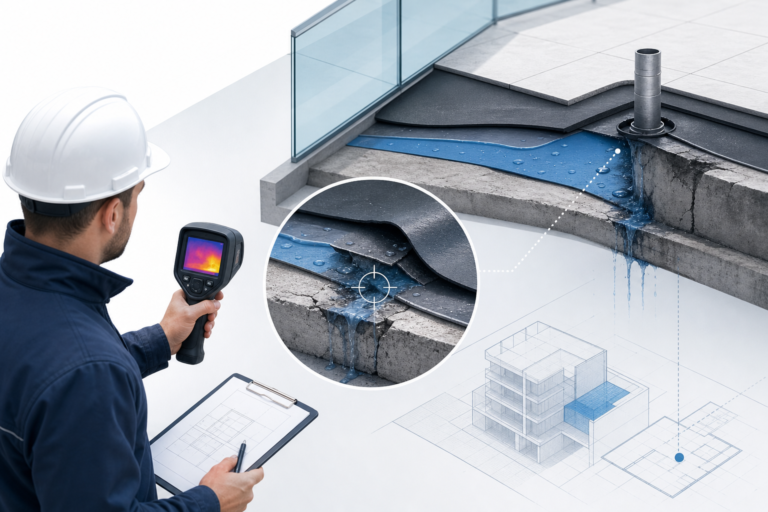
Waterproof Membrane Failure: How Inspectors Find the Cause
Waterproof membrane failure is diagnosed by tracing the water entry point, reviewing design documents, exposing the membrane for visual inspection,
Read More »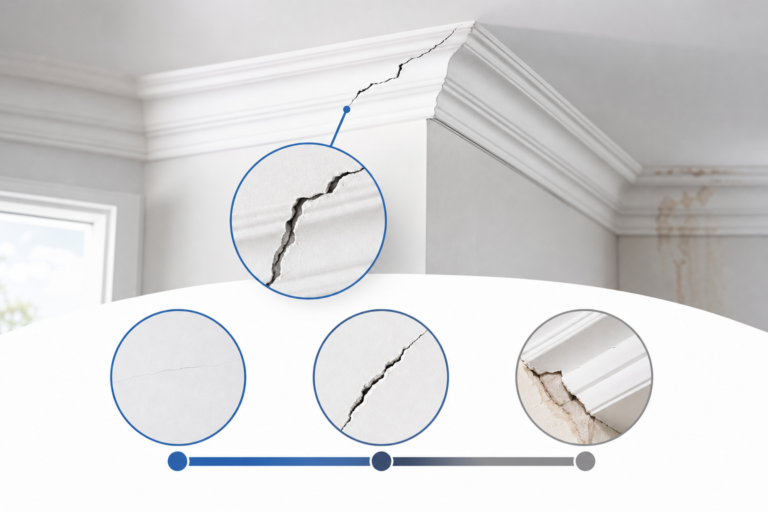
Cornice Cracking: How to Tell If the Damage Is Serious
Cornice cracking is one of the most common concerns Australian homeowners raise, and the hard part is not spotting the
Read More »
Digital Construction Consultant Australia: What They Do
A digital construction consultant in Australia manages the technology-driven side of building projects: BIM coordination, clash detection, asset data handover,
Read More »