A roofing dispute kicks off when a homeowner and a builder can't see eye to eye on the quality, cost, or timing of a roofing project. Usually, it’s about alleged defects—leaks are the classic example, but using non-compliant materials is another common flashpoint.
These conflicts can get complicated, fast. With over 35 years in Building & Construction and more than 15 years providing litigation support to home owners, builders and lawyers, we at Awesim Building Consultants have seen it all. Our job is to cut through the noise and guide homeowners, builders, and lawyers toward a resolution grounded in facts and solid evidence.
Why Roofing Building Disputes Are on the Rise in NSW
It’s a scenario nobody wants, but roofing disputes are becoming a frustratingly common part of the construction landscape across New South Wales. The anxiety of spotting a leak or seeing shoddy workmanship can quickly spiral from a simple phone call into a full-blown conflict. To solve the problem, you first have to understand what’s causing it.
In our experience, these disputes don't just materialise out of thin air. They're often the result of several contributing factors that have been building up throughout the project.
The Key Drivers of Roofing Disputes
A major cause is the immense pressure from tight deadlines and even tighter budgets. When a job needs to be finished quickly, it's easy for corners to be cut and crucial installation details to be missed. This pressure can lead to shortcuts, like using non-compliant materials or methods that don't meet Australian Standards, which is just asking for problems down the track.
Miscommunication is another huge one. Vague contracts, verbal agreements that were never put in writing, or just a failure to manage expectations can create a chasm of misunderstanding. What the builder considers an "acceptable finish," the homeowner may see as a clear defect.
At Awesim Building Consultants, we've seen that the most complex disputes often start from the smallest oversights. A single poorly installed flashing or a misunderstood variation to the contract can be the trigger for a major disagreement that requires expert intervention.
The Role of Evidence and Expertise
In the fast-paced NSW construction sector, many of these disagreements find their way to the New South Wales Civil and Administrative Tribunal (NCAT). The construction industry consistently produces a high volume of disputes, a trend backed up by national data. For instance, in the September quarter of 2026, there were 74 new industrial disputes logged across Australia.
Here in NSW, Fair Trading reports show that building defect claims—of which roofing issues are a major part—account for a huge chunk (25-30%) of all residential construction cases filed at NCAT. You can dig deeper into these trends by exploring the industrial dispute data on the Australian Bureau of Statistics website.
This is exactly why moving from the initial shock of finding a defect to achieving a clear resolution demands a structured, methodical approach. It isn’t about who is right or wrong; it’s about who can prove their case with objective, credible evidence. This is where professional expertise becomes non-negotiable, helping to strip away the emotion and focus on the facts.
A well-prepared expert report provides the clarity needed to resolve a roofing building dispute, often before it ever needs to go to the tribunal. You can also explore our related services to see how we help identify and document defects in building projects.
Your First Moves When You Suspect a Roofing Defect
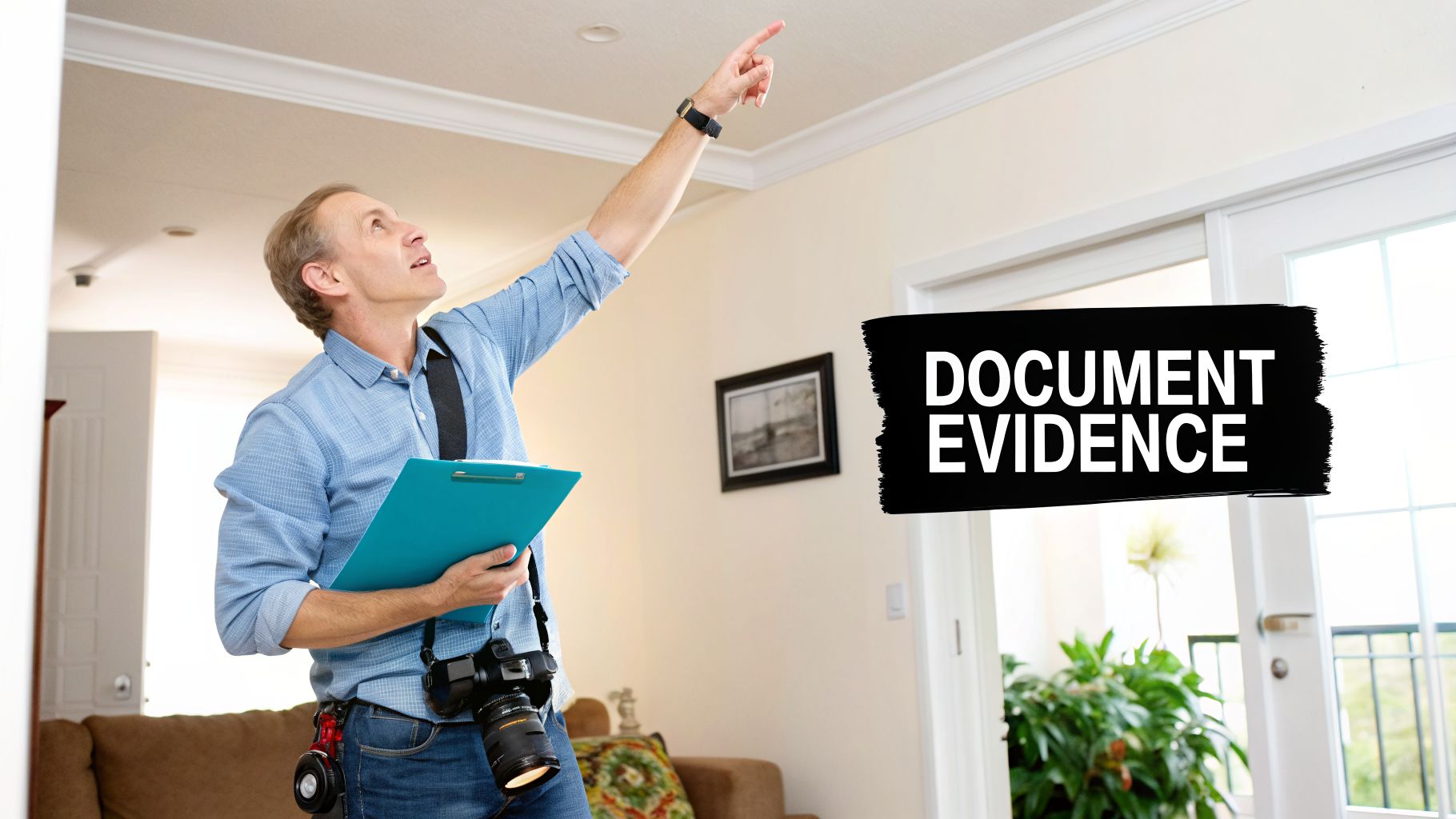
It’s a moment every homeowner dreads. A fresh water stain appears on the ceiling, or you spot a loose roof tile lying on the ground after a storm. Your first reaction might be panic, but what you do in the next 48 hours is crucial. The key is to act with a clear head, not emotion, to set yourself up for a successful resolution.
Most people’s first instinct is to immediately call the builder. While you do need to communicate, your initial moves should be all about methodically documenting what you’ve found. This groundwork becomes the absolute foundation of your case if things escalate.
So, before you pick up the phone, grab your smartphone. It’s time to start creating a visual record as if you were preparing evidence for court—because one day, that’s exactly what it might become.
Master Your Documentation from Day One
The evidence you gather at the very beginning can genuinely make or break your claim down the line. Photos and notes taken in the heat of the moment are infinitely more powerful than trying to recall details weeks or months later.
Your photo and video log needs to be thorough.
- The Defect Itself: Get clear, close-up shots of the issue—the water stains, cracked tiles, pooling water, or torn flashing.
- The Wider Context: Pull back and take photos showing where the defect is located in relation to the rest of the roof or the room. Context is key.
- Evidence of Damage: Photograph any resulting damage. This includes stained carpets, peeling paint, or damaged personal belongings.
- Timestamps: Don't worry about the date on the screen; most smartphones automatically embed timestamp data into the file. This creates an indisputable digital record of when you first noticed the problem.
While you're at it, start a simple communication log. A notebook or a digital document works perfectly. Jot down every call, email, or conversation about the issue, noting the date, time, who you spoke with, and a quick summary of what was discussed.
In our 35+ years of experience in construction disputes, we've seen straightforward, well-kept communication logs become the single deciding factor. It cuts through the "he said, she said" and establishes a factual timeline that’s incredibly difficult to dispute.
No matter how tempting it is, resist the urge to do any repairs yourself or hire another tradesperson for a "quick fix". Any unauthorised work can muddy the waters, making it almost impossible to prove the original builder was at fault. It can also give them a legitimate reason to void their warranty obligations.
Distinguish Defects from Maintenance
It's important to remember that not every issue with a roof is a building defect. You need to make an honest initial assessment of what you're dealing with. A true defect is about faulty workmanship or substandard materials that don't comply with the National Construction Code or relevant Australian Standards.
For instance, a leak caused by incorrectly installed flashing is almost certainly a workmanship defect. On the other hand, a leak from a gutter overflowing with leaves is a maintenance issue that falls to you as the homeowner. Knowing the difference helps you frame your discussion with the builder far more effectively. If you're unsure, our guide on identifying common defects in building can offer more clarity.
Identifying Common Roofing Defects and Evidence to Collect
To help you get started, this table outlines some common roofing problems we see, their likely causes, and the specific evidence you should be gathering to build a strong case from the get-go.
| Common Roofing Defect | Potential Cause (Workmanship/Material) | Essential Evidence To Collect |
|---|---|---|
| Water Stains/Leaks | Improperly installed flashing, punctured membrane, poor sealing around penetrations, cracked tiles. | Photos of stains (with a ruler for scale), video during rain if possible, photos of the corresponding roof area. |
| Ponding Water | Incorrect roof pitch/fall, blocked drainage points, structural sagging not accounted for in design. | Photos of standing water >48 hours after rain, measurements of water depth, photos showing the overall roof slope. |
| Cracked/Slipped Tiles | Incorrect fixing/nailing, failure to use appropriate clips in high-wind zones, defective tile materials. | Close-up photos of cracked tiles, images showing loose or slipped tiles from the ground, photos of any fallen pieces. |
| Rusted Metal Sheets/Flashings | Use of incorrect materials for coastal environments, incompatible metals causing corrosion, scratches during installation. | Photos showing the extent and location of rust, close-ups of any corroded fasteners or cut edges. |
| Poorly Installed Flashing | Gaps between flashing and wall/roof, incorrect overlap, use of sealants as a primary water barrier. | Close-up photos showing gaps, peeling sealant, or water entry points around chimneys, vents, and wall junctions. |
Having this level of organised evidence from day one is a game-changer. It demonstrates that you are serious, prepared, and have a clear record of the facts.
Organising all this evidence is your next powerful move. Create a dedicated folder—either digital or a physical binder. Keep your photos, communication log, and copies of your building contract, plans, and invoices all in one place. This simple act of organisation will be invaluable when you formally notify the builder or, if it comes to it, engage a building consultant.
By taking these methodical steps, you shift from being a stressed homeowner to a prepared claimant, taking control of your roofing building dispute.
Knowing When to Call in an Expert Building Consultant

When a roofing building dispute grinds to a halt, it usually feels like you've hit a brick wall. The builder might have gone silent, be flat-out denying there's a problem, or offering a "patch-up" job that you know deep down won't fix the underlying issue. At this point, taking the builder at their word is one of the most common—and expensive—mistakes a homeowner can make.
This is the moment to stop reacting and start taking control. Bringing in a genuinely independent expert isn't just about getting a second opinion; it's a strategic move. You're arming yourself with a professional who can diagnose the root cause of the defect, properly quantify the scope of the damage, and explain the problem in a language that builders and tribunals simply can't ignore.
But who, exactly, do you call? The term "expert" gets thrown around a lot. There’s a world of difference between a standard building inspector and a specialist consultant qualified to act as an Expert Witness for the NSW Civil and Administrative Tribunal (NCAT). Picking the right one is absolutely critical to the outcome of your dispute.
The Expert Witness vs. The Standard Inspector
Think of a standard building inspector as a GP. They're fantastic for pre-purchase reports, giving a property a general health check and spotting obvious, major problems for a potential buyer. Their job is to give a broad overview of the building's condition on that particular day.
An Expert Witness, on the other hand, is a specialist surgeon. Their role is far more forensic. Crucially, their primary duty isn't to you or the builder—it's to the Tribunal. They must remain impartial, be meticulously thorough, and produce a report that can withstand intense cross-examination. This isn't a skill you pick up overnight; it's honed over years of experience in litigation.
With over 15 years providing litigation support, we've seen firsthand how a well-qualified expert can completely turn a case around. Their report doesn't just list defects; it tells the story of why the defect occurred, backing it up with hard evidence and citing specific clauses from the National Construction Code (NCC) and relevant Australian Standards. It’s this level of forensic detail that forces a resolution.
Of course, the best-case scenario is to avoid disputes entirely by knowing how to choose a trustworthy roofing contractor from the start. But once you're in a dispute, the game changes. Your focus has to shift to professional diagnosis and bulletproof evidence gathering.
Your Checklist for Vetting a Building Consultant
When you start looking for an expert to help with your roofing building dispute, you need to be asking some tough questions. This is not the time to be hunting for the cheapest quote; you're hiring a partner whose expertise could save you tens of thousands of dollars.
Here's a practical checklist to help you sort the true experts from the rest:
- Time on the Tools: Don't just ask how long they've been inspecting. Ask how many years they physically spent working in construction before they started consulting. Look for 35+ years of hands-on experience as a benchmark for genuine, practical knowledge.
- Litigation and NCAT Experience: Be direct. Ask how many reports they’ve prepared specifically for tribunal hearings and how often they appear as an Expert Witness. You want someone who knows the process inside and out.
- Fluency in Codes and Standards: Test their knowledge. Can they talk confidently about specific clauses of the NCC or Australian Standards (like AS 2050 for roof tiles) that relate to your roof? Their ability to do this off-the-cuff is a huge indicator of technical depth.
- Ask for a Sample Report: Request a redacted (for privacy) sample of a recent Expert Witness Report they’ve submitted. It should be incredibly detailed, heavily referenced, and include properly costed rectification works.
- A Clear Fee Proposal: A true professional will provide a transparent fee structure that outlines all potential costs, from the initial inspection right through to the final NCAT-compliant report and potential court appearances.
Hiring the right expert is an investment, not an expense. Their real value isn't just in finding the leaks and dodgy workmanship. It’s in producing a comprehensive, evidence-based report that diagnoses the root cause, outlines a compliant fix, and puts a real dollar figure on it. This document becomes your single most powerful negotiation tool, often forcing a fair settlement long before you ever see the inside of a courtroom.
To get a better sense of what makes a consultant effective in these disputes, you can learn more about what to look for in a building consultant on our services page. Their job is to bring clarity and authority to your corner, transforming a confusing, stressful situation into a structured, fact-based process.
What a Winning Expert Report Actually Looks Like
When a roofing building dispute gets serious, the expert witness report is often the document that tips the scales. This isn't just a list of what’s wrong; it’s a forensic, evidence-based document that turns a homeowner's frustrations into a legally compelling case that a tribunal can act on.
A good report isn't about being aggressive. It's about being undeniable. The goal is to present the facts, codes, and standards so clearly that the other party sees the writing on the wall. Often, a well-constructed report is what brings everyone back to the negotiating table, simply because the risk and cost of fighting it at NCAT suddenly look very unattractive.
Grounding Every Claim in Australian Standards
The real power of an expert report comes from its foundation in black-and-white rules. Every defect your expert identifies must be tied directly to a specific clause in the National Construction Code (NCC) or a relevant Australian Standard.
A statement like "the flashing is installed incorrectly" is vague and easily dismissed. A proper expert finding, however, will read something like: "The apron flashing does not have the minimum 150mm vertical upstand required by AS 2050, Clause 5.4.3, which has resulted in water ingress during recent wind-driven rain events."
This precision achieves two critical things:
- It immediately defines the defect as a failure to comply, taking it out of the realm of opinion.
- It showcases the expert's technical authority, giving immense weight to their conclusions.
For roofing disputes, this is non-negotiable. It stops the "he said, she said" arguments and centres the discussion on the industry’s own rulebook. Standards like AS 2050 for roof tiles or AS 1562.1 for sheet metal roofing are the bedrock of any solid report.
Over our 15 years of litigation support, we've seen that reports methodically linking defects to code clauses are almost impossible to challenge successfully. It puts the builder in a position where they have to argue against the very standards they are required to build to—a fight they rarely win.
The Anatomy of a Report Built for NCAT
An NCAT-compliant report is a specific and highly structured document. It’s designed to be easily digested by a Tribunal Member who needs to make a legally binding decision. While the exact layout might differ slightly between experts, a report built to win will always have certain key components.
These aren't just bureaucratic tick-boxes; each section plays a role in building a complete, logical argument. To get a better sense of what these formal documents entail, you can review our detailed breakdown of what goes into a robust Expert Witness Report.
The Strategic Power of a Scott Schedule
The Scott Schedule is the centrepiece of most formal building disputes in NSW. It’s a specialised table that NCAT requires to keep the proceedings organised. Think of it as the official scorecard of the dispute, where every defect is listed, costed, and argued over in a structured way.
A professionally prepared Scott Schedule organises the chaos. It typically has columns for:
- Item Number: To identify each defect.
- Claimant's Complaint: A simple description of the problem (e.g., "Water ponding on the north-west corner of the flat roof").
- Respondent's Position: The builder’s side of the story.
- Expert's Opinion: The expert’s findings, complete with references to the NCC and Australian Standards.
- Rectification Method: The expert’s step-by-step guide on how to fix the problem correctly.
- Estimated Cost: A detailed and itemised cost to perform the compliant rectification.
The Scott Schedule is arguably the most powerful document in your arsenal. It forces everyone to address each issue one by one, preventing the debate from getting sidetracked by vague complaints. The costed solutions give NCAT a clear, evidence-based figure for making a monetary order if the case goes all the way to a hearing.
In our experience, serving a meticulously prepared expert report and Scott Schedule on the other party is a game-changer. It’s a clear signal that you are prepared, have the evidence, and are ready to proceed to NCAT. More often than not, this is the very thing that brings a reluctant builder to the table for a serious settlement discussion, saving everyone the time, cost, and stress of a formal hearing.
Navigating the NSW Formal Dispute Resolution Process
Your expert report is more than just a document; it's the foundation of your formal dispute strategy. With this evidence in hand, the focus shifts to navigating NSW's official dispute resolution channels. The goal here isn't necessarily to race to a hearing, but to use the strength of your case to force a resolution.
Let's be clear: the process doesn't begin by lodging an application. It starts with firm, clear communication, using the solid evidence your building consultant has compiled. This is your chance to show you mean business and encourage the other party to see reason before things escalate.
Starting with a Letter of Demand
Before you even think about lodging papers with the tribunal, the first move is almost always a formal Letter of Demand. This isn't just another angry email; it's a professionally structured letter, typically drafted by a solicitor, that puts the builder on notice. It’s your first official shot across the bow, signalling that you're prepared to escalate if a solution isn't found.
A well-drafted Letter of Demand should always contain:
- A concise summary of the roofing defects identified in your report.
- A clear reference to the attached Expert Witness Report and Scott Schedule.
- A non-negotiable timeframe (e.g., 14 or 21 days) for the builder to respond with a resolution plan.
- An explicit statement that failure to respond will result in proceedings commencing in the NSW Civil and Administrative Tribunal (NCAT) without further warning.
Often, the reality of a detailed, costed analysis of their defective work is enough to bring a reluctant builder to the table. Suddenly, the financial and reputational risk of a public tribunal hearing becomes very real.
Mandatory Mediation at NSW Fair Trading
If the Letter of Demand goes unanswered or the response is inadequate, your next port of call is the free dispute resolution service offered by NSW Fair Trading. In fact, for most residential building disputes, attempting mediation through Fair Trading is a mandatory step before you can even apply to NCAT.
A Fair Trading officer will facilitate an informal discussion between you and the builder, aiming to find some middle ground. This is where your expert report becomes a massive asset.
In our 15+ years of litigation support, we've seen countless mediations succeed or fail based on preparation. Walking in with just your opinion is one thing; walking in with an independent, structured report detailing every breach of the building code gives you an undeniable advantage.
Lodging Your NCAT Application
When mediation fails, your final option is to formally lodge an application with NCAT. This involves submitting your application, paying the associated fees, and "serving" all your evidence—especially the expert report and Scott Schedule—on the builder (the respondent).
This is where the quality of your expert's documentation is truly tested.
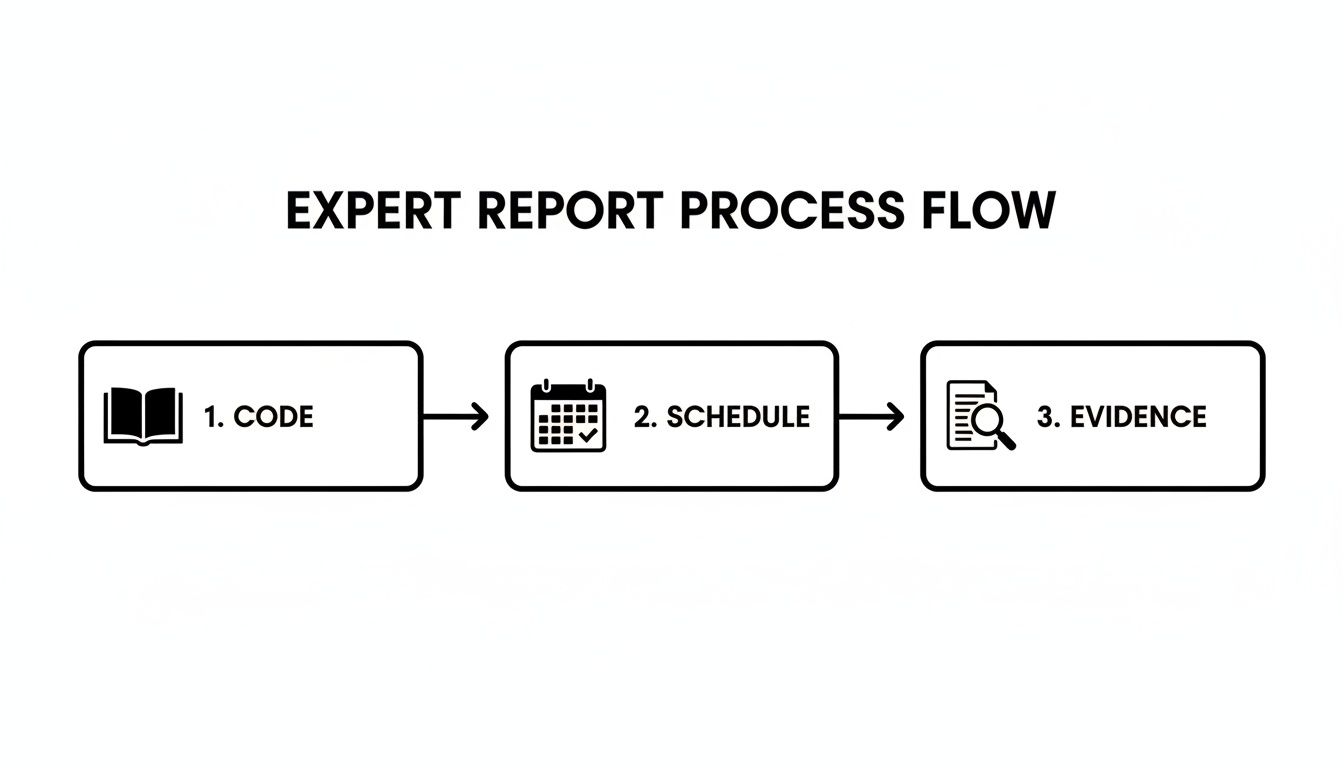
The process illustrated above ensures every single claim you make is systematically tied back to building codes, organised cleanly in a schedule, and proven with objective evidence. It’s the blueprint for a strong NCAT case.
Once your application is lodged, NCAT will issue "Procedural Directions" that set the timeline and rules for the case. One of the most critical is Procedural Direction 3, which outlines exactly how expert evidence must be prepared and presented. It ensures all experts follow the Expert Witness Code of Conduct, reminding them that their primary duty is to the Tribunal, not the person paying them.
Your building consultant is pivotal at this stage, ensuring their report is fully compliant. With over 35+ years in the building industry, we know these procedures inside and out. From attending directions hearings to participating in expert conclaves and giving evidence at the final hearing, we guide clients and their legal teams through every step. We’re here to demystify the process and make sure your case is presented with absolute clarity and authority.
Your Questions on Roofing Disputes Answered
If you're caught in a roofing dispute, you're not alone. The questions can pile up fast, and the uncertainty is often the most stressful part. With our team's 35+ years on the tools in construction and over 15 years supporting clients in litigation, we've seen just about every roofing drama you can imagine.
Here are the answers to the questions we hear most often from homeowners, builders, and lawyers. We've kept them straightforward to give you the clarity you need.
How Long Do I Have to Claim for a Roofing Defect in NSW?
This is the big one. In NSW, the clock starts ticking the moment the work is considered legally complete, and the warranty periods under the Home Building Act 1989 are absolute.
You have a six-year window to claim for ‘major defects’. Think of issues so serious they make the building unsafe, unusable, or even threaten its collapse. A widespread, systemic waterproofing failure that compromises the structure would almost certainly be classed as 'major'.
For everything else—what the Act calls ‘non-major’ defects—you have just two years. This is where most roofing problems fall, like minor leaks from poorly fitted flashing or a few cracked tiles that are down to shoddy workmanship.
Getting this classification right is everything. If you miss the deadline, your right to make a claim is gone for good. This is exactly where an expert building consultant comes in—they can assess the defect against the Act's specific definitions and tell you which warranty period applies to your case.
What Is a Scott Schedule and Why Is It So Important?
A Scott Schedule is a special document—basically a highly structured table—that NCAT requires to keep building disputes organised. It’s designed to methodically list out every single defect being claimed, forcing both sides to address each problem point-by-point.
Think of it as the official scorecard for the dispute. It has columns for the defect claim, the builder’s response, the expert’s independent opinion, the recommended fix, and the estimated cost for that fix.
Its importance cannot be overstated. A well-prepared Scott Schedule prevents the case from descending into vague arguments. It becomes the foundational document for the Tribunal Member, allowing them to compare positions and make clear, evidence-based decisions. It is the backbone of an organised and persuasive case.
This format strips away the noise and focuses everyone on the facts of the roofing building dispute. You can see how we put these critical documents together by reading about our approach to the Expert Witness Report.
Can I Really Resolve This Without Going to NCAT?
Yes, absolutely. In fact, avoiding the Tribunal is almost always the best outcome for everyone. The first port of call should always be direct, professional communication with the builder. If that doesn't get you anywhere, NSW Fair Trading offers a free, mandatory mediation service that can be very effective at finding common ground.
But honestly, the most powerful tool for settling a dispute before it ever sees the inside of a tribunal room is a high-quality, independent expert report.
When you hand the builder a clear, unbiased report that details the defects, quotes the relevant Australian Standards, and lays out a costed rectification plan, the whole dynamic shifts. It’s no longer your word against theirs; it's a matter of documented, expert-verified fact. This is often all it takes to bring them back to the table for a serious negotiation. NCAT should always be your last resort, not your first move.
Of course, disputes can sometimes lead to negative online feedback for a contractor. Knowing how to handle these comments is vital for protecting a business's reputation. For some great pointers on professional communication, check out these examples for responding to negative reviews.
What Does an Expert Witness Report Cost?
There’s no single price tag. The cost for an expert report on a roofing dispute really depends on the specifics—how complex are the defects? How big is the property? Do we need to do any invasive testing, like controlled water tests or removing sections of the roof to see what’s going on underneath?
A simple visual inspection and report will cost less than a full, NCAT-compliant expert witness report that needs a detailed Scott Schedule, extensive photographic evidence, and itemised rectification costs.
The key is to view this as an investment, not just a cost. A rock-solid report from a seasoned consultant gives you the leverage you need to secure a fair settlement or a win at NCAT. That initial outlay can easily save you tens of thousands of dollars in botched repairs or lost claims down the track.
Always ask for a detailed fee proposal upfront that breaks down all the potential costs. You want complete transparency, with no surprises. That initial investment is what puts you in control.
Are you navigating a complex roofing building dispute? Don't go it alone. Awesim Building Consultants offers the independent, expert analysis you need to build a strong case and achieve a fair resolution. With over 15 years of litigation support experience, we provide NCAT-compliant reports and Scott Schedules grounded in decades of real-world construction knowledge. Contact us today to discuss your situation at https://www.awesim.com.au.