
Strata Waterproofing Responsibility NSW: Common Property vs Lot Owner and What Changes After a Defect Claim
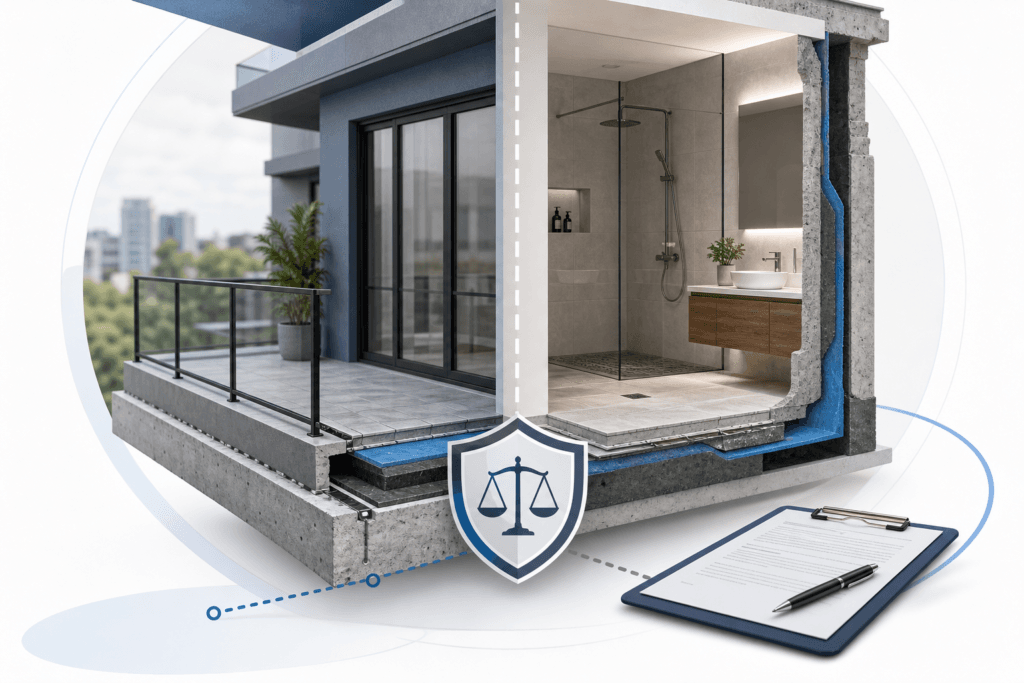
Strata waterproofing responsibility needs to be checked against the registered strata plan, relevant by-laws and the history of alterations. Record where water appears without assuming that this identifies the failed membrane or the party responsible. Use NSW Government strata guidance alongside an independent assessment of the defect.
- Who Actually Owns the Leaking Shower Wall?
- How NSW Law Defines Common Property in a Strata Scheme
- Common Strata Waterproofing Defects and Where They Originate
- What Changes After a Defect Claim Is Lodged
- The Role of a Forensic Waterproofing Inspection in Strata Disputes
- Scott Schedules and Strata Defect Claims
- When the Dispute Goes to NCAT
- Practical Steps If You Are Dealing With a Strata Waterproofing Dispute
- FAQs
- Getting the Responsibility Question Right Before Proceedings Begin
Who Actually Owns the Leaking Shower Wall?
Strata waterproofing responsibility in NSW depends on the property boundaries, relevant records and the circumstances of the work. A leak may affect several lots without revealing where it began. This guide explains the documents and inspection evidence needed to investigate the source and clarify the responsibility questions.
This article explains how NSW law draws that line, what changes legally and practically once a defect claim is lodged, and what kind of expert evidence you need to move a strata waterproofing dispute toward resolution.
How NSW Law Defines Common Property in a Strata Scheme
The starting point is the Strata Schemes Management Act 2015 (NSW) and the strata plan registered for the building. Common property is everything shown on the strata plan that falls outside a lot boundary. In most residential strata schemes, that means the building's structural elements, external walls, the roof, and shared services including drainage lines.
That boundary matters enormously for waterproofing because it determines who carries the legal obligation to maintain and repair. The owners corporation is responsible for common property. Individual lot owners are responsible for their own lot, including fixtures within it.
The Boundary Is Not Always the Wall Surface
A common misconception is that the wall surface visible from inside your unit is part of your lot. In many schemes it is not. The strata plan boundary often runs to the inner face of the structural wall, meaning the wall itself — including any waterproofing membrane applied to it — is common property.
This has direct consequences for shower waterproofing. If the membrane behind tiles in a ground-floor bathroom was applied to a structural slab or an external wall, it may sit on common property even though it is physically inside a private lot. Whether that membrane is common property depends on the registered strata plan and, in some cases, the building's by-laws.
Original Construction vs. Subsequent Lot Owner Works
Things get more complicated when a lot owner has renovated. A bathroom retiled in 2018 — by the current owner or a previous one — may have introduced a waterproofing system that replaced or modified what the developer originally installed. If that renovation was approved under a by-law and carried out to the owner's specification, responsibility for that waterproofing layer shifts to the lot owner, not the owners corporation.
This is one reason forensic waterproofing inspections need to establish not just where the failure is, but when the waterproofing was installed and by whom.
Common Strata Waterproofing Defects and Where They Originate
Waterproofing failures in strata buildings tend to cluster around a handful of locations. Understanding the typical failure points helps clarify the responsibility question before any report is commissioned.
Shower enclosures and wet areas. The most frequent source of inter-tenancy water damage. Failures here usually involve membrane delamination, inadequate upstands at wall junctions, or grout and tile movement that breaks the seal over time. Whether the membrane is common property or lot property depends on the strata plan boundary.
Balconies and terraces. These are almost always common property in NSW strata schemes, or at least the structural slab beneath them is. Membrane failures on balconies typically fall to the owners corporation to repair, even where the lot owner has exclusive use of the space.
Roof and roof penetrations. Clearly common property in most schemes. Failures at penetrations, flashings, and drainage outlets are owners corporation responsibilities, though the damage they cause to individual lots can generate separate claims.
Basement and carpark areas. Common property. Waterproofing failures in below-grade structures are among the most expensive to remediate and are frequently the subject of building bond claims under the Residential Apartment Buildings (Combating Dodgy Building Practices) Act 2020.
Plumbing within walls. Shared drainage stacks and supply lines running through walls or slabs are common property. Individual lot supply lines from the isolation valve to the fixtures are the lot owner's responsibility. A burst pipe on the shared stack is the owners corporation's problem; a failed flexi hose under your kitchen sink is yours.
What Changes After a Defect Claim Is Lodged
Once a formal defect claim enters the dispute resolution process, the practical and legal landscape shifts in several ways.
The Owners Corporation’s Duty to Act Becomes Enforceable
Before a claim, an owners corporation might defer maintenance or dispute whether a defect is their responsibility at all. Once a claim is filed at NCAT or a notice is issued under the Strata Schemes Management Act, the obligation to repair becomes enforceable on a specific timeline. Failure to act can result in orders compelling repair, or orders that the owners corporation pay for remediation the lot owner has already carried out.
Evidence Preservation Becomes Critical
Once a claim is active, the physical evidence needs to be documented before any repair work begins. This is where many disputes go wrong. A strata manager or lot owner arranges emergency repairs to stop the water ingress — entirely understandable — but in doing so they remove or obscure the evidence that would have established who was responsible and how the failure occurred.
An independent forensic inspection conducted before or immediately after emergency works, with photographs, moisture readings, and material sampling, preserves the evidentiary record. Without it, you are relying on what the parties say happened rather than what the building itself shows.
The Scope of the Expert’s Role Expands
In a straightforward repair situation, a building consultant might identify the defect and specify the remedy. Once litigation or tribunal proceedings are underway, the role changes. The report must now meet the standards required by the forum where it will be used.
For NCAT proceedings, and for any matter in the NSW District Court or Supreme Court, expert witness reports must comply with Schedule 7 of the Uniform Civil Procedure Rules 2005. Schedule 7 sets out the expert's duty to the tribunal or court rather than to the party who engaged them, requires disclosure of the facts and assumptions underlying each opinion, and demands that the expert acknowledge the limits of their expertise. A report that does not meet these requirements will not be accepted as expert evidence, regardless of how technically accurate it is.
The Role of a Forensic Waterproofing Inspection in Strata Disputes
A standard building inspection identifies visible defects. A forensic waterproofing inspection goes further: it investigates the cause and mechanism of the failure, not just its symptoms.
In a strata waterproofing dispute, the forensic investigation typically needs to answer several specific questions:
- Where exactly is the water entering the building or the affected lot?
- What is the source — the waterproofing membrane, the substrate, a penetration, or a drainage failure?
- Was the waterproofing installed in accordance with the applicable Australian Standard at the time of construction or renovation?
- Has the failure been caused by original construction defects, subsequent works, maintenance failures, or normal wear and tear?
- Does the failure originate in common property, within the lot, or at the boundary between them?
The answers determine who is responsible, what the remedy should be, and what it is likely to cost. In a dispute context, they also form the factual foundation for an expert witness report.
Awesim Building Consultants has provided forensic waterproofing inspection services across NSW since 1996, with on-site inspection capability from offices in Sydney, Tamworth, and Tweed Heads. Reports prepared for use in NCAT, District Court, or Supreme Court proceedings are written to Schedule 7 of the Uniform Civil Procedure Rules 2005.
Scott Schedules and Strata Defect Claims
When a strata defect dispute involves multiple items — whether across a single building or a large development with dozens of affected lots — a Scott Schedule is the standard format for presenting defects and their associated costs in a way a tribunal or court can use efficiently.
A Scott Schedule itemises each defect separately, describes it, identifies the responsible party, and sets out the cost of rectification. In NCAT proceedings, a well-prepared Scott Schedule allows the parties to identify which items are genuinely in dispute and which can be agreed, reducing hearing time and legal costs for everyone involved.
The schedule is not simply a list. Each entry needs to be grounded in an inspection finding and supported by a cost assessment that reflects current market rates for the remediation work described. A Scott Schedule prepared by a consultant with no current knowledge of construction costs, or one that describes defects without inspecting them, will be challenged and may be rejected.
When the Dispute Goes to NCAT
The NSW Civil and Administrative Tribunal hears most residential strata defect disputes, including waterproofing claims. NCAT has jurisdiction over disputes between lot owners and the owners corporation, and over building defect claims against developers and builders under the Design and Building Practitioners Act 2020 and the Home Building Act 1989.
For homeowners and strata managers navigating NCAT, the practical challenge is that the other side will almost always have legal representation and a building consultant of their own. An independent expert witness report that meets Schedule 7 requirements, prepared by someone with no financial interest in the outcome, is the most effective way to put your position on equal footing.
Awesim has prepared expert witness reports for NCAT proceedings across NSW, and principal consultant Glen Sim's case references are documented at awesim.com.au/glen-sim-expert-witness-case-references. If you are approaching a tribunal date and need a report that will hold up under cross-examination, the starting point is understanding what the report needs to contain and who is qualified to prepare it. Full details on Awesim's expert witness and Scott Schedule services are available at awesim.com.au.
Practical Steps If You Are Dealing With a Strata Waterproofing Dispute
Whether you are a lot owner, a strata manager, or a solicitor advising either party, the following sequence applies in most strata waterproofing disputes in NSW.
Step 1: Document before you repair. Photograph everything. Get moisture readings. If at all possible, engage a building consultant before any remediation work begins.
Step 2: Identify the strata plan boundary. Obtain a copy of the registered strata plan and confirm whether the affected area is common property or within the lot. If the boundary is ambiguous, that ambiguity may itself need to be resolved before the responsibility question can be answered.
Step 3: Check whether a by-law affects the position. Some by-laws allocate responsibility for specific elements differently from the default position under the Strata Schemes Management Act 2015. It is worth confirming this early.
Step 4: Commission a forensic inspection. An independent forensic waterproofing inspection establishes the cause and mechanism of the failure and provides the factual basis for any subsequent claim.
Step 5: Determine the forum. For most residential strata defect disputes in NSW, NCAT is the appropriate forum. For larger or more complex matters, the District Court or Supreme Court may be relevant. The forum determines the procedural requirements for expert evidence.
Step 6: Commission a compliant expert witness report. If the dispute is proceeding to NCAT or a court, the expert's report must comply with Schedule 7 of the Uniform Civil Procedure Rules 2005. A report that does not meet this standard will not be accepted as expert evidence.
FAQs
Who is responsible for waterproofing in a strata building in NSW?
Responsibility depends on where the waterproofing sits relative to the strata plan boundary. Waterproofing on common property — balcony membranes, roof membranes, basement waterproofing — is the owners corporation's responsibility. Waterproofing within a private lot, such as a shower membrane in a bathroom renovated by the lot owner, is generally the lot owner's responsibility. The registered strata plan and any relevant by-laws determine where that line falls.
Can a lot owner be responsible for waterproofing that is physically inside their unit?
Yes. If the membrane sits on the lot side of the strata plan boundary, or if it was installed by the lot owner or a previous owner as part of a renovation, the lot owner is typically responsible for maintaining and repairing it.
What is a forensic waterproofing inspection and how does it differ from a standard building inspection?
A standard building inspection identifies visible defects. A forensic waterproofing inspection investigates the cause and mechanism of the failure — including whether the membrane was installed correctly, what standard applied at the time, and whether the failure originated in common property or within the lot. In a dispute context, the forensic investigation provides the factual foundation for an expert witness report.
What is a Scott Schedule and when is it used in strata defect disputes?
A Scott Schedule is a structured document that itemises each defect, identifies the responsible party, and sets out the cost of rectification. It is used in NCAT and court proceedings to present multiple defects in a format that allows the parties and the tribunal to identify agreed and disputed items efficiently.
What does Schedule 7 of the Uniform Civil Procedure Rules 2005 require from an expert witness?
Schedule 7 sets out the code of conduct for expert witnesses in NSW courts and NCAT. It requires the expert to acknowledge that their duty is to the tribunal or court, not to the party who engaged them. The report must disclose the facts and assumptions underlying each opinion, identify the limits of the expert's expertise, and state whether any opinion is provisional or dependent on facts not yet established.
What happens if waterproofing repairs are carried out before a forensic inspection?
Repairs carried out before an inspection remove or obscure the physical evidence that would have established the cause of the failure and the responsible party. In a dispute context, this can significantly weaken a claim or defence. Where emergency repairs are necessary to prevent ongoing damage, the inspection should follow as soon as possible, and the pre-repair condition should be documented as thoroughly as possible before work begins.
How long does it take to get an expert witness report for a strata waterproofing dispute in NSW?
Timeframes vary depending on the complexity of the defects, the number of affected lots, and the access required for inspection. If you have a tribunal date set, engage a building consultant as early as possible to allow time for the on-site inspection, forensic analysis, and preparation of a compliant report. Awesim offers a free initial consultation at 1800 293 746 to discuss your timeframe and what the report will need to cover.
Getting the Responsibility Question Right Before Proceedings Begin
Strata waterproofing disputes are rarely straightforward. The physical failure, the legal boundary, the renovation history, and the procedural requirements for expert evidence all need to be understood before you can build a credible claim or defence.
The most common mistake is treating the responsibility question as something to argue at the hearing rather than something to establish with evidence beforehand. A forensic inspection, conducted early and documented properly, gives you a factual foundation that is far harder to challenge than a position built on competing accounts.
If you are dealing with a strata waterproofing defect in NSW and need independent expert advice, Awesim Building Consultants has been preparing litigation-grade reports across the state since 1996. The free initial consultation is the right place to start.

Related Posts

Strata Report: What Buyers Need to Read Before Signing
A strata report is the document that surfaces hidden obligations before you are legally committed to a purchase. A strata
Read More »
Inspection of Structures: What to Check Before You Buy
An inspection of structures examines a property's load-bearing elements, including foundations, walls, beams, roof framing, and floor systems, to identify
Read More »
Water Damage in Homes: How to Track Down the Source
Water damage in a home rarely announces itself at the source. A stain on the ceiling, a musty smell in
Read More »