
Swimming Pool Waterproofing: When a Leak Becomes a Formal Defect Claim in NSW
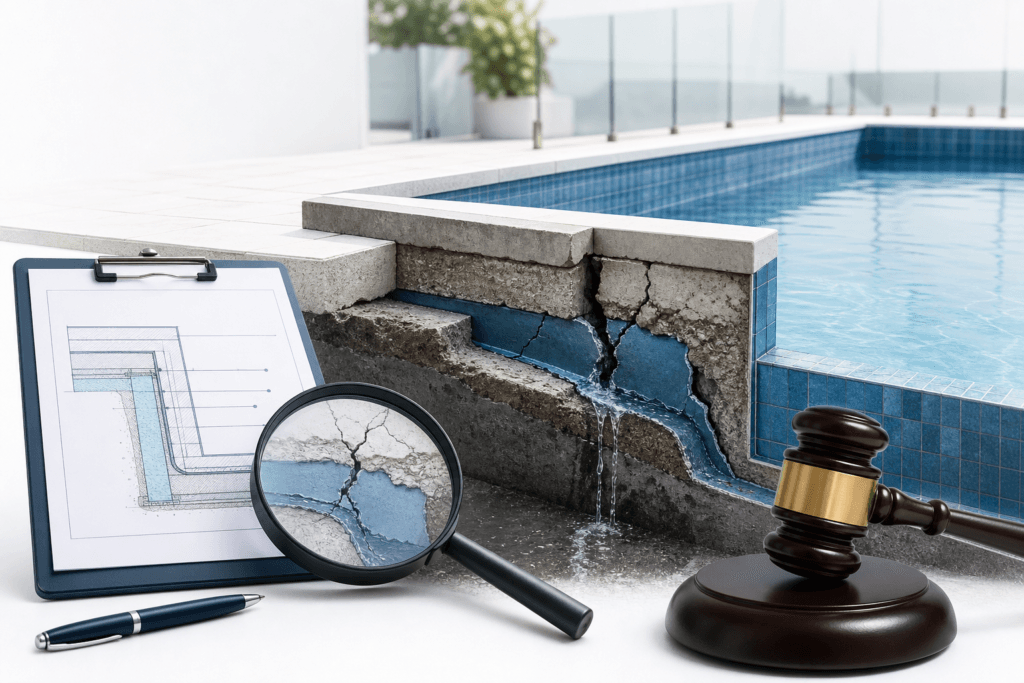
- What Counts as a Waterproofing Defect in a Swimming Pool?
- The Difference Between a Leak and a Documented Defect
- When Does a Pool Leak Reach NCAT?
- What a Forensic Waterproofing Report Needs to Cover
- Pool Waterproofing Defects in Strata Buildings
- Choosing an Expert Who Can Support a Formal Claim
- From Leak to Claim: A Practical Summary
- FAQs
A wet patch near the pool coping. A damp wall in the room below. Grass that stays saturated long after the last rainfall. These are the early signs of a failing waterproofing system, and for many NSW homeowners, they mark the start of a dispute that eventually ends up before a tribunal or court.
Knowing when a pool leak crosses from a maintenance issue into a formal building defect claim — and what evidence you need to support that claim — can save you months of delay and a significant amount of money.
What Counts as a Waterproofing Defect in a Swimming Pool?
Not every pool leak is a defect in the legal sense. A seal that has worn out after 25 years of normal use sits in very different territory to a pool that starts leaking within a few years of construction because the membrane was applied incorrectly or the wrong product was specified.
In NSW, a building defect generally involves a failure to meet the applicable standard of construction. For swimming pools, that standard is set by the relevant Australian Standards covering waterproofing and the specific requirements of the building contract. Where a builder has used a membrane product outside its manufacturer's specification, failed to prepare the substrate correctly, or omitted a required bond breaker at movement joints, the resulting leak is likely to be a defect rather than normal wear and tear.
That distinction matters because it determines whether you have a claim, who is responsible, and which forum can hear it.
The Difference Between a Leak and a Documented Defect
A leak is a physical observation. A documented defect is a legal finding supported by evidence.
To pursue a formal claim, you need to move from "the pool is losing water" to a position where you can demonstrate, with expert evidence, that a specific failure has occurred, that it is attributable to a breach of the applicable construction standard, that it caused the loss you are claiming, and that the cost to rectify it is a quantified, defensible figure.
This is where a forensic waterproofing inspection becomes essential. A forensic inspection goes well beyond a visual check. It investigates the cause of the failure, documents the extent of the damage, identifies the responsible construction element, and produces a report that can be used as evidence in formal proceedings.
A standard building inspection report, by contrast, is typically prepared to note the condition of a property at a point in time. It is not structured to withstand cross-examination, and it rarely traces a failure back to its root cause with the specificity that NCAT or a court requires.
When Does a Pool Leak Reach NCAT?
NCAT is the most common forum for residential building disputes in NSW. If your pool was built or waterproofed under a residential building contract, a claim for defective work generally falls within NCAT's jurisdiction under the Home Building Act 1989.
The process typically follows this sequence:
- You identify the leak and attempt to resolve it directly with the builder or waterproofing contractor.
- The builder disputes liability, fails to respond, or offers a rectification that does not fix the problem.
- You obtain an independent expert report documenting the defect and its cause.
- You file an application with NCAT, attaching the expert report as evidence.
- NCAT lists the matter for a directions hearing, and eventually a hearing on the merits.
At the hearing stage, your expert witness report needs to comply with Schedule 7 of the Uniform Civil Procedure Rules 2005 — the code of conduct governing how expert witnesses must conduct themselves and what their reports must contain. A report that does not meet Schedule 7 requirements can be rejected or given little weight, which undermines your entire case.
That requirement applies whether you are self-representing or instructing a solicitor.
What a Forensic Waterproofing Report Needs to Cover
For a pool waterproofing defect claim, a forensic inspection report should address:
The nature and location of the failure. Where exactly is water escaping? Through the shell, at penetrations, at the coping joint, or at the junction between the pool and adjacent structures?
The cause of the failure. Was the membrane the wrong type for the application? Applied at insufficient thickness? Was substrate preparation inadequate, or were movement joints omitted or incorrectly detailed?
The applicable standard. What did the contract or the relevant Australian Standard require, and how does the actual construction fall short?
The extent of consequential damage. Has water tracked into adjacent walls, footings, or structures? What secondary damage has the leak caused?
The rectification scope and cost. What work is required to properly fix the defect, and what does it cost? This figure needs to be defensible, not a rough estimate.
A report that covers all of these points, written by an independent expert with no affiliation to the builder or contractor, gives you the foundation for a credible claim.
Pool Waterproofing Defects in Strata Buildings
Swimming pool waterproofing disputes are particularly common in strata schemes, where the pool is common property and responsibility sits with the owners corporation. When a strata pool begins leaking into car parks, plant rooms, or lower-level apartments, the owners corporation is typically responsible for rectification.
If the pool was constructed or last waterproofed under a contract with a builder, and the failure occurs within the statutory warranty period, the owners corporation may have a claim against that builder. Strata managers dealing with this scenario face the same evidentiary requirements as individual homeowners: an independent forensic report capable of supporting a formal claim.
The complexity in strata matters is often greater. The damage path can be harder to trace, multiple contractors may have worked on the pool over its life, and the owners corporation needs to demonstrate that the failure is a defect rather than a maintenance issue it was responsible for addressing earlier.
Choosing an Expert Who Can Support a Formal Claim
The expert you engage needs to be able to do two things: conduct a technically rigorous forensic investigation, and produce a report that will hold up under cross-examination. These are not the same skill set, and not every building inspector has both.
An expert witness report for NCAT or court proceedings must comply with Schedule 7 of the Uniform Civil Procedure Rules 2005. The expert must acknowledge their overriding duty to the tribunal or court — not to the party who engaged them. The report must state the expert's qualifications, the documents and materials relied on, the assumptions made, and the reasoning behind each conclusion.
If the report does not meet these requirements, the other side will challenge it. The tribunal may give it limited weight or exclude it entirely.
Awesim Building Consultants prepares Forensic Waterproofing Inspection reports and Expert Witness Reports for NCAT, District Court, and Supreme Court proceedings across NSW. Operating since 1996, with offices in Sydney, Tamworth, and Tweed Heads, the firm writes all expert witness reports to comply with Schedule 7. There is no builder affiliation — a basic requirement for an opinion that will be accepted as independent.
From Leak to Claim: A Practical Summary
If you are dealing with a swimming pool waterproofing failure in NSW and considering a formal claim, the practical steps are:
- Document the leak as thoroughly as possible before any repair work is done. Photographs, water loss measurements, and any correspondence with the builder are all useful.
- If you can avoid it, do not allow the builder to carry out further work on the pool before an independent inspection has taken place. Rectification work can obscure evidence of the original defect.
- Engage an independent building consultant to conduct a forensic waterproofing inspection, and make clear from the outset that you need a report suitable for use in formal proceedings.
- Confirm the report will be written to Schedule 7 of the Uniform Civil Procedure Rules 2005 if you are heading to NCAT or a court.
- Check the limitation period. Claims under the Home Building Act 1989 are subject to statutory warranty periods, and leaving a claim too long can extinguish your rights.
The difference between a pool leak that costs you money and one that results in a successful defect claim almost always comes down to the quality and independence of the expert evidence behind it.
FAQs
What is a forensic waterproofing inspection and how does it differ from a standard pool inspection?
A forensic waterproofing inspection investigates the cause of a waterproofing failure, not just its presence. It traces the failure back to a specific construction defect, documents the extent of damage, and produces a report structured for use as evidence in formal legal proceedings. A standard pool inspection typically assesses the current condition of the pool without attributing cause or producing court-ready documentation.
Does a swimming pool waterproofing defect fall under the Home Building Act 1989 in NSW?
If the pool was constructed or waterproofed under a residential building contract, the statutory warranties under the Home Building Act 1989 generally apply. These include a warranty that work will be done in a proper and workmanlike manner and in accordance with the plans and specifications. A waterproofing failure within the warranty period may constitute a breach of those warranties.
What is Schedule 7 of the Uniform Civil Procedure Rules 2005 and why does it matter for my pool defect claim?
Schedule 7 is the code of conduct governing expert witnesses in NSW courts and tribunals, including NCAT. It requires the expert to acknowledge their duty to the tribunal rather than to the party who engaged them, and sets out what the report must contain. A report that does not comply can be challenged and may be given little weight, which weakens your case.
Can a strata owners corporation bring a pool waterproofing defect claim?
Yes. If the pool is common property and was constructed or waterproofed under a contract, the owners corporation can bring a claim for defective work in the same way an individual homeowner can. The evidentiary requirements are the same: an independent forensic report that documents the defect, its cause, and the cost of rectification.
How do I know if my pool leak is a defect or just normal wear and tear?
The distinction depends on the age of the pool, the nature of the failure, and whether the construction met the applicable standard. A forensic waterproofing inspection by an independent expert is the most reliable way to answer this question. If the failure is attributable to incorrect specification, poor workmanship, or non-compliant installation, it is likely a defect regardless of the pool's age.
Do I need an expert witness report before I file at NCAT?
You are not legally required to have one before filing, but in practice, a defect claim without supporting expert evidence is very difficult to prosecute. NCAT will expect expert evidence on the nature and cause of the defect and the cost of rectification. Obtaining the report before filing also helps you assess whether your claim has merit and what the likely rectification cost is.
How can I get a forensic waterproofing inspection for my pool in NSW?
Awesim Building Consultants conducts Forensic Waterproofing Inspection reports and Expert Witness Reports across NSW from offices in Sydney, Tamworth, and Tweed Heads. A free initial consultation is available by calling 1800 293 746 or through awesim.com.au.
A pool leak that goes undocumented rarely resolves itself. If you have reason to believe the failure is a construction defect, getting an independent forensic inspection done early gives you the best chance of recovering the cost of rectification through a formal claim.

Related Posts

Strata Report: What Buyers Need to Read Before Signing
A strata report is the document that surfaces hidden obligations before you are legally committed to a purchase. A strata
Read More »
Inspection of Structures: What to Check Before You Buy
An inspection of structures examines a property's load-bearing elements, including foundations, walls, beams, roof framing, and floor systems, to identify
Read More »
Water Damage in Homes: How to Track Down the Source
Water damage in a home rarely announces itself at the source. A stain on the ceiling, a musty smell in
Read More »