
Reinstatement Cost Assessment: A Guide for NSW
A reinstatement cost assessment is the professional estimate of what it would cost to rebuild a property after total or substantial destruction, not what the property would sell for. A defensible figure must include demolition and site clearance, elemental rebuild costs, construction escalation, professional and statutory fees, and relevant ancillary costs such as loss of rent or temporary accommodation.
A homeowner usually starts looking at this issue after an uncomfortable letter from an insurer, a renewal notice with a changed sum insured, or a major building dispute where nobody agrees what the work should cost. The same property can have a high market value but a much lower rebuild cost, or a modest sale price but an expensive reconstruction because of its site, materials, access, or compliance requirements.
In NSW, the important question isn't, “What is the house worth?” It's, “What figure would let the owner reinstate the building properly after a covered loss?” That requires measured inspection, current local cost information, and a report another professional can audit.
What a Reinstatement Cost Assessment Really Is
A weatherboard cottage in western Sydney is a useful example. The owners had arranged insurance using an online calculator several years earlier. After a major fire, the insurer's assessment indicated that the building would cost substantially more to restore than the sum insured allowed. The owners then faced the difference themselves, including costs that the calculator hadn't properly captured.
That is the exposure a reinstatement cost assessment is designed to identify before a claim. It's an independent, itemised estimate of the cost to demolish, rebuild, and recommission a property to the relevant pre-loss condition, using current labour and material prices in the local NSW market. The figure is prepared for insurance purposes under the sum insured approach, not as a market appraisal.
Authoritative Australian guidance describes an RCA as a detailed, site-checked report based on inspection, plans, and a full cost schedule. It should include demolition, elemental rebuilding, construction inflation during the policy period, professional and statutory fees, and loss of rent where relevant, as set out in Knight Frank's Australian insurance reinstatement guidance.
The five inclusions that matter
A defensible assessment accounts for:
- Demolition and site clearance, including removing the damaged structure and clearing the site.
- Elemental rebuild costs, covering the building's measurable components, from foundations to finishes.
- Construction escalation, allowing for price movement between assessment, approval, tendering, and the likely rebuild period.
- Professional and statutory fees, including design, engineering, certification, approvals, and related compliance work.
- Ancillary costs, such as debris removal, temporary accommodation, loss of rent, landscaping, and other site-specific allowances.
A builder's verbal estimate usually isn't enough. It may omit statutory fees, hazardous materials, escalation, or the cost of restoring ancillary works. A generic valuation has a different purpose altogether.
Owners rely on the RCA to set adequate cover. Insurers and brokers use it to test the sum insured. Lawyers and tribunals can rely on the underlying measurements and cost schedule when the property later becomes the subject of a quantum or rectification dispute. The report is therefore a technical risk-management document, not a guess dressed up as a number.
Reinstatement Cost vs Market Value vs Replacement Cost
These three figures answer different questions.
Reinstatement cost asks what it costs to restore the building on its existing site to an equivalent condition, subject to the policy wording and applicable requirements. Market value asks what a willing buyer might pay for the land and improvements. Replacement cost generally describes the cost of obtaining an equivalent new asset using current design, materials, and construction techniques.
The difference is easier to understand through a used-car comparison. A panel beater's repair quote is similar to reinstatement cost. A dealer's trade-in figure resembles market value. The showroom price of a current equivalent model is closer to replacement cost. They relate to the same vehicle, but they aren't interchangeable.
For a NSW house, reinstatement cost may include rebuilding on a difficult existing block, matching the original construction, removing damaged materials, and meeting relevant current requirements. Market value includes the land, location, demand, school catchments, views, zoning, and recent auction results. Replacement cost may assume a straightforward equivalent dwelling rather than the precise constraints of the existing site.
Why the distinction affects a claim
A property's land value can dominate its sale price without adding anything to the cost of reconstructing the building. Conversely, a low-value property can be expensive to reinstate if it has restricted access, non-standard construction, steep ground, heritage considerations, or hazardous materials.
Independent Australian valuation guidance distinguishes reinstatement cost from replacement cost and explains that reinstatement is limited by the relevant insurance basis. The practical distinction is set out in this Australian building insurance valuation guide.
| Basis | Reinstatement Cost | Market Value | Replacement Cost |
|---|---|---|---|
| Main question | What will it cost to restore the insured building? | What might the property sell for? | What will an equivalent new asset cost? |
| Land included | Normally no separate land value | Yes | Usually not as a separate market component |
| Existing site | Central to the calculation | One factor among many | May not reflect site-specific difficulty |
| Claim purpose | Sets or tests the sum insured | Not normally the claim rebuild figure | Useful comparison, but not automatically the policy basis |
| Typical evidence | Inspection, plans, elemental schedule, current rates | Comparable sales and valuation analysis | Current construction and design assumptions |
Insuring for market value can lead to unnecessary premium on a land-heavy property, while relying on a basic replacement estimate can leave out cost of demolition, compliance, and professional work. The policy wording still controls the claim, so the assessment should be prepared against that wording rather than against a convenient headline figure.
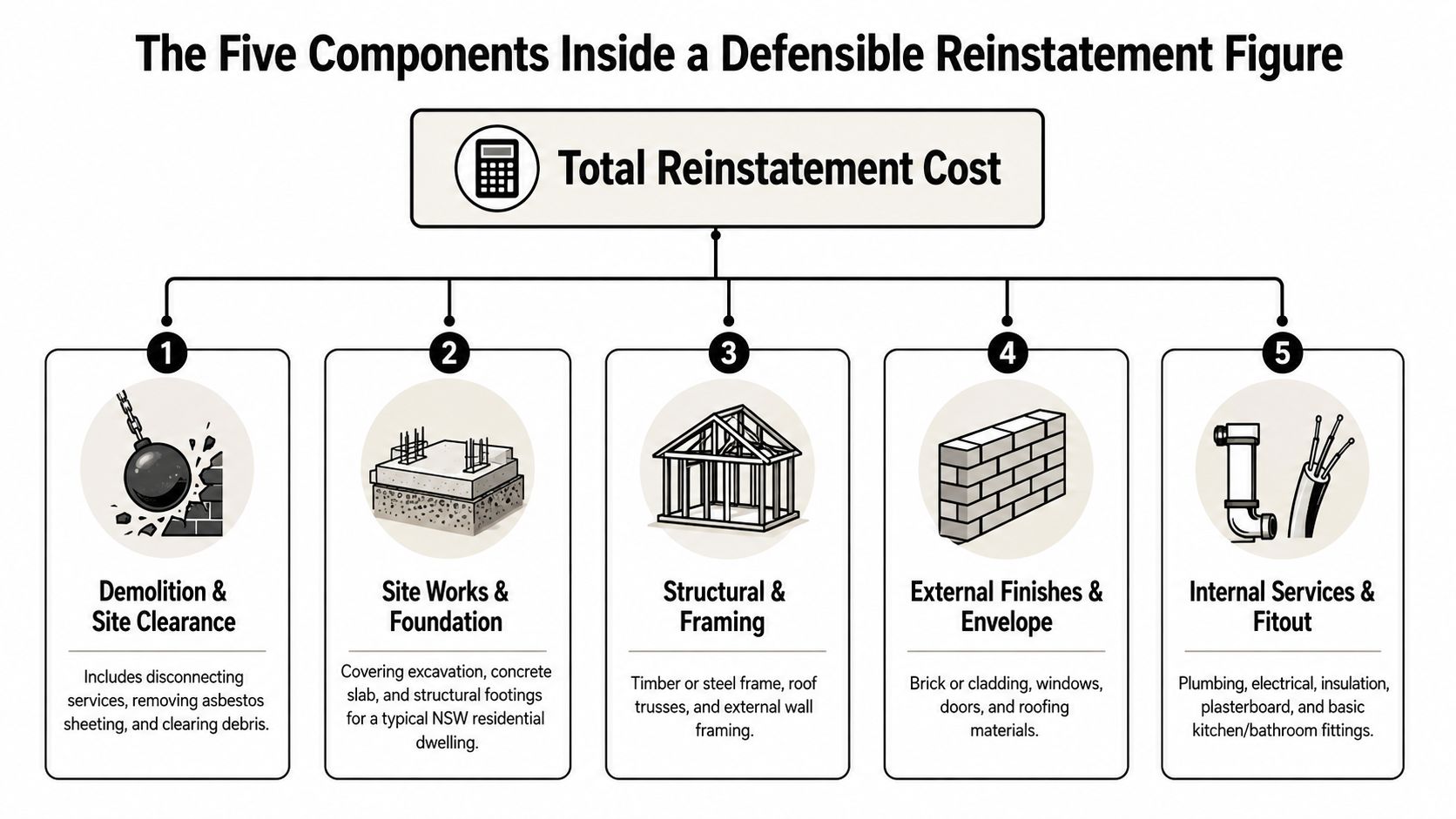
The Five Components Inside a Defensible Reinstatement Figure
A sound figure is built from components that can be identified, measured, tested, and explained. The total isn't just a floor area multiplied by a rate.
Demolition and site clearance
The first cost is often the one owners forget. A damaged building may require service disconnections, controlled demolition, asbestos handling, waste sorting, site clearance, and preparation for new work. Debris may be contaminated or difficult to remove, and access can determine the plant and labour needed.
Independent Australian guidance identifies demolition, site clearance, professional fees, and ancillary structures as necessary parts of a rebuild estimate, as explained in this Australian underinsurance guide.
Elemental rebuilding
This is the main construction schedule. It should identify the substructure, slab or footings, frame, roof structure, roof covering, external walls, windows, doors, internal linings, wet areas, joinery, finishes, electrical work, plumbing, and other services.
A weatherboard cottage, a rendered masonry house, and a multi-level brick dwelling shouldn't receive the same allowance because they have similar floor areas. Regional labour availability, site access, slope, material selection, and construction complexity all affect the result.
Escalation through the rebuild period
The inspection date isn't necessarily the date construction starts. Approvals, design, tendering, demolition, procurement, and contractor availability can all separate the assessment from the work. A defensible report states the assumed timing and applies a reasoned escalation allowance rather than freezing every rate at the inspection date.
Professional and statutory fees
A complete allowance can include building design, structural engineering, surveying, certification, council or approval charges, project administration, and the cost of preparing the assessment. Current compliance requirements can also affect design and approval work, particularly where the original building no longer reflects the standards applying to new work.
Ancillary items
Temporary accommodation, loss of rent, restoration of grounds, fences, driveways, retaining structures, debris removal beyond ordinary allowances, and other detached or external improvements can materially affect the claim outcome. The consultant should state whether each item is included, excluded, or subject to a separate policy limit.
Practical rule: If a cost would arise because the owner has to return the property to an equivalent usable condition, it deserves a clear place in the scope or an explicit exclusion.
How a Qualified Consultant Prepares and Validates the Assessment
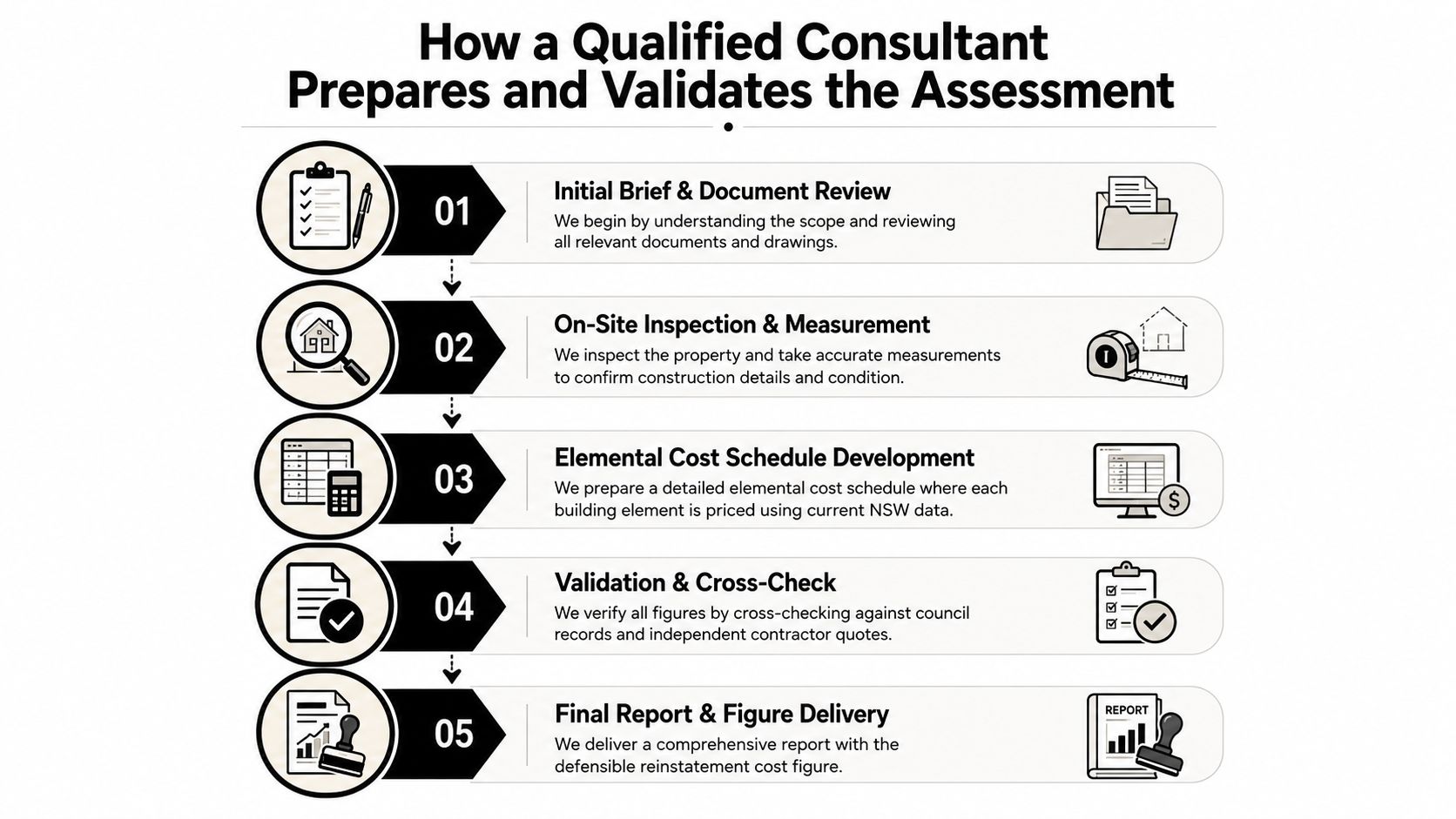
A credible assessment starts before the calculator. The consultant first clarifies the purpose, policy basis, property interest, valuation date, and expected rebuild assumptions.
Start with the site
The inspection records the building's construction type, measured areas, levels, roof form, external finishes, internal fit-out, services, detached structures, access, slope, retaining elements, and visible hazards. Photographs support the written observations, particularly where the report may later be reviewed by an insurer, solicitor, loss adjuster, or tribunal.
The consultant also considers what can't be seen. Plans, prior approvals, engineering records, strata material, photographs, and previous reports can reveal extensions, concealed construction, or site conditions that a short inspection won't establish.
Build the elemental schedule
Each building element is quantified and priced using current NSW labour and material information. The schedule should distinguish quantities from rates, and rates from allowances. That makes it possible to challenge one assumption without throwing out the whole assessment.
A report prepared for a complex property may need more investigation than a straightforward dwelling. Heritage fabric, steep access, unusual structure, bushfire exposure, flood-related requirements, or multi-level construction can all require specific allowances.
Validate the result
Validation involves cross-checking the assumptions against recognised construction-cost references, local market information, available contractor pricing, council records, and the physical evidence. Cordell Construction Cost Index data provides state-based Australian editions, including NSW material for benchmarking local rebuilding assumptions, as described by Cotality's Cordell Construction Cost Index.
The final report should explain escalation, professional fees, demolition, compliance, contingencies, exclusions, and the reason for any unusual allowance. A consultant should be able to show how the total was assembled, not merely announce the answer.
For broader work involving measured cost advice, a construction cost consultant may also be engaged where the assessment overlaps with project planning or dispute quantification.
The Three-Year Review Cycle and Why Costs Keep Moving
An RCA has a useful life, but it doesn't stay accurate forever. Construction labour, materials, approvals, compliance expectations, access conditions, and contractor capacity can change after the inspection.
The Royal Institution of Chartered Surveyors issued its current professional standard for Reinstatement Cost Assessment of Buildings on 19 June 2024, providing a contemporary benchmark for surveyors preparing these reports. Australian practice also commonly uses a three-year full assessment cycle, with interim indexation between full inspections, as described in the industry guidance cited in this RICS professional standard.
Indexation is useful, but it isn't a substitute for inspection
Indexation can move a sum insured between formal assessments. It can't see a new extension, a converted garage, a changed finish, deteriorated access, a newly identified hazard, or a shift in the likely reconstruction method. It also may not reflect the precise labour and material conditions affecting a particular NSW locality.
That distinction matters because underinsurance provisions can reduce a claim where the insured amount is below the relevant rebuilding figure. The owner may then need to fund the gap, even if the policy has been renewed and an indexation adjustment was applied.
| Review point | What should be checked | Why it matters |
|---|---|---|
| Initial assessment | Existing building, scope, policy basis, site conditions | Establishes the starting sum insured |
| Interim renewal | Index movement and policy wording | Keeps the figure moving between inspections |
| Three-year review | Fresh site inspection and elemental costing | Tests whether the original assumptions remain sound |
| After building work | Additions, alterations, upgraded finishes | Prevents improvements from sitting outside the sum insured |
| After major site change | Access, retaining work, hazards, approval requirements | Captures new reconstruction constraints |
Owners should trigger an interim review after an extension, substantial renovation, change in use, major improvement, or a significant change in construction conditions. Waiting for the next routine renewal can leave an altered property insured against an outdated description.
Common Pitfalls That Leave NSW Owners Underinsured
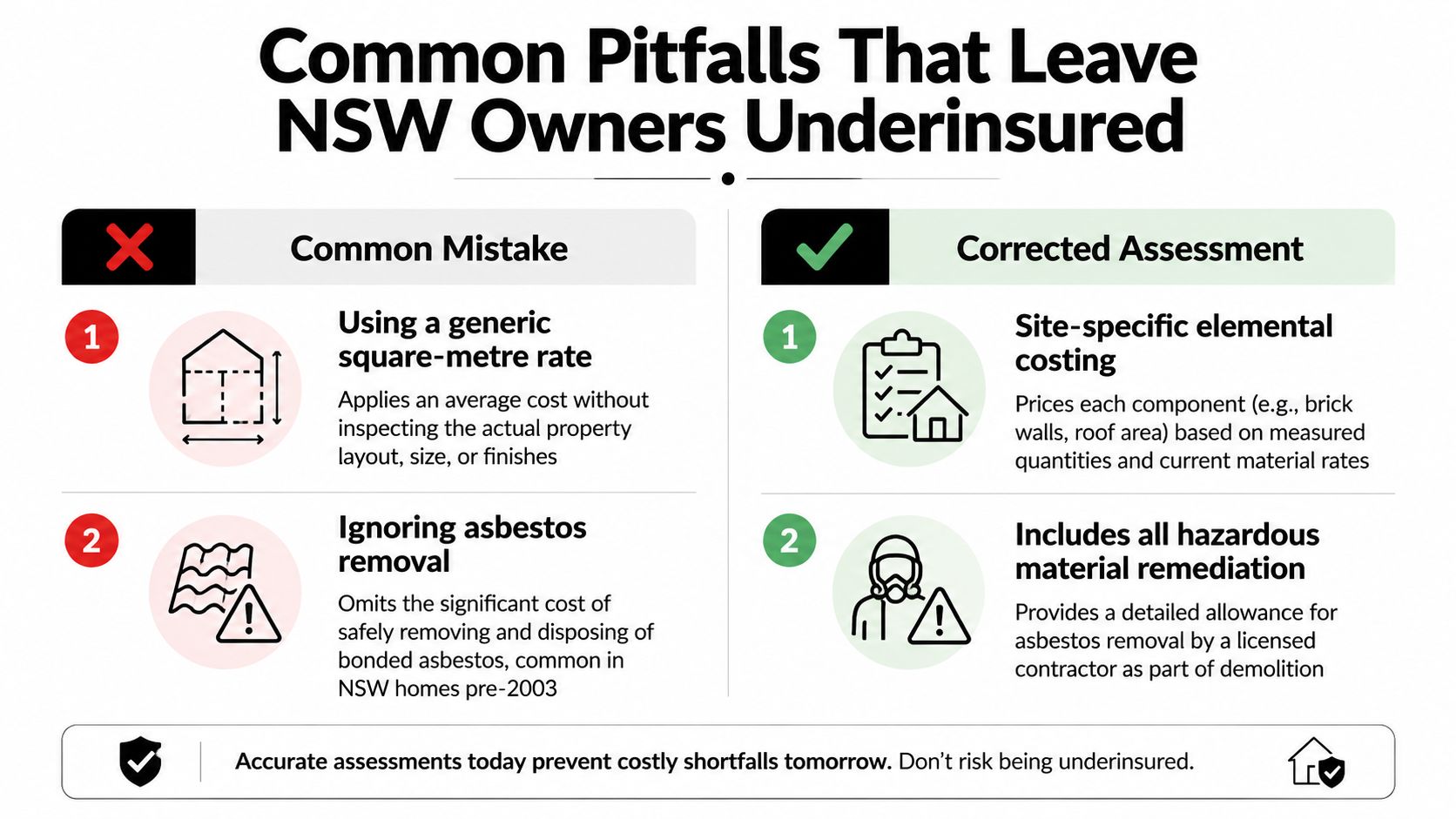
The most common mistake is treating a property as a mathematical average. A square-metre rate may be a useful sense check, but it can't describe every dwelling accurately.
A consultant inspecting a Sydney, Newcastle, or Wollongong property needs to account for layout, storeys, finishes, access, slope, construction type, external works, and site constraints. A narrow terrace with difficult material handling may behave very differently from a single-level house with clear access, even where their floor areas appear similar.
What weak assessments leave out
- Generic rates: A broad allowance can ignore unusual structure, premium finishes, difficult access, or the actual geometry of the building.
- Demolition and hazardous materials: Asbestos removal, service disconnection, contaminated waste, and site preparation need explicit treatment.
- Professional fees: Design, engineering, certification, approvals, and project-related costs shouldn't disappear into an unexplained percentage.
- Frozen pricing: Rates at inspection date may not represent the cost when rebuilding begins.
- Compliance obligations: Current NCC requirements and site-specific bushfire, flood, energy, or planning controls can change the work required.
An online estimate can be attractive because it is quick and cheap. It won't usually provide the measured evidence or assumptions needed when a claim is challenged.
A proper report also avoids false precision. Where information is unavailable, the consultant should identify the limitation, make a reasoned allowance, and explain what further evidence would change the figure. That is more useful than presenting a neat total unsupported by a schedule.
The best test is simple. Ask whether the report tells an insurer, builder, lawyer, or tribunal exactly what has been included and why. If it doesn't, the number may look authoritative without being defensible.
Where Reinstatement Assessments Meet NCAT Disputes
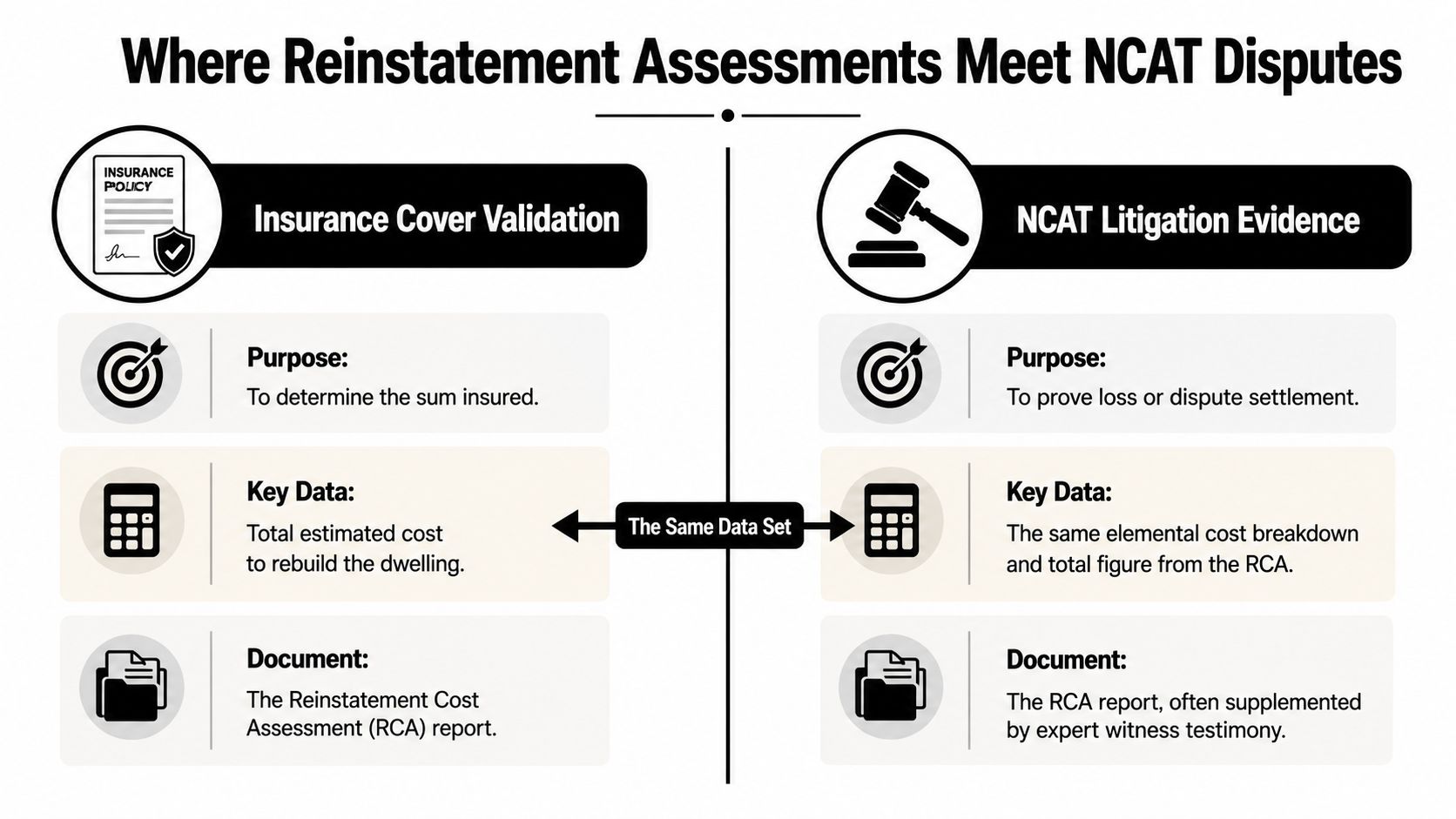
Insurance and building disputes often concern the same physical facts. The floor area, construction type, damaged elements, access constraints, and reasonable cost of work don't change because the audience changes from an insurer to the NSW Civil and Administrative Tribunal.
An RCA prepared for cover validation can provide a strong starting dataset for a Scott Schedule, a competing quantum report, or an expert statement. It may need additional opinions for a dispute, particularly on causation, defects, contractual scope, or rectification methodology, but the underlying measurements and elemental costing can remain valuable.
Two uses for one disciplined evidence base
| Insurance use | NCAT dispute use |
|---|---|
| Establishes or tests the sum insured | Quantifies claimed loss or rectification work |
| Focuses on rebuilding the insured property | Focuses on the disputed scope and monetary outcome |
| Relies on policy wording and inclusions | Relies on pleadings, evidence, directions, and expert methodology |
| Presents a total with supporting allowances | Presents itemised issues, quantities, rates, and differences |
The connection is especially useful where an insurer disputes the claim quantum, an owner and builder disagree about cost to rectify, or a strata committee challenges a proposed scope of works. In each situation, the decision-maker needs more than a conclusion. They need a transparent path from observation to quantity, rate, allowance, and total.
What makes the evidence usable
NCAT's procedural materials identify Procedural Direction 3 as the expert-evidence direction, and its public guidance includes a Scott Schedule template for home building disputes. NCAT also records that the earlier direction was superseded on 11 September 2024 during the later direction cycle, so practitioners should check the current procedural material rather than rely on an old report format. The relevant information appears on NCAT's procedural directions and guidelines page.
An expert report should disclose the consultant's instructions, inspection date, documents reviewed, methodology, cost sources, assumptions, limitations, and calculations. Independence matters too. An expert isn't an advocate for the party who retained them.
A consultant who understands both insurance costing and building litigation can identify where the two scopes overlap and where they don't. That helps prevent a policy sum insured from being mistaken for a rectification entitlement, or a disputed repair estimate from being treated as the complete insurance rebuild figure. Guidance on the broader role of expert evidence in NSW building matters is available in this resource on residential building disputes and NCAT expert reports.
Commissioning a Reinstatement Cost Assessment in NSW
Start by defining the purpose of the assessment. An owner may need a full rebuild figure for a house, a partial reinstatement scope after damage, a strata building assessment, or evidence for a dispute. A lawyer may need the report to answer a defined quantum question. Those instructions produce different documents, even when they concern the same property.
Provide the current policy schedule, title and strata information where relevant, plans, approval documents, recent photographs, prior valuations, renovation records, and details of detached structures. Tell the consultant about known hazards, access restrictions, heritage controls, flood or bushfire exposure, and any claim or dispute already underway. Missing site information can affect both the scope and the assumptions behind the figure.
Ask what the report will contain
A useful appointment checklist includes:
- Independence: Confirm that the consultant can provide an impartial opinion rather than reproduce an insurer's figure.
- Inspection basis: Ask whether the report includes a physical inspection, measurements, photographs, and documented site constraints.
- Elemental schedule: Require the total to be traceable through quantities, rates, allowances, inclusions, and exclusions.
- Escalation treatment: Check the assumed rebuild timing and how construction-cost movement is handled.
- Professional and statutory fees: Confirm that design, engineering, approvals, certification, and related costs have been addressed.
- Ancillary works: Ask about demolition, debris, temporary accommodation, landscaping, fences, driveways, and other improvements.
- Dispute readiness: Confirm whether the same consultant can explain the calculations in an expert report or Scott Schedule if the figure is later challenged.
Fees vary with the property, scope, access, evidence available, and reporting standard. Independent Australian industry guidance states that insurance cost assessments can start from about $600 plus GST in metropolitan areas, while the final fee depends on complexity and the level of inspection and reporting required, as noted in the Australian underinsurance resource. Request a fixed-fee proposal that identifies the deliverables, inspection limits, assumptions, and reporting format rather than accepting an unexplained estimate.
A clear document trail helps owners, solicitors, brokers, and strata managers. Where several parties must review and sign property documents remotely, guidance on e-sign documents for closings can help organise approvals and records. For a broader explanation of professional report and inspection pricing, see this guide to building consultant fees in NSW.
35+ years in Building & Construction, with over 15+ years providing litigation support to homeowners, builders, and lawyers, gives Awesim Building Consultants practical experience across site investigations, Building & Construction Expert Witness Reports, and Scott Schedules. Email admin@awesim.com.au or call 1800 293 746 to discuss a defensible reinstatement cost assessment or related NSW building evidence, then visit Awesim Building Consultants to request an assessment.

Related Posts
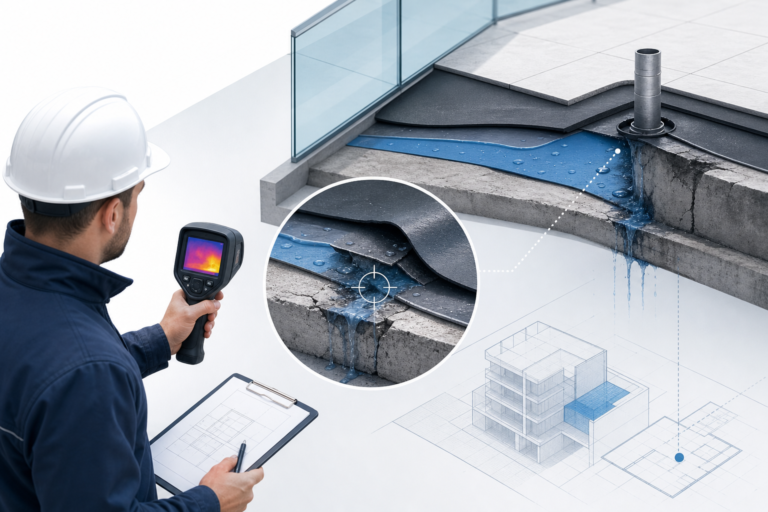
Waterproof Membrane Failure: How Inspectors Find the Cause
Waterproof membrane failure is diagnosed by tracing the water entry point, reviewing design documents, exposing the membrane for visual inspection,
Read More »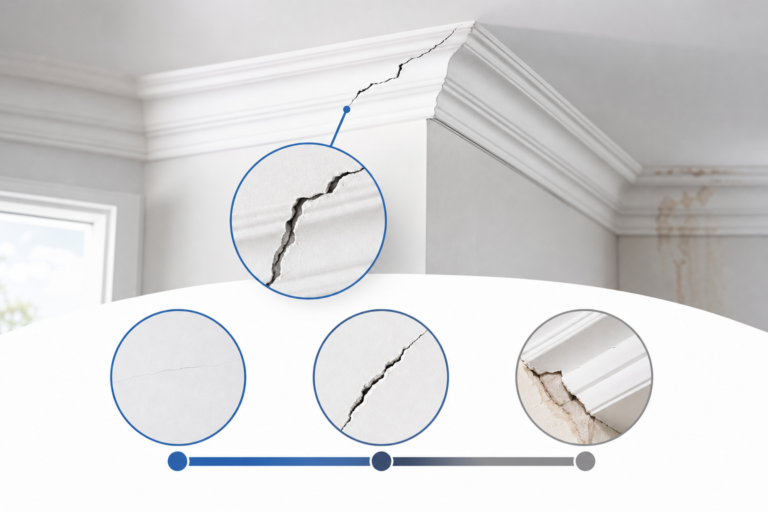
Cornice Cracking: How to Tell If the Damage Is Serious
Cornice cracking is one of the most common concerns Australian homeowners raise, and the hard part is not spotting the
Read More »
Digital Construction Consultant Australia: What They Do
A digital construction consultant in Australia manages the technology-driven side of building projects: BIM coordination, clash detection, asset data handover,
Read More »