
When to Brief a Construction Dispute Solicitor
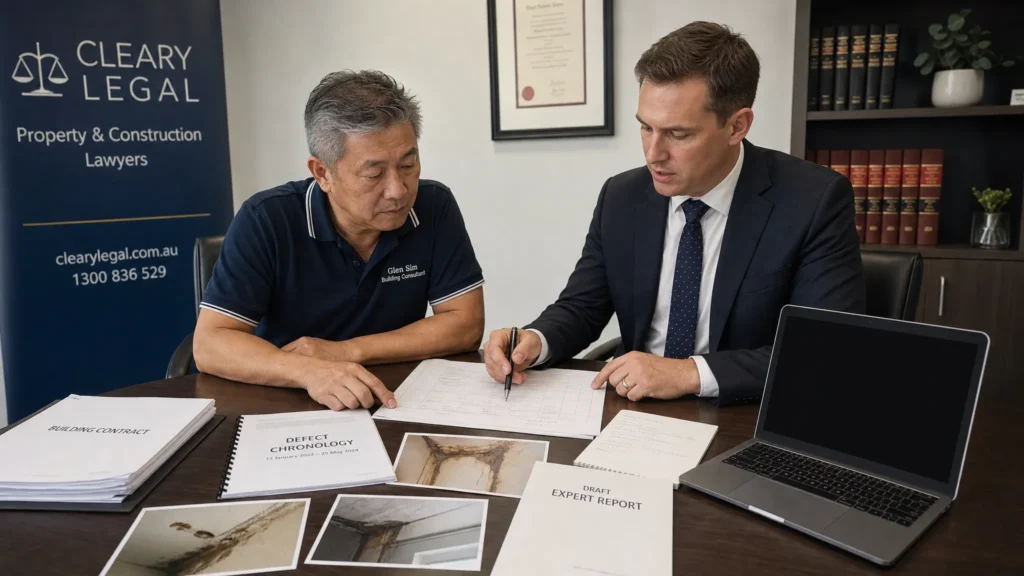
Construction disputes rarely become serious overnight. They usually begin with a practical problem, such as a leak, delay, unpaid invoice, disputed variation or incomplete work, then escalate when the parties cannot agree on responsibility, value or the right repair method.
The difficult question is timing. Brief a solicitor too late and you may have already missed procedural deadlines, made damaging admissions or allowed weak evidence to shape the dispute. Brief one too early for a minor issue and you may spend money before the problem has matured.
For NSW owners, builders and lawyers, the best answer is usually this: brief a construction dispute solicitor when the matter has moved beyond ordinary project management and into legal risk. At the same time, if the dispute turns on defects, workmanship, variations, delay impacts or rectification costs, legal advice should be supported by independent technical evidence.
Glen Sim, owner and director of Awesim Building Consultants, often sees matters become harder because expert input is sought only after positions have hardened. A solicitor can advise on rights, procedure and strategy. An independent building consultant can help explain what happened on site, what is defective, what work is incomplete, and what rectification or valuation evidence may be needed.
This article is general information for NSW building disputes and is not legal advice. For advice about your specific rights, deadlines and strategy, speak with a qualified solicitor.
What a construction dispute solicitor does
A construction dispute solicitor helps you understand and enforce your legal position. In a NSW building dispute, that may include interpreting the building contract, advising on statutory warranties, preparing or responding to notices, negotiating settlement, drafting pleadings, managing evidence, and representing or advising you in NCAT or court proceedings.
A solicitor is particularly valuable where the dispute involves legal concepts such as repudiation, termination, breach of contract, misleading conduct, payment claims, limitation periods, insurance issues, security of payment, or quantum meruit. These issues can affect whether you should keep negotiating, lodge an application, defend a claim, serve a notice, accept a settlement offer or proceed to hearing.
What a solicitor generally does not do is inspect the building as a technical expert. They usually cannot tell the tribunal whether waterproofing was installed correctly, whether a structural element complies, whether cracking is cosmetic or significant, or whether a claimed rectification scope is reasonable. That is where an independent expert report, Scott Schedule or quantum assessment can become essential.
If you are still working out the broader pathway, Awesim’s guide to the NSW building dispute process explains the usual steps before and during formal dispute resolution.
The clearest signs you should brief a solicitor now
Not every disagreement on a building project needs immediate legal intervention. A minor communication breakdown, small defect list or straightforward variation can often be resolved through written clarification and practical negotiation.
However, there are warning signs that a matter has become legally significant. If any of the following apply, it is usually time to speak with a construction dispute solicitor before taking further steps.
| Trigger | Why a solicitor matters | Why technical evidence may also matter |
|---|---|---|
| You have received a legal notice, letter of demand or NCAT application | Your response may affect your legal position, deadlines and settlement options | The allegations may need to be tested against site evidence, photos, contracts and standards |
| You are close to a limitation or statutory warranty deadline | Missing a deadline can affect whether a claim can be brought | Expert evidence may be needed quickly to identify defects and support the claim |
| A contract has been terminated or someone is threatening termination | Termination can carry serious legal consequences if handled incorrectly | An expert may need to assess incomplete work, defective work and site status at the time of termination |
| Payment is being withheld or claimed as a large debt | Legal advice may be needed on contractual payment rights, notices and recovery options | A valuation or quantum meruit assessment may be required to support or challenge the amount claimed |
| Defects are serious, expensive or disputed | The legal claim must be framed properly | An expert report can address cause, compliance, rectification scope and reasonable cost |
| Variations, delays or verbal instructions are in dispute | These disputes often turn on contract terms, authority and evidence | A consultant can help separate original scope from varied work and assess reasonable value |
| Settlement terms are being proposed | A solicitor can protect you from unclear releases or future liability | Expert input can help you avoid settling for a repair scope or amount that is unrealistic |
The key is not simply whether you are angry, disappointed or owed money. The key is whether the next communication or procedural step could affect your rights.
Statutory warranty and deadline risks in NSW
One of the strongest reasons to brief a solicitor early is timing. NSW residential building disputes often involve statutory warranties under the Home Building Act 1989. In general terms, statutory warranties may apply for six years for major defects and two years for other defects, subject to the legislation and the facts of the case.
You can review the Act directly through the NSW legislation website, including the Home Building Act 1989, but you should not rely on your own interpretation if a deadline is approaching. A solicitor can advise how the warranty periods, limitation issues and procedural requirements apply to your circumstances.
This matters because owners sometimes wait until defects worsen before acting. Builders sometimes wait too long before responding to complaints, assuming they can resolve matters informally later. By the time the matter reaches NCAT or court, delay may have affected both legal rights and the quality of evidence.
If you are unsure whether a defect is major, whether the relevant period has expired, or whether an application should be filed urgently, get legal advice promptly. If the issue is technical, arrange expert input in parallel so the legal advice is based on a clear understanding of the building issues.
What to prepare before the first solicitor conference
A solicitor can help you faster if your documents are organised. You do not need a perfect legal brief before making contact, but you should avoid arriving with scattered screenshots, incomplete invoices and no chronology.
Prepare a simple chronology that sets out the project timeline. Include the contract date, start date, major payment dates, variation discussions, key inspections, defect notifications, attempts to rectify, termination or suspension events, and any NSW Fair Trading or NCAT steps.
Also gather the core evidence that shows what was agreed, what was built, what was paid and what remains disputed.
- Building contract, plans, specifications and scope documents
- Variations, quotes, emails, text messages and site instructions
- Invoices, receipts, payment schedules and bank records
- Photos and videos of defects, incomplete work or site conditions
- Inspection reports, certificates, engineering advice or consultant reports
- Notices, letters of demand, Fair Trading correspondence or NCAT documents
- A list of the disputed items, including the amount claimed or rectification sought
Do not edit the facts to make your position look cleaner. A good solicitor needs to know the risks as well as the strengths. If a variation was verbal, say so. If access was refused, explain why. If a defect was repaired before being photographed, identify what evidence remains. Surprises late in the process are usually more damaging than difficult facts disclosed early.
When to involve an expert building consultant
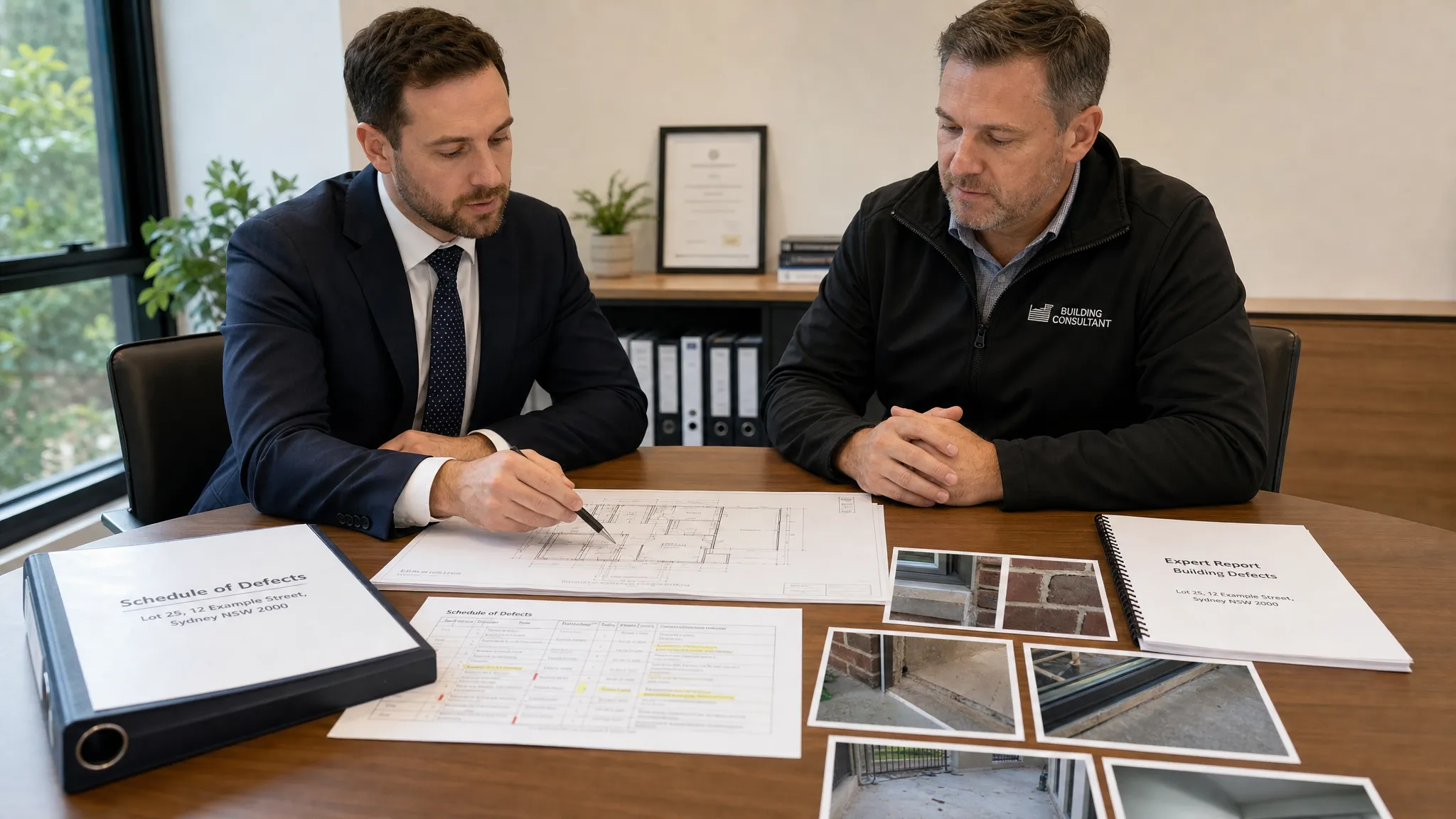
If the dispute is about legal entitlement only, a solicitor may be the main professional you need. But most construction disputes involve technical questions as well as legal ones. In those cases, the solicitor and expert should work together early enough that the evidence is coherent.
Technical evidence is often needed where the dispute involves defective work, incomplete work, non-compliance, water ingress, structural issues, poor finishes, alleged overcharging, disputed scope, rectification cost or reasonable value of work performed.
This is where Glen Sim’s role as an independent building consultant becomes important. Glen’s task is not to argue the legal case. It is to assist with clear, objective analysis of building issues so solicitors, owners, builders and decision-makers can understand the technical foundation of the dispute.
Awesim Building Consultants provides independent building dispute support across NSW, including expert witness reports, Scott Schedules, quantum meruit reports, NCAT dispute reports and building defect assessments. If you want to understand the expert’s role in more detail, this article on what a building consultant can do for your case explains how technical evidence can support dispute preparation.
For lawyers, early expert input can also help shape pleadings, identify missing evidence and test whether the client’s position is technically supportable. For owners and builders, it can prevent a dispute from being driven by assumptions rather than site evidence.
The best timing by dispute stage
The right time to brief a construction dispute solicitor depends on the stage of the dispute. The table below gives a practical guide, but legal advice should always be tailored to the circumstances.
| Dispute stage | Should you brief a solicitor? | Practical reason |
|---|---|---|
| Early disagreement about minor defects or communication | Sometimes | A short legal consultation may help if the relationship is deteriorating or money is being withheld |
| Formal complaint to NSW Fair Trading | Often, especially for larger claims | Legal advice can help you frame the issues before mediation or inspection steps |
| Defect list is growing and liability is denied | Yes | You may need advice on warranties, evidence, notices and the correct respondent |
| Letter of demand, termination notice or payment dispute | Yes | The next response may affect rights, admissions and commercial leverage |
| NCAT application is being prepared or has been served | Yes | Procedural steps, evidence timetables and claim framing become important |
| Directions require a Scott Schedule or expert evidence | Yes, with an expert | Poorly prepared schedules and reports can weaken an otherwise valid claim |
| Settlement deed or Calderbank-style offer is proposed | Yes | Settlement wording can affect future rights, costs arguments and liability |
| Hearing preparation or court proceedings | Yes | Advocacy, evidence management and procedural compliance are critical |
NCAT is designed to be more accessible than a court, but building disputes can still become complex. NCAT provides public information about building and construction disputes, including the types of matters it may hear. Depending on the matter, legal representation may require permission, so you should check the current rules and obtain advice if you are unsure.
Scott Schedules: when a solicitor and expert should coordinate
A Scott Schedule is often used in building disputes to organise each disputed item, the parties’ positions, evidence and claimed rectification costs. It can be highly effective when prepared properly, but confusing or unsupported schedules can create problems.
If a tribunal direction requires a Scott Schedule, do not treat it as an administrative form. It may become a central document in the dispute. A solicitor can help ensure the schedule aligns with the legal claim or defence. An expert can help ensure the technical descriptions, causation opinions, rectification scope and costing assumptions are supportable.
For example, a homeowner may describe an item as “defective bathroom”. That is rarely enough. The useful evidence may need to identify failed waterproofing, non-compliant falls, damaged finishes, the applicable standard, the required rectification method and the reasonable cost. A builder may respond that the issue is maintenance, owner damage, design-related or outside scope. Each position needs evidence.
If you have been ordered to prepare one, Awesim’s guide to what a Scott Schedule does in a building dispute is a helpful starting point.
Different considerations for owners, builders and solicitors
Homeowners
Homeowners often delay seeking advice because they hope the builder will return and fix the problem. That can be sensible for minor issues, but risky where defects are serious, the builder denies responsibility, access arrangements are breaking down, or warranty deadlines may be approaching.
If you are an owner, brief a solicitor when you need to understand your rights, the proper respondent, the remedy to seek and the correct forum. Brief an expert when you need to prove the defect, its cause, the appropriate repair method and likely rectification cost.
Builders
Builders should brief a solicitor when allegations threaten payment, licence reputation, termination rights, insurance position or future liability. A dispute can become more difficult if responses are informal, inconsistent or unsupported by site records.
If you are a builder, technical evidence may be needed to show that work complies, that alleged defects are maintenance or design issues, that variations were properly valued, or that rectification demands are excessive. A clear expert assessment can also help resolve matters before they become disproportionate.
Lawyers and solicitors
For solicitors, the key timing issue is whether the technical evidence is available early enough to inform the legal strategy. In building disputes, pleadings and schedules prepared without expert input may later need to be amended, narrowed or abandoned.
Briefing Glen Sim early can help identify the real issues, separate strong items from weak ones, and prepare evidence in a form that is more useful for negotiation, NCAT directions or hearing preparation. This is particularly important where the matter involves multiple defects, incomplete work, disputed variations or a quantum meruit claim.
The cost of waiting too long
Late legal advice can be expensive because it often requires urgent correction. A solicitor may need to respond to directions, seek adjournments, repair defective pleadings, reconstruct a chronology or deal with evidence that should have been gathered months earlier.
Late expert evidence creates similar problems. The site may have changed, defects may have been covered up, repairs may have been completed without proper records, subcontractors may be unavailable, and photographs may not show the necessary detail. In some cases, the best evidence is lost before anyone realises it was important.
Waiting too long can also affect settlement. Parties often negotiate from stronger positions when they understand the legal issues and the technical evidence. Without that clarity, owners may overstate claims, builders may underestimate exposure, and both sides may spend months arguing about issues that could have been narrowed earlier.
The purpose of briefing a solicitor is not always to start proceedings. Often, it is to avoid making the dispute worse.
Practical briefing checklist
Before you brief a construction dispute solicitor, prepare enough information to make the first advice session productive. Before you brief an expert, prepare enough information to make the inspection and report focused.
A strong initial brief usually includes the contract, scope documents, payment records, correspondence, photos, a chronology, a list of disputed items, and any deadlines or directions already issued. If the matter is in NCAT, include the application, points of claim or defence, orders, directions and hearing dates.
If you are a solicitor briefing an expert, clearly identify the questions to be answered. For example, ask whether particular work is defective, whether it complies with the contract or relevant standards, what rectification is reasonably required, and what cost or value assessment is needed. Avoid asking the expert to decide legal liability. That remains a legal question.
Frequently Asked Questions
Do I need a solicitor before contacting NSW Fair Trading? Not always. For minor issues, you may start by using the available complaint and dispute resolution pathways. However, if the claim is large, deadlines are close, termination is threatened, or the facts are complex, it is sensible to obtain legal advice before taking formal steps.
Should I brief a solicitor or building consultant first? It depends on the issue. If the urgent question is legal, such as limitation, termination or responding to a demand, speak with a solicitor first. If the urgent question is technical, such as whether work is defective or what rectification is required, expert input should be arranged promptly, often in parallel with legal advice.
Can I run an NCAT building dispute without a lawyer? Some parties are self-represented in NCAT, but building disputes can still involve complex evidence, deadlines and legal issues. Legal representation may also depend on NCAT rules and permission requirements. Even if you appear yourself, targeted legal advice can be valuable.
When is a Scott Schedule needed? A Scott Schedule is commonly needed when there are multiple disputed defects, incomplete works, variations or cost items. It helps organise each issue, the evidence and the parties’ positions. If one is ordered, it should usually be prepared with both legal and technical input.
Can Awesim Building Consultants give legal advice? No. Awesim provides independent building dispute support, including expert witness reports, Scott Schedules, quantum meruit reports and defect assessments. Legal advice should come from a qualified solicitor.
Need technical evidence before or after briefing a solicitor?
If your dispute involves defects, incomplete work, variations, rectification costs or reasonable value, legal strategy is stronger when it is supported by independent technical evidence.
Awesim Building Consultants provides NSW-wide building dispute support for homeowners, builders and solicitors. Led by Glen Sim, owner and director, Awesim prepares expert witness reports, Scott Schedules, quantum meruit reports and NCAT dispute reports that help clarify the issues before negotiation, directions or hearing.
To discuss the technical evidence your matter may need, contact Awesim Building Consultants.
Related Posts

Strata Report: What Buyers Need to Read Before Signing
A strata report is the document that surfaces hidden obligations before you are legally committed to a purchase. A strata
Read More »
Inspection of Structures: What to Check Before You Buy
An inspection of structures examines a property's load-bearing elements, including foundations, walls, beams, roof framing, and floor systems, to identify
Read More »
Water Damage in Homes: How to Track Down the Source
Water damage in a home rarely announces itself at the source. A stain on the ceiling, a musty smell in
Read More »