Meta description: NCAT Building Expert Witness Report requirements in NSW, including compliance, costs, process, and common mistakes that get reports rejected.
An NCAT building expert witness report is a formal, independent document prepared by a qualified expert to provide impartial evidence and opinion on building defects, helping the NSW Civil and Administrative Tribunal make informed decisions in construction disputes. In NSW, NCAT handles over 12,000 building dispute cases annually, about 68% involving defective workmanship or non-compliance with Australian Standards, and over 40% of expert reports are rejected when they fail independence requirements.
If you’re reading this, there’s a fair chance the project has already gone sideways. The work may be defective, incomplete, or disputed. You may have a builder blaming scope, an owner blaming workmanship, or a solicitor trying to turn a mess of photos, emails, invoices, and competing opinions into evidence NCAT can use.
That’s where people often get this wrong. They think any building report will do. It won’t.
A proper NCAT Building Expert Witness Report is not a standard inspection, not a defect list, and not a client-advocacy document dressed up as evidence. It has to meet legal and procedural requirements. It has to be independent. It has to show the factual basis for every opinion. If it doesn’t, the Tribunal may give it little weight or reject it altogether.
Awesim Building Consultants have 35+ years in Building & Construction, with over 15+ years providing litigation support to home owners, builders and lawyers. We provide site investigations, Building & Construction Expert Witness Reports and Scott Schedules. That practical background matters because tribunal work is never just about spotting defects. It’s about preparing evidence that survives scrutiny.
What Is an NCAT Building Expert Witness Report
An NCAT building expert witness report is a formal report prepared for use in a NSW building dispute. Its purpose is to help the Tribunal understand technical building issues by setting out observed facts, relevant standards, professional opinion, and rectification pathways in a structured and impartial form.
That last part matters most. The expert’s duty is not to the party paying the invoice. The duty is to the Tribunal.
A standard inspection report usually helps a buyer, owner, or builder understand a property’s condition. An expert witness report NSW is different. It must be written for legal proceedings, comply with NCAT’s expectations, and show clear reasoning from evidence to conclusion.
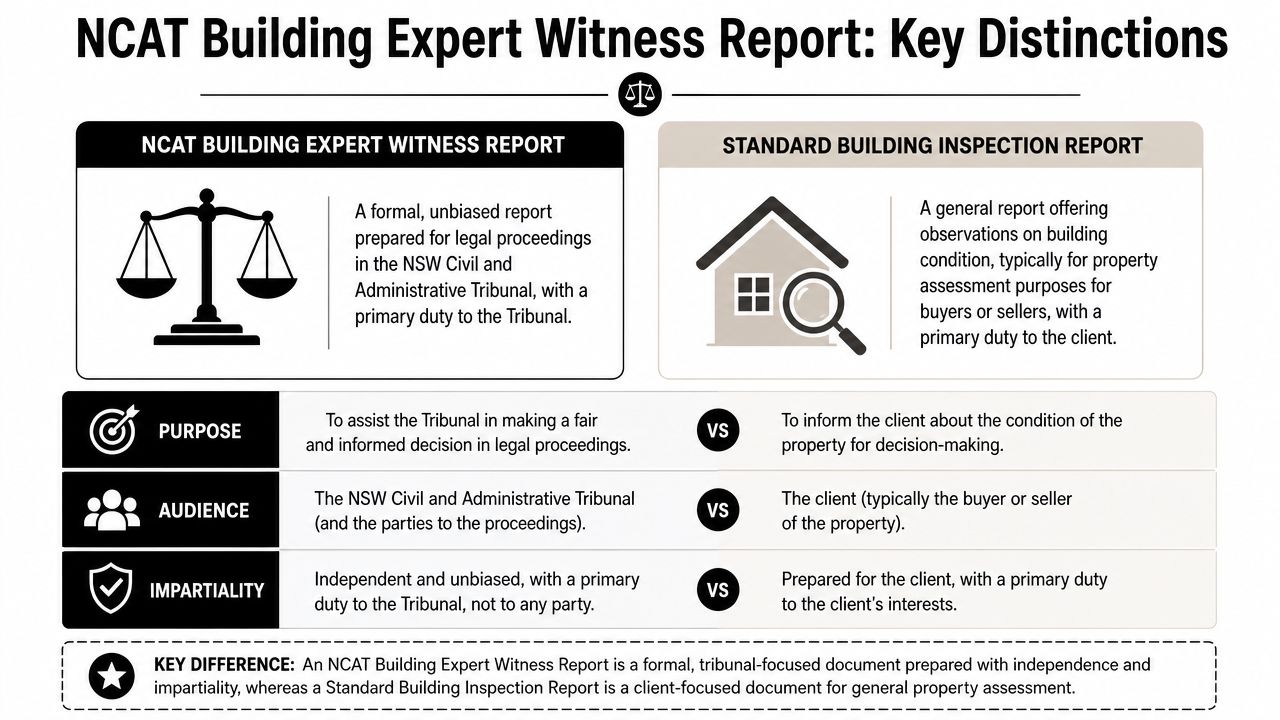
Standard report versus expert evidence
A standard report might say a bathroom has cracking, moisture staining, or poor falls.
An expert report for NCAT must go further. It should identify the exact location, describe the defect precisely, explain the likely cause, refer to the applicable standard, assess the impact, and define an appropriate rectification method. In practical terms, it must help NCAT decide what happened, why it matters, and what should be done about it.
Practical rule: If a report only says something is “poor workmanship” without tying that opinion to evidence and a recognised standard, it’s not ready for tribunal use.
The volume of disputes alone shows why this matters. In NSW, NCAT handles over 12,000 building dispute cases annually, with approximately 68% involving defective workmanship or non-compliance with Australian Standards, and over 40% of reports fail when they don’t meet independence criteria, as outlined in this NSW NCAT expert evidence overview.
Why this document carries legal weight
A building dispute NCAT expert report sits in a different category from routine consulting work because it becomes part of the evidentiary record. Lawyers rely on it. Tribunal members rely on it. The opposing party will test it. If needed, the author may be cross-examined on every assumption, omission, photograph, and standard reference.
That’s why experience on site and experience in dispute work are not the same thing. A competent building consultant must also understand how to present technical findings in a way the Tribunal can accept.
The Critical Role of an Expert Report in NCAT Disputes
Most NCAT matters don’t start cleanly. They start with competing stories.
The owner says the tiles are lifting because the substrate was wrong. The builder says the owner caused the problem through maintenance or later alterations. The strata manager wants clarity. The solicitor wants evidence that can be pleaded and defended. NCAT wants facts, not frustration.
When an expert report is usually needed
An expert witness report is commonly required where the dispute involves:
- Defective building work such as cracking, waterproofing failure, movement, non-compliant finishes, or incomplete compliance with the NCC or Australian Standards
- Incomplete works where one party says the job is substantially complete and the other says key scope items were never delivered
- Variations and cost disputes where the issue is not just whether work changed, but whether the result is compliant and what rectification or completion requires
- Pre-litigation matters where the report is used to support negotiations, NSW Fair Trading processes, or early legal advice
- Active proceedings where NCAT has already made directions for expert evidence, exchange of reports, or a Scott Schedule
How NCAT uses the report
The Tribunal uses the report to understand technical matters that ordinary evidence doesn’t resolve well. A member may use it to determine liability, assess whether work is defective or incomplete, evaluate rectification scope, and compare the competing opinions of each side.
That means the report often shapes more than the final hearing. It can influence settlement discussions, mediation posture, amended pleadings, and whether the parties narrow the issues properly.
A good report reduces argument because it forces each disputed item back onto evidence, standards, and method.
Pre-litigation versus during proceedings
Before proceedings, a report can clarify whether a claim is worth bringing at all. During proceedings, the same report must do more. It must fit the Tribunal’s directions, answer the issues in dispute, and withstand attack.
That’s the practical distinction many parties miss. A report that helps a client understand a problem is useful. A defect report for NCAT must also be procedurally usable.
Core Components of a Compliant Expert Witness Report
A report can be technically correct and still fail at NCAT because it does not show the Tribunal how the opinion was formed, what material was considered, and where the expert’s limits begin. I have seen parties spend good money on reports that looked polished but were easy to attack because they skipped basic procedural requirements.
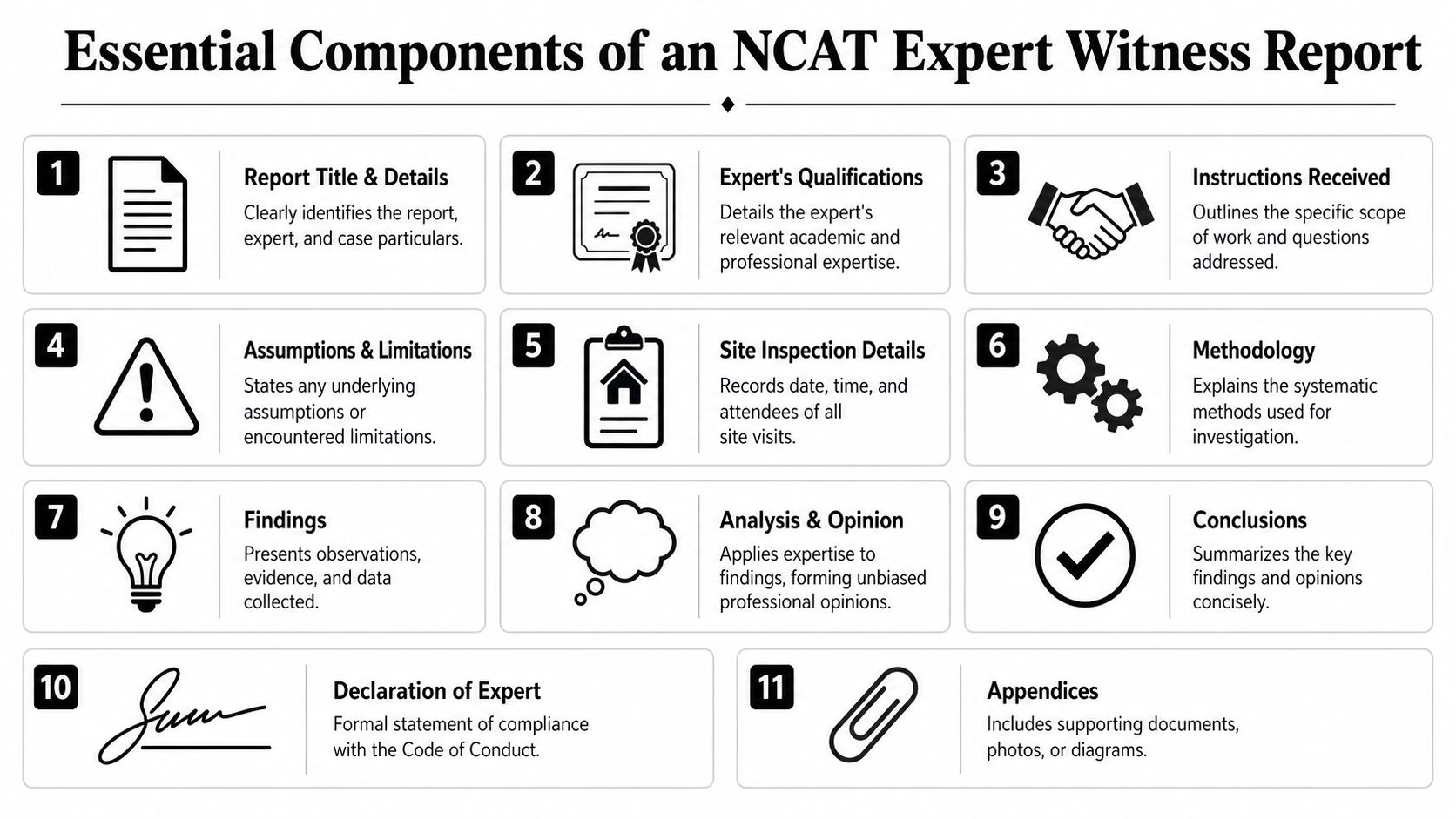
Expert’s qualifications and experience
Start with the author. NCAT needs to see the expert’s name, qualifications, registrations or licences where relevant, years of practice, and direct experience in the subject being addressed.
That last point matters. A person may have broad building experience and still be poorly placed to give opinion evidence on waterproofing failure, slab movement, balustrade compliance, fire separation, or structural cracking. The report should connect the expert’s actual experience to the defects in dispute. If that connection is weak, the other side will say the opinion goes beyond the expert’s field.
Instructions received
The report must set out who engaged the expert, what they were asked to do, and the precise questions they were instructed to answer. If the brief was limited, say so.
This protects the report. It shows whether the expert inspected the whole project or selected items only, whether the task was defect identification, causation, scope of rectification, response to another report, or preparation of a Scott Schedule. Ambiguity here creates room for cross-examination and wasted hearing time.
Documents reviewed, site observations, and factual basis
A compliant report needs a clear factual foundation. NCAT is not interested in broad statements like “poor workmanship throughout” or “the build is non-compliant” unless each conclusion is tied to observable evidence.
List the material reviewed. That usually includes the contract, plans, specifications, engineering details, approvals, variations, photographs, emails, invoices, certificates, and prior expert reports. Then set out what was observed at the inspection.
For each disputed item, record:
- the exact location
- what was seen or measured
- the condition and extent of the defect
- the likely cause, if causation can be expressed on the available evidence
- the standard, code, drawing, specification, or manufacturer requirement relied on
- the rectification work required, if that opinion is given
Where useful, attach marked-up photographs, sketches, or schedules. A member should be able to follow the issue without guessing what part of the building the report refers to. For parties checking format and layout against a practical expert witness report template in Australia, structure matters as much as technical content.
Assumptions, limitations, and areas not inspected
Every proper report states its limits. If roof framing was concealed, if waterproofing could not be inspected without removal of finishes, if levels were not surveyed, or if key documents were missing, say that plainly.
Do not overstate conclusions where the evidence is incomplete. NCAT will usually accept a qualified opinion if the limitation is disclosed. What causes trouble is an absolute conclusion built on a restricted inspection.
This is also where conflicts and independence should be managed carefully. Engagement terms, prior involvement, and reporting boundaries should be clear from the start, and businesses that want a formal framework can review expert advice on conflict policies.
Opinion and reasoning
The opinion section is where weak reports usually unravel. The expert must explain how the conclusion was reached, not just announce it.
Separate observed facts from inference. If the conclusion is that water ingress resulted from failed flashing installation, identify the observations that support that view and the standards or construction principles applied. If there is more than one plausible cause, address the alternatives and explain why one is preferred. That is what gives the opinion weight.
Rectification scope and costing basis
If the report includes rectification recommendations, they must be specific enough to be acted on. “Repair as necessary” is not enough. The report should identify the work sequence, whether demolition or access is required, whether associated trades are involved, and whether further investigation must occur before final scope is fixed.
If costing is included, the basis should also be stated. The Tribunal needs to know whether the figure is a quantity-based estimate, a market rate allowance, a builder quote, or an opinion subject to opening-up works. Vague costing can damage an otherwise sound defects report because quantum becomes impossible to test properly.
Signed declarations and procedural attachments
A compliant report is not complete without the formal parts. The expert should sign the report, date it, attach or refer to the required declaration, and include the materials relied on where appropriate. If photographs, test results, plans, or schedules are referenced, make sure they are attached and clearly labelled.
Many privately commissioned reports frequently fall short. They may help a homeowner understand the problem, but if the report is missing the formal elements NCAT expects, the other side can challenge its use or reduce its weight.
Upholding the Expert Witness Code of Conduct in NSW
The Expert Witness Code of Conduct is not optional paperwork. It is the foundation of admissibility and credibility in NCAT.

The duty is to the Tribunal
The expert must assist NCAT impartially. That means independent opinion, fair treatment of the facts, and no advocacy role for the client.
People don’t always like hearing that. They assume the expert is there to “prove their side”. That is exactly the wrong approach. Once the report starts arguing like a party submission, its value drops.
The fastest way to damage expert evidence is to write it as though the expert has joined one side of the fight.
The mandatory Formal Declaration in an NCAT report must be signed and must confirm that the expert has read and agrees to be bound by the Expert Witness Code of Conduct, affirming the duty to the Tribunal. If that signed declaration, together with the statement of independence and qualifications, is missing, the evidence can be rejected entirely, as explained in this NCAT report declaration guide.
Independence has to be visible on the page
Independence isn’t just a private mindset. It has to appear in the drafting.
That means:
- Balanced language that states findings without loaded commentary
- Acknowledged limitations instead of pretending the inspection answered more than it did
- Clear boundaries where the expert avoids giving opinions outside their field
- Transparent assumptions so the Tribunal can see what the opinion depends on
For parties and professionals who want a broader framework on managing independence issues, expert advice on conflict policies is worth reading. The same principle applies in expert evidence. Conflicts and partiality undermine trust before the technical issues are even debated.
A practical reference for the tribunal obligations themselves is this page on the NCAT expert witness code of conduct.
Commissioning a Report Process Costs and Timelines
Commissioning an NCAT report properly saves time, cost, and procedural trouble later. Commissioning it badly usually creates a rushed inspection, missing documents, and a report that answers the wrong question.
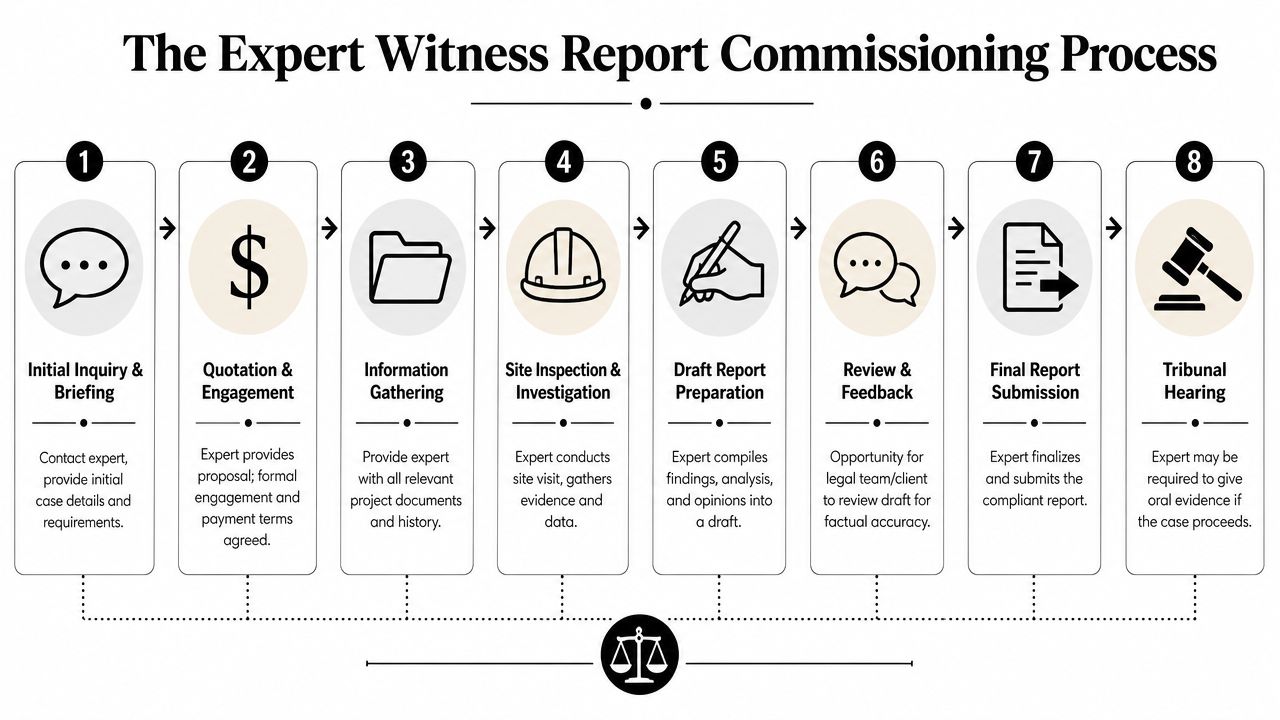
What the process usually looks like
A sound engagement usually follows this sequence:
- Initial briefing. The party or solicitor explains the dispute, site, documents available, and intended use of the report.
- Scope and quotation. The expert identifies what will be inspected, what documents are needed, and what deliverables are proposed.
- Document review. Contracts, plans, approvals, variations, photos, prior reports, and correspondence are reviewed before site attendance.
- Site inspection. The expert inspects the property, records observations, photographs defects, and notes access limits.
- Analysis and drafting. The evidence is matched against standards, causation is assessed, and rectification recommendations are framed.
- Final report. The completed report is issued in a compliant format, with declaration and supporting material.
What the costs actually cover
The cost structure is often misunderstood. The total cost for an NCAT expert witness report can exceed $6,500 + GST, comprising site inspection ($1,600 to $2,500), document review ($300 to $1,000), and report drafting ($1,000 to $3,000), as set out in this breakdown of NCAT expert witness report costs.
That breakdown matters because many clients assume there is one flat fee for “a report”. There isn’t. Inspection, document analysis, and report preparation are separate pieces of work.
A similar point applies in specialist investigations. If your matter includes drainage failure, blocked stormwater, or subsoil concerns, this expert drain inspection cost breakdown gives useful context on why technical evidence often involves layered costs rather than one simple charge.
Timelines and trade-offs
The actual timeframe depends on access, the volume of documents, the number of alleged defects, and whether the matter also needs a Scott Schedule or response to another expert.
Client advice: If you leave the instruction until just before exchange dates, you increase the risk of a thin report. Good evidence takes time because the expert has to inspect, review, analyse, and write with care.
For a fuller pricing discussion, this page on how much an expert witness report costs in NSW gives practical budgeting context.
Common Pitfalls and Why the Right Expert Matters
A case can be lost before the hearing starts. I have seen parties spend good money on a report that looked polished, only to have its value cut down because the author argued the client’s case, skipped key assumptions, or gave opinions outside their field. NCAT does not reward effort. It relies on evidence that is independent, clear, and properly reasoned.
Common mistakes that weaken a report
The failures are usually predictable.
- Advocacy dressed up as expertise. The report reads like submissions for one side instead of an independent opinion based on inspection, documents, and applicable standards.
- Loose defect identification. The author describes a problem in broad terms but does not fix the exact location, extent, probable cause, and consequence of the defect.
- Missing report mechanics. Instructions, documents reviewed, assumptions, limitations, methodology, and declarations are absent or hard to find.
- Opinions outside competence. A building consultant starts giving engineering conclusions, legal interpretations, or costing opinions without the qualifications to support them.
- Weak photographic evidence. Photos are too wide, too few, unlabelled, or disconnected from the written findings, so the Tribunal cannot tell what is being shown or why it matters.
Visual material often exposes the difference between an ordinary inspection report and a report that can survive challenge. A useful image identifies the location, shows scale, ties back to a stated defect, and supports the opinion being expressed. If the photo needs the client in the room to explain it, it is not doing enough work.
What the right expert does differently
The right expert handles the job like evidence, not marketing.
That means the report identifies the actual issue in dispute, separates observed facts from opinion, cites the relevant standard or contractual requirement, and stays within the author’s area of expertise. If the matter is challenged at hearing, the reasoning still stands because each conclusion can be traced back to an inspection note, a document, a measured condition, or a recognised building requirement.
I also look for judgment. Some defects are obvious. Others involve competing causes, incomplete records, destructive inspection limits, or prior repair attempts that obscure the original problem. An experienced expert makes those limits clear instead of overstating the conclusion. That honesty usually strengthens the report, because NCAT can see where the opinion is firm and where caution is required.
Awesim Building Consultants is one NSW provider that prepares site investigations, Building and Construction Expert Witness Reports, and Scott Schedules for homeowners, builders, and solicitors. The point is not the brand name. The point is to instruct someone who understands both construction defects and the procedural standard expected in tribunal evidence.
Why experience still matters
A person can know building work and still be the wrong expert for NCAT.
Tribunal work requires technical competence, disciplined report writing, and the ability to answer questions without becoming defensive, evasive, or argumentative. A weak expert can damage a sound case by conceding avoidable errors, overstating conclusions, or failing to explain the basis for an opinion under pressure.
That is where the financial risk becomes real. If the report is given little weight, you may need a replacement report, an adjournment, or further evidence. Each outcome adds cost and delay. In some matters, it also hands the other side a procedural advantage that should never have been given away.
Choose the expert the same way you would assess evidence for your own case. Check qualifications, report structure, tribunal experience, subject-matter limits, and whether the person can defend their reasoning in plain language. If those pieces are missing, the report is a liability, not an asset.
NCAT Expert Report FAQs and Final Advice
A common NCAT mistake is painfully simple. A party spends good money on a building report, turns up confident, and then finds the report carries little weight because it was written as a general inspection document rather than tribunal evidence. By that stage, the damage is cost, delay, and a weaker position on the day.
What is an NCAT expert witness report
An NCAT expert witness report is a formal opinion prepared for a building dispute before the Tribunal. It should set out the relevant facts, site observations, documents reviewed, applicable standards, reasoning, conclusions, and any rectification scope or cost opinion within the expert’s area of expertise.
The Tribunal uses that report to understand technical issues it cannot determine from submissions alone. A report that is clear, neutral, and properly reasoned helps the Member deal with the core issues. A report that overreaches, skips the reasoning, or ignores procedure creates avoidable problems.
Who can prepare an expert witness report for NCAT
The report should be prepared by a qualified expert with direct experience in the subject matter in dispute. In building matters, that usually means someone with substantial construction knowledge who also understands how expert evidence must be presented in legal proceedings.
I have seen technically capable people produce reports that fail under scrutiny because they write like advocates, not experts. NCAT is not looking for a hired gun. It is looking for an independent opinion from someone who stays within their discipline and explains each conclusion by reference to facts, standards, and inspection findings.
What does NCAT require from expert evidence
NCAT expects expert evidence to be independent, relevant, and properly explained. The report should identify the instructions received, documents reviewed, matters observed, assumptions made, limitations on the opinion, and the basis for every conclusion.
The expert also needs to confirm compliance with the Expert Witness Code of Conduct and sign the required acknowledgement. If that declaration is missing, or if the report reads like submissions for one side, the other party has an opening to challenge its weight or use.
That challenge can matter more than clients expect.
A weak report can force a reply report, an adjournment, further inspection costs, or cross-examination on issues that should have been settled on the papers.
Final practical advice
If you are dealing with a NSW building dispute, instruct the expert early and brief them properly. Give them the contract, plans, specifications, variations, photographs, relevant correspondence, and any prior reports before the inspection, not after it.
Make sure the report is prepared for NCAT from the start. Reworked inspection reports often carry the wrong structure, omit the code declaration, or fail to state the reasoning clearly enough. If the dispute also needs item-by-item identification of issues, defects, responsibility, and cost positions, ask whether a Scott Schedule is required and how it will be coordinated with the expert report.
Awesim Building Consultants prepares site investigations, Building and Construction Expert Witness Reports, and Scott Schedules for homeowners, builders, and solicitors. The point is practical fit. Use an expert who understands both defective building work and the procedural standard the Tribunal expects.
Final advice. Do not treat the report as a formality. In many matters, it is the foundation of the case. If the report is compliant, measured, and well supported, it can assist settlement and help the Tribunal decide the dispute efficiently. If it is careless or partisan, you may spend the hearing arguing about the report instead of proving the building defects.
If you need a compliant report for a NSW building dispute, Awesim Building Consultants can assist with site investigations, Building & Construction Expert Witness Reports, and Scott Schedules. To discuss your matter, email admin@awesim.com.au or call 1800 293 746.