
Construction Expert Witness Guide for NSW Disputes
You’re already past the point where polite letters will fix the problem. The deposit has been paid, the build has stalled, or the defects are starting to stack up, and every email from the other side seems to make the gap wider. In that moment, a construction expert witness isn’t just someone who gives an opinion, they’re the person who turns a messy building dispute into evidence a tribunal member or judge can test.
For NSW disputes, that difference matters. The building market is large, with the 2023 to 24 value of new residential building work at A$46.3 billion and alterations and additions at A$16.6 billion according to the Australian Bureau of Statistics figures cited in Expert Institute’s guide. When that much work is moving through the system, disputes over defects, delays, scope, and compliance are inevitable, and they often need an independent expert who can explain what was built, what should have been built, and what it will take to fix it.
When a Building Dispute Needs a Construction Expert Witness
A homeowner rings after months of silence from the builder. The slab is down, the roof is half-finished, or the waterproofing has failed, and both sides are trading angry letters about who caused what. At that point, the core issue usually isn’t emotion, it’s proof.
A construction expert witness becomes essential when the dispute stops being a conversation and becomes a question of technical causation. That means the tribunal or court needs someone who can look at the defect, the contract, the photographs, the approvals, and the site history, then explain whether the work complies with the relevant standard or not. In NSW, that technical explanation is often what separates a claim that sounds convincing from one that can survive scrutiny.
For solicitors, the trigger is usually straightforward. If the case turns on workmanship, incomplete work, latent defects, or whether a variation was authorised, a lay witness can describe what happened, but they can’t bridge the gap between the visible problem and the technical conclusion. That bridge is exactly where expert evidence earns its place.
Practical rule: if the dispute will turn on what the building should have been, not just what it looks like now, the expert needs to be involved early.
Awesim’s own guide on when to hire a building expert witness for disputes is useful because it matches the way these matters unfold, where the report is often the first document that makes the conflict legible. A good expert doesn’t just inspect damage, they help turn the site into usable evidence.
The timing point matters. Once parties start fixing defects informally, moving furniture, or doing partial rectification without records, the evidentiary trail gets thinner. That’s when a construction expert witness stops being optional and becomes the only reliable way to preserve what the dispute is really about.
What a Construction Expert Witness Actually Does
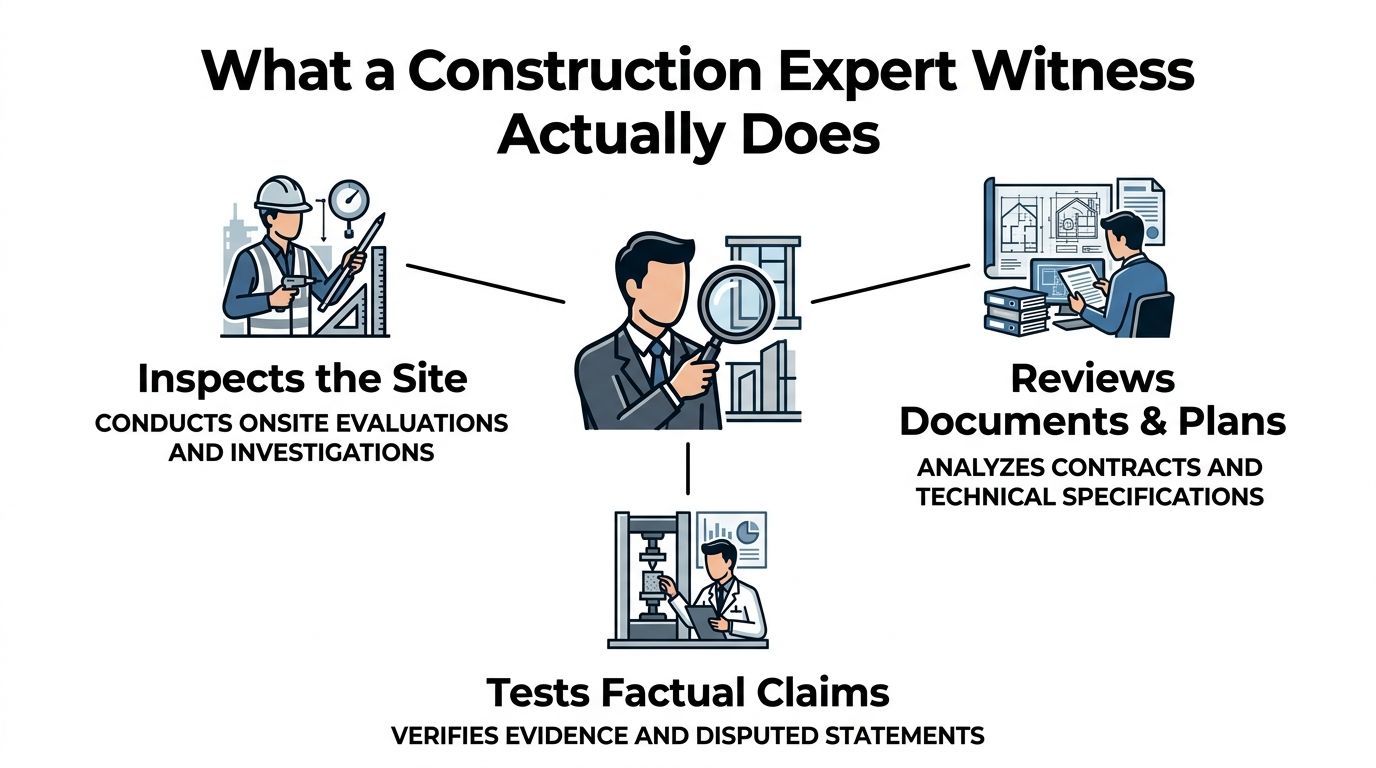
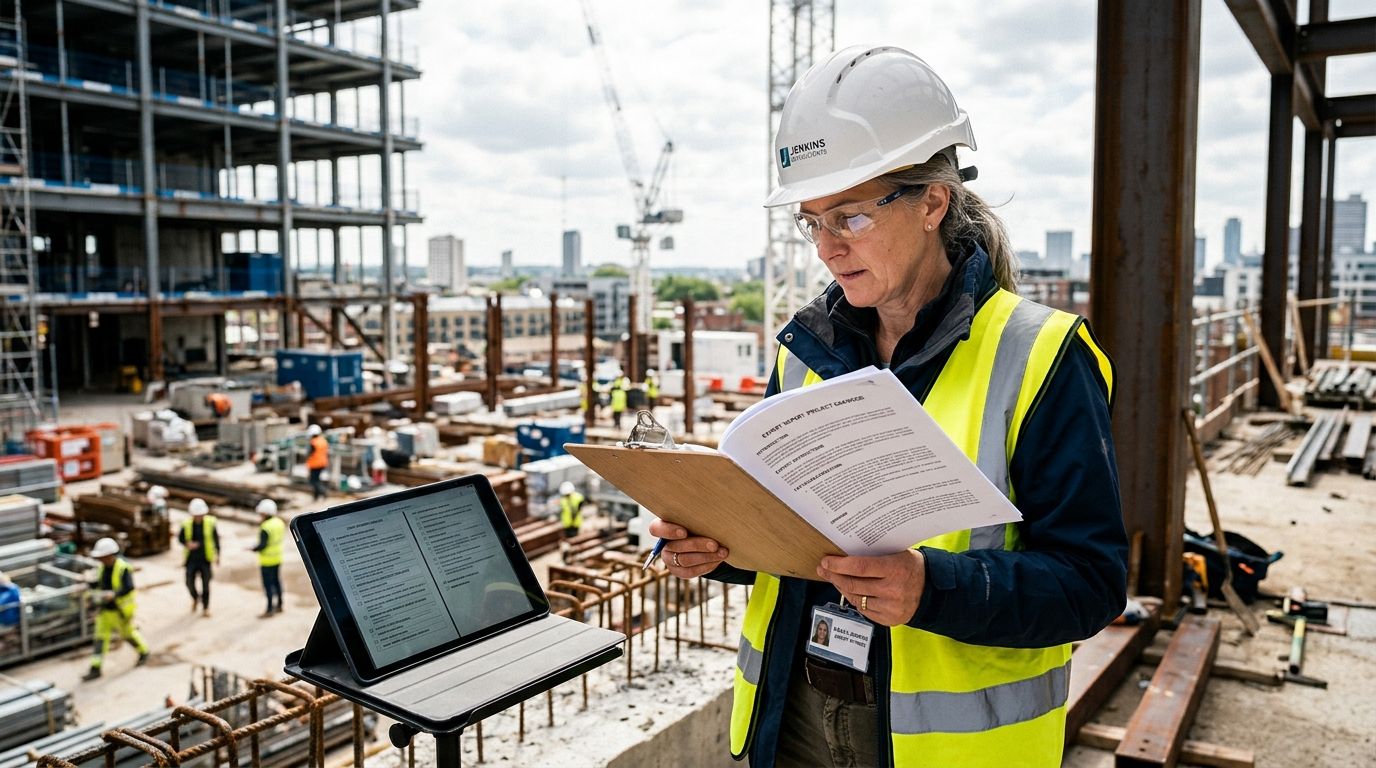
The role sounds simple until you do it properly. A credible construction expert witness inspects the site, reviews the paperwork, tests the competing claims, and then writes an opinion that can stand up in NCAT or court.
The work starts with the site
The inspection is not a casual walk-through. The expert is looking for defect symptoms, dimensions, workmanship patterns, material issues, and signs of sequencing problems, then recording them in a way that can be checked later. Photos matter, but so do measurements, dates, and the logic linking what is seen to what is alleged.
The documents matter just as much
The contract, plans, approvals, correspondence, repair quotes, and photos often tell the story the site can’t. A well-prepared report compares the physical condition against the documentary record, then identifies where the facts support the claim and where they don’t. That is why the expert’s independence matters so much, because the report must be built around evidence, not loyalty.
Under NSW expert evidence rules, the expert’s overriding duty is to assist the court impartially, and the report has to say that duty clearly. The expert isn’t there to argue the client’s case, they’re there to give an opinion the decision-maker can rely on. The NSW-focused requirements described by CCR Work reflect that basic rule, the expert must disclose factual assumptions, the basis of opinion, and any limits in expertise.
A good expert report reads like a careful chain of reasoning. A poor one reads like a brief for one side.
That distinction shows up immediately in conference and cross-examination. If the expert can separate fact from inference, explain the method, and stay within their expertise, the evidence tends to be usable. If they start sounding like an advocate, the report loses weight fast.
Qualifications and Evidence Standards That Hold Up
A credible expert is built on two things, practical building experience and disciplined evidence handling. In NSW disputes, formal credentials help, but they don’t replace hands-on knowledge of how buildings are put together, where failures happen, and how to read the signs on site.
What gives the opinion weight
The best experts usually understand the National Construction Code, relevant Australian Standards, contract administration, and site sequencing. They also know when they’re dealing with a workmanship issue, a design issue, a compliance issue, or a combination of all three. That mix matters because a tribunal member needs a clear path from the defect to the conclusion, not a blur of industry language.
Evidence quality is the key filter. The expert needs a clean line from the documents reviewed, to the inspection notes, to the opinion. If photographs are undated, instructions are vague, or approval documents are missing, the report becomes weaker because the conclusions rest on assumptions rather than records. Awesim’s NSW guidance on site safety guards sits in the same practical universe, because site control, access, and preservation of evidence all affect what can still be proved later.
| Standard | What It Means | Why It Matters |
|---|---|---|
| Fact | What the expert actually observed or was given | Keeps the report anchored in evidence |
| Inference | What the expert concludes from those facts | Shows the reasoning process |
| Methodology | How the site was inspected and analysed | Lets the court test reliability |
| Assumptions | What the opinion depends on | Makes limits visible |
| Document chain | Plans, photos, approvals, correspondence | Protects the evidentiary trail |
The best reports also state what they can’t determine. That honesty is not a weakness, it’s what makes the opinion credible. If the documents are incomplete, the expert should say so plainly and explain the effect on confidence.
For comparison, a technical opinion only becomes useful when it can be checked against the file, the site, and the standards. That’s the standard that survives cross-examination.
How NCAT and the Courts Use Expert Evidence
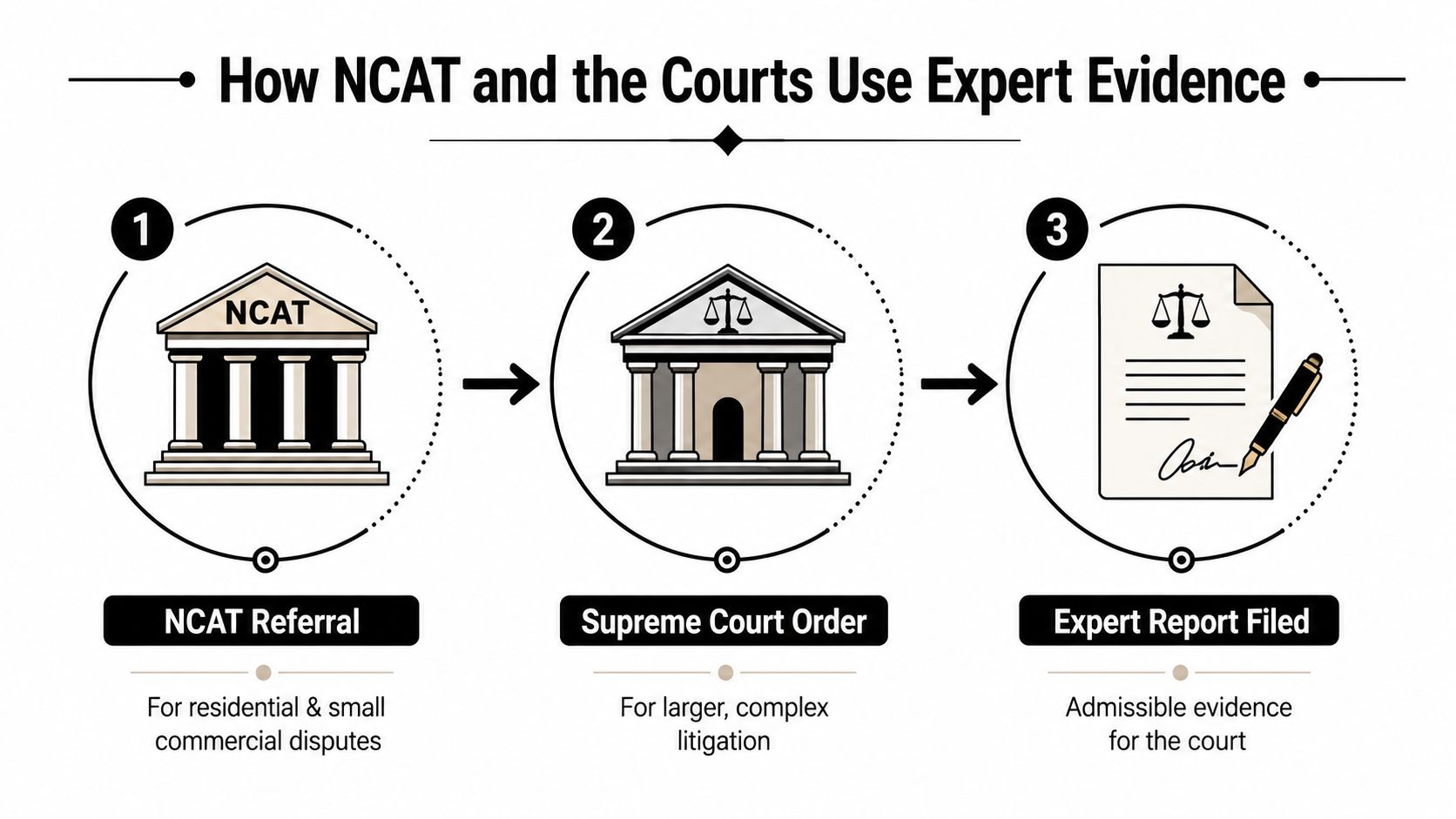
NCAT and the courts don’t just accept expert material because it exists. They use it when it is ordered, properly structured, and tied to the issues in dispute.
The forum shapes the process
Residential and smaller commercial building disputes commonly move through NCAT, while larger or more complex claims may end up in the Supreme Court or District Court. The procedural path matters because each forum expects evidence to be framed differently, especially where the issues need to be narrowed through expert reports or a Scott Schedule. Awesim’s NCAT procedural directions page is relevant because it reflects how tightly expert evidence now has to fit tribunal expectations.
The court or tribunal may order a joint expert, separate experts, or concurrent evidence if the matter needs it. Joint instruction can cut duplication, but it also requires careful neutrality and well-defined questions. Separate experts may suit adversarial disputes better, but they can increase time and cost because each side needs to develop its own technical case.
If the report format doesn’t match the forum, the evidence gets slowed down or sent back for rework.
Scott Schedules make disputes readable
A Scott Schedule organises the defect, the response, the expert opinion, and the remedy in one place. That’s useful because many building disputes are not just about whether something is wrong, they’re about whether it’s proved, how serious it is, and what it will cost to fix. A schedule that is too vague leaves the tribunal guessing, while one that is properly structured helps the issues narrow quickly.
The difference between a lay witness and an expert witness is decisive here. A lay witness can say what they saw or did. An expert can explain what the condition means in technical terms and why it matters under the contract or standard. That’s why the structure of the report often determines whether it is persuasive on first reading.
Instructing an Expert and Using a Scott Schedule
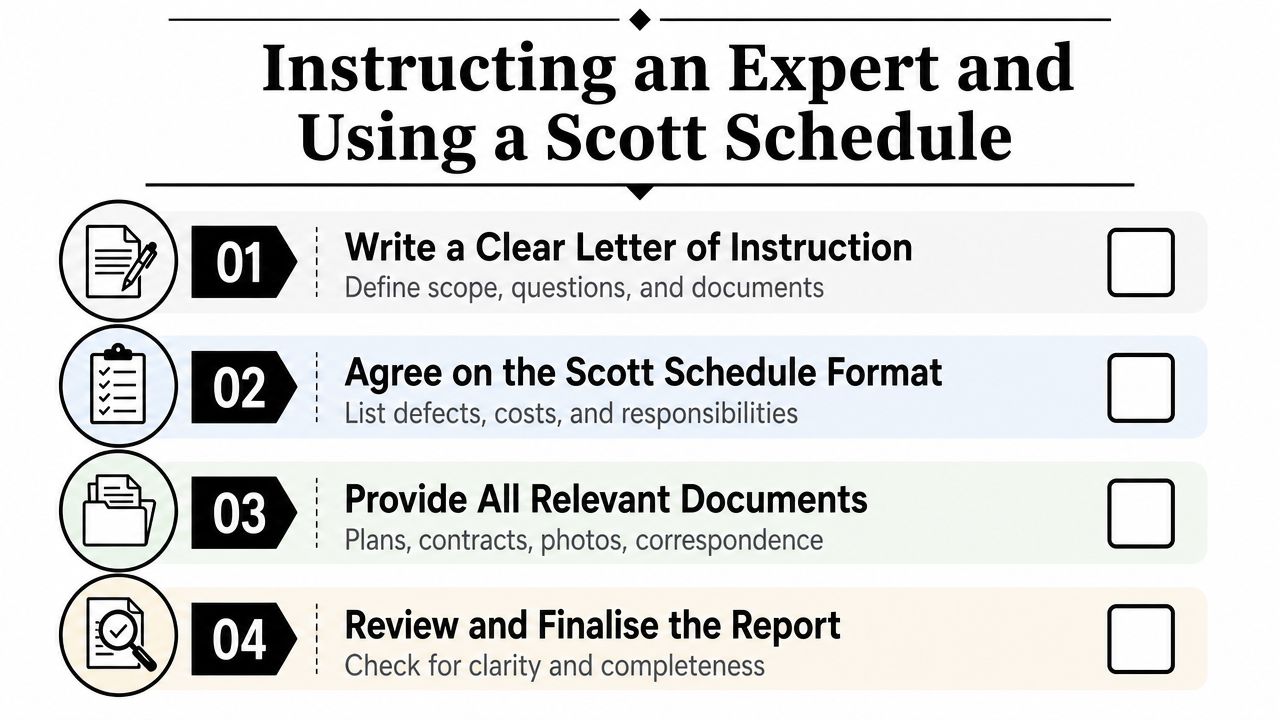
The best engagements start with a clean brief. If the instruction is vague, the expert spends time chasing facts that should have been in the file from the start, and that pushes cost and delay up for everyone.
Start with the letter of instruction
The letter should state the questions the expert must answer, the dispute background, the forum, and the documents already available. It should also make the scope clear, whether the expert is being asked to deal with defects, compliance, delay, cost, or a combination. Awesim’s Scott Schedule guidance for NSW building disputes is useful because it focuses on the practical items that need to be captured, not just the theory.
Give the expert the record, not just the story
The contract, approved plans, variations, correspondence, photos, videos, and repair quotes should go in the file early. Where appropriate, a joint site inspection helps because both sides see the same conditions at the same time, which reduces arguments later about access or selective photography. That does not remove disagreement, but it does improve the quality of the evidence.
Use the Scott Schedule to separate issues
A properly built Scott Schedule should list the alleged defect, the response, the evidence, and the proposed rectification. That structure is especially helpful when the matter also involves quantum meruit or no-contract variation arguments, because cost and scope need to be separated from the emotional noise around the dispute. The schedule becomes a working document, not just a pleading attachment.
Practical rule: if you can’t explain a defect in one line inside a Scott Schedule, the issue probably isn’t ready for hearing.
Iframe video lead-in: a short walkthrough can help clients and solicitors understand how the schedule fits the broader dispute process.
A clean instruction, complete documents, and a proper Scott Schedule save time because the expert can move straight to the key issues. That’s where the report becomes more than opinion, it becomes a usable case tool.
Report Structure, Costs and Typical Timelines
A report that holds up in NSW usually has the same core sections, even if the subject matter changes. The difference between a useful report and a weak one is not decoration, it’s completeness.
What the report should contain
A proper expert report normally sets out the instructions received, the documents reviewed, the factual background, the site inspection method, the applicable standards, the opinion on each issue, the assumptions relied on, and a costed rectification schedule where needed. If delay is part of the dispute, the report should address it directly rather than burying it in general comments. If the matter involves cost allocation, the opinion needs to be tied to measurable work, not just described as “unsatisfactory”.
What drives cost and time
The biggest drivers are usually the number of defects, the quality of the records, and whether the report has to deal with broader issues such as quantum meruit or no-contract variations. Travel and additional site attendance add time, and concurrent evidence preparation can also make the process more involved. A tightly drafted brief reduces wasted steps, because the expert isn’t spending hours working out what the question really is.
A well-prepared Scott Schedule also shortens the process. It lets the expert tie each alleged defect to a specific response and a specific remedy, which is much quicker than trying to reconstruct the dispute from scattered emails and phone notes. That’s one reason a strong initial file often reduces fees in practice.
The value of experience shows up here. Awesim Building Consultants brings 35+ years in building and construction, with 15+ years of litigation support to homeowners, builders and lawyers, and that kind of background tends to reduce false starts because the first inspection is more focused. The same practical approach is what you want when the dispute needs both a technical opinion and a defensible remediation pathway.
Good reports don’t just identify defects, they show how the remedy is measured.
If the report can explain the defect, the standard, the causation, and the likely rectification scope in one coherent package, it’s much easier to use in mediation and much harder to attack at hearing.
Practical Tips and How to Engage Awesim
The best disputes move faster when everyone treats the expert like a source of evidence, not a sounding board. Keep communications factual, send documents in one place, and avoid asking the expert to argue the case before they’ve inspected the site. That saves time and protects the independence that NCAT and the courts expect.
For homeowners, the main job is preservation. Keep photos, approvals, invoices, messages, and any repair quotes, then stop informal patch-up work until the expert has seen the defect where possible. For builders, the better approach is to give the records early and be clear about what was built, what was varied, and what was still outstanding.
For solicitors and law firms, the priority is a focused brief and a report that can be used, not just filed. A good expert should be able to assist with site investigations, Building & Construction Expert Witness Reports, Scott Schedules, and cost estimates that help the matter settle or narrow before hearing.
Awesim Building Consultants is one option for NSW building disputes where the evidence needs to be practical, structured, and court-aware. The work is built around site investigations, expert reports, and dispute support that align with the way NCAT and court matters are usually managed.
Frequently Asked Questions About Construction Expert Witnesses
When should I instruct an expert?
As early as possible, ideally before the site changes any further and before mediation if the technical issues are disputed.
Can a Scott Schedule be prepared without a full report?
Sometimes, yes, but it depends on how much technical analysis the dispute needs. A schedule without proper evidence is often too thin for serious matters.
Who pays the expert’s fees?
Usually the party who instructs the expert pays first, although the question of recovery can become part of the broader costs outcome.
How long does a report take?
It depends on the scope, the documents available, the number of defects, and whether there’s a need for further inspection or cost analysis.
Can one expert help with mediation and hearing?
Yes. A well-prepared report can be useful in both settings if it is neutral, clear, and tied to the documentary record.
A CTA for Awesim Building Consultants. If you’re dealing with a NSW building dispute and need a site inspection, a Building & Construction Expert Witness Report, or a Scott Schedule that’s ready for NCAT or court, email admin@awesim.com.au or call 1800 293 746 to arrange an initial consultation.
Related Posts
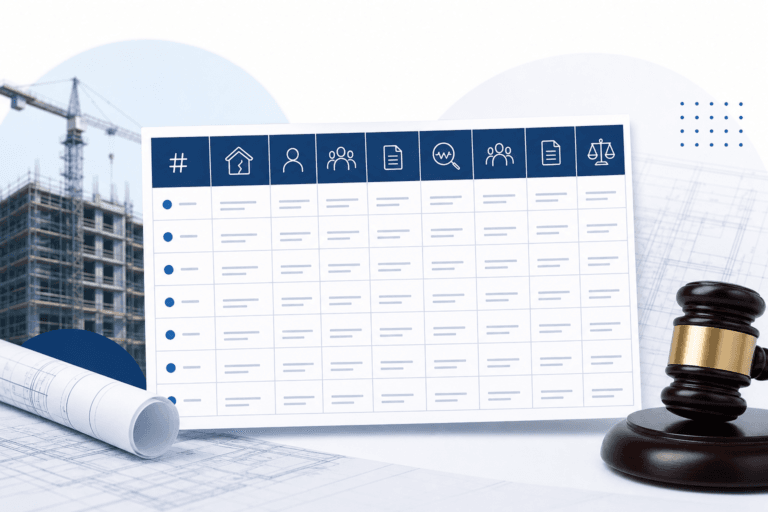
Scott Schedule Template: What Columns a NSW Claim Needs
What Is a Scott Schedule? Why the Column Structure Matters The Core Columns in a NSW Scott Schedule Template Column
Read More »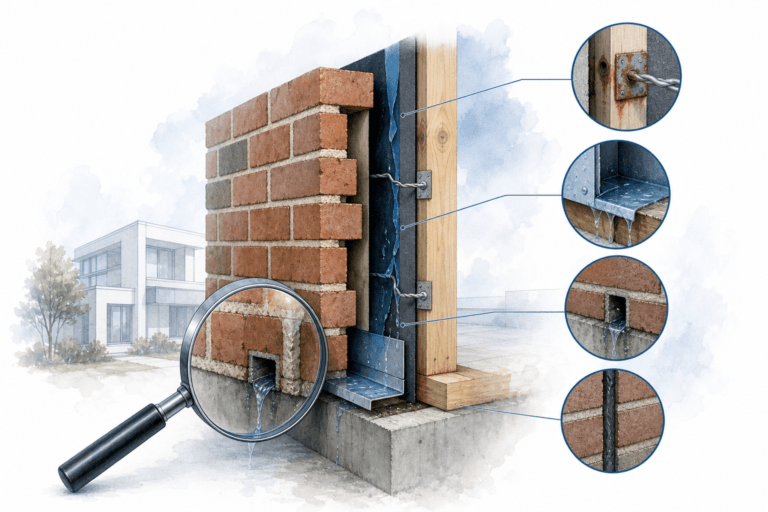
Brick Veneer Construction Defects: A Site Inspector’s View
What Brick Veneer Construction Actually Is The Most Common Brick Veneer Construction Defects Cracking in the Brickwork Missing or Blocked
Read More »
Liquidated Damages in Construction: How NSW Contracts Work
What Are Liquidated Damages in Construction? Why Contracts Use Them How Liquidated Damages Work in NSW Building Contracts Standard Contracts
Read More »