
What a Scott Schedule Should Include in a NSW Building Dispute
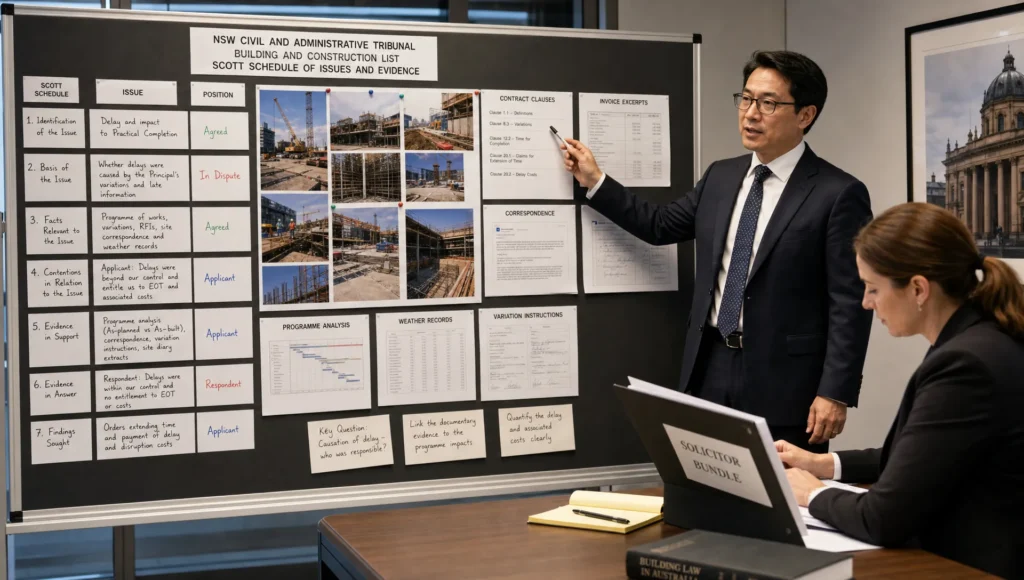
A Scott Schedule can make a NSW building dispute easier to understand, or it can make an already difficult matter even harder to manage. The difference usually comes down to what it includes, how each item is framed, and whether the schedule connects the claim to evidence, standards, responsibility and cost.
For homeowners, builders and solicitors, the goal is not to create the longest possible spreadsheet. The goal is to create a document that allows every disputed item to be identified, answered, assessed and, if necessary, decided.
Glen Sim, owner and director of Awesim Building Consultants, approaches a Scott Schedule as a practical dispute tool. It should help the parties and the decision-maker see exactly what is alleged, what is denied or admitted, what evidence supports each position, and what rectification or payment outcome is being sought.
Start with the purpose of the Scott Schedule
In a NSW building dispute, a Scott Schedule is usually used to break down multiple defects, incomplete works, variations, payment claims or rectification costs into individual line items. It is commonly used in NCAT and court matters because building disputes often involve many overlapping factual and technical issues.
NCAT hears many home building disputes in NSW, including disputes about defective residential building work, non-completion, payment and variations. The NCAT home building disputes guidance explains the types of matters that may come before the tribunal. Where there are multiple issues, a schedule can help organise the dispute into a format that is easier to test.
A well-prepared Scott Schedule should answer five core questions for each item:
- What exactly is the issue?
- Where is it located?
- What evidence supports or challenges it?
- What outcome is being sought?
- What amount is claimed, allowed or disputed?
If the schedule does not answer those questions clearly, it may still look organised, but it will not do its job.
The essential columns a Scott Schedule should include
There is no single universal Scott Schedule format for every NSW building dispute. The correct structure depends on the claim, the directions made by NCAT or the court, and the type of building issues involved. However, most effective schedules contain a consistent set of core columns.
| Column | What it should include | Why it matters |
|---|---|---|
| Item number | A stable number for each separate issue | Allows parties, experts and the tribunal to refer to the same item consistently |
| Location | Room, area, elevation, level or drawing reference | Prevents confusion about where the issue is alleged to exist |
| Issue description | A concise statement of the defect, incomplete work, variation or payment issue | Defines the dispute in plain terms |
| Applicant’s position | The claim being made and the remedy sought | Shows what the owner, builder or claimant is asking for |
| Respondent’s position | Whether the item is admitted, denied or disputed in part | Narrows the real issues in dispute |
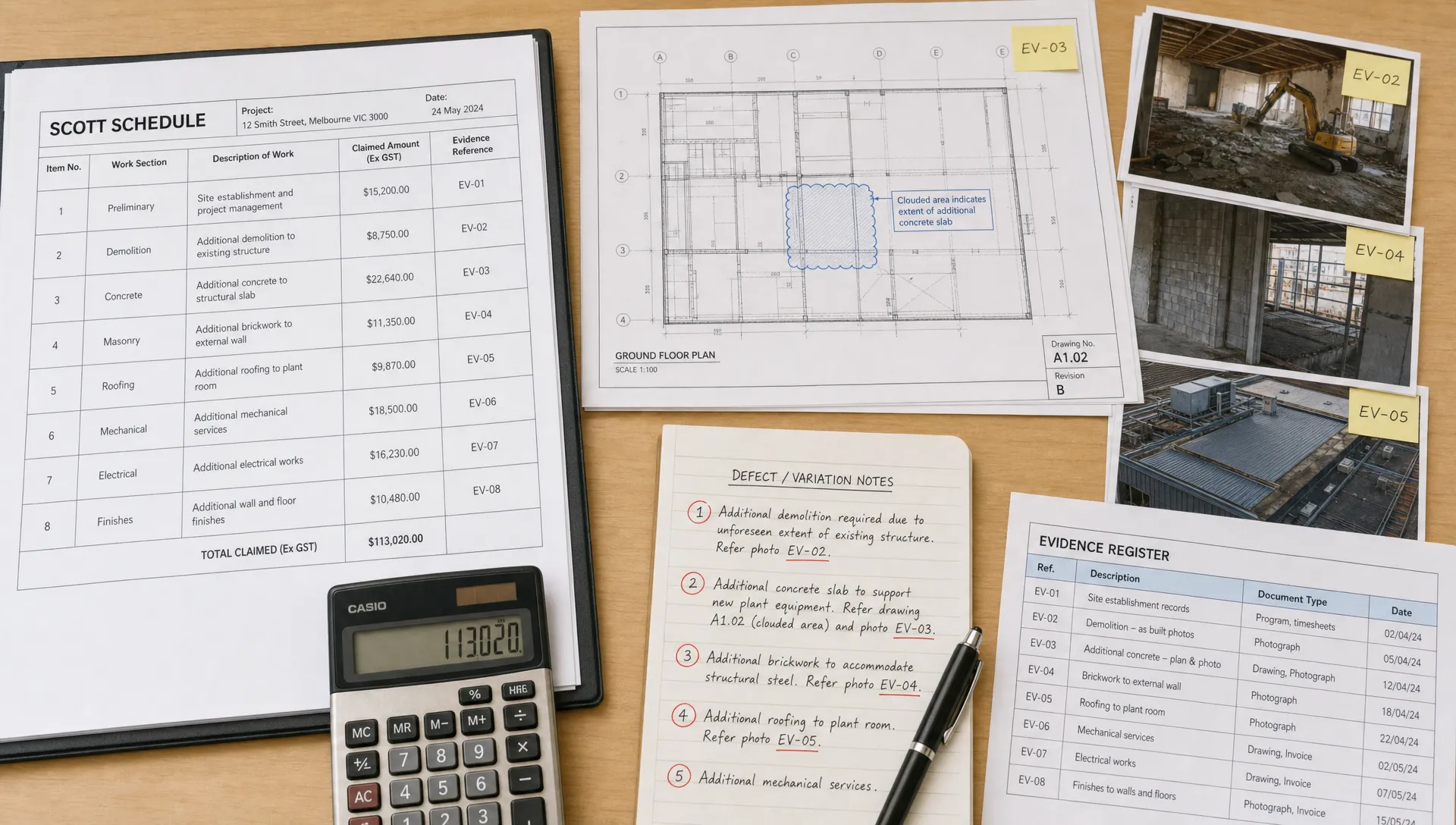
| Evidence reference | Photos, reports, invoices, contract clauses, drawings, emails or bundle references | Connects the item to supporting material |
| Standard or obligation | Contract, specification, Australian Standard, Building Code, statutory warranty or workmanship requirement | Identifies the benchmark used to assess the issue |
| Expert opinion | Technical view on cause, responsibility, compliance and rectification | Helps the decision-maker understand the building issue |
| Rectification scope | What work is required, if any | Links the defect finding to a practical remedy |
| Cost or amount claimed | Claimed, assessed or disputed amount, usually with GST treatment clear | Quantifies the dispute |
| Status or outcome | Agreed, withdrawn, unresolved, allowed or determined | Helps track progress through the matter |
For a more detailed explanation of layout and structure, Awesim’s guide to the Scott Schedule format used in NSW building cases is a useful companion resource.
Item numbers must stay stable
One of the simplest but most important inclusions is a stable item number. Once a Scott Schedule is exchanged, each issue should keep the same number wherever possible. If item 14 later becomes item 22 because rows are moved around, confusion can spread quickly through reports, submissions, witness statements and hearing preparation.
A better approach is to keep the original numbering and mark items as “withdrawn”, “agreed” or “resolved” where needed. If new items are added, they can be given new numbers rather than renumbering the whole schedule.
This sounds administrative, but in a contested building dispute it matters. Lawyers need stable references for submissions. Experts need stable references for reports and joint conferences. Owners and builders need stable references to understand what is still in dispute.
Each defect or claim should be separated into its own line item
A common mistake is grouping several issues into one broad row, such as “defective bathroom works” or “poor quality painting”. That may be understandable as a complaint, but it is usually too broad for a useful Scott Schedule.
Each separate issue should generally have its own row. For example, a bathroom dispute might be broken into waterproofing, falls to floor waste, cracked tiles, incomplete silicone joints, non-compliant shower screen installation and damaged vanity joinery. These may involve different evidence, different standards, different causes and different rectification costs.
The same principle applies to payment disputes. A broad claim for “unpaid variations” should usually be broken down into each claimed variation, with its date, scope, instruction, value, supporting document and response.
Separating the items helps prevent a party from winning or losing an entire category when only part of it is actually established.
The description should be factual, not argumentative
A Scott Schedule should describe each issue clearly and neutrally. It is not the place for long accusations, emotional language or submissions disguised as defect descriptions.
For example, “Builder failed to complete works properly and caused major damage everywhere” is unlikely to assist. A more useful entry would be: “Cracked floor tiles to ensuite bathroom, adjacent to shower entry, approximately six tiles affected.”
That description gives the respondent, expert and decision-maker something specific to inspect, admit, deny, cost or determine. It also reduces the risk of the schedule becoming a second set of pleadings rather than a working dispute document.
Include the relevant contractual or statutory benchmark
In a NSW building dispute, it is usually not enough to say that work is “defective” or “poor”. The schedule should identify the obligation or standard said to have been breached, where that can be done.
Depending on the issue, the benchmark may come from the building contract, drawings, specifications, manufacturer’s installation requirements, Australian Standards, the National Construction Code, or statutory warranties. For residential building work in NSW, statutory warranties under the Home Building Act 1989 (NSW) are often relevant, including warranties that work will be done with due care and skill and in accordance with the plans and specifications set out in the contract.
This column is especially important where the dispute turns on whether something is truly defective, merely unfinished, outside the contracted scope, or a matter of preference. A schedule that identifies the benchmark gives the expert a clearer basis for opinion and gives the opposing party a clearer basis to respond.
Evidence references should be precise
A strong Scott Schedule does not simply say “see photos” or “refer to expert report”. It should identify the relevant evidence precisely enough for the reader to find it without searching through hundreds of pages.
Useful evidence references may include photo numbers, report paragraph numbers, invoice numbers, contract clauses, drawing numbers, email dates, site instruction numbers, variation references and page numbers in the hearing bundle.
Precision matters because building disputes often involve large document sets. If the decision-maker cannot quickly connect a schedule item to the evidence, the item becomes harder to assess.
The respondent’s position should narrow the dispute
A Scott Schedule is most useful when both sides engage with it properly. The respondent’s column should not be filled with generic denials for every item. Where possible, it should state whether the item is admitted, denied, disputed in part, already rectified, outside scope, caused by others, or disputed only as to cost.
For example, a builder might admit that a minor paint defect exists but dispute the owner’s claimed rectification cost. An owner might accept that a variation was requested but dispute the amount claimed. A respondent may also say that the work complies with the contract or that the alleged defect is maintenance-related rather than defective workmanship.
This is where the schedule becomes more than an inventory. It becomes a tool for narrowing issues. Items that are admitted or resolved can be separated from those that require expert evidence or legal determination.
Expert opinion should be separated from advocacy
Where a building expert contributes to a Scott Schedule, the expert’s role should be technical and independent. The expert should assist by identifying the nature of the defect, likely cause, applicable standard, rectification method and reasonable cost, where those matters fall within the expert’s expertise.
In NSW court proceedings, expert witnesses are generally expected to comply with duties such as those reflected in the Expert Witness Code of Conduct, including the duty to assist the court impartially. Even where a matter is in NCAT rather than a court, the same practical principle is important: expert opinion is strongest when it is independent, reasoned and tied to evidence.
This is a key reason parties often seek specialist help. Glen Sim and Awesim Building Consultants prepare independent building dispute documents including expert witness reports, Scott Schedules, quantum meruit reports and NCAT dispute reports. The value is not just in identifying defects, but in explaining them in a way that can be tested.
Rectification scope should match the defect
A schedule should not jump from a minor defect to a major rectification claim without explaining the link. If rectification is claimed, the schedule should state what work is required to fix the problem and why that scope is reasonable.
For example, a cracked tile may require replacement of one tile, replacement of several tiles, investigation of substrate movement, or more extensive waterproofing works. The correct scope depends on the cause and extent of the issue. If the schedule claims a large amount, the supporting material should explain why that level of work is necessary.
This is where expert assessment can be critical. A rectification scope that is too vague may be difficult to price. A scope that is excessive may be challenged. A scope that is too narrow may fail to remedy the actual problem.
Costings should be transparent and consistent
A Scott Schedule should clearly state the amount claimed or assessed for each item. It should also make clear whether the amount includes GST, whether it is based on a quotation, expert estimate, invoice, contract rate, subcontractor price or quantity surveyor assessment.
In payment disputes, the schedule should identify how the amount has been calculated. In defect disputes, it should connect the cost to the rectification scope. In variation disputes, it should show the claimed variation amount and the basis for entitlement.
The following cost details are often useful:
- Whether the amount is claimed, admitted, disputed or independently assessed
- Whether GST is included or excluded
- Whether the figure comes from a quote, invoice, expert estimate or contract rate
- Whether preliminaries, supervision, access, demolition or make-good works are included
- Whether the cost relates to rectification, completion, credit, variation or damages
For larger disputes, it may be necessary to include separate supporting calculations or quantity breakdowns rather than trying to fit everything into one cell.
Different dispute types need different inclusions
The best Scott Schedule is tailored to the dispute. A defect schedule, variation schedule and quantum meruit schedule should not be treated as identical documents.
| Dispute type | Important inclusions |
|---|---|
| Defective work | Location, defect description, applicable standard, cause, rectification scope, cost |
| Incomplete work | Contract scope, work completed, work outstanding, completion cost, evidence of non-completion |
| Variation claim | Instruction, date, scope, approval dispute, valuation basis, supporting emails or site records |
| Payment claim | Contract sum, progress claim, amount paid, amount outstanding, disputed deductions or set-offs |
| Quantum meruit claim | Work performed, request or acceptance, reasonable value, evidence of labour and materials |
| Delay or access issue | Relevant dates, cause, responsibility, notices, time impact and cost impact |
A quantum meruit claim, for example, usually requires a focus on the reasonable value of work performed rather than simply repeating a contract variation price. That is why Awesim’s work in quantum meruit reports is distinct from a standard defect assessment.
Include a clear status column
As a matter progresses, some items may be resolved, withdrawn, admitted or narrowed. A status column helps everyone see what still matters.
This is particularly useful before a conciliation, directions hearing, expert conclave or final hearing. If 40 items were originally raised but 15 have been resolved, the schedule should make that clear. Otherwise, parties may waste time preparing for issues that are no longer live.
A status column might use simple terms such as “unresolved”, “admitted”, “denied”, “partly admitted”, “rectified”, “withdrawn” or “to be determined”. The key is consistency.
What should not be included in a Scott Schedule
A Scott Schedule should be complete enough to be useful, but not overloaded. It should not include every piece of background history, every argument between the parties, or every document copied into a spreadsheet cell.
Avoid including:
- Long narrative submissions that belong in a statement or written argument
- Repeated allegations that do not identify a specific issue
- Unsupported cost figures with no source or calculation
- Duplicated items that inflate the apparent size of the dispute
- New claims that have not been properly pleaded or raised, unless permitted
- Changing item numbers that break references in reports and submissions
Solicitors will usually need to consider whether the schedule is consistent with the pleadings, application, points of claim, points of defence or tribunal directions. Technical experts should not be asked to turn legal arguments into expert opinions.
A practical quality test before you file or exchange it
Before a Scott Schedule is served, filed or relied on in a NSW building dispute, ask whether someone unfamiliar with the project could understand the issue from the row itself and then locate the supporting evidence.
If the answer is no, the schedule probably needs more work.
A useful quality test is to read each row horizontally. The item number, location, issue description, evidence, standard, expert opinion, rectification scope and cost should all connect. If the item alleges cracked render, the photos should show the cracked render, the expert opinion should address why it is defective, the rectification scope should explain how it is to be fixed, and the cost should relate to that scope.
This is also why a Scott Schedule should usually be prepared alongside, not separate from, the expert report and evidence bundle. The schedule is strongest when it acts as a map to the evidence rather than a substitute for it.
If you are preparing for NCAT specifically, Awesim’s article on how to prepare an NCAT Scott Schedule that holds up explains how clarity, evidence and consistency affect the usefulness of the document.
How early should a Scott Schedule be prepared?
A Scott Schedule is often most effective when prepared early enough to shape the dispute, not so late that it merely records entrenched positions. Early preparation can help owners understand the strength of each claim, builders respond to specific allegations, and solicitors identify evidentiary gaps.
However, the schedule should also be updated carefully as evidence develops. New expert findings, rectification quotes, admissions, inspections and tribunal directions may all require changes. Those changes should be controlled, versioned and clearly communicated.
If you are unsure whether your matter needs one, Awesim has also explained when a Scott Schedule may be needed for NCAT in more detail.
Frequently Asked Questions
Does every NSW building dispute need a Scott Schedule? Not always. A simple dispute with one issue may not need one. A Scott Schedule becomes more useful when there are multiple defects, disputed variations, incomplete works, payment items or competing expert views.
Who usually prepares the Scott Schedule? It may be prepared by a solicitor, party, building expert or consultant, depending on the matter and tribunal or court directions. In technical building disputes, expert input is often important so that defect descriptions, standards, rectification scopes and costs are properly framed.
Can a Scott Schedule include both defects and payment claims? Yes, but it must remain clear. In some matters it is better to separate defect items, incomplete work, variations and payment claims into different sections or separate schedules so the issues do not become confused.
Should the Scott Schedule include photos? Usually, the schedule should reference photos rather than embed large numbers of images into the table. Photo numbers, dates and bundle references are often more practical than overloading the schedule itself.
Can the Scott Schedule change during the dispute? Yes. Items may be added, withdrawn, admitted, narrowed or updated as evidence develops. The important point is to keep numbering stable, track versions and avoid making changes that create confusion or unfairness.
Need an independent Scott Schedule for a NSW building dispute?
A well-prepared Scott Schedule can help turn a complex building dispute into a clear set of issues that can be answered, evidenced and assessed. A poorly prepared schedule can do the opposite.
Awesim Building Consultants provides independent building dispute support across NSW, including expert witness reports, Scott Schedules, quantum meruit reports, NCAT dispute reports and building defect assessments. Led by Glen Sim, owner and director, Awesim assists homeowners, builders and solicitors who need clear, independent and litigation-focused building advice.
If your dispute involves multiple defects, disputed variations, incomplete work or contested rectification costs, contact Awesim Building Consultants to discuss the right expert support for your matter.

Related Posts

Water Damage in Homes: How to Track Down the Source
Water damage in a home rarely announces itself at the source. A stain on the ceiling, a musty smell in
Read More »
Waterproofing Membrane Types: Which Fails Most in NSW Bathrooms
Waterproofing failure is the single most common serious defect found in NSW apartments, and the type of membrane used, along
Read More »
Building Certifier NSW: Role, Limits, and When You Need More
A building certifier in NSW is a registered professional who issues construction certificates, conducts critical stage inspections, and grants occupation
Read More »