
How to Prove Building Defects in NSW Disputes
How to Prove Building Defects in NSW Disputes
Most homeowners in a building dispute believe they already have what they need to prove it. They have photos of the crack, the leak, the uneven tiles. What they usually discover, sometimes only once the dispute has escalated, is that a photo of a problem and proof of a defect are not the same thing.
Proving a builder did defective work means building an evidence base that shows what is actually wrong, why it happened, that it falls short of a standard the builder was required to meet, and what it will cost to put right, in a form that holds up to scrutiny rather than just looking convincing to you. This guide walks through what that evidence base actually looks like and how to build it properly, from the first photo you take to the report that eventually carries the case.
Why “I have photos” usually isn’t enough
This is the assumption that catches almost everyone out, and it’s worth understanding early rather than late.
Photographs are useful, but on their own they are limited in a specific way: a photo can show that something looks wrong, but it generally cannot, by itself, show that the work fails to meet a building standard, establish what actually caused the problem, or support a claimed cost of rectification. Tribunal decisions in NSW have specifically addressed this point, finding that photographic evidence typically requires expert interpretation before it can be relied on to draw conclusions about construction quality or compliance. A builder disputing a claim can, and often will, offer an alternative explanation for what a photo shows, normal settlement, maintenance, damage caused after handover, and without more than the photo itself, there is nothing to weigh that explanation against.
This does not make photos worthless. It means they are the starting point of an evidence base, not the whole of it.
What actually constitutes proof
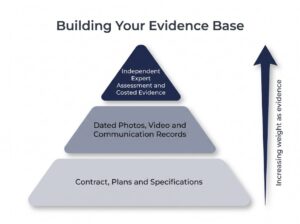
Building a case that holds up means gathering several different layers of evidence, each doing a different job.
The documentary record from the build itself. This is the benchmark everything else gets measured against, and it’s the layer most homeowners forget to gather. Your building contract, the approved plans and specifications, and any written variations set out exactly what the builder was required to deliver. A defect is proven, in part, by showing the finished work falls short of what these documents describe, so locating and keeping them is a genuinely practical first step, not paperwork for its own sake.
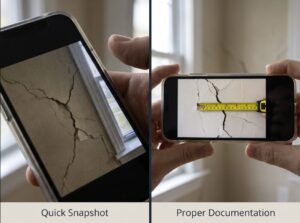
Photographic and video evidence, done properly. The difference between a snapshot and useful evidence is mostly a matter of habit. Photograph from multiple angles, include something for scale such as a tape measure in the frame, and take photos progressively over time rather than only once. Date every image and name files descriptively rather than leaving them as generic phone camera numbers, a folder of clearly labelled, dated photos is far more useful later than a camera roll you have to reconstruct from memory. This kind of documentation does not replace expert evidence, but it gives an expert something solid to work from and makes their eventual report far stronger.
The written communication trail. Every email or letter to the builder about the issue, and every response or lack of one, becomes part of the record. This establishes when you first raised the problem and how the builder responded, which matters both for the substance of the dispute and for showing you acted reasonably and promptly.
Independent expert assessment. This is usually the layer that actually decides a contested claim. An independent building consultant examines the defect, determines its likely cause, and measures the work against the relevant standard, whether that’s the National Construction Code, an Australian Standard, or the contract itself. Their assessment carries weight that a homeowner’s own opinion, or the builder’s self-assessment, generally does not, partly because of their technical expertise and partly because of something homeowners often don’t realise: a properly engaged expert’s overriding duty is to the Tribunal, not to whoever engaged them. That independence is precisely what makes the report persuasive rather than just another opinion in the dispute.
Costed evidence of rectification. Establishing that a defect exists is only part of the picture. A credible cost estimate, with a clear methodology behind it rather than a round number pulled from nowhere, is what turns a defect claim into a claim the Tribunal can actually act on.
Timing matters more than people expect
Evidence gathered early, while a defect is fresh, is consistently stronger than evidence gathered later. Two practical reasons why. First, conditions change: water stains dry out, cracks get painted over, and a defect that was obvious in week one can be much harder to demonstrate months later. Second, if a builder attempts a quick fix before the defect has been properly assessed, that can compromise the very evidence you need, so it’s worth having an independent assessment done before any remedial work happens, not after.
This doesn’t mean you need everything sorted immediately. It means the earlier you start documenting properly, the stronger the position you’ll be in if the matter doesn’t resolve easily.
Turning your evidence into a case
Once you’ve built this evidence base, the next step is usually formalising it, typically as a structured expert witness report and, where multiple defects are involved, a Scott Schedule that sets out each item alongside its supporting evidence and cost. We’ve written in detail about how Scott Schedules work for NCAT and how to prepare more broadly for an NCAT building dispute, which cover that next stage properly.
If you’re still working out whether your situation is a major or minor defect, or what your broader options are if the builder won’t act, our guides on what to do when a builder won’t fix the defects and, for waterproofing specifically, what to do if your new bathroom is leaking after handover walk through that framework in more depth. Our general guide to building defects is also a useful starting point.
Frequently asked questions
Are photos enough to prove a building defect?
Not on their own. Photos are useful supporting evidence, but NSW tribunal decisions have found that photographic evidence generally needs expert interpretation before it can reliably show non-compliance with a standard or establish what actually caused a defect. Photos work best as one part of a broader evidence base, alongside documentation, communication records, and independent expert assessment, rather than as standalone proof.
What evidence do I need to prove my builder did defective work?
A strong case typically combines several things: the original contract, plans and specifications to show what was required, properly dated and detailed photographic and video evidence, a written record of your communication with the builder, an independent expert assessment identifying the cause and measuring the work against the relevant standard, and a costed estimate for rectification. Each layer supports the others rather than standing alone.
Why does an expert report carry more weight than my own assessment?
Partly technical expertise, and partly independence. A properly engaged expert’s primary duty is to the Tribunal itself, not to the person who engaged them, which is exactly what makes their conclusions carry weight that a homeowner’s opinion or a builder’s self-assessment typically doesn’t. They also assess causation and measure the work against a specific standard, which a lay observation generally cannot do convincingly on its own.
Should I let the builder fix the defect before I get it assessed?
Generally, no, not before it has been independently assessed. If a defect is repaired before anyone qualified has examined it, the evidence of the original problem can be compromised or lost entirely, which weakens your position if the matter isn’t resolved amicably. It’s usually best to have an independent assessment done first, even if you ultimately want the original builder to carry out the fix.
How soon after finding a defect should I start documenting it?
As soon as possible. Evidence gathered while a defect is fresh is far stronger than evidence reconstructed later, since conditions change over time, water stains dry, and cracks get covered over. Starting a dated, detailed photo and communication record from the moment you notice a problem puts you in a much stronger position if the dispute doesn’t resolve quickly.
Build your evidence properly from the start
The homeowners who end up in the strongest position are rarely the ones who gathered the most photos. They’re the ones who understood, early, what actually counts as proof and built their evidence accordingly.
Awesim Building Consultants provides independent building assessments and expert evidence for homeowners across NSW, including the reports and Scott Schedules that turn a documented defect into a case that holds up. If you’d like an independent view of your situation, [get in touch for an obligation-free discussion](link: https://awesim.com.au/contact/).
This article provides general information about evidence in NSW building disputes and is not legal advice. Case law referenced should be independently verified. For advice specific to your situation, speak to a qualified building consultant or solicitor.

Related Posts
Waterproofing Inspector: How to Choose One for a NSW Claim
Why a Standard Building Inspector Is Not Enough What a Forensic Waterproofing Inspection Actually Covers Membrane and System Identification AS
Read More »
Building Inspection Report Template and What Courts Expect
What a Building Inspection Report Template Looks Like in Practice The Schedule 7 Requirement and Why It Changes Everything How
Read More »
Dilapidation Report Template: What Must Be in the Document
What a Dilapidation Report Actually Is The Core Sections Every Dilapidation Report Template Must Include 1. Cover Page and Report
Read More »