
Waterproofing Inspector: How to Choose One for a NSW Claim
- Why a Standard Building Inspector Is Not Enough
- What a Forensic Waterproofing Inspection Actually Covers
- The Five Things to Check Before You Hire a Waterproofing Inspector
- Forensic Waterproofing vs. Pre-Purchase Inspection: Not the Same Thing
- What the Report Needs to Do in Your Claim
- Questions to Ask Before You Engage
- Awesim's Forensic Waterproofing Inspection Service
- Conclusion
- Frequently Asked Questions
A waterproofing inspector investigates leakage, assesses the available evidence and explains any limits on the findings. For a NSW dispute, choose someone with relevant technical expertise and experience preparing reports for the intended forum. Ask how the inspection will support an expert witness report, including any need for testing or specialist input.
Why a Standard Building Inspector Is Not Enough
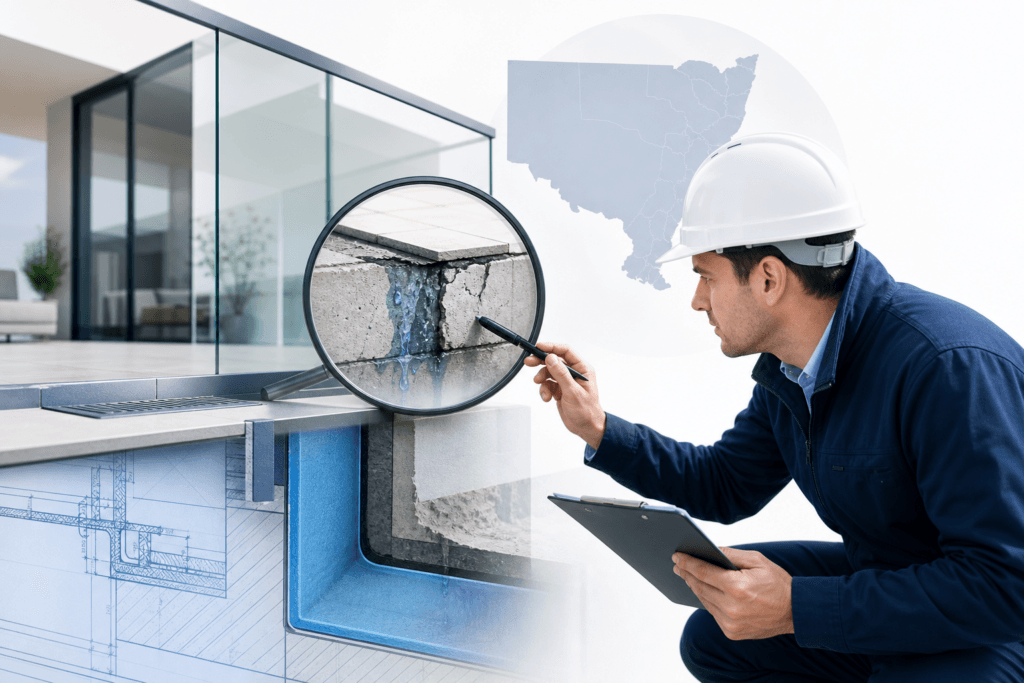
Waterproofing defects are among the most contested issues in NSW construction claims. Failed shower membranes, leaking balconies, inadequate wet-area treatment — these cause significant structural damage and are notoriously hard to prove without specialist knowledge.
A general building inspector can note visible water damage. What they typically cannot do is trace the source, identify the specific failure mechanism, reference the applicable Australian Standard, or produce a report formatted for use as evidence in tribunal or court proceedings.
That gap matters. If your report does not meet the Schedule 7 expert witness code of conduct requirements under the Uniform Civil Procedure Rules, the tribunal or court may give it little or no weight. You can have a genuine defect, clear damage, and a real financial loss — and still lose because the evidence wasn't presented in the right form.
A forensic waterproofing inspector works differently. They investigate the cause of failure, not just the symptom. They assess compliance with AS 3740 (the Australian Standard for waterproofing of domestic wet areas), document findings with photographic and physical evidence gathered on-site, and produce a report structured for formal proceedings.
What a Forensic Waterproofing Inspection Actually Covers
When you commission a forensic waterproofing inspection for a NSW claim, the scope should go well beyond a visual check. Here is what a thorough inspection typically addresses.
Membrane and System Identification
The inspector should identify what waterproofing system was installed — sheet membrane, liquid-applied membrane, or a combined system — and assess whether it was the right product for the application. Many defects originate not from poor workmanship alone but from a product being used outside its intended scope or in conditions it wasn't rated for.
AS 3740 Compliance Assessment
AS 3740 sets out minimum requirements for waterproofing in domestic wet areas: bathrooms, showers, laundries, and similar spaces. A forensic inspector assesses whether the installation met those standards at the time of construction — membrane coverage, upstand heights, substrate preparation, and the treatment of penetrations and junctions.
This matters because the builder's defence will often rest on claiming the work met the standard at the time. Your inspector needs to counter that claim with specific, referenced evidence.
Source Tracing
Visible water damage rarely tells you exactly where the failure occurred. A forensic inspection uses moisture meters, thermal imaging where appropriate, and physical investigation to trace water back to its point of entry. That is what separates a forensic report from a visual summary.
Defect Documentation for Legal Use
Every finding needs to be documented in a way that holds up under cross-examination — precise location references, photographs with clear captions, and descriptions written to the standard required for expert evidence. If the report cannot withstand scrutiny from the opposing party's legal team, it will be challenged.
The Five Things to Check Before You Hire a Waterproofing Inspector
Not every inspector who advertises waterproofing services is qualified to produce evidence for a NSW claim. These are the five things worth verifying before you engage anyone.
1. Are They an Independent Building Consultant, Not a Contractor?
This distinction is critical. A waterproofing contractor can assess a defect, but they have an inherent conflict of interest — they may also want to quote on the remediation. An independent building consultant has no stake in what the repair costs or who carries it out. Their only obligation is to the evidence.
For a formal claim, independence isn't just preferable — it's expected. A report from someone who also tendered for the repair work is vulnerable to challenge on that basis alone.
2. Do They Prepare Reports to Schedule 7 Standards?
Ask this question directly. Schedule 7 of the Uniform Civil Procedure Rules 2005 sets out the code of conduct for expert witnesses in NSW. A compliant report must include a declaration that the expert's duty is to the court or tribunal, not to the party who engaged them. It must also set out the expert's qualifications, the materials they relied on, and the assumptions underlying their opinions.
Many building inspectors have never heard of Schedule 7. If the person you're speaking to cannot explain what it requires, their report will not be suitable for NCAT, District Court, or Supreme Court use.
3. Do They Conduct On-Site Investigations?
A report based on photographs you supply or a desktop review of builder documentation is not a forensic report. The inspector must attend the property, conduct their own investigation, and base their findings on what they personally observed and tested.
On-site investigation is what gives the report its evidentiary weight. It also allows the inspector to be cross-examined credibly — they were there, they saw it, they tested it.
4. Is There a Named Consultant Whose Licence Appears on the Report?
When a report is tendered in proceedings, the opposing party will scrutinise the author's qualifications. A report signed by "the team at XYZ Inspections" with no named individual is far harder to defend than one signed by a named, licensed consultant whose professional standing is attached to every word.
Ask who will conduct the inspection and sign the report. Ask to see their licence number. If the firm cannot answer that clearly, that tells you something.
5. Have They Produced Reports for Similar Proceedings Before?
Experience with NCAT and NSW court proceedings is not the same as general inspection experience. A consultant who has produced reports for NCAT hearings, District Court matters, and Supreme Court proceedings understands how evidence is tested in each forum. They know what opposing counsel will challenge, what the tribunal member will ask, and how to frame technical findings so they are useful to a decision-maker who is not a builder.
Ask for case references. A reputable firm will have them.
Forensic Waterproofing vs. Pre-Purchase Inspection: Not the Same Thing
There is a category of building inspector whose main business is pre-purchase inspections — the report you commission before buying a property to identify visible defects. Some of these operators also offer "expert witness" services as an add-on.
For a defect claim, that distinction matters. Pre-purchase inspections are scoped for a buyer making a purchase decision. They are not typically designed to trace the cause of a failure, assess compliance with a specific Australian Standard, or produce evidence for formal proceedings.
If you are already in a dispute — a tribunal date has been set, a solicitor has advised you to get an independent report, or you have identified a defect and want to pursue a claim — you need a consultant whose primary work is forensic inspection and dispute support, not one for whom it is a secondary service.
What the Report Needs to Do in Your Claim
Understanding what the report needs to achieve helps you evaluate whether the inspector you're considering can actually deliver it.
In an NCAT building dispute, the expert witness report needs to establish three things clearly: what the defect is, why it is a defect (by reference to the applicable standard or the contract), and what it will cost to fix. A waterproofing defect claim also needs to address causation — was this a workmanship failure, a design failure, a product failure, or some combination?
A report that describes the damage without addressing causation leaves the builder room to argue the defect arose from something outside their scope of work. A report that addresses causation but doesn't reference AS 3740 or the relevant contract terms leaves you exposed on the standard of care question.
The inspector you choose needs to understand how their findings will be used, not just how to find them.
Questions to Ask Before You Engage
Before committing to any waterproofing inspector, put these questions to them directly.
- Do your reports comply with Schedule 7 of the Uniform Civil Procedure Rules?
- Will you conduct the on-site inspection personally, or will someone else attend?
- Whose name and licence number will appear on the final report?
- Have you produced reports for NCAT, District Court, or Supreme Court proceedings?
- Can you provide case references for similar waterproofing disputes?
- Do you also offer remediation or repair services, or is your role purely independent?
- What does your report cover in terms of AS 3740 compliance assessment?
If the answers are vague, or the inspector seems unfamiliar with the legal context, that is a signal to keep looking.
Awesim’s Forensic Waterproofing Inspection Service
Awesim Building Consultants has been operating across NSW since 1996, preparing independent, evidence-based reports for construction disputes. Forensic Waterproofing Inspections are a specialist service — distinct from general building inspection — conducted on-site by principal consultant Glen Sim, whose name and licence appear on every report produced.
Reports are prepared to Schedule 7 expert witness code of conduct standards and formatted for use in NCAT, District Court, and Supreme Court proceedings. Awesim serves homeowners, solicitors, strata managers, and builders across NSW, with offices in Sydney, Tamworth, and Tweed Heads and suburb-level coverage across more than 200 NSW locations.
If you're at the stage of evaluating whether a forensic waterproofing inspection is the right step for your claim, a free initial consultation is available. Call the team on 1800 293 746 or explore the full range of dispute support services — including Expert Witness Reports and Scott Schedules — at Awesim Building Consultants.
Conclusion
A waterproofing inspector for a NSW claim is not the same as someone who checks roofs before settlement. You need an independent building consultant who conducts on-site forensic investigations, assesses compliance with AS 3740, and produces reports that meet Schedule 7 requirements for use in tribunal and court proceedings. Verify independence, confirm Schedule 7 compliance, ask who signs the report, and check for real experience with NSW dispute proceedings. Those five checks will narrow the field quickly and give your claim a much stronger foundation.
Frequently Asked Questions
What is a forensic waterproofing inspection and how does it differ from a standard inspection?
A forensic waterproofing inspection is an on-site investigation conducted specifically to identify the cause of a waterproofing failure, assess compliance with the relevant Australian Standard (AS 3740), and produce evidence suitable for use in a legal dispute. A standard building inspection is scoped for general condition assessment — typically for property purchase decisions — and is not structured to meet the evidentiary requirements of NCAT or court proceedings.
What is Schedule 7 and why does it matter for a waterproofing defect claim?
Schedule 7 of the Uniform Civil Procedure Rules 2005 (NSW) sets out the code of conduct for expert witnesses. A compliant report must include a declaration that the expert's duty is to the tribunal or court, not to the party who engaged them, along with the expert's qualifications, the materials relied on, and the assumptions underlying their opinions. Reports that do not meet Schedule 7 requirements may be given reduced weight or excluded from proceedings entirely.
Can I use a waterproofing contractor's report as evidence in an NCAT dispute?
A report from a contractor who also quotes on repairs carries an inherent conflict of interest and may be challenged on that basis. NCAT and NSW courts expect expert evidence to come from an independent party with no financial interest in the outcome. An independent building consultant who does not offer remediation services is the appropriate choice for a formal claim.
What does AS 3740 cover in the context of a waterproofing defect claim?
AS 3740 is the Australian Standard for waterproofing of domestic wet areas. It sets minimum requirements for membrane type, coverage, upstand heights, substrate preparation, and the treatment of penetrations and junctions in bathrooms, showers, laundries, and similar spaces. In a defect claim, demonstrating that the installation did not comply with AS 3740 at the time of construction is often central to establishing the builder's liability.
How do I know if the waterproofing defect in my property is serious enough to pursue a claim?
If you have visible water damage, mould, or structural deterioration that you believe originates from a failed waterproofing system, a forensic inspection can establish whether a defect exists, what caused it, and what remediation is required. The inspection itself is the first step — it gives you the evidence you need to decide whether to proceed with a claim, not the other way around.
Do I need a solicitor before commissioning a forensic waterproofing inspection?
Not necessarily. Many homeowners commission an inspection first to understand the nature and extent of the defect before engaging a solicitor. The report then informs the legal strategy. That said, if you are already represented, your solicitor may have specific requirements for how the report should be structured or what it needs to address — so it is worth having that conversation early.
What areas of NSW does Awesim cover for forensic waterproofing inspections?
Awesim Building Consultants operates across all of NSW from offices in Sydney, Tamworth, and Tweed Heads. The firm has suburb-level service coverage across more than 200 NSW locations. If you are unsure whether your location is covered, call 1800 293 746 or visit awesim.com.au to check.

Related Posts
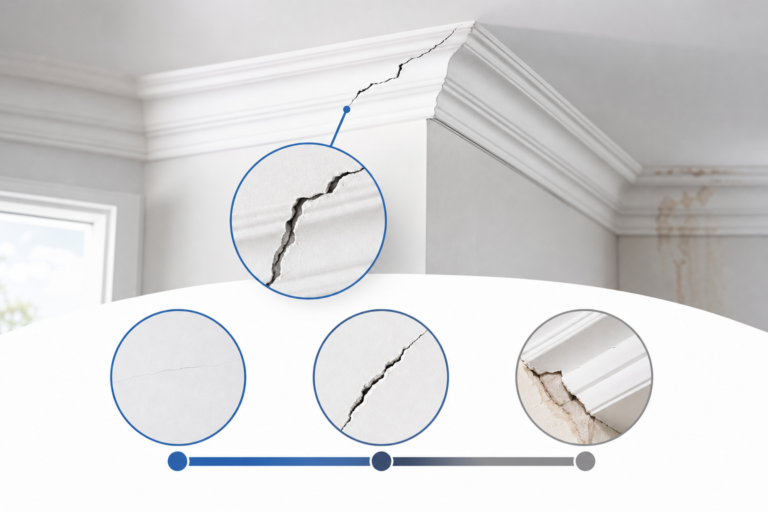
Cornice Cracking: How to Tell If the Damage Is Serious
Cornice cracking is one of the most common concerns Australian homeowners raise, and the hard part is not spotting the
Read More »
Digital Construction Consultant Australia: What They Do
A digital construction consultant in Australia manages the technology-driven side of building projects: BIM coordination, clash detection, asset data handover,
Read More »
Strata Report: What Buyers Need to Read Before Signing
A strata report is the document that surfaces hidden obligations before you are legally committed to a purchase. A strata
Read More »