
Building Expert Witness Guide: NCAT Disputes & Fees
You’ve got the builder’s quote, the waterproofing stains are still spreading, and every call leaves you with the same dead end, the certifier blames workmanship, the builder blames design, and the insurer wants more paperwork. That’s the point where a building expert witness stops being a legal nicety and becomes the person who can turn a mess of photos, emails, and site damage into evidence a tribunal member can use. If you’re also trying to understand what a consumer rights path looks like in a trade dispute, the Newline Painting consumer rights guide is a useful companion read because it shows how quickly an ordinary defect complaint can turn formal.
When a Building Dispute Stops Being a Conversation
The usual pattern is simple. A homeowner notices a leak, a crack, or a failed finish, then tries to sort it out directly with the builder. The builder offers an explanation, the certifier says the paperwork was approved, and the problem keeps getting worse.
At that point, the dispute is no longer about who sounds more convincing on the phone. It becomes a formal evidence problem, and the decision-maker needs an independent professional who can separate observation from opinion. That shift matters in NSW because building disputes are often judged on whether the facts have been collected properly, not just whether someone feels the work was poor.
Practical rule: if the conversation has turned into “who is at fault”, you’re already past the stage where a general opinion will carry much weight.
A useful way to think about it is this, a homeowner needs more than frustration and a stack of photos. They need a structured opinion that can be tested, challenged, and relied on. That’s why expert witness work has grown from a niche task into a major part of professional practice, with a UK survey showing 56% of respondents’ workload was expert-witness related, up from 37% in 2003 and 45% in 2011, and 41% working full time in expert witness work and 47% part time, while average court appearances fell from five times a year in 1997 to 1.4 (survey PDF).
In NSW building disputes, that same reality shows up as a need for reports that are ready for NCAT, the Local Court, the District Court, or the Supreme Court. If you know the issue is technical, the next question is whether you need an expert at all, and if so, what kind and how to brief them.
What a Building Expert Witness Actually Does
A good building expert witness is a translator between a construction site and a courtroom. They take what’s happening on the slab, in the roof space, behind the membrane, or along the wall line, then explain it in a way a tribunal member can follow without being a builder.
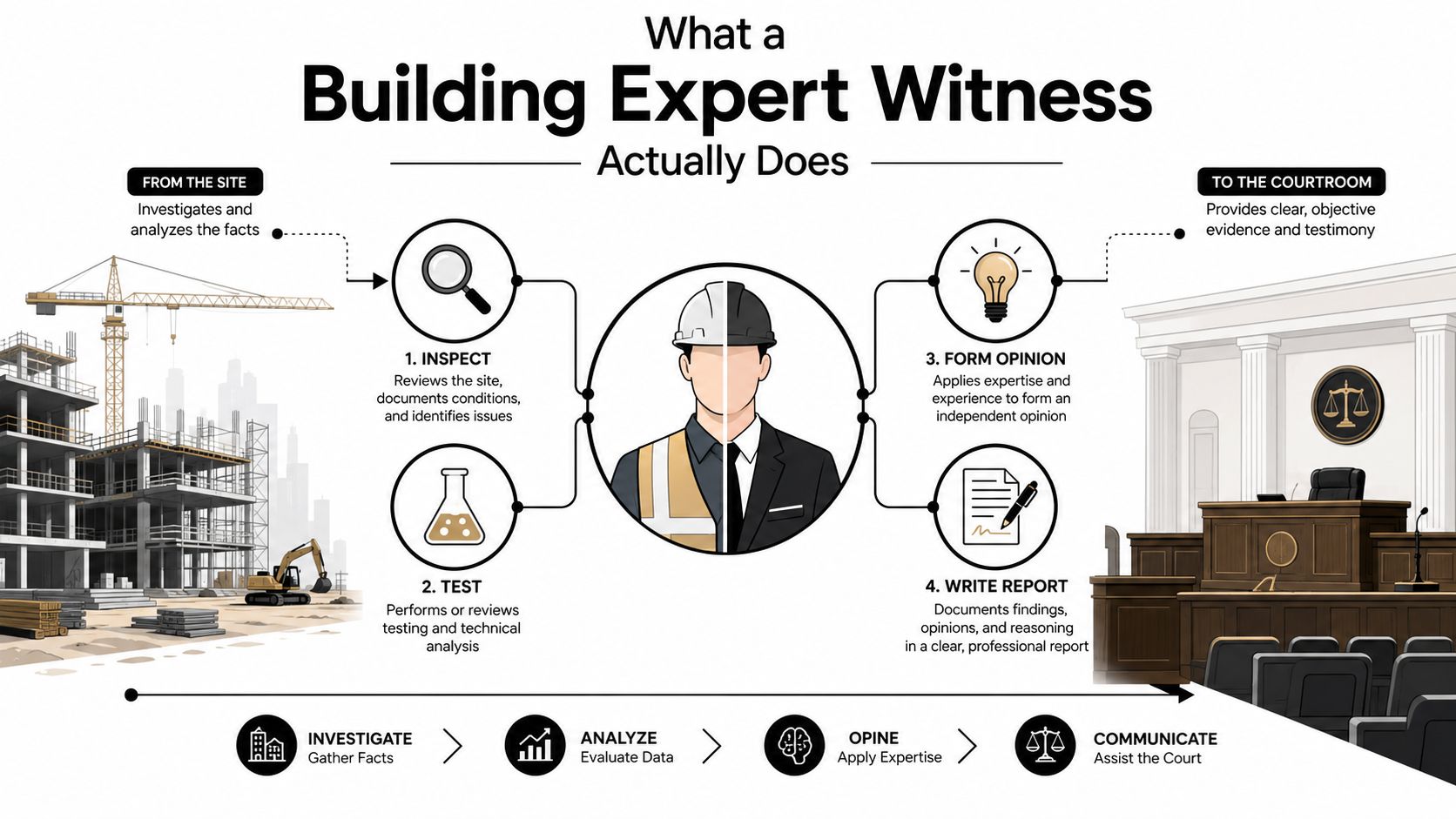
The job usually breaks into four core duties. First, the expert carries out site investigations, which can include visual inspection, measurement, photography, moisture testing, or other appropriate testing depending on the defect. Second, they prepare a written Expert Witness Report that sets out what they found and why it matters.
Third, when directed, they help prepare a Scott Schedule, which compares each defect claim with the other side’s response and the expert’s opinion. Fourth, they may give oral evidence at a hearing or conference, where their report gets tested under questions from the other side.
The key difference between an expert and an advocate is independence. An advocate argues a client’s case. An expert gives an opinion that must survive scrutiny even when it doesn’t help the person who hired them. A lay witness can say what they saw. The expert has to go further and explain cause, consequence, and likely rectification.
That’s why tribunal-ready work in NSW has to reference the National Construction Code, relevant Australian Standards, and any applicable regulations. In practice, the opinion is only useful if it links observations to accepted building criteria and explains the reasoning.
For readers comparing service types, a structural integrity assessment is a useful adjacent example because it shows how technical inspection becomes decision-ready evidence when the problem is more than a quick look over.
Anatomy of a Compliant Expert Witness Report
A tribunal-ready report is built to be read in a specific order. The first things a member or judge wants to know are who instructed the expert, what the assignment was, and whether the writer is independent. Under NSW expert-evidence practice, the report must show a clear chain from site observations and testing to reasoned conclusions, and it should set out qualifications, independence, factual basis, and references to the National Construction Code, Australian Standards, and relevant regulations (NSW expert-evidence code guidance).
What has to be in the report
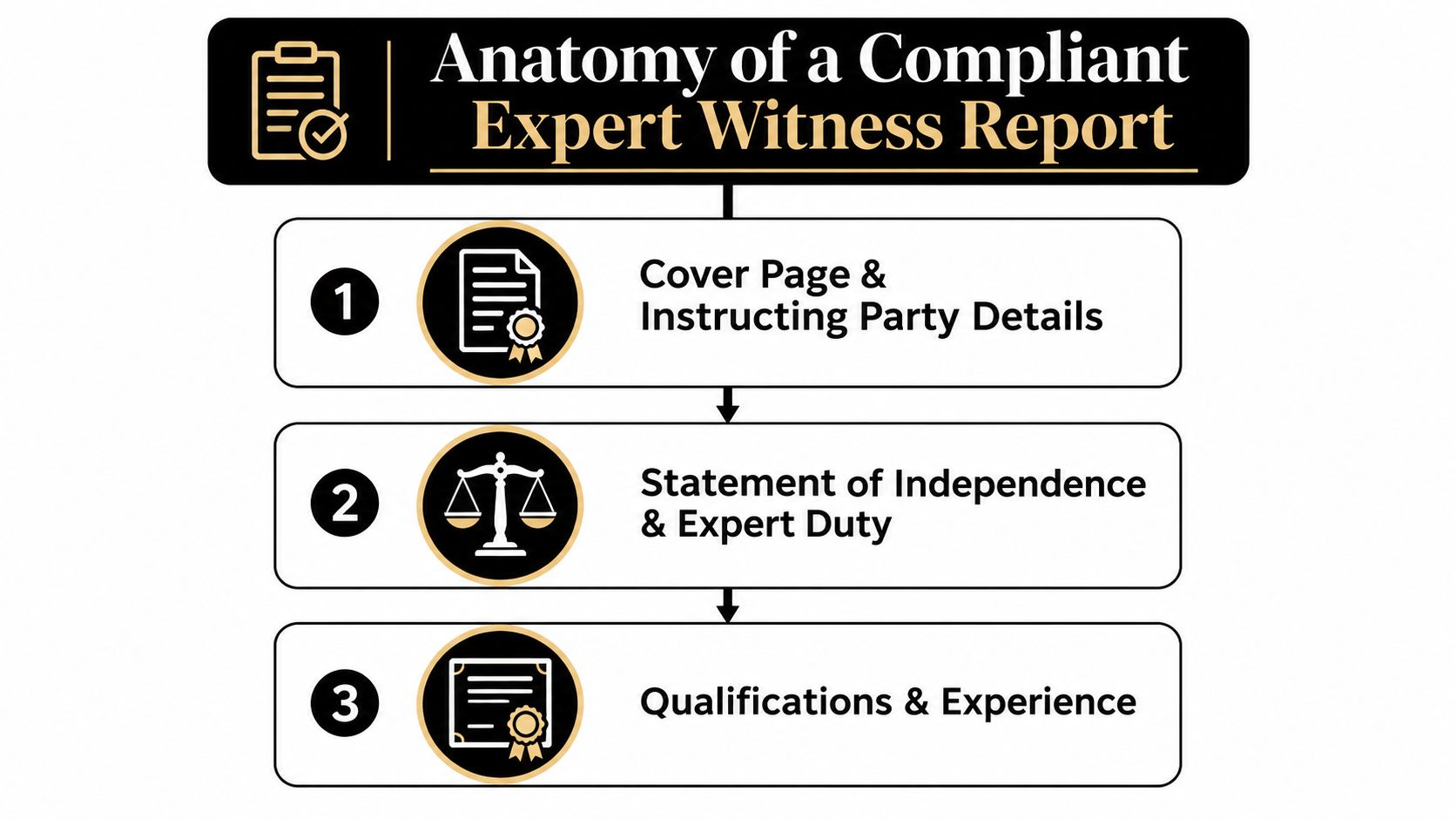
A compliant report usually starts with the cover page and instructing party details, then a clear statement of independence and expert duty, followed by qualifications and experience. After that comes the factual basis, the observed defects, the methodology, and the opinion on cause, consequence, and rectification.
Each part matters because the decision-maker is checking whether the opinion is just an impression or a methodical conclusion. If the report is unsigned, vague about the factual basis, or hides a prior relationship, it can lose weight fast. The credibility issue is not cosmetic, it goes to whether the report can be relied on at all.
The strongest report reads like a controlled chain, observation, testing, method, conclusion. If one link is weak, the whole opinion becomes easier to attack.
A common example is waterproofing. A sound report doesn’t jump from “there’s a leak” to “the builder is liable”. It identifies the defect, records where water is entering, references the relevant code or standard, explains the likely cause, and then sets out rectification options and costs. That is the difference between a complaint and evidence.
Federal Rule of Evidence 702 provides a useful cross-jurisdiction benchmark for methodically defensible opinion, because it requires sufficient facts or data, reliable principles and methods, and a reliable application of those methods to the facts of the case (FRE 702). NSW practice isn’t identical, but the logic is the same, the reasoning has to be traceable.
When You Actually Need One
Some disputes can be handled with a quote, a rectification proposal, and a bit of common sense. Others can’t. The first trigger for a building expert witness is a tribunal or court direction, because once NCAT or a court requires expert evidence, you’re no longer in informal territory.
The second trigger is technical complexity. Structural movement, waterproofing failure, NCC compliance, and cost or quantum analysis are the kinds of issues a member can’t safely resolve from correspondence alone. The third trigger is hearing risk, especially when the other side has their own expert and you’re likely to be cross-examined on technical points without independent support.
In real terms, the difference is brutal. A homeowner who attends NCAT with no report often has to answer building questions with whatever they remember from the job. A homeowner with a report can point to an independent opinion, a defect list, and a causal explanation that’s already written in the language the tribunal expects.
For a practical overview of the engagement side, the Awesim building expert witness page is a direct NSW-focused reference. It sits in the right lane for people who need an expert rather than a general building opinion.
A useful working test is this. If the problem could still be explained away by the other side as design, workmanship, maintenance, or a contract variation issue, the dispute is already in expert-evidence territory. That’s the point where trying to “just explain it yourself” usually fails.
Qualifications That Actually Matter in NSW
The best builder is not always the best witness. That sounds blunt, but in NSW dispute work it’s true more often than people expect. A good trades background helps, but it doesn’t automatically make someone resilient under cross-examination.
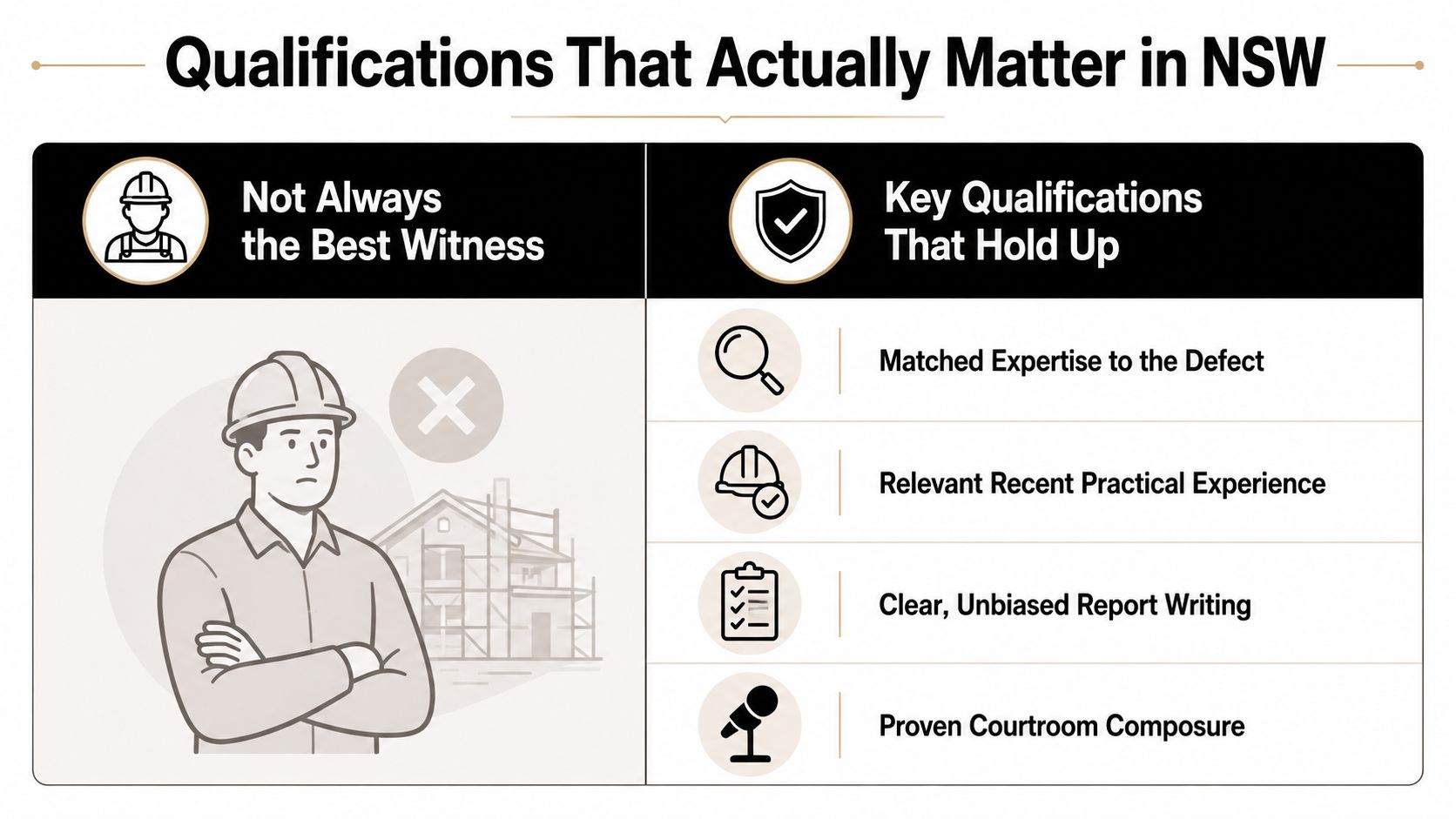
The qualifications that hold up best are specific. First, the expert should match the defect type, a waterproofer for waterproofing, a structural engineer for movement, or a cost expert for quantum issues. Second, they should have current registration or licensing where relevant. Third, they should carry professional indemnity insurance. Fourth, they need proven report-writing discipline, because a brilliant site operator can still produce a weak report.
Why breadth is weaker than fit
Broad experience can sound impressive and still be useless if the dispute turns on one narrow point, such as a particular NCC clause or a failed membrane detail. Specificity beats generality because the tribunal wants a witness who knows the exact issue, not a résumé that stretches across every type of building work.
Procedural credibility matters just as much. The underused question is not only “can this person spot the defect”, but “can they survive scrutiny on bias, prior testimony, conflicts, and consistency across cases”. General expert-witness guidance recommends checking disciplinary records, prior news coverage, courtroom history, and whether repeated work for one side might create a credibility problem (research tips guidance).
NCAT Procedural Direction 3 expects qualified experts, and tribunal guidance on expert letters asks for confirmation of no conflicts and compliance with expert duties (Justice Connect building expert guidance). That’s the core test. A witness has to be qualified, yes, but also careful, neutral, and able to explain themselves under pressure.
Briefing an Expert and Using a Scott Schedule
A strong brief starts before the site visit. The expert needs a written scope, clear access arrangements, and the right bundle of documents. That means the contract, variations, plans, specifications, correspondence, photos, certificates, and any inspection records.
Practical rule: if the expert has to chase basic papers after the first inspection, the report usually takes longer and costs more.
The next step is turnaround discipline. Don’t assume the expert can produce a proper report from a short email and one rushed site look. If the matter is heading into NCAT or court, the brief should explain the venue, the defect issues, and whether a Scott Schedule is needed.
A Scott Schedule is a structured comparison document, usually one row per defect, with columns for the claimant allegation, the respondent response, the expert opinion, and the rectification cost. It’s used to line the parties up before hearing, so the key disagreements are obvious instead of buried in long narrative reports. NCAT Procedural Direction 3 is the procedural anchor for that kind of structured evidence.
Here’s a simple example of how one entry can look in practice.
| Item | Claimant Allegation | Respondent Response | Expert Opinion | Indicative Rectification Cost |
|---|---|---|---|---|
| Missing shower water stop | Water escapes the shower and damages adjacent finishes | Shower was built to normal practice | The shower lacks an effective water stop and the defect is consistent with water migration | To be assessed by the expert |
A Scott Schedule is not the same thing as a Scott Report. The schedule is the comparison tool, while the report is the explanatory evidence behind it. If you want a fuller NSW homeowner guide, the Scott Schedule NCAT guide is a practical reference.
Typical Fees and Timelines in NSW
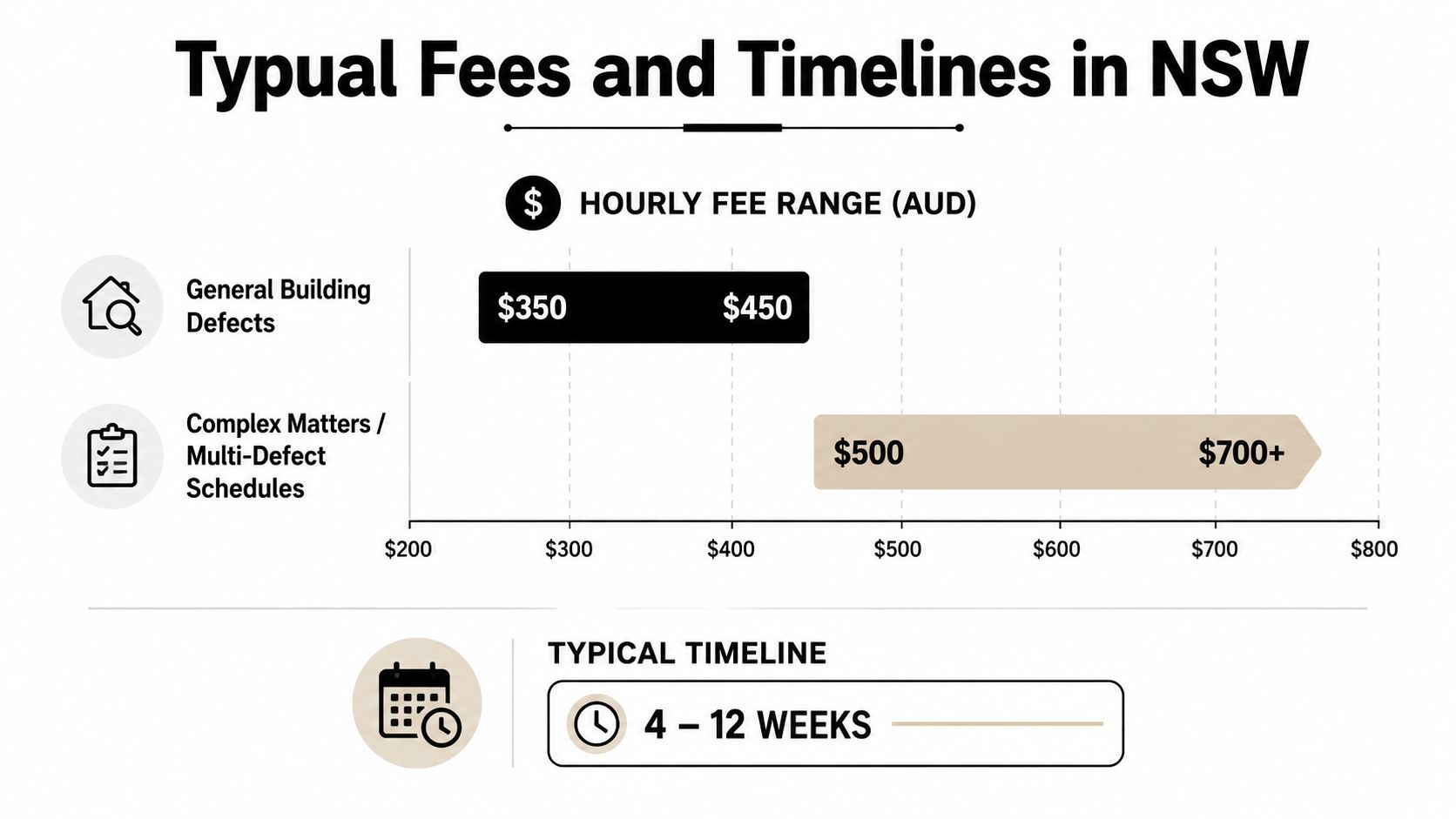
NSW building expert witness work is specialised, and the fee range reflects that. Hourly rates are generally expected to fall between $350 and over $700 (NSW fee benchmark). The higher end is usually associated with complex matters, multi-defect schedules, or tribunal attendance.
What drives the price
The main cost drivers are straightforward. More defects mean more inspection time, more analysis, and more writing. Large document bundles slow the process down. A Scott Schedule adds comparison work, and conference or hearing attendance adds preparation and appearance time.
The timeline depends on those same variables. A single-defect report can often be turned around in a matter of weeks, while multi-defect work with a full schedule usually takes longer. The point is not speed for its own sake, it’s whether the report is solid enough to stand up in a defended dispute.
If you’re weighing the cost against approval issues, rectification scope, or council-related work, the Western Bathroom Renovations approval guide is a useful adjacent read because it shows how quickly a simple renovation can become a compliance issue.
The trade-off is simple. An expert fee can feel heavy when you’re already paying for repairs, but the cost of going into NCAT or court without defensible evidence can be heavier still. For a clearer sense of how pricing is usually framed, the Awesim report cost page is a sensible starting point.
Preparing Your Evidence and Next Steps
Before the first expert site visit, get the paper trail in order. The best files are the boring ones, the ones that show exactly what was agreed, what was built, and when the defect first appeared.
- Building contract and variations: bring the signed contract, every variation, and any side agreements.
- Plans and specifications: include the issued drawings, notes, and finish schedules.
- Certificates and inspections: keep occupancy certificates, compliance documents, and inspection records.
- Photo and video evidence with dates: use clear images that show location, sequence, and progression.
- Correspondence with the builder: save emails, texts, and letters in full.
- Prior rectification quotes: these help show what has already been assessed and what work is still disputed.
A weak file forces the expert to guess at context. A strong file lets the expert tie observations to documents, then test whether the defect is due to workmanship, code non-compliance, a design issue, or something else. That’s where the matter starts to become readable for NCAT or a court.
The strongest NSW building disputes are not won by the homeowner with the angriest complaint. They’re won by the party with the clearest evidence chain and the most defensible expert.
If you’re at that stage now, email admin@awesim.com.au or call 1800 293 746 for a free initial consultation with a NSW building expert witness team that brings 35+ years in building and construction and 15+ years of litigation support to homeowners, builders, and lawyers.
Awesim Building Consultants provides NSW building inspections, Expert Witness Reports, and Scott Schedules for disputes that need clear, court-ready evidence. If you’re dealing with NCAT, a defect claim, or a builder dispute, visit Awesim Building Consultants to arrange a practical first conversation about your matter.
Related Posts
Waterproofing Inspector: How to Choose One for a NSW Claim
Why a Standard Building Inspector Is Not Enough What a Forensic Waterproofing Inspection Actually Covers Membrane and System Identification AS
Read More »
Building Inspection Report Template and What Courts Expect
What a Building Inspection Report Template Looks Like in Practice The Schedule 7 Requirement and Why It Changes Everything How
Read More »
Dilapidation Report Template: What Must Be in the Document
What a Dilapidation Report Actually Is The Core Sections Every Dilapidation Report Template Must Include 1. Cover Page and Report
Read More »