
Quantum Meruit Claim Australia: A Practical Guide

You've finished the work, the owner's stopped answering, and the last progress claim is now a fight about what was agreed, what was changed, and what's payable. That's the kind of dispute where a quantum meruit claim Australia issue gets real fast, because the job may be partly done, the paperwork may be thin, and both sides think the other one is overreaching.
In NSW building work, that problem shows up in residential renovations, staged contracts, defect disputes, and jobs that were terminated before the next payment stage kicked in. The law does give a path to recover the reasonable value of work done, but it's not a blank cheque. The claim lives and dies on evidence, the contract structure, and the way the work was valued on site.
When Contracts Fall Apart and Work Still Needs Paying For
A builder turns up to a half-finished renovation, the owner says the contract is over, and the next payment stage never arrives. The builder has labour on site, materials delivered, and trades booked, but the owner says the amount claimed doesn't match what was agreed. That's the sort of breakdown where quantum meruit becomes the practical legal question, because someone still has to account for the benefit of the work that's already been accepted.
What the claim is really doing
Quantum meruit is a restitutionary claim. It asks what the work was reasonably worth, not what the builder hoped to earn, and not what the owner now wishes had been done differently. In construction disputes, that matters most when the contract is disputed, incomplete, terminated, or unenforceable, and the ordinary payment path no longer gives a clean answer.
That's also why a simple fee note or informal tally rarely carries the day. A sensible starting point is a documented scope, a paper trail, and a clean record of who asked for what. If the arrangement is still being drafted, a practical resource like a fee agreement template can help frame the commercial basics before the job starts drifting into dispute.
Why NSW builders get caught out
In residential work, staged payments and site variations are where the trouble starts. A builder may finish a major portion of the job, but if the next contractual payment stage hasn't accrued, the fight becomes about whether the work is payable under the contract or only through restitution. That distinction became much sharper after Mann v Paterson Constructions Pty Ltd HCA 32.
Practical rule: if the contract still explains what's payable, don't jump straight to quantum meruit. Test the contract first, then test whether the work sits outside it.
For NSW builders, owners, and solicitors, the main issue is usually the file, not the theory. Keep the photos, emails, progress claims, variation instructions, and site notes together, because once the matter hardens, the evidence matters more than the argument.
The Legal Elements of a Quantum Meruit Claim in Australia
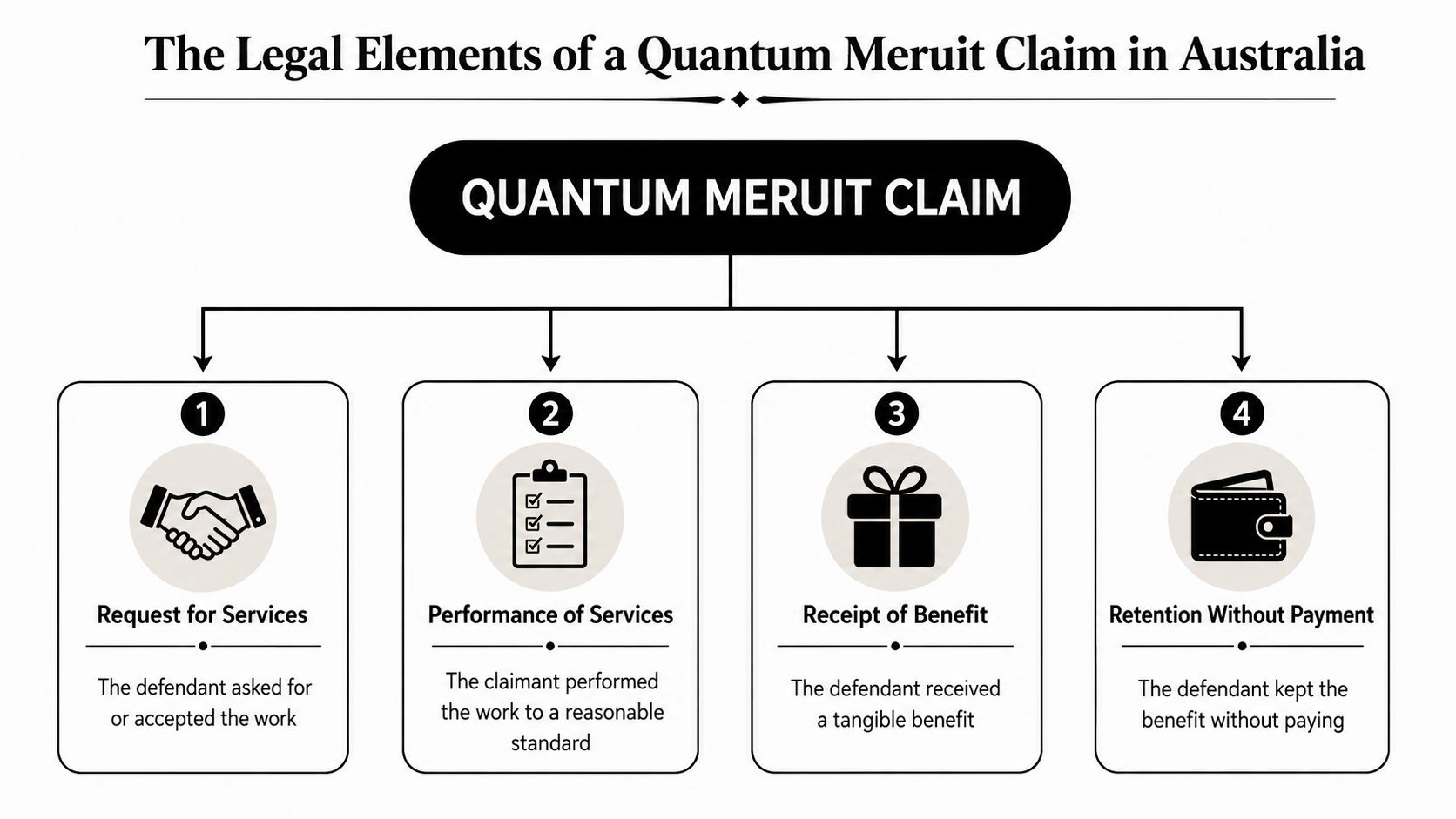
A quantum meruit claim Australia case rises or falls on the evidence in the project file. Australian courts look for a request for services, actual performance, receipt of a benefit, and retention of that benefit without payment in circumstances that make the outcome unjust. Those elements are described in practical Australian commentary on quantum meruit claims in this guide to the claim basics.
The four elements in plain language
The first element is the request. The owner, builder, or principal must have asked for the work, or at least accepted it in a way that shows it was not unwanted. In practice, that request is usually found in emails, site instructions, texts, or conduct on site.
The second element is performance. The claimant must show the work was done, or the services were supplied. For NSW building jobs, that often means being able to point to completed stages, delivered materials, labour on site, or variations that were carried out after instruction.
The third element is benefit. The defendant must have received something real, not just a line item in a claim. In building disputes, that can be a completed structure, installed materials, or work that has moved the project forward in a measurable way.
The fourth element is retention without payment in circumstances that make the result unjust. If the owner keeps the benefit and the builder does not get paid, the court asks whether that outcome is fair on the facts. Site records, payment history, correspondence, and the way the job ended all matter here.
Why Mann v Paterson matters in staged NSW residential work
The practical problem after Mann v Paterson Constructions Pty Ltd HCA 32 is procedural as much as legal. In staged residential work, a builder who has done real work on site still has to ask whether the claim belongs in debt, damages, or restitution, and which part of the file supports each path. If a stage has already matured under the contract, the payment fight usually stays inside the contract. If the work falls outside an accrued contractual entitlement, quantum meruit may still be available, but the claim has to be framed with care.
That is the point NSW builders, owners, and solicitors often miss. The issue is not just whether work was valuable. It is whether the project file shows a contractual payment right, a variation, or a separate restitutionary claim, and whether the evidence can support that choice without overlap. A staged residential job that runs off the rails can produce three different arguments in the same file, and each one needs its own evidence trail.
A practical guide to the construction-law framework is set out in Awesim's quantum meruit claims in building disputes page, which reflects how these disputes are usually tested in real project files.
How to Make a Quantum Meruit Claim in NSW
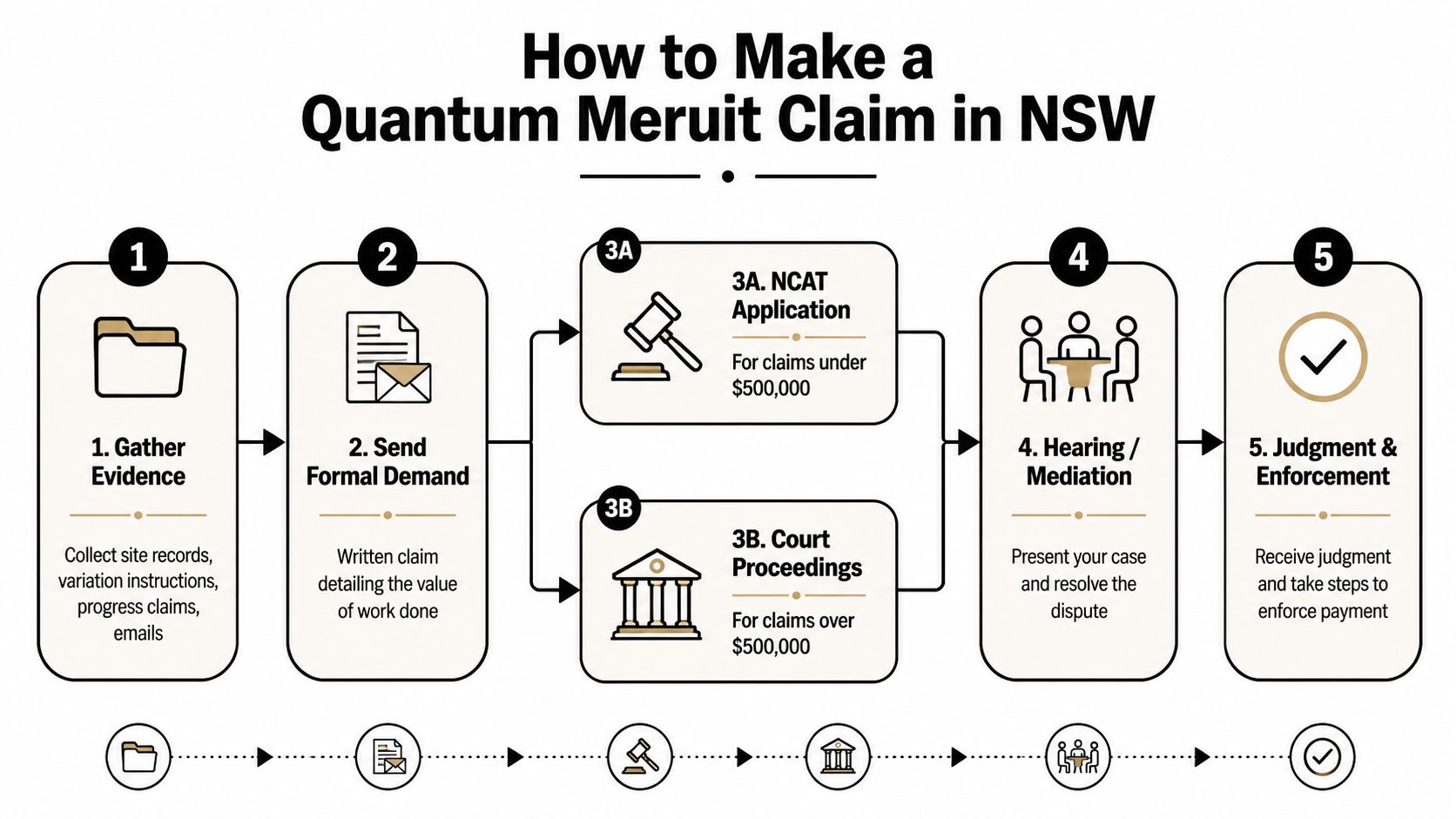
A good claim starts with the file, not the filing. If the job has already gone sideways, the first task is to reconstruct what was done, when it was done, who asked for it, and what value it added to the project. Courts and NCAT don't reward broad assertions, they want evidence that can be checked against site history and trade records.
Build the claim from contemporaneous records
The strongest files usually contain site diaries, variation instructions, progress claims, emails, photos, and delivery dockets. These records matter because they show the work as it unfolded, not after the dispute started. That's the difference between a claim that looks assembled and a claim that looks proven.
For NSW matters, that documentary trail often decides whether the claim is workable at all. If the file is thin, the expert has to work harder, the valuation becomes more contestable, and the defendant gets more room to argue that the claim is inflated or unsupported. A useful NSW-facing reference for dispute preparation is Awesim's quantum meruit claims in NSW construction guide.
Choose the right forum and package the evidence properly
NCAT and court proceedings don't treat evidence the same way, but both expect a coherent story. The claim should identify the work, the date range, the benefit received, and the basis of value. It should also separate completed work from unfinished work, because post-Mann recovery depends heavily on whether a contractual payment right had already accrued.
The cleaner the project file, the easier it is to show what was done, what it was worth, and why the owner can't fairly keep the benefit unpaid.
An expert witness can change the pace of the dispute. A proper valuation report turns a pile of correspondence into an assessable claim, and a Scott Schedule helps isolate disputed items, omissions, and defects so the issue doesn't get buried in noise. Awesim Building Consultants, with over 35 years of estimating the costs of building and construction, prepares site investigations, Building & Construction Expert Witness Reports, and Scott Schedules for dispute work of this kind.
Valuation Methods and Evidence That Courts Accept
The hardest part of a quantum meruit claim Australia dispute is usually not the principle, it is the valuation. Courts and tribunals want the reasonable value of the benefit conferred, which means the figure has to come from evidence, not from whichever number looks convenient on the day. Australian commentary on quantum meruit explains that courts commonly look at market rates, agreed prices, and the nature and duration of the work when setting value, rather than taking a raw cost base at face value as described here.
What valuation looks like on a building file
A defensible claim needs a trade breakdown. That means labour, materials, hire equipment, deliveries, onsite costs, and offsite costs. The valuation also has to reflect what was installed or supplied, not just what was budgeted.
A lump sum without detail usually gets challenged quickly. If the expert cannot show how the number was built, the other side will attack it as a guess dressed up as an assessment. In NSW building disputes, that is why site inspection notes, photographs, invoices, and trade measurements matter so much.
| Valuation Method | When Used | Evidence Required | Court Acceptance |
|---|---|---|---|
| Market-based valuation | Where comparable work and trade pricing can be benchmarked | Trade quotes, market comparisons, scope breakdown | Strong when the comparison is reliable |
| Agreed-price reference | Where the contract or prior pricing helps frame value | Contract documents, variations, progress claims | Strong for completed or partially priced work |
| Cost-based breakdown | Where labour, materials, hire, and deliveries need to be separated | Supplier invoices, labour records, delivery dockets | Useful, but must still show reasonable value |
| Expert trade assessment | Where the job is disputed, incomplete, or poorly documented | Site inspection, photographs, records, measured quantities | Often needed in contested NSW matters |
Why a proper report matters
For NSW claim files, the method often needs to be explained in a way a tribunal can follow. That is where a structured report helps, because it separates the claim into recognisable components and then applies a pricing basis that can be tested. Awesim Building Consultants' quantum meruit report service is built around that kind of evidence-led valuation, including trade breakdowns for labour, materials, hire equipment, deliveries, and onsite and offsite costs.
The point is not to push the figure higher. The point is to make it defensible.
Common Defences and Pitfalls That Defeat Claims
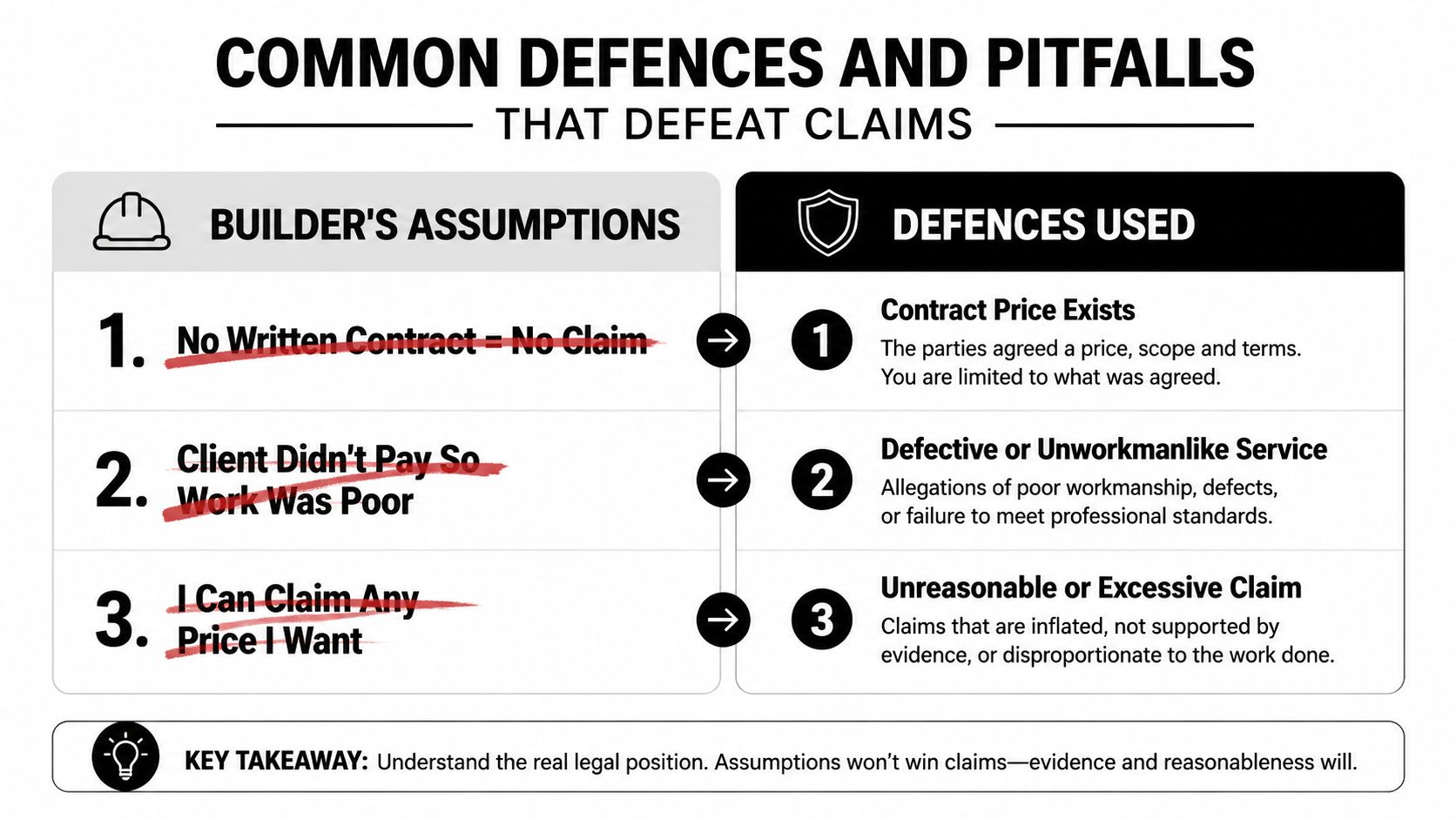
Many builders think a disputed job automatically turns into a payment claim. It doesn't. The owner or principal can defeat a claim by showing that the contract already governs payment, that the work was defective or incomplete, or that the amount claimed is unreasonable when measured against the actual benefit received.
Where claims fail in practice
The termination point matters. Post-Mann, quantum meruit is generally available only for work done before termination when the builder had not yet accrued a contractual right to payment. If the contract already fixed the amount payable for the completed stage, the claim is usually confined to debt or damages under the contract instead of restitution. That distinction is discussed in practical post-Mann commentary here.
The Home Building Act 1989 (NSW) can also complicate matters. If the building contract is unenforceable, a claim may still arise, but the builder still has to prove the fair value of the work performed and the benefit received by the owner. A claim cannot copy the contract sum into the quantum meruit figure, because the court is looking for the value of the work, not a recycled invoice total. That position is outlined in MinterEllison's NSW commentary.
The mistakes that give the other side room to argue
Poor records are the easiest target. If a builder can't show variation instructions, progress claims, or site notes, the owner can argue the work was never properly requested or valued. Overreaching is just as risky. A claim that bundles completed, incomplete, defective, and unproven items together usually loses credibility fast.
Practical rule: if the evidence doesn't support the amount, the court may discount it heavily or reject the claim path altogether.
A common defence is that the defendant already has a contractual ceiling. Another is that the work was not worth what's claimed because the benefit was reduced by defects or unfinished items. The third is that the file doesn't prove unjust retention at all, only that the parties fell out.
Timelines, Costs, and Practical Next Steps
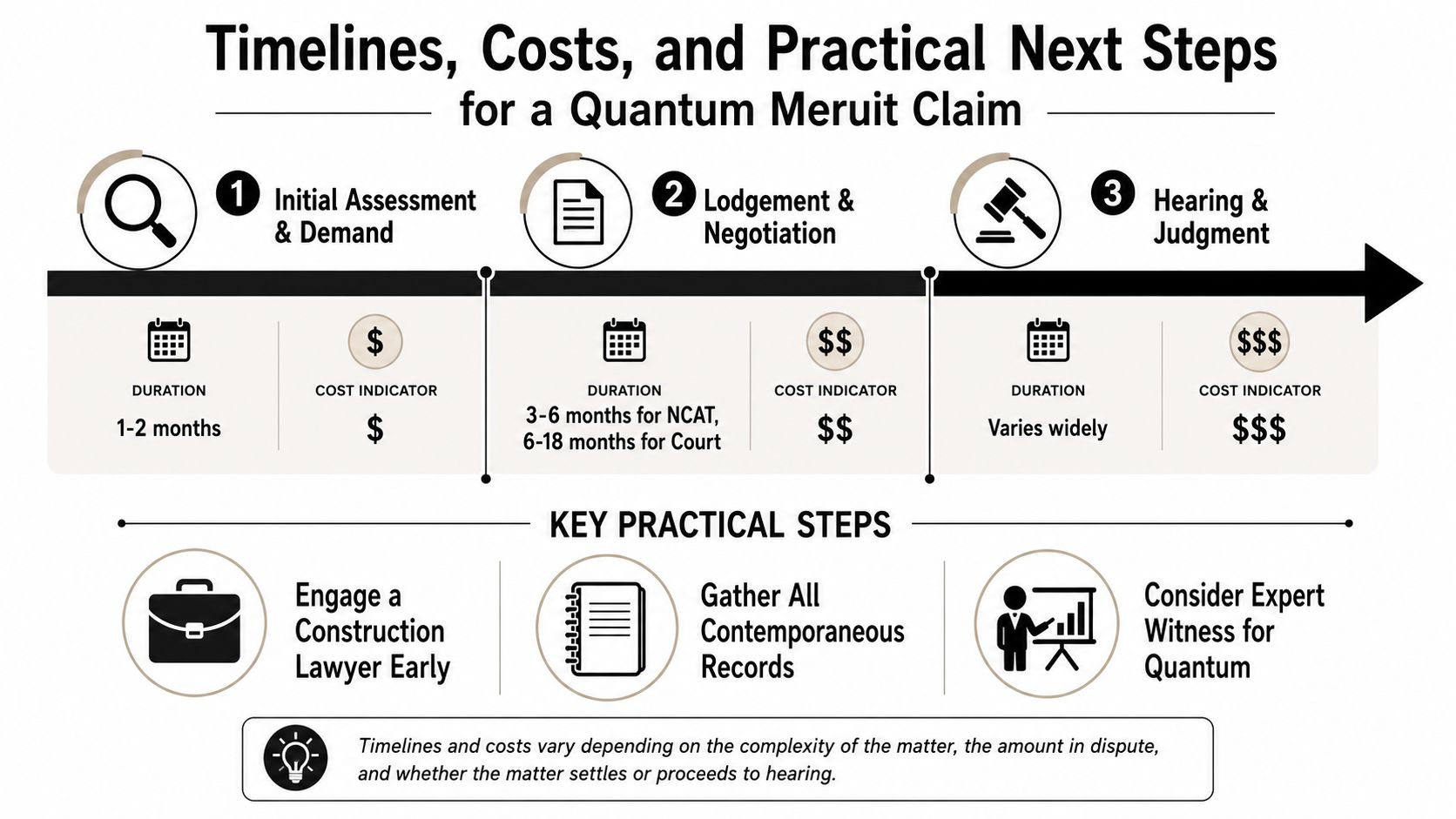
A dispute file goes stale if it is left on the desk. Photos disappear, site memories fade, and the documents that prove the work start to scatter across emails, phones, and old folders. The practical move is to lock down the evidence early, then decide whether the matter needs debt recovery, damages, restitution, or a mix of those paths.
What usually happens once the file is assembled
An initial assessment should sort the work into categories, then test the contract position against the evidence. From there, the claim can be framed for negotiation, NCAT, or court. In a live dispute, the timing depends on the forum, the complexity of the file, and how much of the valuation is in issue.
When an expert becomes worth engaging
The moment the question becomes, “what was this work really worth?”, the valuation needs structure. Site investigations, expert witness reports, and Scott Schedules become useful when the matter has to satisfy tribunal or court expectations. The report should deal with the trade breakdown, the supporting records, and any deductions for omissions or defects.
Awesim Building Consultants' service page for quantum meruit report work is a practical starting point if the file needs a defensible valuation, especially where the dispute involves disputed variations, incomplete documentation, or a staged residential job that never reached the next payment milestone.
The immediate next steps that help
- Preserve the chronology: Save every message, photo, plan mark-up, progress claim, and payment record in date order.
- Separate the claim types: Work out what is debt, what is damages, and what may belong in restitution, because mixing them blurs the case.
- Get the valuation tested early: A trade-based report is easier to defend than a round-number claim assembled after the dispute started.
Awesim Building Consultants has over 35 years of estimating building and construction costs, and more than 15 years providing litigation support to homeowners, builders, and lawyers. If you need a site investigation, an expert witness report, or a Scott Schedule prepared for a NSW dispute, email admin@awesim.com.au or call 1800 293 746.
Frequently Asked Questions About Quantum Meruit Claims
Can quantum meruit apply if the building contract is unenforceable under the Home Building Act 1989 (NSW)? Yes, but the builder still has to prove the fair value of the work done and the benefit received by the owner. The contract sum can't just be copied across.
What happens when work is partly complete and no contractual right to payment has accrued yet? That's where the post-Mann framework matters most. Recovery may still be available, but the claim has to match the contract structure and the evidence of what was done.
How do variation disputes fit into this? Variations often sit at the edge of contract and restitution. If the variation was clearly instructed and priced, the contractual route may still be the cleaner one. If the documentation is weak or the contract can't comfortably cover the work, quantum meruit may become the fallback.
Why do site investigations and expert reports matter so much? Because the court is valuing the benefit conferred, not accepting a builder's headline number. A measured report with trade breakdowns, records, and site findings gives the claim a real evidentiary base.
Awesim Building Consultants prepares site investigations, Building & Construction Expert Witness Reports, and Scott Schedules for NSW disputes where the value of work is contested. If your file involves a terminated job, staged residential work, or disputed variations, visit Awesim Building Consultants to review the available services and get the claim assessed properly.

Related Posts

Waterproofing Inspector: How to Choose One for a NSW Claim
Why a Standard Building Inspector Is Not Enough What a Forensic Waterproofing Inspection Actually Covers Membrane and System Identification AS
Read More »
Building Inspection Report Template and What Courts Expect
What a Building Inspection Report Template Looks Like in Practice The Schedule 7 Requirement and Why It Changes Everything How
Read More »
Dilapidation Report Template: What Must Be in the Document
What a Dilapidation Report Actually Is The Core Sections Every Dilapidation Report Template Must Include 1. Cover Page and Report
Read More »