
Shower Leaking Through the Floor: Structural Risks, Evidence Requirements, and Your Legal Options in NSW
- What Is Actually Happening When a Shower Leaks Through the Floor
- Structural Risks You Should Not Ignore
- Is This a Building Defect Under NSW Law?
- The Evidence Problem: Why a Plumber's Report Is Not Enough
- What NCAT Requires From You
- Your Legal Options in NSW
- Getting the Right Expert Involved Early
- FAQs
A shower leaking through the floor is rarely just a plumbing annoyance. Left unaddressed, it can compromise your home's structural integrity, generate mould, and become a serious legal matter involving your builder, waterproofer, or developer. If you're a homeowner in NSW who has discovered this problem, understanding what's actually happening inside your floor, what evidence you'll need, and what your options are under NSW law will put you in a far stronger position.
What Is Actually Happening When a Shower Leaks Through the Floor
Water escaping through a shower floor is almost always a waterproofing failure, not a plumbing one. The membrane beneath the tiles is designed to contain water within the shower recess and direct it to the drain. When that membrane fails, water penetrates the substrate, saturates the floor structure, and migrates outward and downward.
The most common causes include:
- Membrane not applied to the correct height on walls — the membrane must extend a minimum distance up the wall at the floor junction
- Inadequate or missing membrane at the drain collar, one of the most failure-prone junctions in any shower
- Membrane applied too thinly, particularly at corners and penetrations
- Membrane not allowed to cure before tiling, causing poor adhesion to the substrate
- Movement cracks in the substrate that the membrane was not designed or applied to accommodate
In practice, many waterproofing failures in NSW residential construction come down to non-compliant installation rather than product failure. The membrane was there — it just wasn't installed to the standard required under the National Construction Code and AS 3740, the Australian Standard for waterproofing of domestic wet areas.
Structural Risks You Should Not Ignore
The longer a shower leak goes undetected or unrepaired, the more damage accumulates. Depending on your floor construction, the consequences range from cosmetic to structural.
Timber Subfloor Construction
Older homes and many contemporary builds use timber floor joists. Sustained moisture causes timber to swell, delaminate, and eventually rot. Rotted joists lose load-bearing capacity, and in severe cases a shower floor can become structurally unsafe. You may also see secondary damage in adjacent rooms where water has tracked along joists before appearing as a stain on a ceiling below.
Concrete Slab Construction
Concrete looks more resilient, but water penetrating a slab can corrode the steel reinforcement inside it. Corroding steel expands, which causes the concrete to crack and spall over time. It's a slow process, but expensive to remediate and capable of affecting the structural rating of the slab.
Mould and Air Quality
Waterlogged substrates are ideal environments for mould. Mould hidden beneath tiles or inside wall cavities is a health risk and notoriously difficult to remediate without removing the affected materials entirely. In NSW, mould resulting from a building defect is a legitimate component of a defect claim.
Is This a Building Defect Under NSW Law?
In most cases, yes. Under the Home Building Act 1989 (NSW), residential building work must be carried out with due care and skill, in accordance with the plans and specifications, and in compliance with all applicable laws and requirements. Waterproofing is a statutory warranty item, meaning the builder is liable for defects for a defined period.
For major defects, the statutory warranty period is six years. A defect is classified as major if it affects a structural element, makes the building unfit for occupation, or involves a failure of the waterproofing system. Shower waterproofing failures frequently qualify — which matters significantly for your claim timeline.
For non-major defects, the period is two years. If you're unsure which category applies to your situation, that's exactly the kind of question a building consultant can help you answer before you file anything.
The Evidence Problem: Why a Plumber’s Report Is Not Enough
This is where many homeowners underestimate the complexity of their situation. A plumber can confirm water is escaping. A tiler can confirm the tiles look wrong. Neither observation constitutes the kind of evidence NCAT or a court will rely on to determine liability and quantify loss.
What you need is an independent forensic assessment that:
- Identifies the specific waterproofing failure mode
- Establishes which element of the installation was non-compliant and with what standard
- Documents the consequential damage caused by that failure
- Quantifies the cost of rectification to a proper standard
A Forensic Waterproofing Inspection is a specialist on-site investigation designed to produce exactly this kind of evidence-grade report. It goes beyond visual observation — the inspector examines the membrane system, the drain collar, the substrate condition, the tiling methodology, and the extent of water ingress, with findings documented in a format suitable for formal proceedings.
This distinction matters enormously if your dispute ends up at NCAT or in court. A report that doesn't meet evidentiary standards won't carry weight, regardless of how accurate its conclusions are.
What NCAT Requires From You
The NSW Civil and Administrative Tribunal handles most residential building disputes in NSW. If your shower leak dispute involves a licensed builder and falls within the monetary jurisdiction, NCAT is likely where your matter will be heard.
NCAT will typically require you to produce:
- Evidence of the defect — photographs, inspection reports
- An independent expert report prepared by a suitably qualified person
- A Scott Schedule itemising each defect, the applicable standard breached, the builder's position, and the cost of rectification
The Expert Witness Report must comply with the UCPR Schedule 7 Expert Witness Code of Conduct. This is not optional. A report that doesn't satisfy Schedule 7 requirements will not be accepted as expert evidence. It must state that the expert has read and complied with the code, that the opinions expressed are their own, and that their duty is to the tribunal rather than to the party retaining them.
The Scott Schedule is the document that structures the dispute. Each defect gets its own row, with your position, the builder's position, and the cost attributed to each item set out side by side. Tribunals and courts use Scott Schedules to manage complex multi-defect disputes efficiently. If you've never seen one, Awesim has a Scott Schedule template and plain-English guidance available on their site.
Your Legal Options in NSW
Depending on the value of your claim and the nature of the dispute, several pathways are available.
Negotiation and Demand Letter
Before filing anything, a formal letter of demand supported by a forensic inspection report often prompts a response from the builder or their insurer. It's the least expensive path and worth attempting first.
NCAT Building and Construction Division
For most residential building defect disputes in NSW, NCAT is the appropriate forum. It's designed to be accessible to homeowners without legal representation, though many engage a solicitor for more complex matters. The monetary jurisdiction covers claims up to $500,000 for general building work.
NSW District Court or Supreme Court
Larger claims or disputes involving more complex legal issues may proceed in the District Court or Supreme Court. Expert Witness Reports prepared to UCPR Schedule 7 standards are equally applicable at these levels.
Home Building Compensation Fund
If your builder has become insolvent, died, or had their licence suspended or cancelled, you may have a claim under the Home Building Compensation Fund (HBCF), which provides insurance for residential building work in NSW. A forensic inspection report and expert evidence are still required to support the claim.
Getting the Right Expert Involved Early
The most common mistake homeowners make in shower leak disputes is waiting too long to engage an independent building consultant. By the time a solicitor advises them to get an expert report, they've already made statements, attempted repairs, or allowed the builder access without documentation — all of which can complicate the evidentiary picture.
Engaging a consultant early means the damage is documented in its original state, the cause is identified before remediation obscures it, and you understand the strength of your position before committing to a particular legal pathway.
Awesim Building Consultants has been preparing Expert Witness Reports, Scott Schedules, and Forensic Waterproofing Inspection reports for NSW proceedings since 1996. The firm operates from Sydney, Tamworth, and Tweed Heads, so on-site inspections are available across the state, including regional areas. All engagements start with a free initial consultation, and all work is conducted by or under the direction of principal consultant Glen Sim.
FAQs
Q: How do I know if my shower leak is a major defect under NSW law?
A: A defect is classified as major if it affects a structural element, makes the building unfit for occupation, or involves a failure of the waterproofing system. Shower waterproofing failures commonly qualify, which means the statutory warranty period under the Home Building Act 1989 extends to six years. A building consultant can assess the specific failure and advise on classification before you file.
Q: Can I repair the shower before getting an expert report?
A: Repairing the shower before an inspection is documented can significantly weaken your claim. Once the tiles are removed and the membrane replaced, the original failure mode may be impossible to assess. If the leak is causing urgent structural damage, document everything thoroughly with photographs and video before any work begins, and engage an independent consultant as soon as possible.
Q: What is a Forensic Waterproofing Inspection and how is it different from a standard building inspection?
A: A standard building inspection is a visual assessment of accessible areas. A Forensic Waterproofing Inspection is a specialist investigation focused specifically on identifying the cause and extent of a waterproofing failure. It produces an evidence-grade report suitable for use in NCAT or court proceedings — not just a general condition report.
Q: What does a Scott Schedule look like for a shower leak dispute?
A: A Scott Schedule for a shower leak typically lists each defect as a separate item — for example, membrane failure at the drain collar, inadequate membrane height at the wall junction, and consequential damage to the subfloor. For each item, it records your description of the defect, the standard breached, the builder's response, and the cost of rectification. Awesim publishes a Scott Schedule template you can use as a reference.
Q: How much does an Expert Witness Report cost for a shower leak matter?
A: The market range for expert witness reports runs from $2,000 to $10,000 AUD, with approximately $4,500 being typical. The actual cost depends on the complexity of the matter, the number of defects, and whether an on-site inspection is required. Awesim offers a free initial consultation to discuss your situation before any fee is agreed.
Q: Can I use the same report for NCAT and for a court proceeding if my matter escalates?
A: An Expert Witness Report prepared to UCPR Schedule 7 standards is suitable for use across NCAT, Local Court, District Court, and Supreme Court proceedings. The key is that the report must explicitly comply with Schedule 7 from the outset — reports prepared to a lower standard cannot simply be upgraded later.
Q: What if my builder is no longer operating?
A: If your builder is insolvent, deceased, or has had their licence suspended or cancelled, you may be able to claim under the Home Building Compensation Fund. You'll still need independent expert evidence to support the claim. A building consultant can advise on whether the HBCF pathway applies to your situation and prepare the documentation required.
A shower leaking through the floor often has a clear legal remedy in NSW. How that claim plays out will depend heavily on the quality of the evidence you produce and how early you engage independent expertise. Getting a forensic inspection done before repairs — and before making formal statements to your builder — is the single most important step you can take.

Related Posts
Scott Schedule Template: What Columns a NSW Claim Needs
What Is a Scott Schedule? Why the Column Structure Matters The Core Columns in a NSW Scott Schedule Template Column
Read More »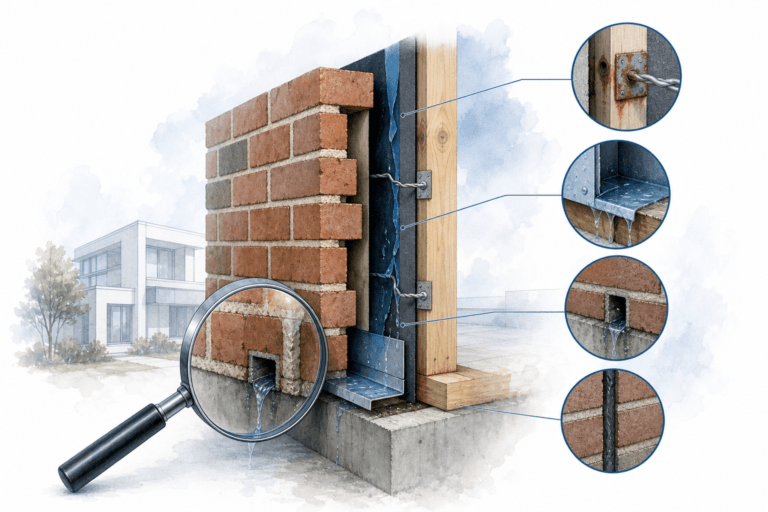
Brick Veneer Construction Defects: A Site Inspector’s View
What Brick Veneer Construction Actually Is The Most Common Brick Veneer Construction Defects Cracking in the Brickwork Missing or Blocked
Read More »
Liquidated Damages in Construction: How NSW Contracts Work
What Are Liquidated Damages in Construction? Why Contracts Use Them How Liquidated Damages Work in NSW Building Contracts Standard Contracts
Read More »