
What Is a Quantum Meruit Claim: Your Guide for 2026

You've probably hit the point where the builder wants more money, the owner says the extra work was never approved, and the paperwork that should settle it is thin or missing. That's the kind of dispute where quantum meruit comes into play, because the argument shifts away from the original contract price and towards the reasonable value of work done.
For NSW homeowners and builders, that change matters. A claim can succeed or fail on the quality of the site records, variation emails, invoices, and proof that the other side requested or knowingly accepted the work. If you're already fighting about unfinished work, extras, or a walk-off site, the question isn't just what was promised. It's what was done, what benefit was kept, and what evidence can prove it.
When Building Agreements Go Wrong
A common NSW dispute starts with a simple conversation on site. The owner asks for an extra room, a change to the bathroom layout, or upgraded finishes. The builder starts the work, the quote never gets amended properly, and by the time the project stalls, both sides are arguing from memory rather than documents.
That's usually when quantum meruit becomes relevant. It's not a shortcut for a builder who missed the paperwork, and it's not a windfall for an owner who got work done but never intended to pay for it. It's the legal pathway that asks a practical question, what was the work worth if the contract price doesn't control the answer?
This is why construction disputes often feel less like a pure legal fight and more like a forensic exercise. The tribunal or court is trying to work out whether the benefit was conferred, whether it was accepted, and how much that benefit was reasonably worth. In a building job, that can mean tracing labour, materials, and variations back through photos, emails, delivery dockets, and site diaries.
Owners and builders can reduce the damage early by thinking like risk managers, not just litigants. If the contract is drifting off the rails, it helps to review practical risk controls such as insuring against construction risks before the dispute hardens. It also helps to compare the dispute with a cost-plus arrangement, which shows how fast the numbers can move when scope and pricing aren't locked down, as discussed in this Awesim cost-plus contract example.
Practical rule: if the work was extra, incomplete, or informally approved, the paper trail usually matters more than the argument.
Quantum Meruit in Plain English
Quantum meruit is Latin for “as much as he has deserved,” but in a building dispute it comes down to a practical question, what amount is fair for work or materials that were provided and kept? In Australia, it is a restitution-based remedy used to recover the reasonable value of work or materials where no enforceable contract price controls the transaction, and the value is often assessed by the market value of labour and materials (Australian construction-law commentary).
A simple example helps. If you take your car to a mechanic, agree to “sort it out later,” and the mechanic completes the repair, you would expect to pay a fair rate for the parts and labour. You would not expect a random number pulled from nowhere, and you would not assume the job is free because the quote was never finalised. A quantum meruit claim works in a similar way, except the work is construction work and the dispute is usually bigger, messier, and backed by more evidence.
What it is, and what it isn't
Quantum meruit differs from contractual damages in a key way. Contract damages aim to put someone in the position they would have been in if the contract had been performed as agreed. Quantum meruit looks at reasonable compensation for services accepted and retained by the other party, even where no formal price was agreed or the price term cannot be enforced (equitable compensation principle).
That difference matters in building work. If the contract is silent on a variation, the contractor finished part of the work, or the agreement is missing altogether, the claim does not ask, “What profit was lost?” It asks, “What value did the other side receive?” That is why independent evidence of labour hours, materials, and reasonable market rates becomes central.
A quantum meruit claim is about the value retained, not the story told after the job goes wrong.
For NSW property disputes, that makes the remedy especially useful where documentation is weak but the work itself is visible. The issue is proving that the benefit was not only performed, but accepted and kept. At NCAT, that usually turns on the paper trail, photos, texts, emails, invoices, and site records that tie the work to the benefit claimed.
The Four Key Elements You Must Prove
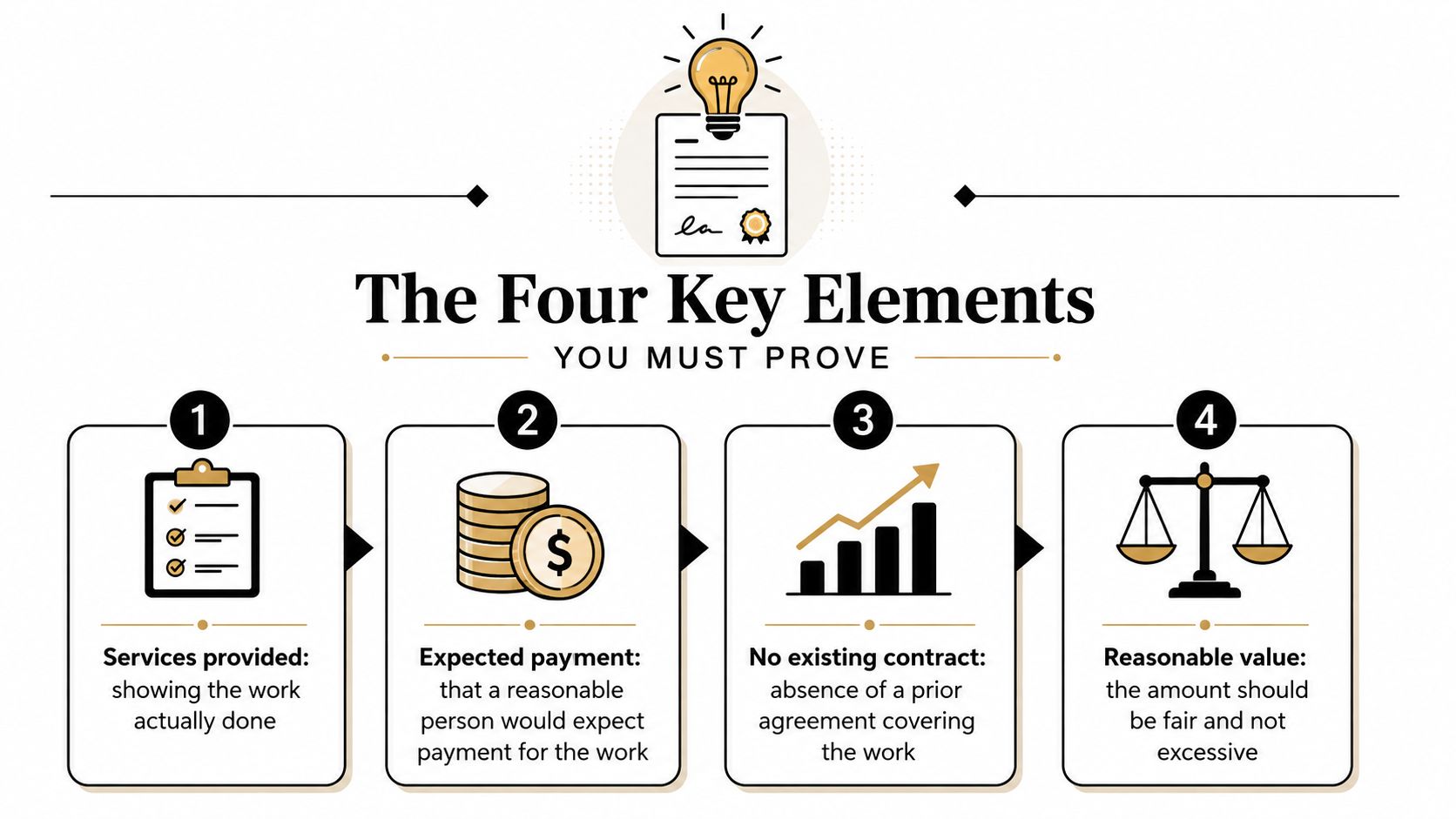
A quantum meruit claim in Australian building disputes is generally framed around four practical elements: a request for services, services performed, a benefit received by the defendant, and unjustness in retaining that benefit without payment (four-element framework). That structure is useful because it turns a legal idea into a checklist a builder, owner, or expert can work through.
1. A request for services
The request doesn't need to be formal, but it does need to be provable. A text message asking for an extra wall, an email approving additional tiling, or a site conversation confirmed later in writing can all matter. If the work was done without any sign the other side asked for it or accepted it, the claim gets harder.
2. Services actually performed
The site record becomes vital. Photos showing progress, delivery dockets, trade invoices, and daily logs can prove the work was done. A claim that sounds strong in conversation can look very weak if there's no evidence that the labour or materials were supplied.
3. A benefit received by the other side
The work has to have left something useful behind. A completed retaining wall, waterproofing already installed, or extra framing left in place can amount to a measurable benefit. If the work was ripped out, rejected, or never retained, the claimant has a much harder road.
4. Unjustness in keeping the benefit without payment
This is the fairness question. It asks whether the recipient knew about the work, took the benefit, and then refused to pay despite the circumstances. In Australian building disputes, that element is often the one that decides whether the claim feels like a real restitution case or just an unpaid invoice dressed up in legal language.
A useful way to test the claim is to ask three questions in order.
- Who asked for the work? Look for written approval, variation emails, or messages.
- What proof shows the work was done? Use progress photos, timesheets, invoices, and delivery records.
- What benefit stayed with the other side? Identify the work that remained on site or was used in the project.
A claim built on those four elements is much stronger than one built only on frustration. The legal theory is important, but the evidence is what makes it real.
Common Scenarios in NSW Building Disputes

A verbal variation is one of the most common triggers. The owner wants the patio extended, the builder does the work, and the written contract never catches up. If the owner later says the extra scope was never authorised, the dispute often turns on whether the builder can prove the owner requested or knowingly accepted the change, which is exactly the kind of problem quantum meruit is designed to deal with (request or acceptance focus).
Another familiar pattern is a project that stops halfway through. One side walks off site, the contract falls apart, and both sides start arguing about what should be paid for the work already carried out. In that setting, quantum meruit is not about punishing the party who left, it's about measuring the value that stayed behind in the building.
A third scenario is where the paperwork is incomplete from the start. No proper written contract, no clear variation approval process, and no tidy record of who signed what. That doesn't mean there's no claim. It means the claim depends even more heavily on proving the work, the benefit, and the circumstances of acceptance.
The practical difference becomes clearer when you look at the evidence trail. NCAT does not need a polished story, it needs a credible reconstruction of what happened on site. That usually means connecting the dots between work orders, texts, invoices, and physical inspection of the completed work.
Here's the kind of evidence that tends to matter most in these disputes.
- Variation correspondence: emails, texts, or signed notes showing the extra work was requested.
- Site records: daily logs, progress photos, and programme updates showing when the work was done.
- Payment records: invoices, progress claims, and receipts that show what was billed and what was paid.
- Completion evidence: photographs or inspection notes showing the work remained part of the project.
What often surprises owners is that even a dispute about incomplete work can still involve a quantum meruit argument. What surprises builders is that doing the work isn't enough on its own. The law still wants proof that the other side asked for it, accepted it, and kept the benefit.
Valuing Your Claim and Gathering Evidence
A quantum meruit dispute usually turns on a hard question, what is the work worth on the ground. The starting point is the reasonable value of the work performed, not the margin someone hoped to make under the contract. In practice, decision-makers look at labour input, materials supplied, market rates, and the benefit retained, then rebuild the value from the records they can trust, using an open-market and actual-input approach. That is why these disputes become a documentation exercise as much as a legal one.
A claim only holds up if the paper trail can support it.
The strongest file is usually built from contemporaneous records, not recollection put together after the dispute starts. Site photos, invoices, programme updates, and variation correspondence matter because they show what was done, when it was done, and how the work fitted into the project. They also help the tribunal separate genuine extra work from loose memory or inflated reconstruction.
A practical evidence bundle should include:
- Receipts and supplier invoices for materials, plant, and hire items.
- Dated site photos that show progress, defects, or incomplete work.
- Written messages confirming changes, extra work, or site instructions.
- Timesheets and daily logs showing labour hours and attendance.
- Subcontractor statements where trades saw the work or supplied the materials.
- Progress claims and payment records showing what was billed and what was paid.
The order matters as much as the documents themselves. Evidence organised by date and scope is easier to follow at NCAT than a loose bundle with no clear sequence. A Building & Construction Expert Witness Report can help turn that material into an independent valuation, especially where labour, materials, and variations need to be separated cleanly. For a practical example of that process, see Awesim's quantum meruit report service, which is used to assess the reasonable value of building work, materials, labour, variations, incomplete work, or disputed construction costs.
A Scott Schedule also helps because it sets out each item of work, the dispute point, the claimed amount, and the response in a format the tribunal can follow. Instead of arguing in broad terms about the whole job, the parties can test each item against the evidence. That matters in disputes over variations, incomplete work, or payment claims, where the issue is often whether a specific item can be proved and valued.
Practical takeaway: if you cannot show the work item by item, it is much harder to prove the value item by item.
That is why expert analysis matters here. A well-prepared report should not just repeat the argument. It should test whether the claimed amount matches the work done and whether the records can stand up in NCAT, and in some matters it may be prepared alongside advice from a wholesaling legal partner if the dispute sits within a broader property or construction arrangement.
Next Steps and Getting Expert Help
If you think you have a claim, the first move is usually to gather your records and send a formal letter of demand that sets out the work, the benefit, and the payment sought. If the dispute doesn't resolve, the matter may be taken to NCAT or another forum, depending on the parties and the nature of the claim. The key is to avoid relying on memory when the dispute can still be anchored to documents, photos, and site records.
If you're defending a claim, the best responses usually target the same weak points. Was the work requested, or was it done off your own back? Was the benefit retained, or was it rejected, removed, or already paid for? Was the amount claimed reasonable, or does the paper trail show a different value entirely?
That's where expert analysis makes a real difference. Quantum meruit is distinct from contractual damages because it focuses on reasonable compensation for services accepted and retained by the other party, a principle aimed at preventing one side from being unjustly enriched at the other's expense (equitable focus). If you need help presenting that issue properly, it's sensible to read what an expert witness report costs and how to get one in NSW before deciding your next step.
For matters involving builders, homeowners, solicitors, or insurers, a specialist building consultant can help by inspecting the site, reviewing the paper trail, and preparing NCAT-ready evidence. That's the point where wholesaling legal partner style cross-disciplinary advice can be useful in other property disputes, but in construction matters the significant value comes from technical proof tied to the work on site.
Awesim Building Consultants has 35+ years in Building & Construction and over 15+ years providing litigation support to homeowners, builders, and lawyers. If your dispute turns on work done, variations, incomplete scope, or fair valuation, the evidence needs to be clear, independent, and ready for NCAT scrutiny.
Awesim Building Consultants prepares site investigations, Building & Construction Expert Witness Reports, Scott Schedules, and quantum meruit evidence for NSW building disputes. If you're dealing with unpaid variations, incomplete work, or a claim about the reasonable value of work done, visit Awesim Building Consultants or contact the team at admin@awesim.com.au or 1800 293 746 for practical help with your next step.

Related Posts

Water Damage in Homes: How to Track Down the Source
Water damage in a home rarely announces itself at the source. A stain on the ceiling, a musty smell in
Read More »
Waterproofing Membrane Types: Which Fails Most in NSW Bathrooms
Waterproofing failure is the single most common serious defect found in NSW apartments, and the type of membrane used, along
Read More »
Building Certifier NSW: Role, Limits, and When You Need More
A building certifier in NSW is a registered professional who issues construction certificates, conducts critical stage inspections, and grants occupation
Read More »