
Building Expert Witness Report: A Complete NSW Guide
A compliant building expert witness report in NSW is a critical legal document, and in residential disputes it typically costs between $1,500 and $4,000 or more depending on complexity. If your matter is heading to NCAT, this report often becomes the document that turns a frustrating building argument into an evidence-based case the Tribunal can decide.
Clients often seek one after the dispute has already gone stale. The defects list has grown, emails have become positional, the builder says the work is within tolerance, the owner says it plainly isn’t, and the solicitor wants something usable in proceedings rather than another opinion that goes nowhere. That’s the point where a proper expert report matters.
A building expert witness report isn’t just a building inspection with stronger language. It’s an independent technical document prepared for a legal setting. It needs to identify the issues, explain how the expert reached each opinion, tie findings to relevant standards and documents, and present the defects in a format that fits tribunal procedure.
That difference matters on the ground. A standard inspection may help you understand what’s wrong. A court-compliant report is built to survive scrutiny from the other side, their lawyer, and the decision-maker reading it.
With 35+ years in building and construction and 15+ years providing litigation support to homeowners, builders, and lawyers, the practical lesson is simple. The strongest cases usually aren’t the loudest ones. They’re the ones with a disciplined report, clear photos, an organised defect list, and an expert who stays independent.
Your Guide to Building Expert Witness Reports
A typical NSW dispute doesn’t begin in the Tribunal. It usually starts with a renovation that didn’t finish properly, a new build that presents cracking or waterproofing concerns, or a strata matter where everyone agrees something is wrong but no one agrees on cause, scope, or responsibility.
That’s where a building expert witness report earns its place. In plain English, it is an independent assessment of defective work, incomplete work, damage, causation, and rectification. It takes a site problem and turns it into a document that lawyers, owners, builders, insurers, and NCAT can all work from.
What the report actually does
The report should do three jobs well:
- Establish the facts: What was observed on site, what documents were reviewed, and what condition the building elements are in.
- Form technical opinions: Whether the work appears compliant, defective, incomplete, poorly sequenced, damaged, or inconsistent with accepted practice and relevant standards.
- Assist resolution: By presenting the issues in a structured way that supports negotiation, directions hearings, conciliation, or final hearing.
For homeowners, that often means clarity. For builders, it can mean separating real defects from allegations that don’t stand up. For solicitors, it means having evidence that is organised enough to plead and practical enough to use.
Practical rule: The report should reduce argument, not add noise. If it leaves everyone more confused than before, it hasn’t been prepared properly.
Why experience changes the quality of the outcome
A consultant with site-based construction experience reads a property differently from someone who only knows paperwork. Sequencing errors, trade interface failures, recurring moisture paths, structural movement patterns, and workmanship issues often make sense only when the expert understands how the building was put together.
That’s why clients usually need more than a defect list. They need a report writer who can inspect, analyse, document, and explain the problem in a way that suits a legal forum without drifting into advocacy.
Why a Building Expert Report is Crucial in NSW Disputes
A typical NCAT problem starts the same way. A homeowner has photos, a builder has emails, and everyone has a strong view about what went wrong. Then the Tribunal asks for expert evidence, and the case turns on whether the report is independent, properly structured, and based on identifiable facts.
That is the point many parties miss. In NSW building disputes, a report is not just supporting paperwork. It often becomes the document that frames the technical issues, defines the alleged defects, and gives the Tribunal a usable path through competing versions of events. After 35 years in NSW building and more than 15 years dealing with NCAT matters, I can say the gap between a site opinion and a tribunal-ready report is wider than clients expect.
NCAT is assessing the report, not just the defect
For NCAT proceedings, expert evidence must comply with the Expert Witness Code of Conduct under the Uniform Civil Procedure Rules 2005. If the report does not set out the instructions received, the material reviewed, the assumptions made, and the reasoning behind the opinion, its weight can drop sharply. In some matters, it is sidelined before the building issues are properly argued.
That creates a real trade-off at the start of the job. A quick inspection with a short defect list is cheaper and faster. It is also often the wrong document for litigation. A properly prepared expert report takes more discipline because the expert has to inspect like a consultant and write like a witness, with independence preserved from the first phone call.
A dispute report serves a different purpose from a standard inspection
Clients regularly send me pre-purchase reports, maintenance reports, or informal defect lists and ask whether they can be filed in NCAT. Sometimes parts of them are useful. Most of the time, they do not answer the questions the Tribunal needs answered.
A standard inspection usually identifies concerns. An expert witness report has to go further and explain the basis for each opinion in a way the other side, the solicitor, and the Tribunal can test.
| Requirement | Why it matters in dispute work |
|---|---|
| Instructions received | Shows the scope of the appointment and whether the expert stayed within it |
| Facts and assumptions | Lets the Tribunal see what the opinion depends on |
| Documents reviewed | Connects the opinion to plans, contracts, photos, variations, and site records |
| Independent opinion | Confirms the expert is assisting the decision-maker rather than arguing for a party |
| Methodology | Shows how the expert moved from observation to conclusion |
On larger matters, parties also use tools such as the AI Agent for Real Estate Inspection Reports to sort records and inspection material. That can help with volume. It does not replace the expert’s judgment on cause, compliance, scope, or rectification.
What this means in practice for each party
For homeowners, a properly prepared report turns a general complaint into evidence that can be tested and answered. For builders, it can separate actual non-compliant work from poor descriptions, maintenance issues, or damage caused by others. For solicitors, it gives the case structure early, which affects pleadings, settlement discussions, and the usefulness of any Scott Schedule later on.
A weak report usually creates more argument. A sound report narrows it.
A building dispute is often won or lost on whether the expert evidence is admissible, independent, and clear enough to use.
The practical question at the outset is simple. Do not ask only who can inspect the property. Ask who can inspect it, identify the key issues on site, and produce a report that will hold its ground in an NSW tribunal setting.
The Anatomy of a Court-Compliant Report
A court-compliant report is not just a defect list with photos attached. In NCAT matters, it needs to show how the expert moved from instructions, documents, and site observations to a clear opinion that can be tested.
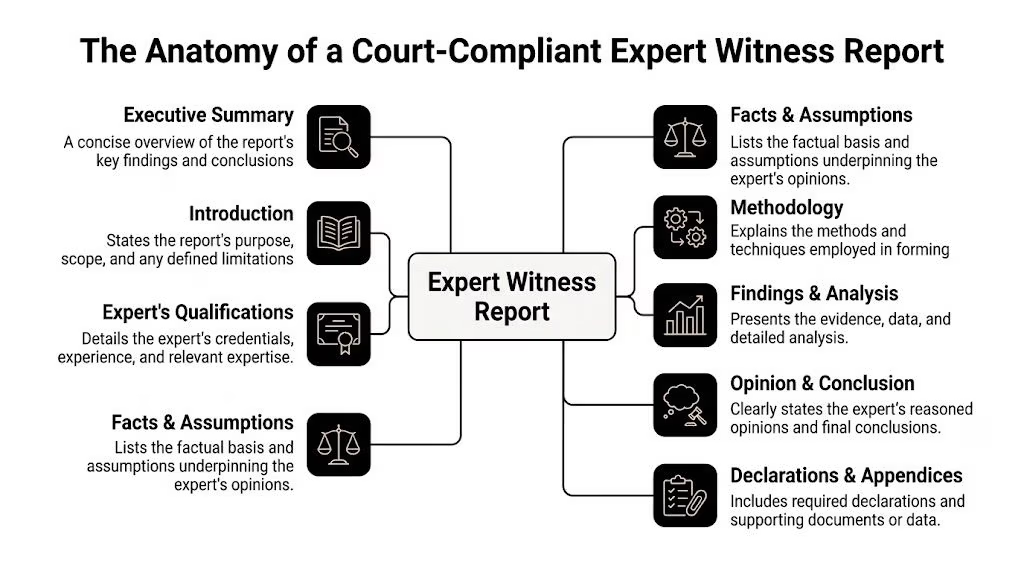
I have seen this play out many times. A party arrives with a folder full of photos, marked-up plans, and a strong view that the work is defective. The problem is not always the absence of defects. The problem is that the report does not identify each issue properly, tie it to the right standard or contractual requirement, or explain the reasoning in a way the Tribunal can rely on. That is the gap between site reality and legal usefulness.
Credentials and instructions
The opening sections need to do more than introduce the expert. They need to establish why that person is qualified to give opinion evidence on the issues in dispute.
That usually means setting out qualifications, licences or registrations where relevant, years in the building industry, the type of work carried out over that time, and any prior expert witness experience. In practice, this matters because a waterproofing dispute, a structural movement issue, and a poor-finish complaint may all call for different technical depth.
The report also needs to record the instructions received with precision. A vague brief often produces a vague opinion. A well-drafted instruction section shows what the expert was asked to inspect, what questions were put to them, what assumptions were made, and where the limits of the retainer sit.
Documents, methodology, and evidence
Weak reports usually fall away at this stage.
A proper methodology explains what was reviewed, what was inspected, what access was available, what could not be inspected, and which standards, codes, plans, specifications, or contractual documents were used to assess the work. If there are limitations, they should be stated plainly. Concealed framing, inaccessible roof spaces, finished surfaces over membrane systems, and absent approval documents all affect the weight of an opinion.
The evidentiary foundation usually includes:
- Site observations: The exact areas inspected, the date of inspection, weather conditions if relevant, and any visible symptoms or workmanship issues.
- Photographic evidence: Images that are clear, dated where possible, and cross-referenced to the relevant defect item.
- Document review: Plans, engineering details, contracts, specifications, variations, certificates, prior reports, and correspondence that affect scope or compliance.
- Reasoned analysis: A line of reasoning from observed condition to conclusion, including whether the issue appears to arise from workmanship, design, maintenance, movement, water ingress, or another cause.
Over 35 years in NSW building work has shown me that the method section often decides whether a report holds up under scrutiny. A conclusion may be right and still carry less weight if the path to that conclusion is unclear.
Findings must be itemised and traceable
One of the most common drafting problems is bundling. Several different complaints get rolled into one paragraph, then one repair allowance is attached to the lot. That makes proper response difficult and often creates avoidable argument about scope, cause, and cost.
A usable report separates each item. It numbers the issue, identifies the location, describes the observed condition, states the relevant benchmark where one applies, explains the likely cause if that can be given responsibly, and deals with rectification in a matching way. If the matter is likely to progress into a line-by-line response process, it helps to structure the report so it can be transferred cleanly into a Scott Schedule for NSW building disputes.
That discipline matters for every party. Owners can see whether each complaint has been captured accurately. Builders can respond to the actual allegation, not a broad accusation. Solicitors can use the report to narrow the issues before directions hearings and settlement discussions.
Costing and rectification need care
Rectification is another area where reports often overreach. An expert can identify defective work and set out a reasonable scope of repair. Costing should be tied to that scope and expressed in a way that matches the itemised findings. Loose allowances with no clear basis tend to cause trouble, especially where access, demolition, make good, or sequencing will affect the actual cost.
Good reports also distinguish between immediate repair items and issues that require further invasive investigation before a final scope can be settled. That is a practical point from site experience. Some conditions can be confirmed visually. Others cannot.
Tools can assist document review
On larger disputes, digital tools can help sort the volume of plans, reports, photos, and inspection records before the expert attends site. The AI Agent for Real Estate Inspection Reports can assist with extracting and comparing material from existing PDFs.
That support is administrative, not evidentiary. Software can organise records. It cannot inspect workmanship, assess credibility of competing defect descriptions, or give an independent opinion to the Tribunal.
A report that can be used in NCAT shows the defect, the basis for the opinion, the limits of the inspection, and the reasoning that connects the two.
Demystifying the Scott Schedule A Key Legal Tool
The Scott Schedule is one of the most useful working documents in a building dispute because it forces everyone to deal with the same defect list. Without it, matters drift into competing narratives. With it, each issue has a line, a location, a description, and a position from each side.

Think of it as the dispute spreadsheet
For non-lawyers, the easiest way to understand a Scott Schedule is as a disciplined comparison table. Instead of saying “there are many defects”, the schedule makes each issue stand on its own. One line for one issue. Then the responding party can admit, deny, qualify, or cost that same issue.
That structure is especially useful in NCAT because it removes ambiguity. A defect list becomes easier to test when every item is isolated.
Here’s the practical effect:
- Owners can see whether every complaint has been captured.
- Builders can respond line by line rather than dealing with broad allegations.
- Solicitors can use the document to narrow issues before hearing.
- The Tribunal gets a readable comparison instead of a pile of disconnected complaints.
For a closer explanation of how it works in NSW proceedings, this guide on what a Scott Schedule is in a building dispute is a useful reference.
Why it matters so much in expert work
A building expert witness report often carries the technical reasoning. The Scott Schedule carries the dispute structure. When they align, the matter becomes much easier to manage.
That’s also why each defect needs to be separately numbered and costed. Grouped allegations create grouped responses, and grouped responses rarely help resolve anything.
This short video gives a practical overview of how the schedule fits into dispute preparation:
If the report explains the building problem, the Scott Schedule organises the argument around it.
How to Commission Your Expert Report
A common NCAT scenario looks like this. The hearing date is approaching, the defect list has grown through emails and site meetings, and someone finally asks for an expert report “as soon as possible”. That timing creates avoidable problems. A sound report starts with a clear brief, the right documents, and an expert who understands both construction practice and tribunal procedure.

Choose the right type of expert
Start with the actual dispute. A workmanship complaint, a water ingress issue, and an alleged structural defect do not require exactly the same skill set. The right consultant needs practical building knowledge, but that alone is not enough. In NCAT matters, the expert also needs to write independently, stay within their expertise, and explain opinions in a way the Tribunal can follow.
In practice, I look for four capabilities:
Thorough site inspection
The expert should be able to identify workmanship defects, sequencing failures, moisture entry paths, movement patterns, incomplete items, and signs that the visible issue may have a deeper cause.Tribunal-ready reporting
The report must be prepared as independent evidence, not as a submission written to support one side at all costs.Disciplined document review
Contracts, drawings, specifications, variations, emails, photos, and earlier reports often change the meaning of what is seen on site.Clear defect identification
If each issue is not described precisely, the other party cannot respond properly and the Tribunal has trouble testing it.
Awesim Building Consultants is one example of a firm that prepares site investigations, expert witness reports, and Scott Schedules for NSW building disputes.
Prepare the brief before the inspection
The inspection is only one part of the job. The expert forms opinions by matching site conditions against the contract, the plans, the scope, and the history of the works.
Give the consultant a usable file from the outset:
- Contract documents: building contract, scope of works, quotations, specifications, and approved variations
- Drawings and approvals: architectural plans, structural details, engineering, certificates, and council or certifier records
- Dispute records: notices, emails, letters, defect lists, and records of attempted rectification
- Photos and videos: especially earlier images showing what is now covered up or how the condition developed
- Access information: who will attend, whether keys are needed, and what areas can be inspected on the day
Poor briefing costs time. It can also narrow the opinion the expert is able to give.
Set the scope before work starts
This is the part clients often skip. Before the inspection is booked, confirm exactly what the expert has been asked to do.
That usually includes:
- whether the expert is assessing all alleged defects or only selected items
- whether causation is required, or only identification of defective or incomplete work
- whether a Scott Schedule is needed
- whether rectification scope and costings are required
- whether the report is for early advice, negotiation, or filing in NCAT
A broad instruction increases time and cost, but a scope that is too narrow can leave out the issue that matters most at hearing. That trade-off needs to be addressed early. A short scoping call often saves a substantial amount of revision work later. For a practical fee guide, see this breakdown of building expert witness report costs.
Know how the engagement usually runs
Once the scope is settled, the process is fairly methodical:
| Stage | What usually happens |
|---|---|
| Initial discussion | The expert identifies the dispute issues, the likely deliverables, and any gaps in the available documents |
| Document review | Key records are reviewed to understand the contractual and technical context |
| Site inspection | The expert inspects accessible areas, takes photos, measurements, and notes, and tests the visible complaints against the documents |
| Analysis and drafting | Findings are assessed, assumptions are stated, and each opinion is tied back to observed conditions and relevant materials |
| Issue of report | The final report is prepared for its intended use, whether that is negotiation, NCAT filing, or both |
The practical point is simple. Commission the report early enough for the expert to inspect properly, request missing documents, and draft without rushing. In building disputes, late instructions usually produce thin evidence, and thin evidence is hard to rely on.
Understanding the Costs and Timelines
A common NCAT scenario goes like this. The hearing date is set, the defects list has grown, and everyone wants a report within days. That is usually when cost and timing become a problem, because proper expert work depends on access, documents, and enough time to assess cause, scope, and rectification options.
In practice, fees vary with the work required. A small single-issue inspection will sit at one end of the range. A matter involving multiple defect items, competing versions of events, incomplete records, or a Scott Schedule will cost more because the expert is doing far more than writing a few pages.
What usually changes the price
The main cost drivers are practical, not mysterious:
- Complexity of the defect issues: Cracked tiles and uneven finishes are usually quicker to assess than structural movement, waterproofing failure, or water ingress with several possible causes.
- Number of items in dispute: More items mean more inspection notes, more photos, more cross-checking against the contract documents, and more time drafting opinions that can stand up at hearing.
- Condition of the file: A well-organised brief saves time. A file spread across emails, text messages, marked-up plans, and partial invoices does not.
- Access at the site: Restricted areas, occupied premises, staged attendance, or concealed work can increase inspection time and sometimes require return visits.
- Deliverables required: A short preliminary opinion is different from a court-compliant report prepared for NCAT, particularly if the expert also needs to prepare or assist with a Scott Schedule.
Clients often ask whether the cheapest quote is good enough. Sometimes it is. Often it is not.
A low fee can mean a narrower scope, less document review, shorter inspection time, or fewer reasons given for each conclusion. That may suit an early settlement discussion. It is a poor fit for a contested hearing where the report needs to explain not just what is wrong, but how the opinion was reached and what standard or contractual benchmark was applied.
For a practical fee guide, see this cost of a building expert witness report.
Timelines depend on decisions made before the inspection
Clients tend to focus on writing time. The bigger delays usually happen earlier.
If access is not confirmed, the key documents arrive late, or the scope changes after inspection, the timetable slips quickly. After 35 years in NSW building work, including many NCAT matters, I can say the report itself is only one part of the program. The complete schedule involves booking the inspection, reviewing the contract and plans, checking variations, identifying the correct standards pathway, and testing whether the alleged defects are visible, measurable, and properly particularised.
A typical matter runs through these steps:
- Instruction received and scope confirmed
- Document brief reviewed for gaps
- Site inspection booked and completed
- Findings checked against the contract, plans, and applicable standards
- Report drafted, reviewed, and issued
Straightforward matters can move quickly if the brief is clean and the site is ready. Disputed, document-heavy matters take longer because the expert has to separate evidence from allegation, and that work cannot be rushed without weakening the report.
The practical rule is simple. If the report is needed for NCAT, commission it early enough for proper inspection and analysis. In tribunal work, late instructions usually cost more and produce less reliable evidence.
Common Pitfalls That Invalidate Expert Reports
A client calls after directions have been made in NCAT. They already have a report, but the other side has attacked it as advocacy, the defects are grouped too broadly, and the conclusions run further than the inspection notes support. At that point, the argument is no longer just about defective work. It is about whether the Tribunal can rely on the document at all.

After decades in NSW building disputes, I see the same problem repeatedly. Reports fail less often because the writer lacks trade knowledge, and more often because they do not convert that knowledge into admissible, independent opinion. A builder may know the work is defective. A homeowner may know the finish is unacceptable. A solicitor may have clear instructions. None of that cures a report that does not show the reasoning, the evidence, and the standard applied.
The failures that cause the most trouble
The report usually starts to unravel in familiar ways:
- Advocacy replacing independence: The expert appears to argue the client’s case instead of giving an impartial opinion.
- Different defects rolled into one item: Cracking, waterproofing, movement, and finish issues are bundled together, which makes response and determination difficult.
- Conclusions outrunning the evidence: The photos, site notes, levels, measurements, or document review do not support the strength of the opinion expressed.
- No clear standards pathway: The report says the work is defective but does not identify the contractual requirement, code provision, standard, tolerance, or accepted practice used as the benchmark.
- Assumptions left unstated: The reader cannot separate what was directly observed from what was inferred, reported by others, or limited by access.
Those errors are avoidable. They are also costly, because once the report’s reliability is questioned, every opinion inside it comes under pressure.
Site conditions matter more than many reports admit
Regional and outer-metro matters often expose this weakness quickly. A report prepared as if every property is a standard suburban project can miss the actual cause of damage or overstate the builder’s responsibility.
On site, defects have context. Wind exposure, drainage patterns, footing movement, maintenance history, material age, workmanship sequence, and access constraints all affect the opinion. Masonry in a rural setting, for example, should not be assessed with generic assumptions borrowed from a sheltered metro job. The legal test still matters, but the physical evidence on the ground matters just as much. Good expert work joins those two pieces.
What a reliable report does instead
The better reports are usually more disciplined and narrower in language.
| Weak approach | Better approach |
|---|---|
| Broad allegations | Separate, itemised defects |
| Emotional or argumentative wording | Neutral technical description |
| Opinion first, evidence later | Evidence first, opinion tied to it |
| Generic assumptions about the site | Analysis based on actual site conditions |
| Certainty on every issue | Clear limits where inspection or documents are incomplete |
That last point matters. An expert report gains credibility when it identifies both the conclusions that can be supported and the limits of the available evidence.
In NCAT, that restraint often carries more weight than forceful language. A report is persuasive when the Tribunal can follow the path from observation, to benchmark, to conclusion, without guessing how the expert got there.
Partner with Awesim for Your Expert Report
A building dispute rarely improves through repetition. It improves when the issues are inspected properly, documented carefully, and presented in a form the Tribunal can use.
A well-prepared building expert witness report does exactly that. It identifies the defects, records the evidence, explains the reasoning, and supports a fair technical assessment of the dispute. When that report is properly structured and independent, it helps owners, builders, solicitors, and decision-makers work from the same factual base.
If your matter involves defective work, incomplete work, causation, rectification scope, or a Scott Schedule for NCAT, getting the report right the first time saves time, cost, and avoidable procedural problems.
For a confidential discussion, email admin@awesim.com.au or call 1800 293 746.
If you need a court-compliant building expert witness report, Scott Schedule, or site investigation for an NSW building dispute, contact Awesim Building Consultants. They assist homeowners, builders, solicitors, and strata clients with independent reporting for NCAT and related proceedings.
Related Posts

NCAT Consumer Division: Steps From Lodgement to Hearing
Most people who end up at the NCAT Consumer and Commercial Division do not arrive there by choice. They arrive
Read More »
Statutory Warranty NSW: What Builders Must Fix and for How Long
Statutory warranty NSW obligations exist precisely for the moment a builder stops returning calls. A crack appears in the render.
Read More »
Home Building Act NSW: Key Clauses Every Owner Should Know
The Home Building Act 1989 (NSW) sets the rules for residential building work in New South Wales. It requires licensed
Read More »