
NSW Expert Witness Code of Conduct: Duties & Compliance
The NSW Expert Witness Code of Conduct is the legally binding set of rules in Schedule 7 of the Uniform Civil Procedure Rules 2005 that governs the duties of experts in NSW courts and tribunals, and its central rule is that the expert’s primary duty is to the court. In NSW, an expert report and oral evidence cannot be admitted unless the expert acknowledges in writing that they’ve read the Code and agree to be bound by it.
If you’re a solicitor briefing a building consultant, or a consultant preparing a report for NCAT or court, that is the starting point. The code isn’t a formality attached at the back of a report. It controls how the expert is retained, how the investigation is carried out, how opinions are expressed, and whether the evidence is usable at all.
NSW Expert Witness Code of Conduct – Legal Obligations Explained
Meta description: NSW expert witness code of conduct explained for NCAT and court matters, with practical guidance on duties, report requirements, and compliance.
In building disputes, the problem usually appears before the hearing. A report arrives with firm conclusions but no clear factual basis, no limits on expertise, and language that reads like submissions for one side. That report may still look persuasive to a client. It won’t survive proper scrutiny.
Understanding the NSW Expert Witness Code of Conduct
The nsw expert witness code of conduct sits in Schedule 7 of the Uniform Civil Procedure Rules 2005, effective from 19 July 2005, and it establishes the legal framework for expert evidence in NSW civil proceedings. Its purpose is straightforward. Courts and tribunals need independent assistance on technical issues, not advocacy dressed up as expertise. The Code requires the expert to assist the court impartially on matters within the expert’s field.
That obligation overrides loyalty to the party who pays the fee. In practice, that changes the role completely. A retained expert is not there to win the case. The expert is there to identify the relevant technical facts, apply specialised knowledge, and explain conclusions in a way the decision-maker can test.
The Code applies across major NSW jurisdictions, including the Supreme Court, District Court and NCAT, and under UCPR r 31.23(3) and (4) the report and oral evidence are inadmissible unless the expert confirms in writing that they have read the Code and agree to be bound by it, as outlined in Schedule 7 guidance for NSW expert evidence.
Where the Code operates in real disputes
For building matters, the practical forums are usually:
- Courts: Supreme Court and District Court proceedings involving defect claims, contractual disputes, negligence allegations, and related loss issues.
- NCAT proceedings: Especially home building claims where expert reports often carry substantial weight.
- Any expert report filed as evidence: If the report is intended to influence findings on causation, defects, compliance, scope, or rectification, the Code matters.
A strong technical opinion doesn’t help if the report is procedurally unusable.
Why this matters in construction work
Building disputes are evidence-heavy. The tribunal or court usually needs help on workmanship, causation, sequencing, moisture pathways, compliance issues, and whether an observed condition is a defect or merely an aesthetic complaint. If the expert misunderstands the Code, the entire evidentiary foundation can collapse.
Core Duties Under the NSW Expert Witness Code
A building expert can lose the case before cross-examination starts. It happens when the report reads like advocacy, strays into another discipline, or hides the assumptions needed to support the conclusion. In NSW building disputes, the Code is applied in that practical way. The question is not whether the expert is experienced. The question is whether the opinion is independent, confined to expertise, and reasoned clearly enough to be used.
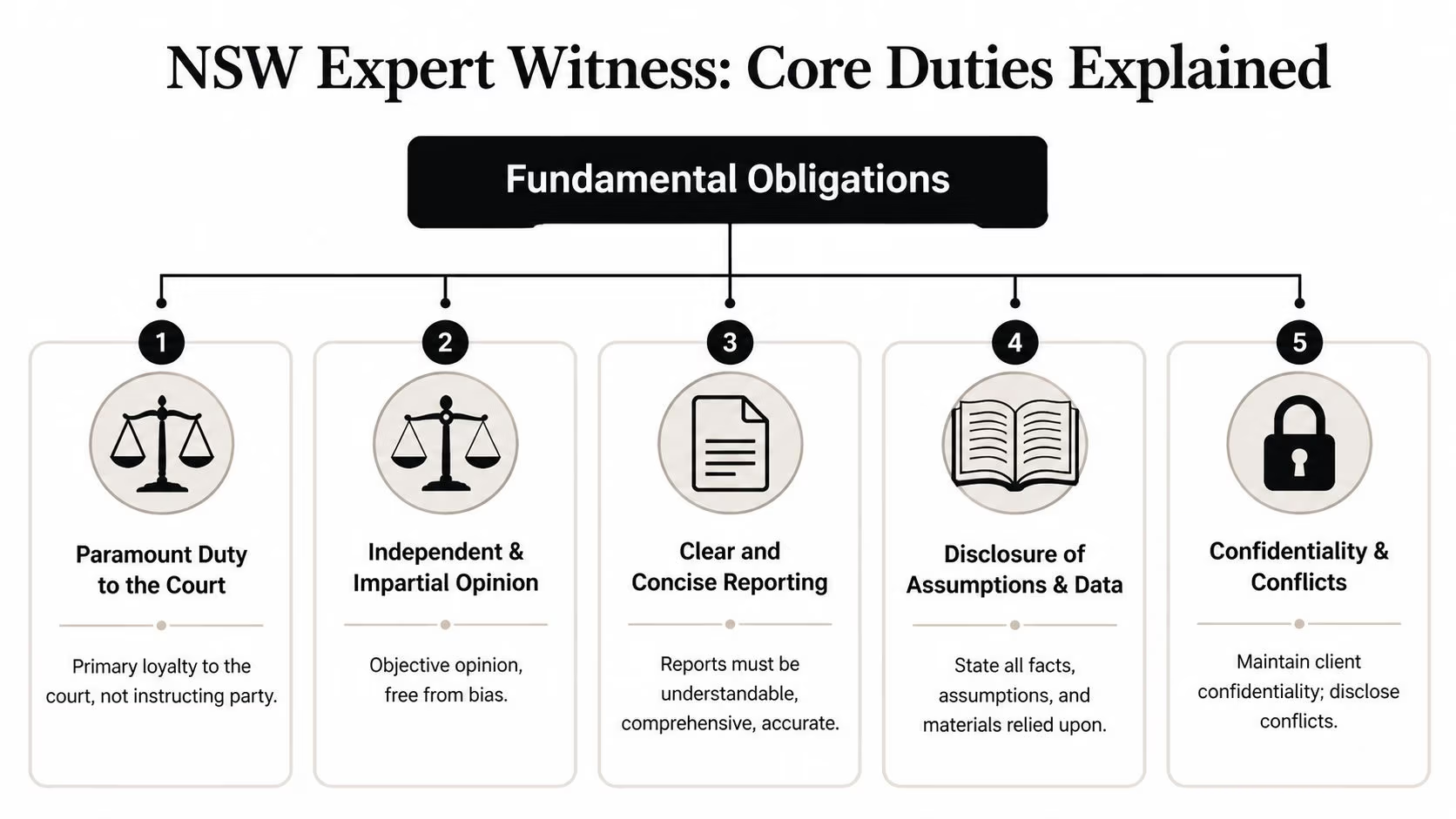
Duty to the Court overrides duty to the client
This is the defining rule in expert witness duties NSW. The expert must assist the court impartially. The solicitor may have a pleaded case. The owner, builder, developer, or insurer may have a commercial objective. None of that changes the expert’s duty.
In practice, the report must be able to withstand the uncomfortable points. A proper expert will say, where necessary:
- The alleged defect is not made out on the material available
- Further investigation is required before a reliable opinion can be given
- Part of the issue falls within engineering, hydraulics, or another specialist field
- The opposing expert is correct on a particular point
That is usually where the primary pressure sits in building matters. Clients pay for an opinion, but the court expects assistance. If an expert cannot disappoint the client when the facts require it, that expert should decline the brief.
Requirement to provide objective, unbiased opinions
Objectivity is shown in method, not slogans. The expert must separate what was seen on site, what was assumed, what technical standard was applied, and how the conclusion was reached. A building report that reads like submissions will usually attract criticism quickly.
The difference is usually obvious:
| Approach that fails | Approach that works |
|---|---|
| Adopting the client’s version of events without testing it | Checking the site conditions, documents, and chronology independently |
| Stating a conclusion and attaching reasons afterward | Setting out the reasoning path in the order it was reached |
| Omitting inconvenient photos, correspondence, or prior repairs | Identifying material that supports and undermines the opinion |
| Using loaded terms such as “clearly defective” without analysis | Using technical language tied to inspection findings and standards |
Practical rule: If a paragraph reads like a submission for one side, rewrite it as expert evidence or remove it.
Obligation to state assumptions and limitations
Assumptions do not weaken a report. Unstated assumptions do. In building disputes, experts are often asked to opine on concealed work, incomplete records, or conditions that have changed since construction. The report must identify what was observed, what was assumed, what testing was done, and what could not be confirmed.
This point matters in defect cases involving water ingress, cracking, settlement, fire compliance, and rectification scope. A consultant may be qualified to inspect finishes, workmanship, sequencing, and visible moisture effects, but not to express structural design opinions or detailed hydraulic causation opinions unless that is within the consultant’s field. That boundary should be stated in direct terms.
The same discipline is expected in NCAT matters. The NCAT Procedural Direction on expert evidence reinforces the need for clarity about assumptions, reasoning, and the scope of the opinion.
Duty to use relevant expertise only
Building practitioners often have broad site experience. Courts and NCAT still require precision about the field of expertise being relied upon. Experience as a builder, superintendent, or consultant does not create authority to answer every technical question in the dispute.
A careful expert asks four things before finalising the report:
- What is the actual discipline engaged by this issue
- What opinions can I support from my own training and experience
- Which opinions require another expert
- Have I marked those limits clearly in the report
I have seen otherwise useful reports lose weight because the author moved from building inspection into structural engineering, acoustics, quantity surveying, or waterproofing design without a proper basis. That is avoidable. A confined opinion usually carries more weight than an ambitious one that can be dismantled in cross-examination.
Requirement to acknowledge uncertainty
Some building issues cannot be resolved to a final conclusion on the available material. Concealed framing may not be opened. Membranes may not be exposed. Movement may have more than one plausible cause. The Code requires candour about that uncertainty.
A qualified opinion is often the stronger opinion. If the conclusion depends on further destructive testing, invasive inspection, laboratory analysis, or records that have not been produced, say so plainly. The tribunal or court can work with a measured opinion. What causes difficulty is false certainty, especially where the reasoning does not match the limits of the inspection.
NSW Procedural Requirements for Expert Reports
The Code drives the substance of the report, but expert witness report requirements NSW also involve structure. If the report is poorly organised, the tribunal or court may struggle to follow the reasoning even when the technical work is sound.

A practical report for building litigation should usually include the following elements:
Core report components
Qualifications and experience
The expert must identify the qualifications and experience that support the opinions offered.Instructions received
The report should disclose the instructions or issues the expert was asked to address. That transparency helps the decision-maker see the scope of the engagement.Documents and materials reviewed
Plans, contracts, photographs, correspondence, standards, prior reports, and any other materials relied upon should be identified.Facts observed and assumptions made
Many reports often fail in this area. Observed site conditions must be distinguished from assumed background facts.Opinions and reasons
Conclusions must be explained, not asserted. The reasoning path has to be visible.Limits and qualifications on opinion
If the opinion depends on limited access, non-destructive inspection, third-party material, or incomplete records, that must be said plainly.
For NCAT expert witness rules, the report also needs to align with the tribunal’s procedural expectations on expert evidence and related material such as Scott Schedules. The current practical context is reflected in NCAT Procedural Direction 3 expert evidence guidance.
What works in drafting
- Short issue-based sections: One defect, one issue, one reasoning path.
- Clear distinction between fact and opinion: This makes cross-examination easier to answer.
- Direct references to inspections and tests: The reader should know how the conclusion was reached.
Consequences of Breaching the Code of Conduct
A building dispute can turn on one report. I have seen matters where a party spent months preparing a defect claim, only to have the expert evidence cut down in cross-examination because the report read like an advocate’s submission rather than independent opinion. Once the tribunal or court loses confidence in the expert, the rest of the case usually weakens with it.

The first consequence is evidentiary. The court or NCAT may exclude the report, restrict its use, or give it little weight. In practical terms, that can leave a homeowner without proof of causation, or a builder without proper technical support for a defence on scope, standard of work, or rectification methodology.
The second consequence is forensic. A breach gives the other side a clear line of attack. Counsel will focus on undisclosed assumptions, selective reference to documents, opinions outside the expert’s field, and any sign that the expert adopted the client’s case theory without independent analysis. In building matters, that damage is often done quickly because the technical reasoning has to survive detailed questioning about inspection limits, sequence of works, and applicable standards.
There are also professional consequences.
- Reduced weight or rejection of the opinion: The decision-maker may accept parts of the evidence, but reject the conclusions that matter most.
- Cross-examination exposure: An expert who overstates certainty, argues the case, or refuses obvious concessions will usually lose credibility.
- Problems in joint conferences and conclaves: Failure to engage properly with the opposing expert can lead to adverse procedural directions and an unhelpful joint report.
- Reputational and regulatory risk: A poor performance in one matter is often remembered by solicitors, insurers, regulators, and repeat litigants.
In construction litigation, the trade-off is real. A forceful report can feel persuasive to the client, but if that force comes from omission, advocacy, or certainty that the evidence does not justify, it creates a larger problem at hearing. Independent experts are not retained to win the argument. They are retained to give opinion evidence that will survive scrutiny.
That same discipline is familiar in other regulated fields dealing with compliance risk for accounting professionals. The common point is simple. Once independence is compromised on paper or in the witness box, the damage is difficult to repair.
The oral evidence matters as much as the report. An expert who becomes defensive, evasive, or argumentative in a conclave or hearing usually confirms the criticism already made about their independence.
Practical Compliance in Building & Construction Disputes
In building cases, compliance is usually won or lost before the report is drafted. It starts with the brief, the inspection method, and the discipline to record what was seen.
The present issue I see most often is reliance on third-party views without proper disclosure. Since early 2025, NCAT and the Supreme Court have applied closer scrutiny to experts who rely on other inspectors or standards bodies without clear attribution, with NSW Judicial Commission statistics showing a 25% increase in evidence challenges on that ground and loss adjuster data showing insurers are rejecting 40% more reports for that gap, as discussed in Clayton Utz on NSW expert witness compliance.
What works on actual matters
The most reliable process is usually the simplest:
- Record the brief carefully: Keep the original instructions and any later refinements.
- Inspect methodically: Identify what was inspected, what wasn’t, and any limitations on access.
- Separate fact from interpretation: Site observations are one category. Technical inference is another.
- Disclose third-party reliance: If you rely on another report, specialist advice, or published material, say so expressly.
- Avoid party language: Terms like “clearly negligent” or “obviously defective everywhere” often weaken the report.
The strongest building expert reports are usually the least dramatic. They show the site evidence, identify the standard applied, and explain the conclusion without argument.
Managing independence in a commercial environment
There is a real trade-off here. Clients want clear answers. Lawyers want usable evidence. Consultants are often briefed under time pressure and with incomplete records. None of that relaxes the Code.
For firms managing broader professional risk, the same discipline used in expert evidence mirrors good operational controls in other fields. The logic is similar to the governance issues discussed in compliance risk for accounting professionals, where documentation, independence, and process control determine whether work can withstand external scrutiny.
In practice, one workable model is to use a standardised reporting workflow for site investigations, expert witness reports and Scott Schedules. Awesim Building Consultants does that in NSW building disputes by structuring inspections, defect analysis and litigation support around Code compliance rather than client preference. That doesn’t guarantee the outcome of a case. It does produce evidence that is easier to defend.
Frequently Asked Questions (FAQ)
What is the expert witness code of conduct in NSW
It is the legally binding code in Schedule 7 of the Uniform Civil Procedure Rules 2005 that governs how expert witnesses must act in NSW proceedings. Its central requirement is impartial assistance to the court within the expert’s actual field of expertise.
What is the duty of an expert witness to the court
The expert’s overriding duty is to assist the court impartially. That duty takes priority over any obligation to the solicitor, homeowner, builder, insurer, or other party who engaged the expert.
What happens if an expert witness is not independent
The report may be excluded, given reduced evidentiary weight, or exposed in cross-examination as advocacy rather than expert assistance. Independence problems also damage the expert’s professional credibility and can lead to complaints and longer-term reputational harm.
If you need an expert report, site investigation, or Scott Schedule that is prepared for NSW litigation standards rather than general complaint handling, contact Awesim Building Consultants. For enquiries, email admin@awesim.com.au or call 1800 293 746.
Related Posts
Strata Report: What Buyers Need to Read Before Signing
A strata report is the document that surfaces hidden obligations before you are legally committed to a purchase. A strata
Read More »
Inspection of Structures: What to Check Before You Buy
An inspection of structures examines a property's load-bearing elements, including foundations, walls, beams, roof framing, and floor systems, to identify
Read More »
Water Damage in Homes: How to Track Down the Source
Water damage in a home rarely announces itself at the source. A stain on the ceiling, a musty smell in
Read More »