- What the NCC Requires for Balcony Waterproofing
- Where Balcony Waterproofing Most Often Fails
- When Balcony Waterproofing Becomes a Legal Dispute
- Frequently Asked Questions
Balcony waterproofing failures are among the most common defects that end up in NSW construction disputes. Water gets through the deck, works its way into the substrate, and quietly damages the structure below — often for months or years before anyone notices. By the time the damage is visible, repair costs are significant and responsibility is already being contested.
This article covers what the National Construction Code requires for balcony waterproofing, where installations tend to break down in practice, and what your options look like if you're already dealing with a defect.
What the NCC Requires for Balcony Waterproofing
The NCC sets minimum performance requirements for waterproofing in wet areas and on external exposed surfaces. For balconies, the relevant provisions sit within Volume One (Class 2–9 buildings) and Volume Two (Class 1 and 10 buildings), with AS 4654.2 being the referenced Australian Standard for waterproofing of external above-ground structures.
AS 4654.2 and What It Covers
AS 4654.2 applies to balconies, podiums, planter boxes, and similar exposed horizontal surfaces. It sets out requirements for:
- Membrane type and minimum thickness
- Surface preparation before membrane application
- Minimum fall (slope) to drainage outlets
- Upstand heights at walls, doors, and penetrations
- Detailing at junctions, corners, and terminations
The standard doesn't mandate a specific membrane product or system. It defines performance outcomes, and the installer is responsible for selecting a system suited to the substrate, exposure conditions, and expected movement.
Minimum Fall Requirements
One of the most frequently cited requirements is the minimum fall to drainage. For trafficable balconies, AS 4654.2 requires a minimum fall of 1:100 across the waterproofed surface toward the outlet. In practice, this fall is either not achieved during construction or is lost when tiles are laid over the membrane with inconsistent bedding.
When the fall is inadequate, water pools on the surface. Standing water accelerates membrane degradation and increases hydrostatic pressure at any weak points in the system.
Upstand Heights
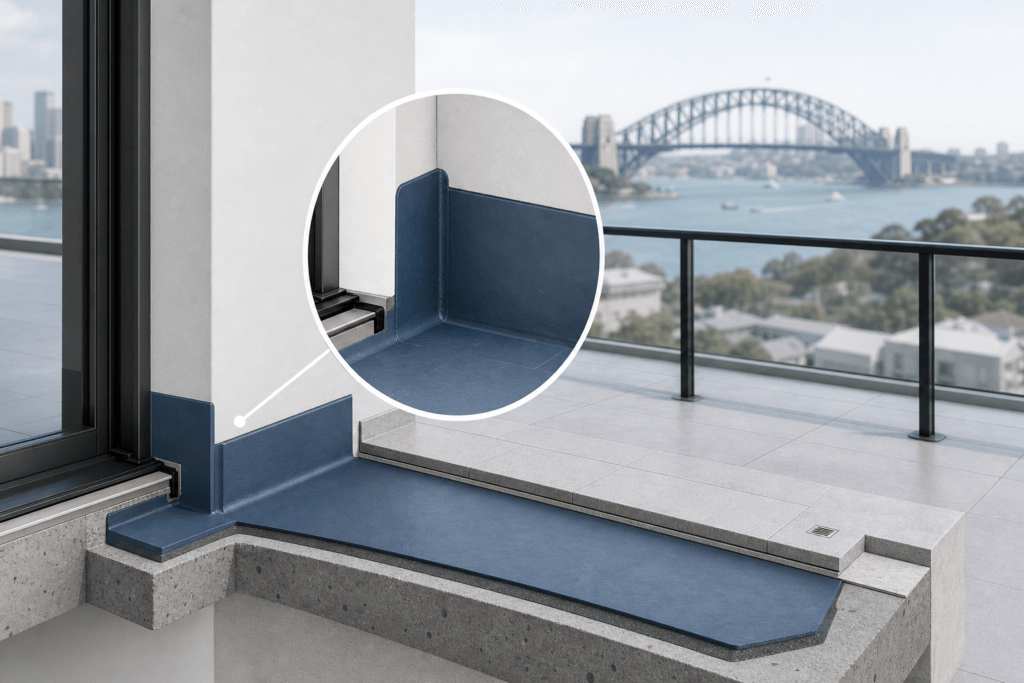
Where a balcony meets an external wall or sliding door threshold, the waterproof membrane must turn up the vertical surface to a minimum height. The NCC and AS 4654.2 specify these minimums to stop water tracking behind or beneath the membrane at these junctions.
In practice, upstands are frequently too low — particularly at door thresholds, where builders often try to minimise the step height for accessibility. This is a known tension between waterproofing compliance and level-access design, and it requires careful detailing to satisfy both requirements at once.
Where Balcony Waterproofing Most Often Fails
Understanding the code requirements is useful. Knowing where installations actually break down in the field is more useful still.
Junction and Corner Detailing
The membrane is most vulnerable at changes of direction: internal corners, external corners, the junction between the horizontal deck and the vertical wall, and where the membrane terminates against a door frame or skirting. These are the locations where differential movement between materials is greatest and where hand application is hardest to execute consistently.
Failures at junctions typically show up as cracking or delamination at the corner, allowing water to track behind the system. By the time it's discovered, water has usually been entering the substrate for some time.
Penetrations
Every pipe, drain, conduit, or fixing that passes through the waterproof membrane is a potential failure point. The membrane needs to be dressed tightly around each penetration, and in many cases a proprietary collar or flashing is required to maintain continuity of the waterproof layer.
Inadequate penetration detailing is a common finding in forensic inspections. Drains are a particular problem: if the drain collar isn't properly integrated with the membrane, water can bypass the waterproof layer entirely at the very point where it's supposed to be collected.
Membrane Thickness and Coverage
Some membrane systems are applied by brush or roller, relying on the installer achieving a minimum dry film thickness. On site, this is difficult to verify visually. Thin spots, holidays (gaps in coverage), and areas applied over a dusty or contaminated surface are all common causes of premature failure.
Tiled balconies add another complication. Once tiles go down, the membrane is hidden. Defects that would have been visible during a pre-tile inspection are concealed, and the first sign of failure is often water damage to the ceiling or wall of the room below.
Tile Bedding and Grout
Even a correctly installed membrane can be put under pressure by failed tile bedding and grout. Cracked grout and deteriorating bedding allow water to sit against the membrane continuously rather than draining away, accelerating any existing weakness in the system.
This matters in disputes because the cause of failure is as important as the failure itself. A membrane that failed due to poor installation is a different defect from one that degraded prematurely due to maintenance neglect. Establishing the cause requires a forensic inspection — not just a visual assessment of the visible damage.
When Balcony Waterproofing Becomes a Legal Dispute
Most balcony waterproofing defects aren't discovered until damage is already visible. At that point, the homeowner or strata manager is facing a repair bill and a question about who is responsible. If the building is within the statutory warranty period under the Home Building Act 1989, a claim may be available against the builder or contractor.
Statutory Warranties in NSW
Under the Home Building Act 1989, residential building work in NSW carries statutory warranties. Major defects — including waterproofing failures that affect structural performance or habitability — are covered for six years from the date of completion. Other defects carry a two-year warranty.
For strata buildings, the Strata Schemes Management Act 2015 also places obligations on the owners corporation to maintain common property, which can include balcony waterproofing depending on how the strata plan defines lot boundaries.
What Evidence You Need
A general description of the problem won't get you far at NCAT or in court. You need a report that:
- Documents the defect with photographs and measurements
- Identifies the specific NCC or Australian Standard provision that hasn't been met
- States the likely cause of failure
- Provides a costed scope of remedial works
That's what a Forensic Waterproofing Inspection report does. It's prepared by an independent building consultant who inspects the balcony, tests where appropriate, and produces a report structured as evidence — not as a general assessment.
For proceedings at NCAT, District Court, or Supreme Court, the report must also comply with Schedule 7 of the Uniform Civil Procedure Rules 2005, which sets out the obligations of an expert witness in NSW. A report that doesn't meet Schedule 7 requirements can be challenged or excluded.
Awesim Building Consultants has been preparing forensic waterproofing inspection reports and expert witness reports for NSW construction disputes since 1996. All reports are written to comply with Schedule 7 of the Uniform Civil Procedure Rules 2005. If you're dealing with a balcony waterproofing defect and need independent evidence for a claim, call 1800 293 746 or use the free initial consultation to discuss your situation.
Frequently Asked Questions
What is the minimum fall required for a balcony under the NCC?
AS 4654.2, referenced by the NCC, requires a minimum fall of 1:100 across the waterproofed surface toward the drainage outlet — meaning for every 100mm of horizontal distance, the surface must drop at least 1mm toward the drain. Inadequate fall is one of the most common defects found in balcony waterproofing inspections.
How long is the warranty on balcony waterproofing in NSW?
Under the Home Building Act 1989, waterproofing failures that constitute a major defect are covered by a six-year statutory warranty from the date of completion. Other defects carry a two-year warranty. In strata buildings, the owners corporation's obligations under the Strata Schemes Management Act 2015 may also be relevant depending on how lot boundaries are defined.
What is a Forensic Waterproofing Inspection report?
It's a report prepared by an independent building consultant that documents waterproofing failures as evidence for use in legal proceedings. It identifies the specific defect, the applicable NCC or Australian Standard requirement that hasn't been met, the likely cause of failure, and the cost of remediation. Unlike a general building inspection report, it's structured to be used as evidence in a tribunal or court.
Does a waterproofing report need to comply with Schedule 7 of the Uniform Civil Procedure Rules 2005?
Yes — if the report is to be used as expert evidence in NSW court or tribunal proceedings, including NCAT, it must comply with Schedule 7. This sets out the expert's duty to the court, the required content of the report, and the declaration the expert must sign. A non-compliant report can be challenged or excluded during proceedings.
What are the most common causes of balcony waterproofing failure?
The most common causes are poor detailing at junctions and corners, inadequate upstand heights at walls and door thresholds, insufficient membrane thickness or coverage, and inadequate penetration detailing around drains and pipes. Failed tile bedding and grout can also accelerate membrane deterioration by keeping water in prolonged contact with the membrane surface.
Can I use a general building inspection report for an NCAT claim about balcony waterproofing?
A general inspection report may confirm that a problem exists, but it's unlikely to provide the technical detail and legal compliance needed to support a claim at NCAT. For tribunal or court proceedings, you need a report that identifies the specific NCC or Australian Standard breach, states the cause of failure, provides a remediation cost, and is written to comply with Schedule 7 of the Uniform Civil Procedure Rules 2005.
How do I find out if my balcony waterproofing failure is covered by statutory warranty?
Start by identifying when the work was completed and whether it falls within the definition of residential building work under the Home Building Act 1989. A building consultant or solicitor can advise on whether the defect is likely to qualify as a major defect and whether the warranty period is still open. Awesim offers a free initial consultation to help you understand your position before committing to a formal report.
Balcony waterproofing failures don't resolve themselves. If water is getting through, the damage is ongoing. The sooner you get an independent assessment, the clearer your position will be — whether you're negotiating with a builder, preparing an NCAT claim, or instructing a solicitor. Contact Awesim Building Consultants on 1800 293 746 or visit awesim.com.au to arrange a free initial consultation.