
Expert Witness Code of Conduct NSW: A Practical Guide
Your builder says the cracking is cosmetic. Your waterproofing contractor blames movement. Your strata manager wants a report. Your solicitor wants one that will survive NCAT or court scrutiny. That’s usually the point where people realise a building report and an expert witness report are not the same thing.
In a dispute, the report has to do more than describe defects. It has to play by the rules. In New South Wales, those rules sit inside the expert witness code of conduct nsw framework. If the report doesn’t comply, you can end up with a document that’s expensive, technically detailed, and still weak where it matters most.
After decades in building and construction, and many years dealing with litigation support, one pattern keeps repeating. The strongest cases don’t always come from the loudest allegations. They come from reports that are careful, independent, and properly limited to what the expert can prove. Good expert evidence is like good footing design. If the base is wrong, everything built on top of it starts to move.
Your Guide to the Expert Witness Code of Conduct in NSW
Many first encounter the code when a dispute has already become stressful. Water ingress won’t stop. A handover has gone badly. A renovation has left structural or finishing issues. Someone says, “Get an expert report,” as if that solves everything.
It doesn’t. Not by itself.
A report only helps if the decision-maker can rely on it. That’s where the expert witness code of conduct nsw matters. It’s the rulebook that tells experts how to prepare evidence for legal proceedings in NSW. In practical terms, it applies when an expert is giving an opinion for a tribunal or court, not just writing a general building inspection note for private use.
For homeowners, the code matters because it helps separate a useful report from an advocacy document dressed up as technical evidence. For lawyers, it matters because a non-compliant report can create procedural headaches and credibility problems at exactly the wrong time.
Practical rule: If a report reads like a closing argument instead of a technical assessment, trouble usually follows.
In building disputes, that distinction matters more than many people expect. A sound report needs to identify defects, explain the basis for the opinion, stay within the expert’s field, and avoid turning the expert into a second solicitor. It should help the tribunal or court understand the building issues, not push a party’s case beyond what the evidence supports.
That’s the lens to use for every report you commission or receive. Ask a simple question. Is this document built to inform the decision-maker, or built to please the client? One of those works. The other often unravels under challenge.
The Paramount Duty to the Court or Tribunal
The single most important point is this. An expert witness is not there to help a party win. The expert is there to help the court or tribunal understand technical matters properly.
That sounds straightforward, but it’s where many reports go off the rails. Clients pay the invoice, give the instructions, and often feel strongly about what happened. That pressure can pull an expert into advocacy. The code is designed to stop that.

Referee, not team coach
In construction terms, think of the expert as a certifier checking work against standard, not a foreman defending his own crew. A good certifier calls what’s in front of him. If the slab is out, it’s out. If the complaint overreaches, that gets said too.
The same applies in expert evidence. The expert must act like an impartial referee, not a team coach trying to get the result over the line.
That principle is formally embedded in Schedule 7 of the Uniform Civil Procedure Rules 2005, and Rule 31.23 requires compliance. An expert’s report shall not be admitted into evidence if the expert fails to acknowledge that they have read and agree to be bound by the code, as set out in this summary of the NSW expert witness framework.
Why this matters in real disputes
In a building case, the paying party often wants certainty. They want the expert to say the defect is obvious, the builder is wrong, and the rectification path is clear. Sometimes that can be said. Sometimes it can’t.
A proper expert has to resist the temptation to overstate. If there are competing causes, they should say so. If destructive inspection is needed before a firm conclusion can be reached, they should say that. If another discipline needs to be brought in, they should stop at the edge of their expertise.
The quickest way to weaken an expert report is to make it sound certain where the building evidence is still conditional.
That’s not weakness. That’s credibility.
Non-compliance is not a technicality
Some people treat the code like boilerplate. It isn’t. If the acknowledgment is missing, the report can face admission problems. If the expert behaves like an advocate, the report may be given less weight even if it gets in.
For parties in NCAT matters, it also makes sense to understand the tribunal’s current approach to expert material. NCAT Procedural Directions 3 on expert evidence is worth reading alongside the code because procedural compliance and technical credibility usually rise or fall together.
What works and what doesn’t
A useful contrast helps.
| Approach | What it looks like in practice |
|---|---|
| What works | The expert identifies observed defects, explains the likely cause, notes any limits on the opinion, and remains neutral on disputed factual narratives they cannot verify. |
| What doesn’t | The expert repeats the client’s allegations as if proven, ignores contrary material, and writes the report as advocacy. |
A tribunal member or judge doesn’t need a partisan builder in a collared shirt. They need a disciplined technical witness. That’s the whole foundation of the code.
Key Obligations for Compliant Expert Reports
Once independence is understood, the next question is practical. What has to go into the report so it complies and carries weight?
At ground level, a compliant report has to show its working. In building terms, you don’t just point at a failed membrane and announce the conclusion. You identify what was observed, what testing or inspection was done, what assumptions were made, and where the edges of your expertise sit.
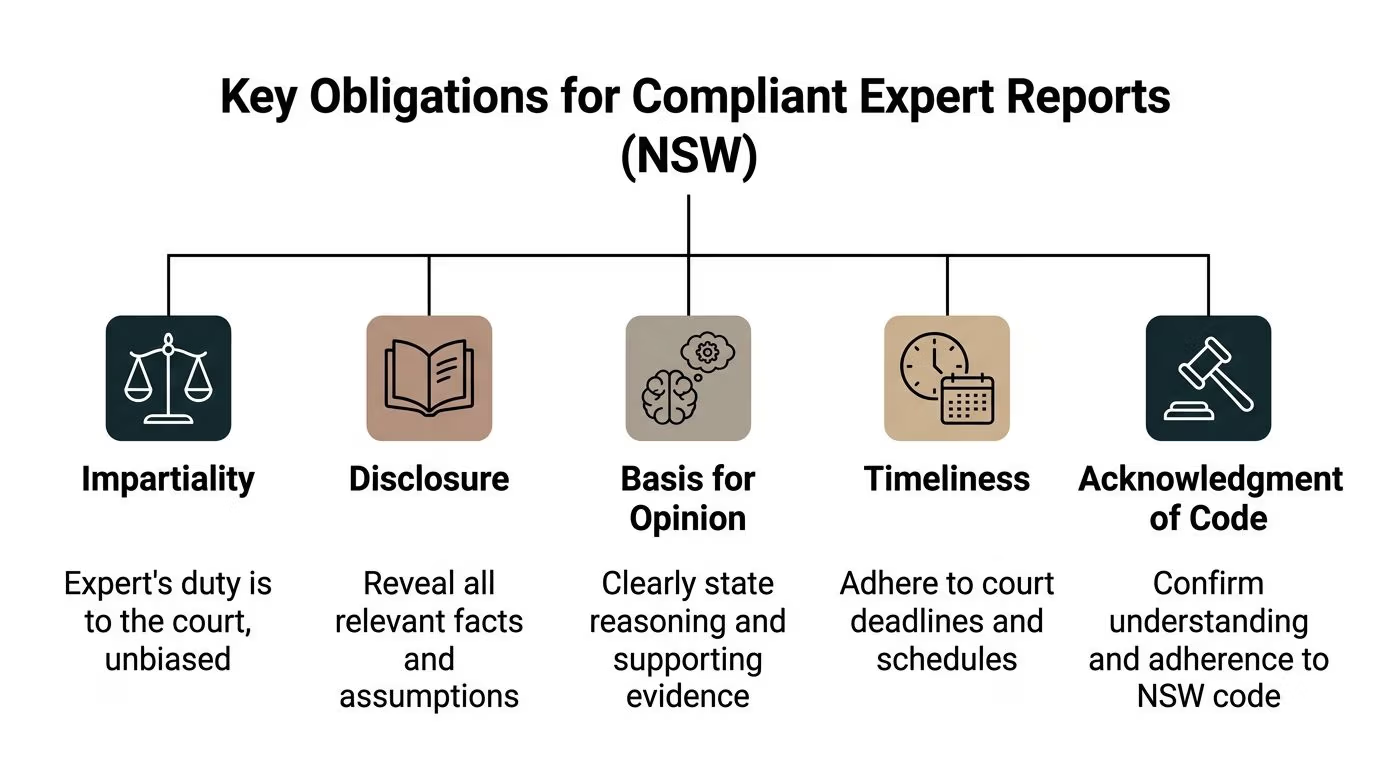
The code requires experts to include thorough detail on all examinations, tests, or investigations relied upon, to distinguish between factual observations and professional opinions, and to declare the limits of their expertise, as outlined in this explanation of expert duties and report requirements in NSW.
Independence in the body of the report
Independence is not just a statement at the back of the document. It has to show up in the language and structure.
A compliant report doesn’t cherry-pick. It doesn’t bury inconvenient site conditions. It doesn’t pretend the other side’s material doesn’t exist. If there’s a competing explanation for cracking, leaking, settlement, or workmanship issues, the report should deal with it directly.
That doesn’t mean every possible theory deserves equal weight. It means the expert should explain why one conclusion is preferred over another.
Facts and opinions must stay separate
This is one of the biggest practical issues in construction reports.
“Tiles are drummy in several locations” is an observation if the inspection supports it. “The tiler used poor installation methods” is an opinion. “The failure was caused by substrate movement rather than tile adhesive application” is a further opinion that needs reasons.
When those categories get mixed together, reports become slippery. A reader can’t tell what the expert observed and what the expert inferred.
A clean report usually separates material like this:
- Observed facts. Site conditions, measurements, visible cracking patterns, moisture readings, photographic records, and what parts of the building were inspected.
- Assumptions. Access limitations, hidden conditions, prior repair history, or reliance on supplied plans and documents.
- Opinions. Technical conclusions drawn from the observations and assumptions, with reasons.
A strong report lets the reader trace the path from site evidence to conclusion without guessing what happened in the middle.
Stay inside the lane
Construction disputes often cut across multiple disciplines. A building consultant may identify signs consistent with structural movement. That doesn’t automatically make the consultant a structural engineer. A waterproofing issue may involve design, installation, ventilation, and maintenance. One person may not be qualified to speak to all of it.
That’s why the code requires experts to identify matters outside their field. This isn’t a weakness in the report. It’s one of the things that makes the report reliable.
Here’s where experts often get into trouble:
| Risk area | Better approach |
|---|---|
| Overstepping expertise | State that a further opinion from the relevant specialist is required |
| Hidden assumptions | Set them out plainly so the tribunal can see what the opinion depends on |
| Thin methodology | Describe inspections, tests, documents reviewed, and who carried out any investigations |
Full disclosure matters more than style
A polished report can still be weak if it hides the basis for the opinion. Courts and tribunals need to know what material the expert used. If tests were done, the report should identify them. If another person carried out part of the investigation, that should be clear too.
Many privately commissioned building reports fall short. They may be visually neat and forceful in tone, but they don’t provide enough underlying detail to withstand scrutiny.
The solicitor has a role too
Compliance isn’t just the expert’s problem. The code framework also expects the instructing solicitor to provide a current copy of the code to the expert. That creates a clean chain of compliance and helps avoid the awkward situation where everyone assumes someone else dealt with the formalities.
For homeowners acting without a solicitor, the lesson is simple. Don’t assume the expert witness requirements will take care of themselves. Ask for confirmation that the report is being prepared for legal use and in line with the NSW code.
Common Pitfalls for Building Experts in NCAT Disputes
Most weak expert evidence doesn’t fail because the writer lacks construction knowledge. It fails because the report drifts away from the discipline the tribunal expects. It becomes advocacy, guesswork, or a technical document with missing foundations.
Acting like a hired gun
This is the classic mistake. The expert starts writing for the client instead of the tribunal.
A homeowner may be angry. A builder may feel unfairly blamed. A solicitor may want a crisp opinion to support a pleading. None of that changes the expert’s job. Once the report starts sounding like partisan argument, credibility drops quickly.
A familiar sign is loaded language. Another is a report that never concedes uncertainty, competing causes, or factual disputes outside the expert’s knowledge.
Giving opinions outside the actual trade or discipline
A builder may know a lot about framing, waterproofing interfaces, sequencing, and practical workmanship. That doesn’t make the builder a structural engineer, hydraulic consultant, or fire specialist.
I’ve seen reports where the writer could identify the symptom but overreached on the cause. That’s dangerous. In NCAT, overstepping can distract from the valid parts of the report because the other side only needs to show that the expert has wandered beyond their proper field.
If an expert has to keep stretching to make the whole case fit, the report is usually carrying more than it should.
Poor inspection scope
Some reports are written from photographs, emails, and one-sided instructions when the issues demanded a proper site investigation. That’s like pricing a footing repair without opening the ground. You may end up with a theory, but not a dependable conclusion.
Common inspection problems include:
- Missing areas. The report comments broadly on the dwelling but key wet areas, roof spaces, subfloors, or external drainage points weren’t inspected.
- No documented testing basis. The opinion refers to moisture, movement, or failure patterns without showing what inspection steps support that view.
- Unclear authorship. It’s not obvious who carried out the inspection or any supporting investigation.
A related issue appears in compliance-heavy environments more broadly. Where procedures matter, businesses often need systems that keep evidence, records, and responsibilities clear. In that broader risk-management sense, some teams also look for ways to simplify compliance with Safety Space when workplace rules and documentation obligations start intersecting with dispute preparation.
Assumptions that stay hidden until cross-examination
A report may look solid until one assumption is tested. The membrane failure opinion assumed no later penetration works. The movement opinion assumed the drainage layout matched the supplied plan. The workmanship criticism assumed the photographed area represented the whole installation.
Once that hidden assumption gives way, the report can lose its footing.
Here’s a short discussion that helps people understand how these mistakes often show up in practice:
Confusing structure
Some technically capable people write reports that are hard to use. They jump between chronology, complaint history, observations, standards, opinions, and costings without a clear sequence. The tribunal then has to reconstruct the logic itself.
That’s avoidable. A report should move in a clean order. Instructions. Material reviewed. Inspection scope. Observations. Assumptions. Opinions. Limitations. If it doesn’t, even good technical content can lose impact.
A Practical Compliance Checklist for Your Expert Report
If you already have a draft report, audit it before you rely on it. If you’re about to commission one, use this list before the inspection starts. A good report should pass these checks without argument or improvisation.
What to check before the report is finalised
- Code acknowledgment. Does the report state that the expert has read and agrees to be bound by the applicable code of conduct?
- Qualifications. Are the expert’s qualifications and relevant experience clearly set out?
- Instructions received. Does the report identify what the expert was asked to do?
- Material reviewed. Are the documents, plans, photographs, correspondence, and other inputs listed?
- Inspection scope. Does it say what was inspected, when, and with what limitations?
What to check in the body of the opinion
At this stage, weak reports usually become evident.
- Facts separated from opinions. Can you tell what the expert observed as distinct from what they concluded?
- Assumptions stated plainly. If the opinion depends on an assumption, is it written down?
- Methodology explained. Are the examinations, tests, or investigations identified clearly?
- Reasoning shown. Does each major conclusion have a traceable explanation behind it?
- Expertise boundaries. Does the report identify anything outside the expert’s field?
Before a report goes anywhere near NCAT or a court brief, ask whether a stranger could follow the reasoning from start to finish without private background knowledge.
What to check for procedural strength
A technically sound opinion can still stumble if the document is poorly prepared for tribunal use.
| Checklist item | Why it matters |
|---|---|
| Clear structure | Decision-makers need to find the basis for each opinion quickly |
| Neutral language | Advocacy can reduce confidence in the expert’s independence |
| Consistent terminology | Mixed terms create ambiguity about defect location, cause, or scope |
| Attachment control | Photos, plans, and annexures should match the text accurately |
If you want a starting point for structure and inclusions, this expert witness report template for Australia is a useful reference point before the final report is settled.
How Awesim Delivers Compliant NCAT-Ready Reports
In building disputes, process matters as much as technical knowledge. A report can only help if it is grounded in actual site evidence, written within the expert’s field, and prepared with the discipline required for tribunal use.
That’s why the working method matters. The practical sequence is straightforward. Inspect properly. Record accurately. Separate observation from opinion. State assumptions. Identify limitations. Keep the language neutral. If another discipline is needed, say so.
What a reliable process looks like
Over 35+ years in Building & Construction, with over 15+ years providing litigation support to homeowners, builders and lawyers, the approach has to be anchored in field reality rather than theory alone. That means the report should reflect what the building is doing, not what a party hopes the building will prove.
In practical terms, that usually involves:
- Site investigation first. Defect opinions should start with actual inspection, not just correspondence and selected photographs.
- Evidence chain kept clean. The report should identify documents reviewed, inspection limits, and the basis for each conclusion.
- Scope kept honest. Where a matter crosses into another specialty, that needs to be identified rather than glossed over.
Why this matters in NCAT matters
NCAT building disputes often turn on whether the technical evidence is organised and usable. A report that identifies defects but doesn’t explain reasoning may not carry enough weight. A report that argues too hard may look partisan. A report that wanders across disciplines may hand the other side an easy point.
That’s also why supporting documents such as Scott Schedules matter in the right case. They force each issue into a disciplined format and make it easier to compare allegation, response, finding, and rectification position.
For parties needing formal assistance, Awesim Building Consultants provides site investigations, Expert Witness Reports and Scott Schedules for NSW building disputes. Related guidance on expert witness reporting services and practical dispute material on the site can help parties and solicitors line up the technical side of a matter before hearing day.
The real advantage is not aggression
Homeowners sometimes think they need the toughest report. Lawyers sometimes inherit reports drafted to sound decisive rather than reliable. In practice, the better report is usually the one that stays calm under pressure.
A dependable expert report should still make strong findings where the evidence supports them. But it shouldn’t overswing. It shouldn’t hide uncertainty. It shouldn’t pretend every complaint has the same technical merit.
That’s the discipline the expert witness code of conduct nsw is trying to enforce. In building terms, it asks the expert to build the opinion on inspected facts, sound reasoning, and proper limits. If those elements are in place, the report is far more likely to stand up when the dispute gets serious.
If you need an independent expert report, site investigation, or Scott Schedule for a building dispute, contact Awesim Building Consultants. Email admin@awesim.com.au or call 1800 293 746 to discuss a compliant NCAT-ready brief.
Related Posts

Strata Report: What Buyers Need to Read Before Signing
A strata report is the document that surfaces hidden obligations before you are legally committed to a purchase. A strata
Read More »
Inspection of Structures: What to Check Before You Buy
An inspection of structures examines a property's load-bearing elements, including foundations, walls, beams, roof framing, and floor systems, to identify
Read More »
Water Damage in Homes: How to Track Down the Source
Water damage in a home rarely announces itself at the source. A stain on the ceiling, a musty smell in
Read More »