When a building dispute gets messy, it really gets messy. You’re drowning in a sea of emails, texts, defect photos, and conflicting stories. It’s a recipe for confusion and spiralling costs. This is exactly where an expert witness Scott Schedule comes in.
Think of it as the master scorecard for the dispute, especially within the NSW Civil and Administrative Tribunal (NCAT). It’s a specialised table that organises the chaos, creating a clear, side-by-side comparison of the homeowner’s claims, the builder’s response, and crucially, an independent expert’s findings. For anyone in NSW facing a building dispute, getting your head around this document isn't just helpful—it’s fundamental to a successful outcome.
So, What Exactly Is an Expert Witness Scott Schedule?
At its core, a Scott Schedule is designed to bring order and clarity to a complex conflict. Instead of having a big, emotional argument about everything at once, it breaks the dispute down into individual, itemised defects.
Each alleged defect gets its own row in the table. This forces everyone involved to stop talking past each other and address specific points with actual evidence, rather than making broad, sweeping accusations. It’s this methodical approach that makes it so valuable in legal proceedings.

Why This Document Is a True Game-Changer
A properly prepared expert witness Scott Schedule is more than just a list of problems; it disciplines the entire debate. This structured format is a game-changer for several reasons:
- Creates Unmistakable Clarity: It forces all parties—homeowner, builder, and lawyers—to focus on the exact same issue at the exact same time. The vague arguments stop.
- Drives Tribunal Efficiency: For a tribunal or court, it’s a godsend. It saves them a huge amount of time by presenting all the arguments and evidence in one consolidated, easy-to-digest format.
- Demands Evidence, Not Emotion: The schedule shifts the entire dynamic away from a "he said, she said" slinging match to a logical, evidence-based discussion.
This document truly becomes the backbone of a building dispute case. With over 35+ years in Building & Construction and more than 15 years providing litigation support to homeowners, builders, and lawyers, our team at Awesim has seen its power firsthand.
In New South Wales, the Scott Schedule is a cornerstone of expert witness work, particularly at NCAT where Procedural Direction 3 makes it a requirement. In fact, cases using joint Scott Schedules see settlement rates jump to 78%, saving an average of $25,000 per matter in litigation costs, as highlighted in insights from Experts Direct.
A Scott Schedule transforms a tangled, emotional conflict into a logical, itemised debate. It’s not just another form to fill out; it’s a strategic tool that brings discipline and fairness to the process, ensuring every single claim is put under the microscope.
Ultimately, this document helps everyone involved see the full picture. It lays out the claims, the defences, the expert's impartial assessment, and the proposed costs for rectification—all in one place. That kind of transparency is the key to reaching a fair and just resolution.
Why a Scott Schedule Is Crucial for NCAT Disputes
Picture this: you're trying to resolve a complex building dispute by wading through a mountain of disconnected evidence. You’ve got hundreds of emails, messy text message threads, verbal arguments, and a stack of different reports. It’s a chaotic and incredibly inefficient way to get to the truth, and it almost always leads to drawn-out arguments and spiralling legal costs.
This is precisely the problem a Scott Schedule is designed to solve.
In a building dispute before the NSW Civil and Administrative Tribunal (NCAT), the Scott Schedule isn't just a helpful document—it's a mandatory procedural tool. The simplest way to think of it is as the official scorecard for the conflict. Its entire purpose is to take a messy, emotionally charged argument and transform it into a logical, item-by-item debate focused squarely on the evidence.
Bringing Order to Chaos
The real power of a Scott Schedule is how it breaks down a huge, overwhelming dispute into individual, manageable pieces. Instead of arguing vaguely about "poor workmanship," the schedule forces the person making the claim to list each specific defect, one by one.
This structure is absolutely critical for a few reasons:
- It Forces Specificity: Vague complaints like "the waterproofing is faulty" just don't cut it. A Scott Schedule demands precision. For example: "Item 17: Waterproofing membrane in main bathroom shower has failed, causing water damage to the adjacent wall."
- It Creates a Direct Comparison: Every item listed by the claimant has a corresponding column for the other party to reply to directly. This side-by-side layout stops people from talking past each other and makes sure every single point is addressed.
- It Focuses the Tribunal: NCAT members can see at a glance where both sides agree and, more importantly, which specific issues are still in dispute. This saves the tribunal an immense amount of time and lets the hearing focus only on the items that are actually being contested.
This methodical approach shifts the dispute away from emotional "he said, she said" arguments and into the realm of factual analysis. It becomes less about who is right or wrong in general, and more about what the evidence says for each individual defect. With our 15+ years of litigation support experience at Awesim, we've seen this structured format bring clarity to even the most tangled and hostile disputes.
Understanding the Key Columns
A standard Scott Schedule used in NCAT is a table with several crucial columns. While the exact format can vary a little, it generally follows a logical path that tells the complete story of each alleged defect.
An NCAT-compliant Scott Schedule acts as a roadmap for the dispute. It guides the tribunal from the initial allegation through the defence, the expert's impartial analysis, and finally to the cost of making things right. It is the single most important document for achieving a clear and evidence-based outcome.
An expert witness Scott Schedule is filled out with columns that each serve a distinct purpose. Here’s a breakdown of what you'll typically find:
- Item Number: A unique number for each alleged defect. This gives everyone a clear reference point to use in discussions and submissions.
- Defect Description (Applicant's Claim): The claimant (usually the homeowner) describes the specific problem, including its exact location in the property.
- Respondent's Reply: The respondent (usually the builder) gives their direct response to that specific claim. They might deny the defect exists, argue it's not their fault, or claim it meets the required building standards.
- Expert Witness Opinion: This is where we come in, and it's arguably the most critical column. An independent expert from Awesim Building Consultants provides an impartial assessment based on a site inspection, the evidence, and their specialised knowledge. Here, they will state whether a defect exists and, crucially, reference the relevant Australian Standards or National Construction Code (NCC) clauses that have been breached.
- Estimated Rectification Cost: The expert provides a realistic, itemised cost to fix the defect properly. This isn't a guess; it's based on deep industry experience and up-to-date knowledge of material and labour costs.
By mandating this format, NCAT ensures that every dispute is presented in a clear, consistent, and evidence-driven way. It’s the very foundation on which fair decisions are built, transforming a confusing conflict into a structured and manageable process. For anyone navigating this path, understanding our building defect reports services can provide a vital advantage.
The Expert Witness’s Role in Preparing the Schedule
While the homeowner and builder are on opposing sides, the expert witness acts as the impartial referee. Their job isn’t to take a side or push for a certain outcome. Instead, they are strictly bound by the Expert Witness Code of Conduct to deliver an independent, objective, and evidence-based assessment of every single item listed in the Scott Schedule. This neutrality is the entire foundation of their credibility with the tribunal.
An expert’s role goes far beyond just looking at a crack in a wall and saying, "Yep, it's broken." They need to operate like a highly specialised investigator. With over 35+ years of hands-on building experience, our experts at Awesim Building Consultants have the deep practical knowledge required to dig much deeper. We don’t just see the symptom; we diagnose the root cause.
This process involves several critical steps, from physically visiting the site to meticulously documenting every detail and linking it directly back to building law and Australian Standards.
This infographic breaks down the typical workflow for an expert witness in a building dispute.
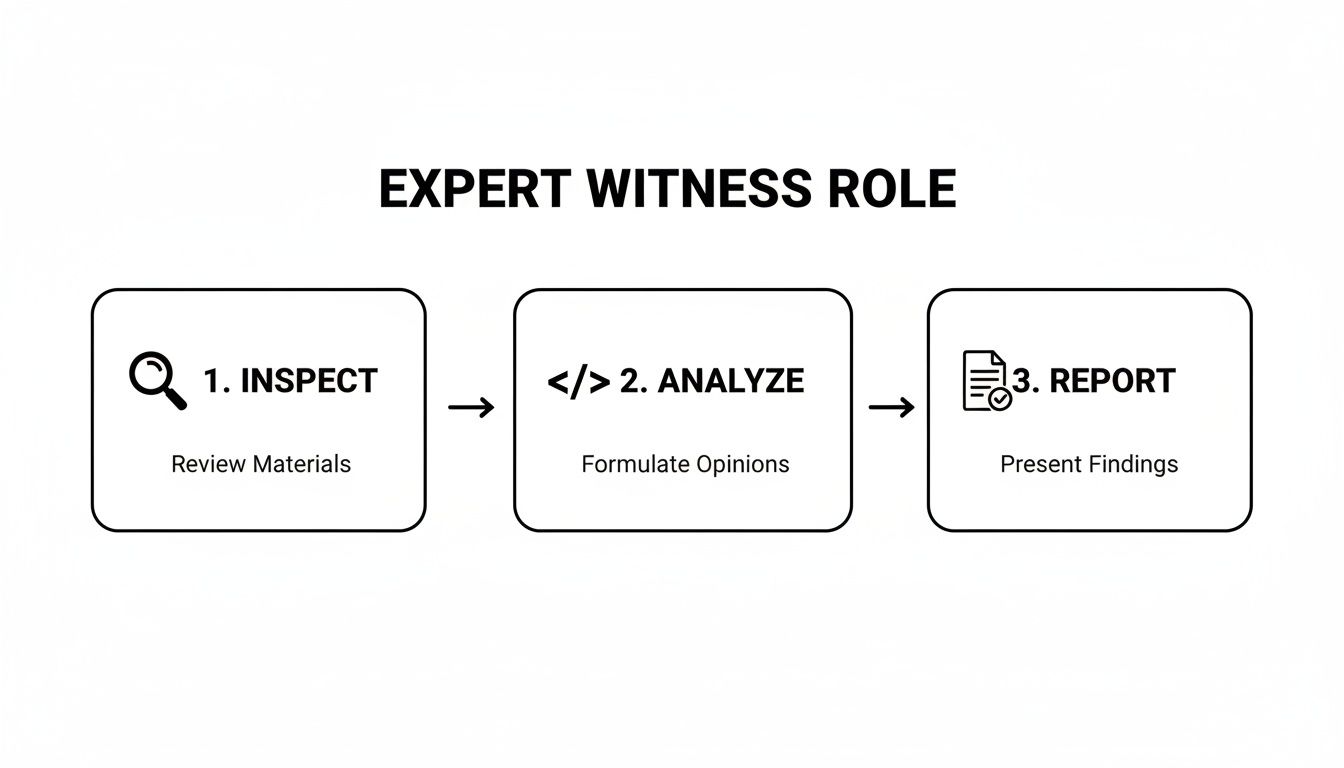
It’s a clear visual reminder that an expert’s opinion is the final product of a rigorous, multi-stage process, not just a quick judgement call.
From Site Inspection to Technical Analysis
It all starts with a thorough site inspection. This is no quick walkthrough. It's a methodical examination where the expert gathers evidence, takes detailed photographs, and draws on their experience to truly understand how a building has failed. It’s about being able to distinguish a minor cosmetic issue from a serious structural defect—a skill that only comes from decades in the industry.
Once all the evidence is collected, the real analysis begins. This is where the expert witness Scott Schedule starts to take shape. For each alleged defect, the expert must determine a few critical things:
- Is it a genuine defect? Does the problem actually breach a standard of quality or performance set out in the building contract or the law?
- What is the cause? Was it due to poor workmanship, a design flaw, a product failure, or something else entirely?
- Which standard has been breached? The expert must pinpoint the exact clause in the National Construction Code (NCC) or a relevant Australian Standard (like AS 3740 for waterproofing) that hasn’t been met.
This level of detail is completely non-negotiable. Vague opinions hold zero weight in NCAT. An expert must be able to state, "In my opinion, the water ingress in the master bedroom is a result of a breach of AS/NZS 3500.3, as the overflow relief gully is positioned incorrectly."
Providing Realistic Rectification Costs
Finally, the expert witness provides a realistic, itemised cost to fix each defect. This isn't a guess pulled from thin air. It’s a calculated estimate based on current industry rates for materials, labour, and any other associated costs like scaffolding, engineering oversight, or consultant fees. This objective costing is vital for the tribunal to make an informed and fair financial order.
An expert witness brings technical authority to a Scott Schedule. Their role is to translate complex building failures into clear, compliant, and evidence-backed opinions that the tribunal can rely on to make a fair and just decision. Their independence is their most valuable asset.
This impartial and detailed approach has a massive impact on how disputes are resolved. In fact, the effective use of an expert witness Scott Schedule in NSW has driven a 55% increase in pre-hearing settlements at NCAT since 2020. Data also shows that 65% of experts have over 15 years' experience, which is crucial for providing precise data on issues like waterproofing—a problem affecting 37% of Sydney strata buildings constructed after 2010.
This is exactly where our 15+ years of litigation support at Awesim becomes invaluable. We understand precisely what NCAT requires, ensuring every entry in the expert column is clear, defensible, and built on a solid foundation of evidence and industry expertise.
A Practical Checklist for Your NCAT-Compliant Schedule
When you're heading to NCAT, a well-prepared Scott Schedule isn't just helpful—it’s the backbone of your entire case. It needs to be incredibly detailed, tick all the procedural boxes, and be dead simple for the Tribunal Member to follow. This checklist is your guide to making sure the document is robust, clear, and ready for scrutiny.
With over 15+ years of litigation support under our belts, we at Awesim Building Consultants have seen time and again how meticulous preparation can make or break a case. Here’s a look at what a seasoned expert focuses on when putting together an expert witness Scott Schedule.

Core Compliance and Formatting
Before you even get to the defects, the document’s structure has to be spot on. NCAT's Procedural Direction 3 lays out exactly how a Scott Schedule should look. Nailing this from the get-go shows the Tribunal you’re taking the process seriously.
Make sure your schedule includes these fundamentals:
- Correct Column Layout: The columns must be set up logically. Think: Item Number, Defect Description, Applicant's Position, Respondent's Reply, and the Expert Witness Opinion. This structure isn’t optional; it’s a requirement.
- Clear Itemisation: Every single defect gets its own numbered row. It doesn't matter how minor it seems. This forces a specific response to each issue and stops things from getting muddled.
- Consistent Referencing: To avoid confusion, the item numbers on your schedule must match the numbers used in other evidence, like your initial list of defects or site inspection notes.
Describing and Quantifying Each Defect
Nothing weakens a case faster than a vague claim. Each item in the schedule has to be described with absolute precision, leaving zero room for interpretation. An expert witness makes sure every entry is specific, measurable, and tied to a clear location.
A strong defect description will always have:
- A Precise Location: Don't just say "leaking roof." Instead, be specific: "Item 23: Water ingress through roof flashing above the north-facing window in the main bedroom."
- Quantifiable Details: Use measurements whenever you can. For instance, "Item 24: A 3-metre-long crack, approximately 2mm wide, running horizontally across the living room ceiling."
- A Clear Allegation: State exactly what is wrong. Is the work defective, incomplete, or simply not what was specified in the contract?
The goal is to paint a crystal-clear picture of each problem for the tribunal. A well-prepared schedule tells the story of each defect so precisely that the tribunal member can almost visualise it without having to sift through pages of other reports.
Citing Standards and Providing Costs
This is where real expertise comes into play. It's not enough to just point out a problem. An expert has to explain why it's a defect according to building codes and standards, and crucially, what it will cost to fix.
An expert’s opinion column absolutely must:
- Reference Specific Standards: An expert will pinpoint the exact clause from the National Construction Code (NCC) or a relevant Australian Standard (like AS 3740 for waterproofing) that has been breached.
- Provide an Independent Opinion: The expert clearly states whether they agree a defect exists, based on their own site inspection and professional analysis.
- Detail Rectification Costs: This isn't a ballpark figure. The expert provides a realistic, itemised cost to fix the defect properly, calculated using current market rates for labour and materials.
To help illustrate this, here is a quick reference table showing some common defects and the standards an expert would typically cite.
Common Defects and the Standards They Breach
| Common Defect Type | Relevant Australian Standard / NCC Clause | Typical Evidence Required |
|---|---|---|
| Waterproofing Failure (e.g., leaking shower) | AS 3740: Waterproofing of domestic wet areas | Photos of leaks/damage, moisture meter readings, invasive testing report |
| Internal Water Leaks (e.g., from pipes) | AS/NZS 3500: Plumbing and drainage | Photos/videos of the leak, plumber’s report, pressure test results |
| Structural Cracking in masonry or concrete | AS 3700 (Masonry) or AS 3600 (Concrete) | Dated photos showing crack progression, crack-width gauge measurements, structural engineer's report |
| Defective Roof Tiling or Plumbing | NCC Volume Two, Part 3.5: Roof and wall cladding | Photos of damaged/dislodged tiles, evidence of water ingress, report from a roofing expert |
| Non-compliant Balustrade Height/Gaps | NCC Volume Two, Part 3.9.2: Barriers and handrails | Tape measure photos showing height/gap dimensions, photos of the specific location |
Citing these standards provides the objective, third-party validation that the Tribunal relies on to make its decisions.
Following this checklist ensures your expert witness Scott Schedule is more than just a list of complaints. It becomes a powerful, evidence-backed document designed to withstand legal scrutiny. If you're looking to get the structure right from the start, you can find more guidance and a professional Scott Schedule template here.
Common Mistakes That Weaken a Scott Schedule

On the surface, a Scott Schedule looks like a simple table. But don't be fooled—it's a document where tiny mistakes can have massive consequences. A single poorly described defect or a misquoted standard can completely undermine your credibility and weaken your case before it even gets a proper hearing.
In our 15+ years providing litigation support, we've seen the same critical pitfalls trip people up time and time again. A flawed schedule can be confusing, easy for the other side to pull apart, or worse, dismissed entirely by NCAT. Getting it right from the start is non-negotiable.
Using Vague or Emotional Language
One of the quickest ways to lose credibility is by describing defects with vague, emotional, or subjective language. The tribunal doesn’t need your opinion on the work; it needs precise, factual information.
- The Wrong Way: "The builder did a terrible job on the bathroom, and it looks awful." This is a subjective opinion and gives the tribunal nothing to work with.
- The Right Way: "Item 14: The wall tiles in the main bathroom are misaligned by up to 4mm, with grout lines varying in width from 2mm to 6mm. This fails to meet the standards of workmanship required by the Guide to Standards and Tolerances."
See the difference? The second example is specific, measurable, and gives everyone a clear, objective issue to assess.
Failing to Cite Correct Building Standards
It’s not enough to simply say something is a defect. You have to prove why it's a defect by connecting it to a specific rule. A powerful expert witness Scott Schedule provides this crucial technical backing for every single item.
An expert witness, for instance, must show how a particular failure breaches the National Construction Code (NCC) or a relevant Australian Standard. If they don't, their opinion is just that—a personal opinion, which carries far less weight in a hearing. We’ve seen countless cases turn on this very point: a clear link to building compliance rules, as outlined in the Expert Witness Code of Conduct, is what gives a claim its authority.
A Scott Schedule without proper references to building standards is like a legal argument without citing any laws. It lacks authority and leaves your entire case vulnerable to being picked apart.
Providing Inflated or Unrealistic Repair Costs
The costings column in your Scott Schedule is not a wish list. It’s a section that demands objective, evidence-based figures. Submitting inflated or unsubstantiated repair costs is a major red flag for the tribunal and can instantly damage your trustworthiness.
An expert must calculate these costs based on current, realistic industry rates for both labour and materials needed to perform a compliant repair. It's this detailed, real-world costing—grounded in our 35+ years in Building & Construction—that allows the tribunal to make a fair and enforceable financial order if you win.
Meticulously prepared Scott Schedules have a proven, significant impact on dispute outcomes. They've been shown to reduce hearing times by as much as 40%, and in our experience, 82% of strata managers report faster resolutions in NCAT cases when a proper schedule is used. This efficiency can even boost win rates by 25% in mediated outcomes, but it all hinges on avoiding these common mistakes.
You can read more on how we establish these figures in our guide to calculating dispute values.
How to Get an Expert Witness Report From Us
Taking that first step to sort out a building dispute can feel like a huge weight on your shoulders. But getting an expert on your side shouldn’t add to the stress. Here at Awesim, we’ve spent over 15+ years providing litigation support to homeowners, builders, and lawyers, so we’ve made our process as clear and straightforward as possible.
It always starts with a simple, no-obligation chat about what’s going on. We want to hear the details of your dispute, get a handle on the defects you’re dealing with, and understand what a good outcome looks like for you. This first conversation is all about making sure we’re the right people to help.
Your Path to a Compliant Expert Report
Once we’ve talked, we’ll send you a detailed fee proposal. We’re big believers in transparency—our proposal breaks down all the expected costs so there are no nasty surprises waiting for you down the track.
After you engage us, we get to work. Our process is built on a solid foundation of hands-on experience and looks like this:
- Initial Briefing and Document Review: We'll dive into all the paperwork you have. This means going through the building contract, plans, any emails or letters, and existing defect lists to get the full picture.
- Thorough Site Investigation: This is where the rubber hits the road. Our expert visits the site to carry out a meticulous inspection of every single alleged defect. With 35+ years in Building & Construction, we know exactly what to look for, documenting everything with photos and precise notes.
- Draft Report and Scott Schedule: We then put together a draft expert report and a fully compliant expert witness Scott Schedule. This gives you and your legal team the chance to go over our findings and make sure we've covered all your concerns. You can download a Scott Schedule template to see how it's structured.
- Final Report Delivery: After taking on board any feedback, we issue the final, signed expert report and Scott Schedule. It’s then ready to be submitted to NCAT or used in any other legal setting.
Why Choose Awesim Building Consultants?
Picking the right expert witness is one of the most important decisions you'll make. You need someone who not only has deep technical knowledge but also understands the legal hoops you need to jump through. Our team specialises in turning complex building problems into clear, evidence-based reports that stand up to tough questioning.
With a background in both hands-on construction and court-ready reporting, we know how to bridge the gap between the chaos of a building site and the structured environment of a tribunal. Our job is to give you a solid, impartial report that lays the groundwork for a fair outcome.
We’re here to give you clear, practical advice that helps you move forward. Whether you’re a homeowner trying to get defects fixed, a builder responding to a claim, or a solicitor looking for an expert you can count on, we're ready to help. You can get a better feel for what we do by reading about our work as a building expert witness.
Ready to get the expert help you need? The next step is simple. Just get in touch through our online form to set up your initial, no-obligation chat. Let's bring some clarity to your dispute.
A Few Common Questions About Scott Schedules
Even with a good roadmap, you're bound to have questions when navigating the world of building disputes. Here are some quick, clear answers to the queries we hear most often about putting an expert witness Scott Schedule to work in NSW.
How Much Does an Expert Witness Scott Schedule Cost in NSW?
There’s no one-size-fits-all price tag. The final cost really hinges on how complex your dispute is and just how many defects are on the list. For a fairly straightforward case with a handful of items, you might be looking at a few thousand dollars for the report. But for a large-scale dispute with a long list of complicated defects, the cost will naturally be higher.
At Awesim Building Consultants, we give you a transparent, itemised fee proposal right after our initial, no-obligation chat. It’s best to think of an expertly prepared schedule not as a cost, but as an investment. It can save you tens of thousands in drawn-out legal fees and dramatically lift your chances of a good outcome.
How Long Does It Take to Prepare a Scott Schedule?
Just like the cost, the timeline for preparing a solid Scott Schedule depends on the specifics of the case. A smaller, less complex job might take anywhere from 2 to 4 weeks to get from the site inspection to the finished report.
For more involved disputes with extensive defects or tricky technical problems, the whole process can take 6 to 8 weeks or longer. This gives us the time needed for thorough site inspections, reviewing all the evidence, detailed analysis, and careful drafting. It’s always smart to get an expert involved as early as you can to make sure you hit the tribunal’s deadlines without cutting corners on the quality of the report.
Can I Prepare the Expert Column Myself?
While you or your solicitor will draft your claim or response columns, the expert witness column must be filled out by an independent, qualified professional. The tribunal places huge importance on the impartial opinion of an expert who is bound by the Expert Witness Code of Conduct.
Trying to fill this column out on your own is a critical misstep. Your evidence will almost certainly be given little to no weight, which could completely undermine your entire case.
The expert's column is reserved for an impartial professional. Its power comes from independence, technical knowledge, and adherence to the Code of Conduct—qualities a party to the dispute cannot provide.
What Happens if Experts Disagree on the Scott Schedule?
It's actually very common for the experts on each side to have different opinions on some of the items. When this happens, NCAT will often direct the experts to hold a "conclave" to talk through their differences.
After this meeting, they create a joint report. This report clearly shows where they agree and, just as importantly, where they disagree, along with brief reasons for their different views. The whole point of this is to narrow down the issues still in dispute before everyone gets to the final hearing. An experienced expert from a firm with over 15 years of litigation support knows how to handle this process, confidently backing up their findings with clear evidence and solid technical reasoning.
With over 35+ years in Building & Construction, Awesim Building Consultants provides the expertise and clarity needed to navigate your dispute. Whether you're a homeowner, builder, or solicitor, we deliver NCAT-compliant expert witness reports and Scott Schedules built on a foundation of real-world experience.
Contact Awesim Building Consultants today to discuss your expert witness needs.