
Waterproof Membrane Failure: How Inspectors Find the Cause
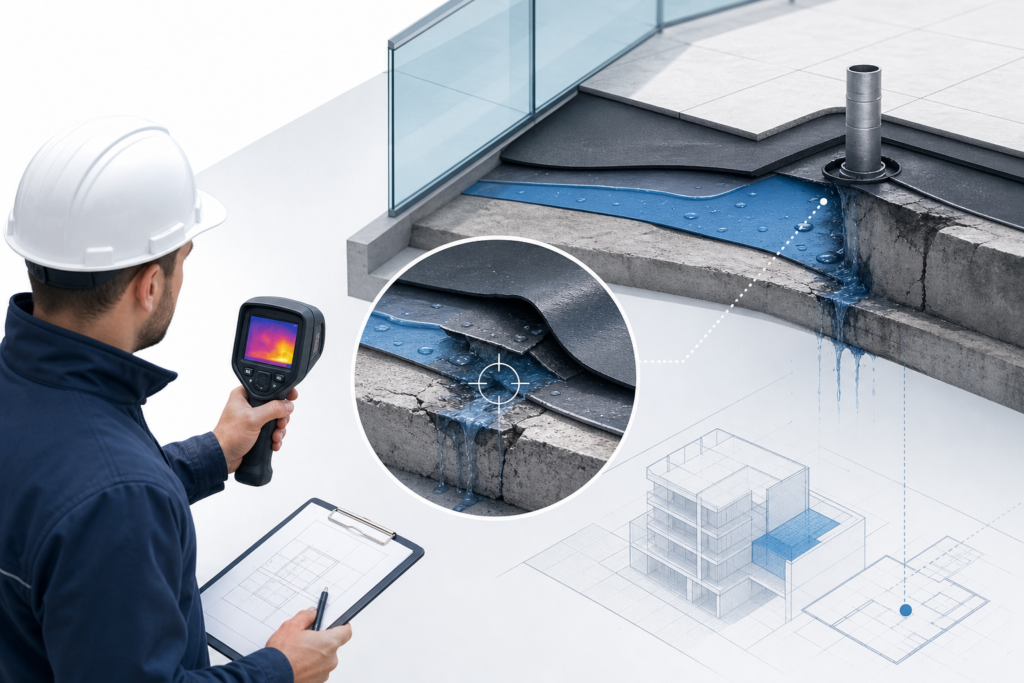
Waterproof membrane failure is diagnosed by tracing the water entry point, reviewing design documents, exposing the membrane for visual inspection, and running non-destructive tests such as infrared thermography or electronic leak detection. According to Kryton's 2021 report, approximately 90% of failures trace back to poor installation rather than the membrane material itself, making a systematic inspection essential before any repair or legal claim is pursued.
Finding the true cause matters more than patching the symptom. This guide walks through the diagnostic sequence used in a forensic waterproofing inspection, from first observation through to test data analysis, so you understand what a proper investigation looks like and what evidence it produces.
What Are the Symptoms of Waterproof Membrane Failure?
Waterproof membrane failure presents differently depending on where the membrane sits in the building.
Roof membranes tend to show the following signs:
- Blistering or bubbling on the membrane surface: Trapped moisture or vapour beneath the membrane causes it to separate from the substrate, forming visible domes or blisters.
- Ponding water after rain: Standing water that does not drain within 48 hours accelerates membrane deterioration and indicates drainage or fall defects.
- Cracking or splitting at seams and flashings: Thermal movement and UV exposure cause the membrane to crack, particularly at termination points and around penetrations such as pipes and drains.
- Water staining or dampness on ceiling surfaces below: By the time staining appears on an interior ceiling, moisture has already travelled through the substrate and into the building fabric.
Shower and wet area membranes present differently:
- Efflorescence on tiles or grout: White mineral deposits on grout lines or tile faces indicate water is moving through the substrate behind the tiles.
- Swelling or lifting of floor finishes and skirtings in adjacent rooms: Moisture spreading beyond the shower footprint affects floor coverings, door jambs, and architraves in adjoining spaces.
- Persistent musty odour: Concealed moisture trapped behind tiles or within wall cavities promotes mould growth long before visible damage appears.
- Hollow-sounding tiles: A tile that sounds hollow when tapped has lost adhesion to its substrate, often because moisture has compromised the bond.
Concrete substrates and podium decks show a distinct pattern:
- Rust staining or spalling concrete: Water reaching steel reinforcement causes corrosion, which expands and fractures the surrounding concrete.
- Damp patches or active seepage on soffits: Water tracking through a concrete slab will appear on the underside, sometimes well away from the original breach point.
- Pinholing or delamination of the membrane coating: Small perforations or areas where the membrane has separated from the concrete surface allow water direct access to the substrate.
For a closer look at how different membrane types perform across these locations, the guide to waterproofing membrane types and which fails most in NSW bathrooms covers the material-specific patterns in detail.
Why Do Waterproofing Membranes Fail?
A blister on a roof membrane and a damp patch on a concrete soffit can both trace back to inadequate substrate preparation before the membrane was applied. Understanding why failures occur explains why a visual inspection alone is never sufficient.
Poor installation and workmanship account for the large majority of failures. Industry estimates suggest roughly 90% of waterproofing membrane failures result from incorrect installation or poor workmanship rather than material defects. Common errors include applying the membrane at insufficient thickness, failing to prime the substrate correctly, leaving voids at penetrations and terminations, and not allowing adequate cure time before tiling.
Substrate problems are a closely related cause. A membrane applied over a cracked, contaminated, or damp substrate will not bond correctly. Concrete that has not cured fully, or that contains residual form-release agents, will reject the membrane adhesive. Substrate defects are often invisible once the membrane is installed, which is why they go undetected until failure occurs.
Design flaws create conditions the membrane cannot overcome regardless of how well it is applied. Insufficient fall to drainage points, missing or incorrectly detailed flashings, and incompatible membrane and substrate combinations are design-stage failures that show up as waterproofing defects during the building's service life.
Material age and degradation do eventually become a factor. Modified bitumen roofing membranes are expected to exceed 35 years under ideal conditions, according to the European Waterproofing Association. UV exposure, thermal cycling, and maintenance neglect can shorten that considerably. Liquid-applied and sheet membranes in wet areas have shorter expected service lives and need periodic inspection.
Chemical and mechanical damage round out the common causes. Cleaning products, solvents, and some grout additives can degrade membrane materials. Foot traffic on unprotected roof membranes, or movement from structural settlement, can introduce breaches unrelated to installation quality.
How Inspectors Diagnose Waterproof Membrane Failure: A Step-by-Step Process
A forensic waterproofing inspection and a contractor's repair quote serve different purposes. A repair quote identifies what needs to be replaced. A forensic inspection identifies why the failure occurred, who is responsible, and what evidence supports that conclusion.
Identify the exact point where water is entering the structure. The first step is mapping all visible signs of water ingress: staining, dampness, mould, and efflorescence. Water travels, often considerable distances, before it appears at a surface, so the entry point and the symptom location are frequently different.
Examine original building plans and material specifications. Before touching the membrane, the inspector reviews design documents to check whether the installed system matches what was specified. Maintenance logs, warranty claims, and previous repair records are also reviewed to establish a history of the system's performance.
Remove surface layers or excavate the site to inspect the membrane directly. Where non-destructive methods cannot conclusively locate the breach, controlled destructive investigation is necessary. This means lifting tiles, removing topping slabs, or cutting access panels to expose the membrane surface. Bond failure, insufficient thickness, and pinholing are confirmed at this stage.
Conduct non-destructive testing to map moisture paths. Infrared thermography detects temperature anomalies caused by hidden moisture in the substrate. Electronic leak detection uses a low-voltage electrical circuit to locate breaches in non-conductive membranes over conductive substrates such as concrete or steel. Moisture meters quantify relative humidity within the substrate. Flood testing, where water is ponded over a membrane area for a defined period, confirms whether a suspected breach is active.
Analyse field observations and test data to distinguish primary failure from secondary damage. The inspector correlates test results with physical evidence to answer the key question: did the membrane fail first, or did something else, a structural crack, a plumbing leak, or a blocked drain, create conditions that overwhelmed an otherwise intact membrane? The distinction matters in a warranty or insurance context, because secondary damage caused by a plumbing fault may fall under a different liability framework than a defective installation.
The output is a documented inspection report recording the evidence, test results, and conclusions. For matters heading toward NCAT or the NSW courts, that report must meet the standard required for formal proceedings. The guide to waterproofing inspections in NSW covers the process and documentation requirements in full.
Which Non-Destructive Testing Tools Do Inspectors Use?
Non-destructive testing lets an inspector locate membrane breaches and map moisture paths without demolishing surrounding finishes. Each tool works on a different physical principle, and inspectors typically combine two or more to cross-check findings before recommending invasive investigation.
Electronic Leak Detection (ELD): ELD locates breaches in non-conductive membranes applied over conductive substrates such as concrete or steel. A low-voltage electrical circuit passes across the wetted membrane surface; a breach allows current through to the deck below, pinpointing the defect. ELD works well on flat roof membranes and podium decks where substrate conditions are suitable.
Infrared Thermography (IR): Thermal imaging detects temperature anomalies caused by hidden moisture in the substrate. Wet material retains heat differently from dry material, and those differences appear as distinct zones on a thermal camera. The method requires a sufficient temperature gradient to produce a readable result; roof inspections after sunset, when the surface is cooling, typically yield the clearest data.
Moisture Meters: These instruments quantify relative humidity and moisture content within substrates such as concrete and masonry. A moisture meter does not locate a breach directly, but it maps where saturation is elevated so the inspector knows where to focus further investigation. In wet area inspections, readings are taken at multiple points across floor and wall substrates.
Electrical Impedance Testing: This method detects leaks by measuring the electrical resistance of the membrane material itself. A change in impedance indicates a defect. It is used on horizontal membranes and large-area roofs where continuous coverage needs to be verified.
Flood testing is also used to confirm whether a suspected breach is active. Water is ponded over the membrane area for a defined period and the soffit or ceiling below is monitored for seepage. No single method is definitive; inspectors use these tools in combination, with each result informing where to apply the next.
Waterproof Membrane Failure and Your Warranty: What NSW Owners Need to Know
When a waterproofing membrane fails in a NSW residential building, the first question most owners ask is who bears the cost of rectification. The answer depends on whether the failure qualifies as a major defect under the Home Building Act 1989 (NSW) and when it was first identified.
In New South Wales, the Home Building Act 1989 (NSW) provides a 6-year statutory warranty period for major waterproofing defects. Waterproofing is explicitly classified as a major defect category under the Act, which means a failure that allows water ingress into the building fabric is likely to attract the full 6-year period from the date of completion. Minor defects carry a shorter two-year warranty period, so correctly classifying the failure matters from the outset.
A documented inspection report is essential to support a warranty claim. Without evidence of the breach location, the cause of failure, and the extent of damage, a builder or insurer can dispute both liability and scope. An inspection report that records test results, photographic evidence, and a clear causal analysis gives the claimant a factual basis for the claim and, if the matter proceeds to NCAT, the evidence required for formal proceedings.
It is also worth understanding the distinction between waterproofing and damp-proofing, because the two are not interchangeable in a legal context. Waterproofing is designed to resist hydrostatic pressure and prevent water from penetrating a structure entirely. Damp-proofing reduces moisture vapour transmission through a surface but is not designed to hold back liquid water. A damp-proof coating applied in a location that requires full waterproofing is a non-compliant installation, not a substitute system. Insurers and tribunals treat the two differently.
Water intrusion issues are cited as responsible for roughly 70% of legal disputes in the construction industry, according to Kryton's 2021 report. If your matter is heading toward a formal dispute, the building defect report service covers the documentation and reporting requirements for NSW proceedings in detail.
What Does a Waterproof Membrane Inspection Cost?
The cost of diagnosing waterproof membrane failure varies considerably depending on the situation. Understanding what drives the cost helps you assess quotes and avoid commissioning an inspection that is either insufficient for your purpose or more extensive than your situation requires.
Membrane type and location are the primary variables. A shower recess inspection is physically contained and requires fewer testing methods than a large commercial roof or a podium deck above a basement car park. Accessible membranes cost less to inspect than those concealed beneath tiles, topping slabs, or landscaping.
Access difficulty affects both time and equipment requirements. Inspections at height, in confined spaces, or on occupied strata properties involve additional preparation and, in some cases, specialist access equipment.
Testing methods add to the scope. An inspection that combines infrared thermography, electronic leak detection, and moisture mapping across a large surface area requires more time and equipment than a visual inspection with targeted moisture readings.
Report purpose is also a factor. A report prepared for an insurance claim or NCAT proceedings must meet a higher evidentiary standard than a general condition assessment. Forensic reports require more detailed documentation, analysis, and professional sign-off, which is reflected in the scope of work.
When Should You Commission a Forensic Waterproofing Inspection?
A standard repair quote tells you what a contractor proposes to fix. A forensic waterproofing inspection tells you what failed, why it failed, and who is responsible. Those are different questions, and they require different levels of investigation.
Several situations call for a formal forensic inspection rather than a contractor assessment. If you are pursuing a warranty claim under the Home Building Act 1989 (NSW), you need documented evidence of the breach, its cause, and the extent of damage before a builder or insurer is obliged to act. If the matter is heading toward NCAT or the NSW courts, that evidence must meet the standard required for formal proceedings. Water intrusion issues account for roughly 70% of legal disputes in the construction industry, according to Kryton's 2021 report.
Pre-purchase inspections are another trigger. A property with a history of waterproofing repairs, or one where the vendor cannot produce documentation of the original installation, warrants independent assessment before exchange.
Strata disputes involving shared waterproofing elements, such as a roof membrane or podium deck that affects multiple lots, also require an independent inspection to establish where responsibility sits between owners corporation and individual lot owners.
For matters involving forensic waterproofing specialists in NSW, an independent expert report is what gives your position a factual basis in formal proceedings.
Prices and plan limits verified as of October 2026.
FAQs
Does home insurance cover failed waterproofing?
Home insurance policies in Australia generally cover sudden and accidental water damage, such as a burst pipe, but they typically exclude gradual water ingress caused by a failed waterproofing membrane. Insurers treat membrane failure as a maintenance or defect issue rather than an insurable event. Where the failure results from defective workmanship, your recourse is more likely through the builder's statutory warranty under the Home Building Act 1989 (NSW) than through your home and contents policy. An inspection report documenting the cause of failure is essential before lodging any claim.
How long should a waterproof membrane last?
Service life depends on the membrane type, its location, and how well it has been maintained. Modified bitumen roofing membranes are expected to exceed 35 years under ideal conditions, according to the European Waterproofing Association. Liquid-applied and sheet membranes used in wet areas typically have shorter service lives and should be inspected periodically. UV exposure, thermal cycling, foot traffic, and chemical contact all reduce longevity regardless of the membrane type. Age alone is rarely the primary cause of failure; poor installation remains the dominant factor.
How do you repair a damaged waterproofing membrane?
Repair depends on the cause and extent of the failure. Localised breaches at penetrations or terminations can sometimes be addressed with targeted recoating or flashing replacement. Widespread bond failure or delamination across a large area usually requires full membrane removal and reinstatement. Before any repair is carried out, the root cause must be confirmed through inspection; applying a new membrane over an unresolved substrate problem or design flaw will reproduce the failure. Rectification scope should be documented in a report so the work carried out matches the defect identified.
What is the difference between waterproofing and damp-proofing?
Waterproofing is designed to resist hydrostatic pressure and prevent liquid water from penetrating a structure. Damp-proofing reduces the transmission of moisture vapour through a surface but cannot hold back liquid water under pressure. The two are not interchangeable. Applying a damp-proof coating in a location that requires full waterproofing, such as a shower recess or below-ground wall, is a non-compliant installation. Insurers and tribunals treat the distinction seriously, and a forensic inspection will identify whether the correct system was specified and installed for the location.
Are warranty periods for waterproofing defects the same in every Australian state?
No. In New South Wales, the Home Building Act 1989 (NSW) provides a 6-year statutory warranty period for major waterproofing defects. Other states and territories have their own home building legislation with different warranty periods and defect classifications. The six-year period discussed in this article applies to NSW only. If your property is in another state, you should check the relevant legislation or seek advice from a building consultant familiar with that jurisdiction's requirements.
Conclusion
Waterproof membrane failure is rarely a matter of worn-out material. The cause is almost always found in the installation, the substrate preparation, or the original design, and locating it requires a structured diagnostic process rather than a visual guess. A forensic inspection works backward from the symptom to the source, using non-destructive testing to map moisture paths and physical investigation to confirm what the tests indicate.
If you are dealing with visible water damage, a warranty dispute, or a matter heading toward NCAT, the first practical step is to establish what actually failed and why. Commission an independent inspection before agreeing to any repair scope, and confirm that the report is prepared to the evidentiary standard your situation requires. A report that records the breach location, the cause of failure, and the extent of damage gives you a factual basis to act on, whether that means pursuing a warranty claim, negotiating a rectification scope, or presenting evidence in formal proceedings.

Related Posts
Waterproof Membrane Failure: How Inspectors Find the Cause
Waterproof membrane failure is diagnosed by tracing the water entry point, reviewing design documents, exposing the membrane for visual inspection,
Read More »
Cornice Cracking: How to Tell If the Damage Is Serious
Cornice cracking is one of the most common concerns Australian homeowners raise, and the hard part is not spotting the
Read More »
Digital Construction Consultant Australia: What They Do
A digital construction consultant in Australia manages the technology-driven side of building projects: BIM coordination, clash detection, asset data handover,
Read More »