
Who Provides a Scott Schedule? Expert Guide for NSW Disputes

You're standing in a half-finished house or a strained renovation, and the dispute has already moved beyond phone calls and photo texts. The builder says the defects are minor, the homeowner says the work is unsafe or incomplete, and the solicitor is asking for a Scott Schedule that can be used in NCAT or court. At that point, the question isn't what a Scott Schedule is, it's who provides it, who fills it out, and who makes sure it stands up as evidence.
In NSW building disputes, that answer is rarely “the court” and rarely “the claimant alone.” A Scott Schedule is usually assembled cooperatively by the parties, their solicitors, and their experts, because the document has to do more than list complaints. It has to separate each disputed item, compare liability positions, and set out rectification cost in a way a decision-maker can follow item by item, as described in court guidance and Australian dispute materials on Scott schedules (Scott schedule guidance note).
Understanding Your Role in the Dispute Process
A homeowner usually reaches for a Scott Schedule at the point where the dispute stops being a conversation and starts becoming a file. The ceiling crack keeps reappearing in photos, the waterproofing issue hasn't been fixed, or the variation claim is ballooning. That's when the parties need a document that can hold the dispute together without turning it into a blur of attachments.
The first draft often starts with the party who knows the facts
A homeowner can prepare a first version when the aim is to organise the complaint, not to prove it. That draft might list the rooms, the defects, the dates, the correspondence, and the remedy sought. It's useful because it gives the solicitor and expert consultant a clean starting point, especially when the owner has already collected reports, plans, emails, and photographs.
That said, the homeowner usually shouldn't try to finalise the technical analysis alone. If the issue turns on whether the work meets the NCC, the approved plans, or the contract documents, the schedule needs a technical lens. A rough draft from the owner is a beginning, not the finished product.
The expert usually turns complaints into evidence
Where the dispute involves workmanship, defects, or rectification cost, the Scott Schedule is usually populated by a building consultant or expert witness. That person maps each alleged defect to the governing standards and documents, then gives the schedule evidentiary weight by tying description, liability, and cost together. In practice, that's the point where a complaint becomes something a tribunal can assess.
Practical rule: if a line item can't be linked to a defect description, a technical standard, and a cost basis, it's not ready for serious use in NSW dispute work.
The solicitor controls the procedural frame
The solicitor usually takes over the final framing once the technical content is drafted. That matters in NCAT matters because the schedule has to fit the dispute pathway, the directions, and the way the other side is expected to respond. The solicitor's job is to make sure the document is usable, not just informative.
For parties who want a worked example or a template structure, this Scott schedule example and template for NSW building disputes is a practical starting point. It also helps to have a procedural reference nearby, such as GM GROUP Services' compliance documentation guide, because the same discipline of document control applies here, just in a dispute context.
What a Scott Schedule Actually Does in Building Disputes
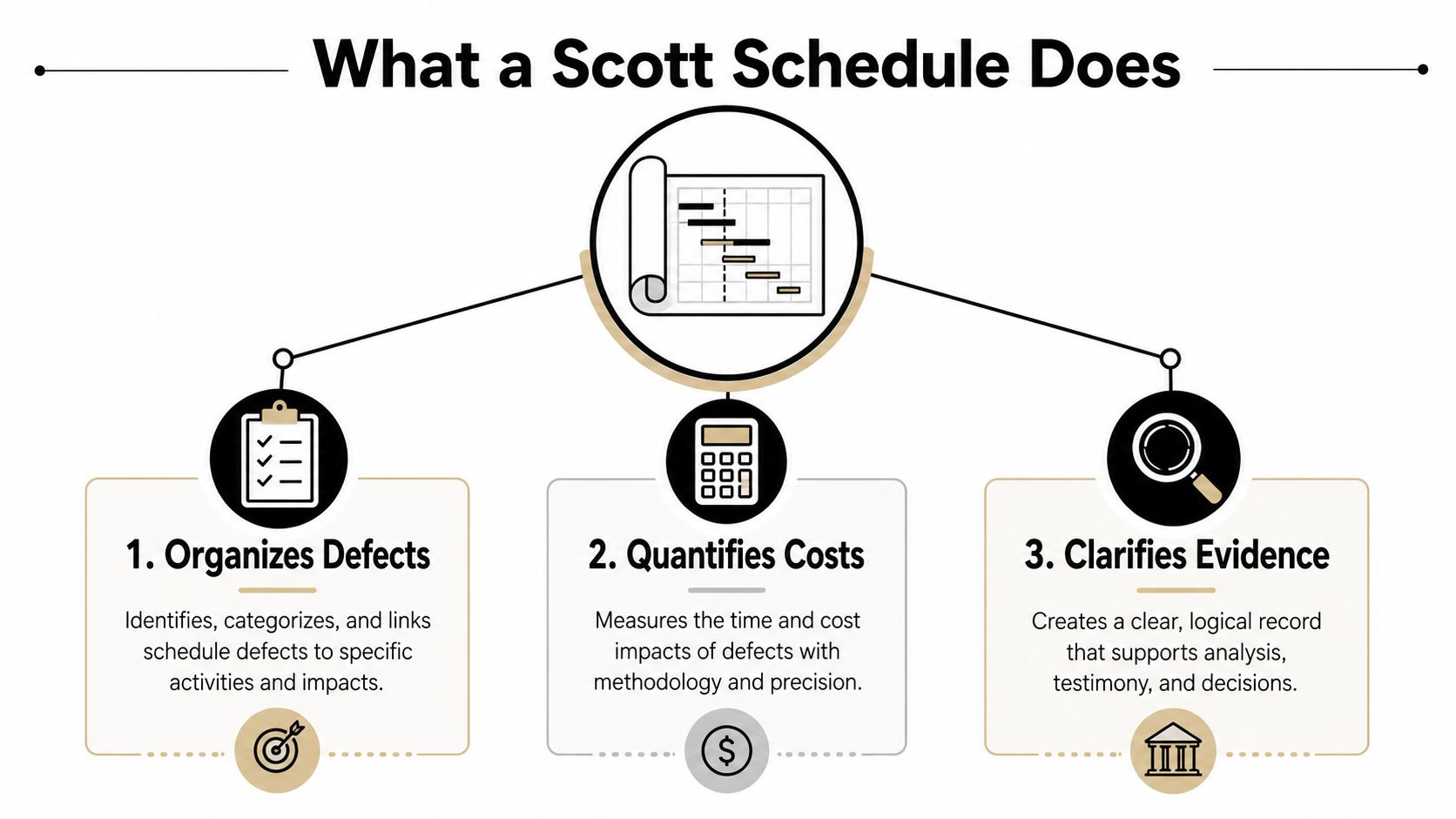
A Scott Schedule is not just a spreadsheet of complaints. It is a decision-making tool that breaks a building dispute into itemised parts so a tribunal or court can deal with each issue on its own terms. That matters in disputes involving multiple defects, variations, and delay claims, where a long narrative can obscure the core points of disagreement. For a practical overview of its function in NSW matters, see this Scott schedule guidance note.
It turns a pile of disputes into a structured comparison
The main strength of the schedule is its tabular format. One side does not say the whole job is defective, and the other side does not just answer that everything is acceptable. Each alleged issue is set out separately, then compared against the other side's response so the decision-maker can see exactly where the disagreement sits.
That format is why it has stayed useful in common-law dispute resolution. It handles technical building disputes better than narrative pleading alone because it keeps the attention on the item in issue, not on side arguments around it. In NSW construction matters, that makes it easier to deal with workmanship defects, incomplete work, and compliance questions without losing the thread.
The schedule aligns facts with standards and documents
A useful Scott Schedule is built around the NCC, Australian Standards, approved plans, and contract documents. That is the test for whether a defect description has evidentiary value. If the item cannot be linked back to something objective, the schedule loses force quickly.
Awesim's NSW service description follows that approach by preparing Scott Schedules for NCAT, court, mediation, and construction litigation, with each item assessed against the NCC, Australian Standards, contract documents and approved plans (Awesim Building Consultants). That item-by-item mapping is what gives the document value in both settlement discussions and hearing preparation.
It helps tribunals see liability and quantum separately
The schedule also separates liability from quantum. A tribunal member can see what the alleged defect is, whether the other side accepts it, and what each party says it should cost to fix. That separation matters because a dispute can be partly accepted and still be strongly contested on cost.
A standard version may contain six core headings, item number, alleged defect, plaintiff's cost estimate, defendant's response, defendant's cost estimate, and a reserved column for the judge's use (Scott schedule commentary). That structure is what lets a large, technical dispute become readable without stripping out the detail that matters.
The Professionals Who Prepare Scott Schedules
There isn't just one person who “provides” a Scott Schedule in NSW. The better question is who should prepare which part, because that changes with the stage of the dispute, the quality of the documents, and whether the issue is technical or procedural. In real cases, the schedule is often built by cooperation between the parties, their solicitors, and an expert consultant rather than by one side acting in isolation (Scott schedule guidance note).
| Professional Type | Primary Role | When to Engage | Key Qualifications |
|---|---|---|---|
| Homeowner or builder | Drafts the first factual list of items in dispute | Early, when the dispute is still being organised | Good records, photos, correspondence, and a clear chronology |
| Solicitor | Controls procedural framing and NCAT or court compliance | Once the dispute needs a filing-ready form | Knowledge of tribunal process and document requirements |
| Building consultant or expert witness | Populates defects, standards, causation, and rectification cost | When the dispute turns technical or needs expert evidence | Site-based construction knowledge, report writing, and evidence discipline |
| Insurer or loss adjuster | May commission the schedule for claim assessment | When liability or quantum needs assessment for a claim file | Claims handling and loss quantification experience |
| Jointly instructed expert team | Works through the items cooperatively for both sides | When directions or settlement strategy call for a shared document | Ability to stay neutral and evidence-based |
A homeowner can prepare the rough shape of the schedule, but that's only useful if the facts are organised and the items are clearly separated. A builder facing a claim may also do the same to respond properly, especially where the complaint list is broad and the underlying documents are incomplete. In both cases, the aim is to create a draft that a lawyer or expert can use.
The strongest schedules are usually prepared by a technically competent consultant who can match each defect item to the right document set. That's where hands-on building experience matters. A consultant with decades in residential construction can spot when a defect description is too vague, when a cost allowance doesn't match the scope, or when the complaint is really about design, not workmanship.
Awesim Building Consultants' published service position is straightforward, it provides site investigations, Building & Construction Expert Witness Reports and Scott Schedules, with over 35 years in building and construction and over 15 years providing litigation support to homeowners, builders and lawyers. That kind of background is relevant because Scott Schedules are not administrative forms, they're evidence documents.
If the document is going to be relied on in NCAT, the safest approach is to have the solicitor frame the process and the expert populate the technical content.
For readers comparing providers, this guide on how to compare construction consultants in Sydney is useful because the Scott Schedule itself is only as good as the consultant behind it.
Inside a Standard Scott Schedule Structure
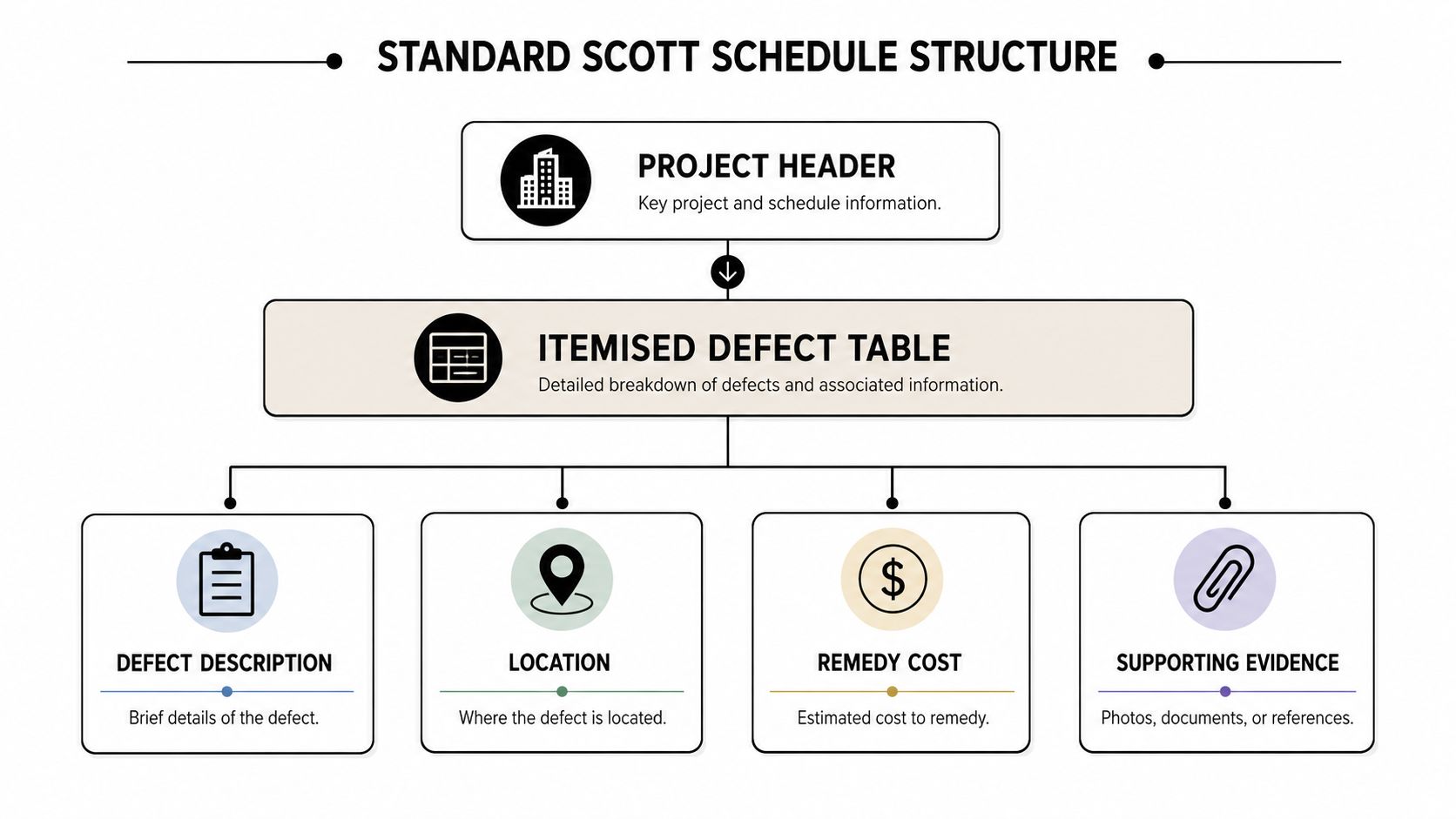
A standard Scott Schedule works because it forces discipline. Every line item should be able to stand on its own, so the tribunal can deal with one alleged defect at a time rather than treat the dispute as a single undifferentiated argument. In legal commentary, the common format is described as a table with six core headings, which is exactly what makes it practical in litigation (Scott schedule commentary).
The six headings do the heavy lifting
The usual columns are item number, alleged defect description, plaintiff's cost estimate, defendant's response, defendant's cost estimate, and a judge's column. That layout matters because it keeps the positions visible side by side. It also stops the dispute from drifting into long narrative exchanges that are hard to compare.
The item number gives each issue a fixed place in the file. The defect description states what is wrong, where it is wrong, and why it matters. The cost columns then show what each side says the rectification will require, which is essential when the dispute is really about scope, not just liability.
The description has to be technical, not theatrical
A strong defect entry is specific. It should say what the problem is, where it sits, and how it relates to the plans or standards. A weak entry says the work is “substandard” without explaining why.
The defendant's response column is just as important. It shows whether the other side accepts the defect, disputes the cause, disputes the remedy, or disputes the amount claimed. That column often reveals which items are genuinely live and which ones are just being carried forward from correspondence.
The schedule is only persuasive when the evidence matches the item
The item-by-item format only works when the evidence lines up cleanly. If the alleged defect says one thing, the expert report says another, and the cost estimate reflects a different scope again, the schedule loses force. That's why good consultants align the description, liability position, and rectification cost before the document is finalised.
When you're preparing one for NCAT, it helps to keep the supporting material close. Plans, specifications, emails, photos, and inspection notes should all point back to the same item number. A practical set of supporting documents is the difference between a readable schedule and a messy one.
For an example of how the document can be set out in practice, the Scott schedule example and template for NSW building disputes is worth reviewing. It's far easier to brief an expert when the line items, supporting evidence, and response fields are already organised into a familiar structure.
How to Commission a Scott Schedule for Your Case
The cleanest way to commission a Scott Schedule is to treat it like a technical brief, not a form-fill. Start by collecting the documents that define the job, then let the consultant map the dispute item by item. If the file is scattered, the schedule will usually be scattered too.
Start with the right documents
Before you call anyone, gather the contract, approved plans, specifications, correspondence, photos, and any existing defect reports. The consultant needs those to decide what belongs in the schedule and what doesn't. Without them, the first draft can end up full of assumptions.
That document pack also helps the solicitor decide the procedural route. In NCAT matters, speed and clarity matter because the parties often have to respond to directions quickly. A clean brief avoids repeated requests for missing information.
Use a site inspection to test the claims
The next step is a site investigation. That's where the consultant verifies the claimed defects, checks the workmanship against the available documents, and notes what can be measured or observed. If the physical evidence doesn't match the allegation, the schedule has to reflect that accurately.
A good schedule doesn't exaggerate. It narrows the case to what can be proved.
That approach matters in dispute work because a tribunal will usually respond better to a careful, itemised document than to an overreaching one. Overstatement weakens credibility, especially when the other side can point to photos, plans, or repair evidence.
Expect drafting, review, and refinement
After the inspection, the consultant prepares the itemised draft and then reviews it with the legal team. That's where wording, scope, and cost assumptions are tightened. The final version should be in a form the tribunal can use, with the technical content separated from the procedural framing.
Awesim Building Consultants says its Scott Schedules are prepared for NCAT, court, mediation, and construction litigation, reflecting the workflow in NSW disputes. A document like that needs to be usable in settlement talks and hearing prep, not just filed and forgotten.
Keep the process realistic
The time and effort involved depend on how many items are disputed and how complex the file is. A short defect list is different from a large building dispute with multiple trade interfaces and competing expert views. The more moving parts there are, the more important it is to keep the schedule disciplined from the start.
If a tribunal directs the parties to use a Scott Schedule, respond quickly. The best files are the ones where the solicitor, expert, and client each know their role and don't try to make the document do more than it should.
Choosing a Credible Building Consultant for Your Scott Schedule
A Scott Schedule only has real value when the consultant behind it understands both the building work and the dispute process. Credentials matter, but only because they show the consultant can identify a defect, connect it to a standard, and explain the issue in plain English. In NSW disputes, that combination is difficult to fake.

Look for construction experience first
The strongest providers usually have deep site-based experience in residential construction, not just report-writing skill. That matters because defect analysis depends on recognising how work fails in practice, not only how it looks on paper. A consultant who has spent years on the tools can spot issues that a purely desk-based reviewer may overlook.
Awesim Building Consultants presents itself as having over 35 years in building and construction and over 15 years of litigation support for homeowners, builders and lawyers. That background matters for Scott Schedules because the document depends on practical judgement as much as formatting.
Check whether the consultant understands NCAT evidence
A good consultant should know how a report is used in NCAT, how it sits with a solicitor's case theory, and how it fits an expert witness role. Reports have to be factual, independent, and easy for a tribunal member to follow. They also need to stay within the limits of the available evidence.
Experience with NSW Fair Trading, Australian Standards, and tribunal procedure helps keep the document anchored to what can be proved, rather than what a client hopes the file will say. If the consultant cannot explain the reasoning item by item, the report probably is not ready.
Use the provider that matches the dispute, not the branding
Some disputes need a simple preliminary schedule, while others need a full expert report and quantified rectification analysis. The right provider is the one who can match the brief to the stage of the case. A useful comparison point is this guide on how to compare construction consultants in Sydney.
Selection rule: choose the consultant who can make the schedule readable, defensible, and tied to the documents, not the one who only promises speed.
A credible Scott Schedule is persuasive because the consultant keeps the technical content honest and the structure clear enough for a tribunal to use.
Taking the Next Step in Your Building Dispute
If you're stuck on who provides a Scott Schedule, the practical answer is simple. The homeowner or builder may start the draft, the solicitor frames it for the case, and the expert consultant turns the disputed items into evidence that can be tested. That cooperative model is what usually works in NSW building disputes, especially where NCAT needs a clean, itemised schedule rather than a broad complaint list.
The best next move is to pull together your contract documents, approved plans, correspondence, and defect photos, then send them to a consultant who understands both construction and dispute work. If you need site investigations, Building & Construction Expert Witness Reports, or Scott Schedules, Awesim Building Consultants works across Sydney, the New England region, and rural New South Wales, and the contact details are admin@awesim.com.au and 1800 293 746.
If you need a Scott Schedule for an NCAT matter, Awesim Building Consultants can assess the dispute, inspect the site, and prepare the itemised documentation your solicitor can use. Visit Awesim Building Consultants to organise a discussion about your building dispute and get the right evidence in place before the file moves any further.

Related Posts

Waterproof Membrane Failure: How Inspectors Find the Cause
Waterproof membrane failure is diagnosed by tracing the water entry point, reviewing design documents, exposing the membrane for visual inspection,
Read More »
Cornice Cracking: How to Tell If the Damage Is Serious
Cornice cracking is one of the most common concerns Australian homeowners raise, and the hard part is not spotting the
Read More »
Digital Construction Consultant Australia: What They Do
A digital construction consultant in Australia manages the technology-driven side of building projects: BIM coordination, clash detection, asset data handover,
Read More »