
How Construction Defect Experts Identify Hidden Problems
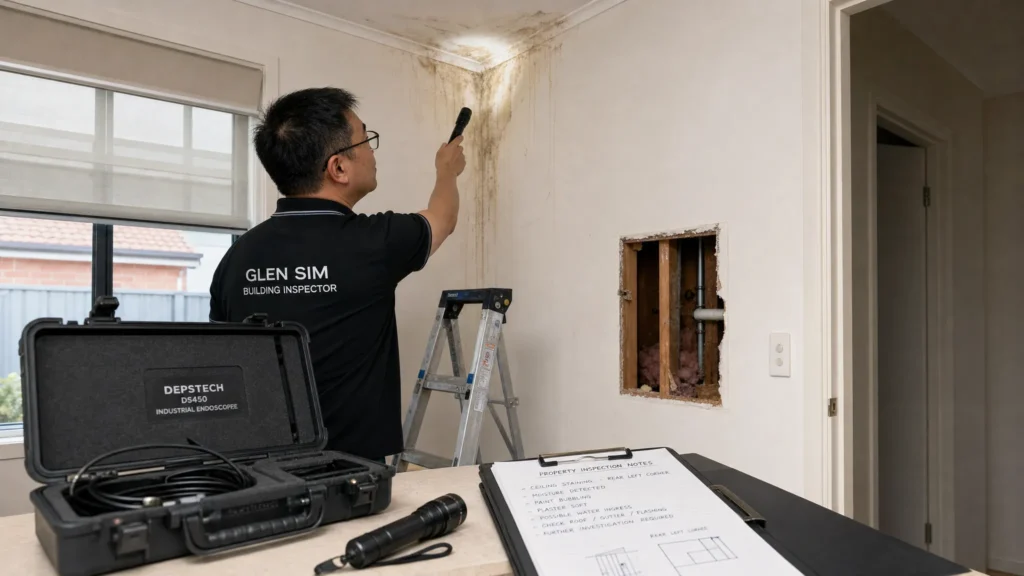
Hidden building defects rarely announce themselves with one obvious sign. A stain on plasterboard might begin at a roof flashing, a balcony membrane, a window junction, or condensation inside a wall cavity. A crack might be harmless shrinkage, or it might be the surface expression of movement elsewhere in the building.
That is why construction defect experts do more than record visible damage. Their work is forensic. They identify patterns, test competing explanations, and connect symptoms to the most likely underlying cause.
For homeowners, that can mean understanding whether a problem is urgent or cosmetic. For builders, it can help separate workmanship issues from design, maintenance, or existing conditions. For solicitors, it provides the structured technical evidence needed to progress a building dispute with clarity.
Hidden defects are about cause, not just condition
A hidden building problem is not always completely invisible. Often, the defect itself is concealed, but it leaves clues on the surface. The expert’s job is to understand whether the visible clue is the whole problem or only the end point of a deeper failure.
For example, repainting a water stain may make a ceiling look better for a few weeks, but it does not identify whether water is entering through a failed roof penetration, overflowing gutter, defective plumbing line, or a balcony above. The same applies to cracking, uneven floors, musty odours, efflorescence, swelling joinery, and soft flooring.
Glen Sim, owner and director of Awesim Building Consultants, approaches these matters as an evidence exercise. In a dispute context, the question is not simply what is wrong. The stronger question is what can be proven, what is the probable cause, what further investigation is justified, and what repair is reasonable.
A useful hidden defect investigation will usually consider:
- The nature and location of the visible symptom
- The building element or system likely to be involved
- Whether the issue is active, historical, or intermittent
- Relevant contract documents, drawings, specifications, and approvals
- Applicable performance expectations, including the National Construction Code where relevant
- The limits of what can be concluded without opening up works or specialist testing
That last point matters. A credible expert does not overstate the evidence. Where a wall cavity has not been opened, or where weather conditions have not reproduced a leak, the report should explain what is known, what is inferred, and what remains uncertain.
The investigation starts before the site inspection
Construction defect experts rarely begin with a ladder or moisture meter. They begin with the records.
Before attending site, a consultant may review the building contract, approved drawings, engineering details, specifications, variation records, correspondence, photographs taken during construction, occupation certificates, waterproofing certificates, invoices, maintenance records, and previous reports. These documents help define what was meant to be built, what was actually built, and when the problem first appeared.
This matters because hidden problems often sit at the boundary between several possible causes. A drainage issue might involve design levels, owner-directed landscaping, workmanship, blocked stormwater, or a latent site condition. A leaking shower might involve waterproofing, plumbing, tile junctions, movement, poor maintenance of sealant, or a combination of issues.
Document review also helps the expert avoid a common mistake: assuming that the most visible contractor is automatically responsible. In building disputes, there may be separate roles for designers, certifiers, engineers, builders, subcontractors, suppliers, and owners. A technical report should identify the defect and cause as far as the evidence permits, while leaving legal responsibility to the proper legal process.
For a broader view of the assessment process, Awesim has also explained how a building construction consultant assesses defects in NSW dispute matters.
Reading the clues that concealed defects leave behind
Hidden problems usually create patterns. A single mark may not say much, but its position, shape, timing, recurrence, and relationship to other building elements can be highly informative.
| Visible clue | Possible hidden issue | What an expert may check |
|---|---|---|
| Ceiling stain below a bathroom, balcony, or roof area | Waterproofing failure, plumbing leak, roof leak, condensation | Moisture readings, inspection of wet areas, roof drainage, balcony falls, plumbing access points |
| Cracks around windows or doors | Building movement, lintel issues, frame movement, differential settlement | Crack width and direction, floor levels, external drainage, footing context, opening alignment |
| Efflorescence on brickwork or concrete | Persistent moisture migration through masonry or slab edges | Drainage, weep holes, damp proofing, soil levels, waterproofing junctions |
| Musty odour or recurring mould | Moisture source, poor ventilation, condensation, concealed leak | Ventilation paths, humidity patterns, subfloor or roof cavity condition, moisture mapping |
| Swollen skirting, cupped flooring, or soft particleboard | Water ingress at floor level, wet area leakage, rising moisture | Moisture meter readings, adjacent wet areas, external paving levels, door thresholds |
| Doors binding or uneven floor feel | Structural movement, frame distortion, settlement, deflection | Level survey, crack mapping, subfloor inspection, load paths, historical movement signs |
The table is not a diagnosis by itself. It shows why the same symptom can have several possible causes. Good expert work is the process of narrowing those causes using evidence.
Tools help, but judgement matters more
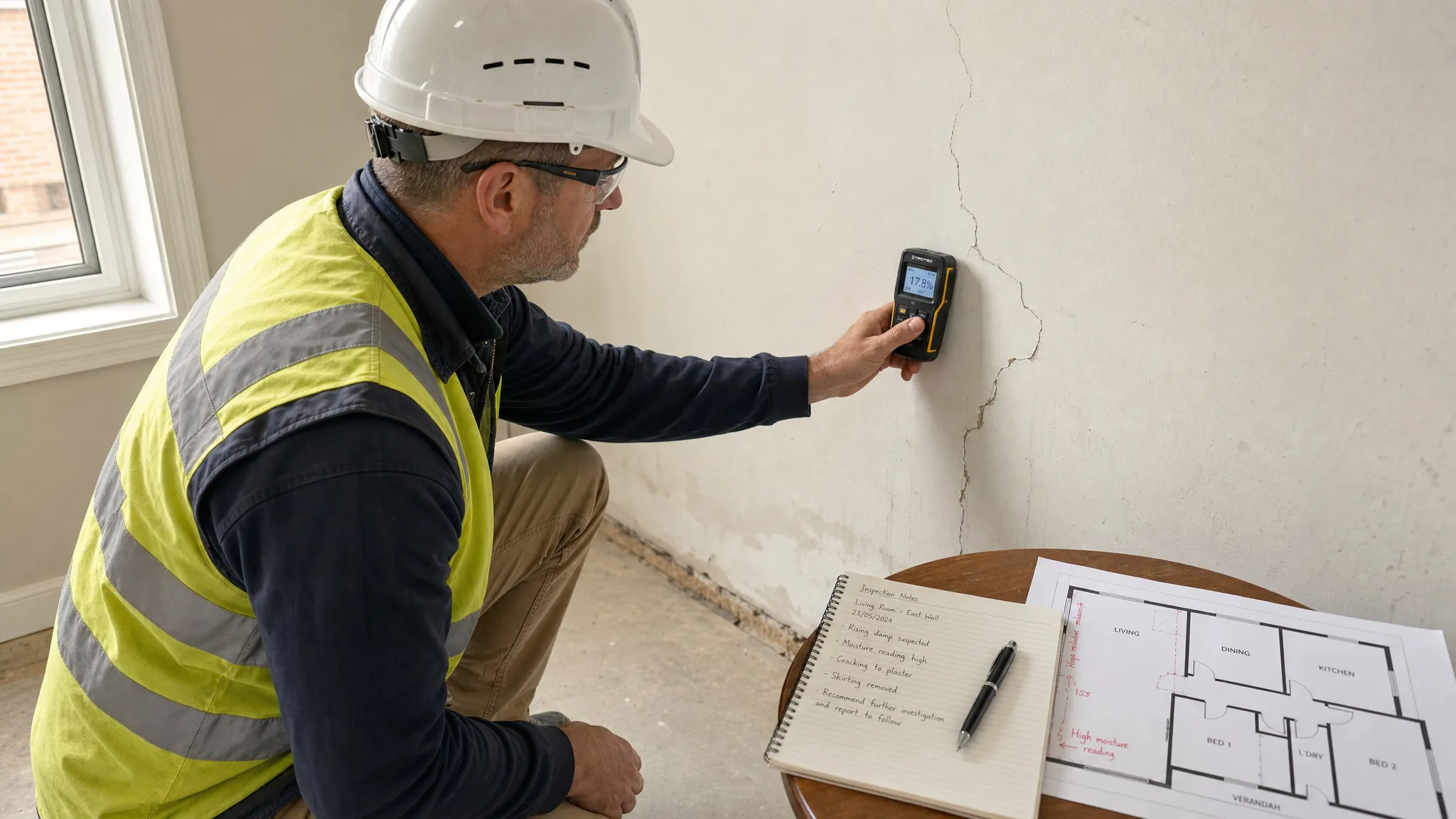
Modern inspection tools can make hidden problems easier to detect, but they do not replace technical judgement. A moisture meter can indicate elevated moisture, but it does not always identify where water entered. Thermal imaging can show temperature differences that may be consistent with moisture, insulation gaps, or air movement, but it requires careful interpretation. A borescope can assist with cavity inspection, but only in the area it can actually see.
Construction defect experts may use non-invasive methods first because they reduce unnecessary damage. These can include visual inspection, moisture mapping, level checks, crack measurements, roof cavity and subfloor inspection where safe and accessible, drainage observations, and review of junctions around windows, doors, roofs, balconies, wet areas, and cladding.
Where non-invasive inspection cannot answer the key question, intrusive investigation may be recommended. That might involve lifting a tile, opening a wall section, exposing a waterproofing junction, checking a concealed flashing, or engaging an engineer, plumber, hygienist, or other specialist. In a dispute, those steps should be planned carefully so evidence is preserved and all parties understand what is being inspected.
This is especially important in NCAT or court matters. If destructive testing is done informally, critical evidence can be lost, contaminated, or disputed later. A clear scope, photographs, notes, chain of events, and explanation of findings all support the reliability of the investigation.
Testing alternative explanations
A hidden defect investigation should not jump from symptom to conclusion. The expert should test alternative explanations and explain why one cause is more probable than another.
Consider a bedroom wall that becomes damp after heavy rain. A quick assumption might be that the window leaks. But an expert will usually look more broadly. Is there a roof valley above? Is there a balcony or parapet nearby? Are gutters overflowing? Is the external ground level too high? Are there cracks in render? Is the dampness at the window head, sill, jamb, or skirting? Does it occur after wind-driven rain only, or after every storm?
The same reasoning applies to cracking. A diagonal crack from the corner of a door may suggest movement, but movement can come from many sources. It may relate to foundation conditions, inadequate drainage, tree influence, frame shrinkage, poor articulation, thermal movement, or localised construction detailing. A construction defect expert will look at crack shape, width, repetition, location, age, and whether other elements show related movement.
The aim is not to make the most dramatic finding. The aim is to make the most defensible finding.
Separating defects from wear, maintenance, and incomplete scope
Not every building problem is a construction defect. Some issues arise from ageing, storm damage, lack of maintenance, occupant use, later alterations, or conditions outside the builder’s control. Other issues arise because something was never part of the contracted scope.
This distinction is crucial for homeowners, builders, and lawyers alike. If an expert labels every imperfection as a defect, the report may become vulnerable to challenge. If an expert dismisses genuine failures as maintenance, the real cause may remain unresolved and the damage may worsen.
A sound assessment usually compares the condition against several reference points. These may include the contract, approved drawings, specifications, engineering details, manufacturer installation requirements, relevant Australian Standards, statutory requirements, and accepted building practice. The applicable reference depends on the building element, the project age, the type of work, and the dispute issues.
In practical terms, this means an expert may find that one item is defective workmanship, another is a design coordination issue, another is maintenance related, and another requires further investigation before a final conclusion can be reached. That level of separation is often what makes an expert report useful.
Why hidden defect evidence matters in NSW building disputes
In NSW building disputes, hidden problems can become difficult because parties often disagree about scope, cause, cost, and responsibility. NSW Fair Trading provides guidance on resolving building disputes, but once a matter becomes technical or contested, independent expert evidence is often needed.
A report for a dispute should do more than describe damage. It should explain the defect item, where it is located, what evidence supports the conclusion, what further investigation may be required, what rectification is reasonable, and whether the proposed repair is proportionate to the issue. Where costs are in dispute, the technical findings may also need to align with a Scott Schedule or quantum assessment.
This is where Awesim’s work is focused. The firm provides independent building dispute support across New South Wales, including expert witness reports, Scott Schedules, quantum meruit reports, NCAT dispute reports, litigation support, and building defect assessments. If a matter is already formal, building consultant services that help resolve disputes can help turn technical observations into a structured evidentiary format.
| Audience | What a hidden defect investigation helps clarify |
|---|---|
| Homeowners | Whether the symptom is serious, what may be causing it, and what evidence is needed before repairs begin |
| Builders | Whether the alleged defect is supported by evidence, whether other causes are possible, and what repair scope is reasonable |
| Solicitors | The technical issues in dispute, the strength of available evidence, and the information needed for pleadings, conferences, reports, or hearings |
Common hidden problems experts look for
Every property is different, but certain concealed problems arise frequently in residential and construction dispute work. They often involve building systems where water, movement, ventilation, or load transfer is not performing as intended.
Common areas of concern include:
- Waterproofing failures behind wet area walls, showers, balconies, terraces, and tiled decks
- Roof plumbing and flashing defects around penetrations, valleys, parapets, box gutters, and junctions
- Site drainage problems, including poor falls, high external ground levels, blocked drains, and water ponding against the building
- Structural movement, framing deflection, inadequate support, or differential settlement
- Window and door installation issues, including failed flashings, poor sealing, and incorrect sill detailing
- Subfloor and roof space ventilation problems that contribute to condensation, mould, decay, or corrosion risk
- Concealed plumbing leaks, particularly where symptoms appear well away from the actual pipe or fitting
The presence of one of these risks does not automatically prove a defect. It tells the expert where to look, what to test, and what evidence is needed before reaching a conclusion.
What to do before an expert attends
If you suspect a hidden defect, avoid rushing into cosmetic repairs unless urgent safety or damage mitigation requires it. Repainting, replacing plasterboard, lifting flooring, or re-tiling may remove evidence that could later be important.
Instead, record the history. Photograph the issue with dates, note when it appears or worsens, keep samples or damaged materials if they are removed, and preserve emails, invoices, plans, approvals, and photographs from construction. If water is involved, note whether the issue follows rain, plumbing use, wind direction, or specific activities such as showering or running an appliance.
Builders should also document their inspections and responses carefully. A clear record can show that a complaint was investigated properly, that access was requested, or that other causes were considered.
Solicitors should brief the expert with the actual questions in dispute, not just a general request to inspect. If the dispute is escalating, it may also be appropriate to consider when to brief a construction dispute solicitor so the technical and legal strategy are aligned.
Frequently Asked Questions
Can hidden defects be found without opening walls or floors? Sometimes. Non-invasive inspection can identify strong indicators such as moisture patterns, cracking behaviour, roof cavity conditions, drainage issues, and defective junctions. However, some concealed issues cannot be confirmed without intrusive investigation or specialist testing.
Is thermal imaging enough to prove a leak? No. Thermal imaging can be useful, but it is an indicator, not a complete diagnosis. Temperature differences may result from moisture, insulation gaps, air movement, or other factors. Findings should be checked against site conditions and other evidence.
Can an expert say who is legally responsible for a hidden defect? A building expert can provide technical opinions about the defect, probable cause, compliance, workmanship, and reasonable rectification. Legal responsibility is usually a matter for solicitors, insurers, tribunals, or courts to determine based on the full evidence.
Should I repair the defect before getting an expert report? If there is no immediate safety or damage mitigation issue, it is often better to obtain expert advice before major repairs. If urgent work is needed, photograph everything, keep records, and preserve removed materials where practical.
Do construction defect experts assist with NCAT matters? Yes, where the expert has the appropriate role and instructions. In NSW disputes, expert reports can help NCAT or a court understand the technical issues, the evidence supporting each item, and the reasonable scope of rectification.
Need independent support with hidden building defects?
Hidden building problems are rarely solved by guesswork. They require careful evidence, disciplined reasoning, and a report that can be understood by homeowners, builders, solicitors, and decision makers.
Glen Sim and Awesim Building Consultants provide independent building dispute support across New South Wales, including expert witness reports, Scott Schedules, quantum meruit reports, NCAT dispute reports, litigation support, and building defect assessments.
If you need an independent view on concealed building issues, contact Awesim Building Consultants to discuss the next step for your matter.

Related Posts
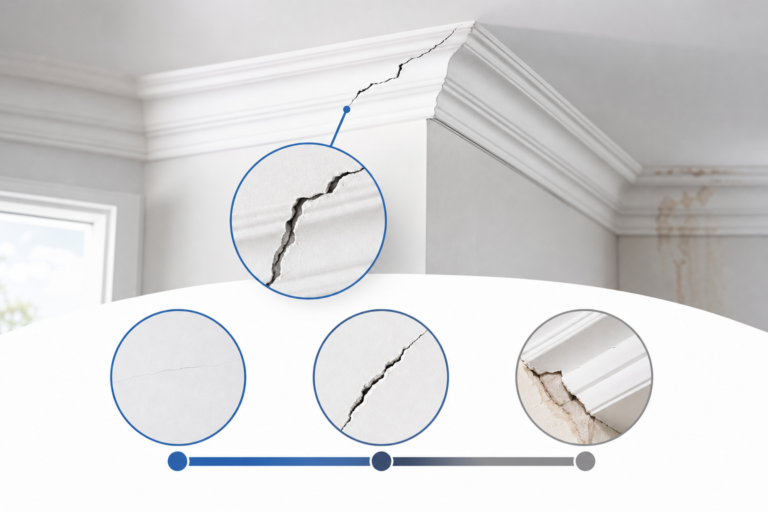
Cornice Cracking: How to Tell If the Damage Is Serious
Cornice cracking is one of the most common concerns Australian homeowners raise, and the hard part is not spotting the
Read More »
Digital Construction Consultant Australia: What They Do
A digital construction consultant in Australia manages the technology-driven side of building projects: BIM coordination, clash detection, asset data handover,
Read More »
Strata Report: What Buyers Need to Read Before Signing
A strata report is the document that surfaces hidden obligations before you are legally committed to a purchase. A strata
Read More »