
New Bathroom Leaking After Handover: Your NSW Rights and Fix
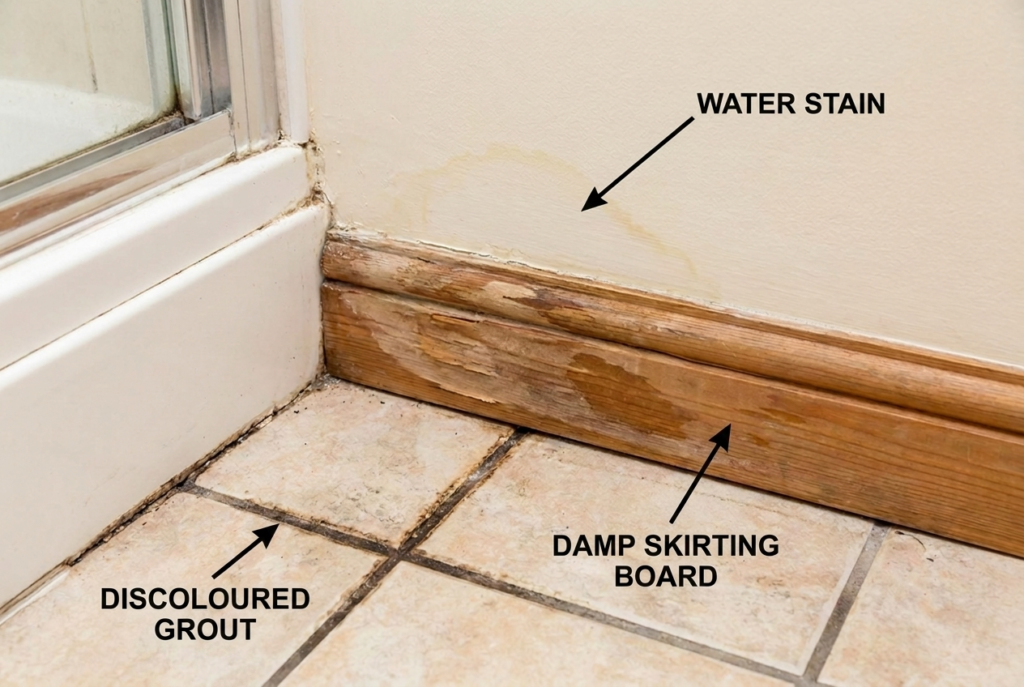
You signed off on the new bathroom weeks ago. Now there’s a damp patch creeping up the skirting in the next room, a musty smell that won’t shift, or grout that’s gone dark and soft in the corner of the shower. The build is finished, the builder’s been paid — and water is already getting where it shouldn’t.
If your new bathroom is leaking after handover, the reassuring news is this: in NSW, you almost certainly have rights, and a waterproofing failure is often the builder’s responsibility to fix, not yours. The frustrating news is that builders don’t always agree, and getting it sorted comes down to two things — understanding your statutory warranty position, and proving the leak is a defect rather than something you caused. This guide walks through both.
Why new bathroom waterproofing fails
Waterproofing is the hidden membrane beneath your tiles and screed that stops water reaching the building structure. When it’s done right, you never think about it. When it’s done wrong, water finds the gap.
In a new or freshly renovated bathroom, leaks almost always trace back to the installation rather than wear and tear, because there hasn’t been time for wear and tear. Common causes include a membrane applied too thinly or unevenly, inadequate coverage at the critical junctions (where the floor meets the wall, or around the drain and tap penetrations), the wrong primer or no primer, tiling started before the membrane fully cured, or simply not following Australian Standard AS 3740-2021, which governs waterproofing of domestic wet areas. Any of these can let water track into the substrate, then into adjoining walls, floors and timber.
This isn’t a rare problem. Waterproofing is consistently one of the most common serious building defects in NSW — one Building Commission NSW study found that of apartment buildings with serious defects, around 42% had waterproofing problems. If it’s happening to you, you’re far from alone.
Is the builder responsible? Your NSW statutory warranties
In NSW, every residential building contract automatically includes statutory warranties under the Home Building Act 1989. These apply regardless of what your contract says, and they make the builder legally responsible for defective work — including waterproofing that fails because of how it was installed.
The key thing to understand is the time limit, because it depends on how serious the defect is:
- Major defects: six years from completion of the work to start proceedings.
- All other (minor) defects: two years from completion.
And there’s a useful safety net: if the problem becomes apparent in the last six months of your warranty period, you get an extra six months to act.
So which one is a leaking bathroom? This is where it gets important — and where a lot of online advice is wrong.
Major defect or minor defect? The distinction that decides everything
It’s tempting to assume any waterproofing failure is automatically a “major defect” with the full six-year window. It isn’t always — and getting this wrong can cost you your claim.
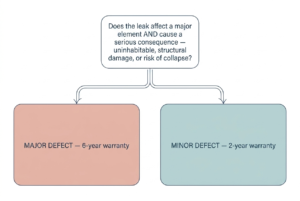
Under the Home Building Act, a defect is major only if it affects a major element of the building and causes a serious consequence: making the bathroom (or part of the home) unable to be used for its intended purpose, causing destruction, or threatening collapse. Waterproofing is recognised as a major element, so a membrane failure that lets water rot timber framing, spread mould through walls, or make a room unusable is a clear-cut major defect with the six-year warranty.
But the line isn’t automatic. In Ashton v Stevenson [2019], the Tribunal clarified that a defect is major only where it has a tangible impact on the building’s integrity or use — mere inconvenience or incidental staining may not qualify. A small shower leak that doesn’t significantly affect how you use the room could fall under the two-year minor-defect warranty instead.
Why does this matter so much? Because it sets the clock on your rights. If your leak is genuinely major and you assume it’s minor, you might wrongly believe your window has closed. If it’s borderline, the classification can be argued either way — and that argument is usually won or lost on expert evidence. Establishing which category your leak truly falls into is one of the most valuable things an independent building consultant does, because it determines how long you have and how strong your position is.
What counts as proof of a waterproofing defect?
Here’s the trap homeowners fall into: a builder will often argue the leak isn’t their fault. Common lines are “that’s condensation,” “that’s a maintenance issue,” “you must have damaged the silicone,” or “that’s just normal for a wet area.”
A photo of a damp wall doesn’t, by itself, defeat those arguments. Proof of a defect means connecting three things:
- The water is penetrating the structure — established by inspection, moisture readings, and sometimes leak-detection testing rather than just a visible stain.
- The cause is the waterproofing installation — not a one-off accident or genuine lack of maintenance, but a membrane or junction that wasn’t done to standard.
- It falls short of the benchmark — the building contract, the plans, or AS 3740-2021.
A general “yes, it’s wet” observation won’t carry a dispute. An independent report that identifies the cause and measures the work against the standard is what does. This is exactly the difference between an expert witness report and a casual opinion — and it’s why gathering evidence early, while the defect is fresh and before any patch-up muddies the picture, matters so much.
What to do right now
If your new bathroom is leaking after handover, a clear sequence protects your position:
- Notify the builder in writing. Not just a phone call — an email or letter listing the problem, dated, with photos. This creates the paper trail NSW Fair Trading and NCAT will expect to see.
- Document everything now. Photograph the damage from multiple angles, note when it appears (after showering, after rain), and keep your contract, any waterproofing certificate, and the completion date.
- Get an independent assessment early. Before the warranty clock runs down and before anyone “tidies up” the evidence, have the cause assessed by someone independent.
- Escalate if the builder won’t act. If they deny responsibility, the path runs through NSW Fair Trading mediation and, if unresolved, to NCAT — where independent expert evidence is decisive. Our guide on what to do when a builder won’t fix the defects covers that escalation in detail.
One more point worth knowing: these statutory warranties run with the property, not just the original contract — so if you bought a home with a recently completed bathroom, you may still be able to claim against the original builder within the warranty period.
Frequently asked questions
Is my builder responsible if my new bathroom leaks after handover?
In most cases, yes. Under the Home Building Act 1989 (NSW), every residential building contract includes statutory warranties making the builder responsible for defective work, including waterproofing that fails due to faulty installation. You have six years to claim for major defects and two years for minor ones, from completion. The builder can be required to rectify the defect or compensate you — though you’ll typically need to prove the leak is a defect, not accidental damage or lack of maintenance.
Is a leaking bathroom a major or minor defect in NSW?
It depends on the consequences. A waterproofing failure is a major defect (six-year warranty) if it affects a major element and causes serious harm — making the room unusable, rotting structural timber, spreading mould, or threatening the building’s integrity. A minor leak that doesn’t significantly affect how the room is used may fall under the two-year minor-defect warranty. Because the classification sets your time limit and is often arguable, an independent expert assessment is the reliable way to establish which applies.
How long do I have to make a claim for bathroom waterproofing in NSW?
Six years from completion for major defects and two years for all other defects, under the Home Building Act 1989. If the defect first becomes apparent in the final six months of the warranty period, you get an extra six months to start proceedings. Because waterproofing leaks can be classified either way, it’s wise to act as soon as you notice a problem rather than risk running down the clock.
What evidence do I need to prove a waterproofing defect?
You need to connect three things: that water is penetrating the structure (shown by inspection and moisture testing, not just a visible stain), that the cause is the waterproofing installation rather than accidental damage or lack of maintenance, and that the work falls short of the building contract or Australian Standard AS 3740-2021. An independent expert report that establishes cause and measures the work against the standard is far stronger than photographs alone.
The builder says the leak is my fault — what can I do?
Builders commonly argue a leak is condensation, a maintenance issue, or owner damage. The way to answer that is independent evidence: an expert assessment that identifies the actual cause and shows it stems from the waterproofing installation, not your use of the room. Document everything, avoid letting the builder do a quick patch-up that hides the cause before it’s assessed, and get a professional view early so your position is based on proof rather than competing opinions.
Get an independent assessment
A leaking new bathroom is stressful, but it’s usually fixable — and in NSW it’s often the builder’s legal responsibility to fix it. The thing that decides how smoothly it gets resolved is evidence: establishing whether your leak is a major or minor defect, what caused it, and how it falls short of the standard.
Awesim Building Consultants has spent decades providing independent building assessments and litigation support to homeowners across NSW. If your new bathroom is leaking and you want clarity on where you stand before the warranty clock runs down, we can give you an independent, expert view of the defect and your options. Get in touch for an obligation-free discussion — distance is no obstacle, and we work throughout New South Wales.
This article is general information about building defects in NSW and is not legal advice. For advice specific to your situation, speak to a qualified building consultant or solicitor.