
Scott Schedule Template Construction Guide for NSW Claims
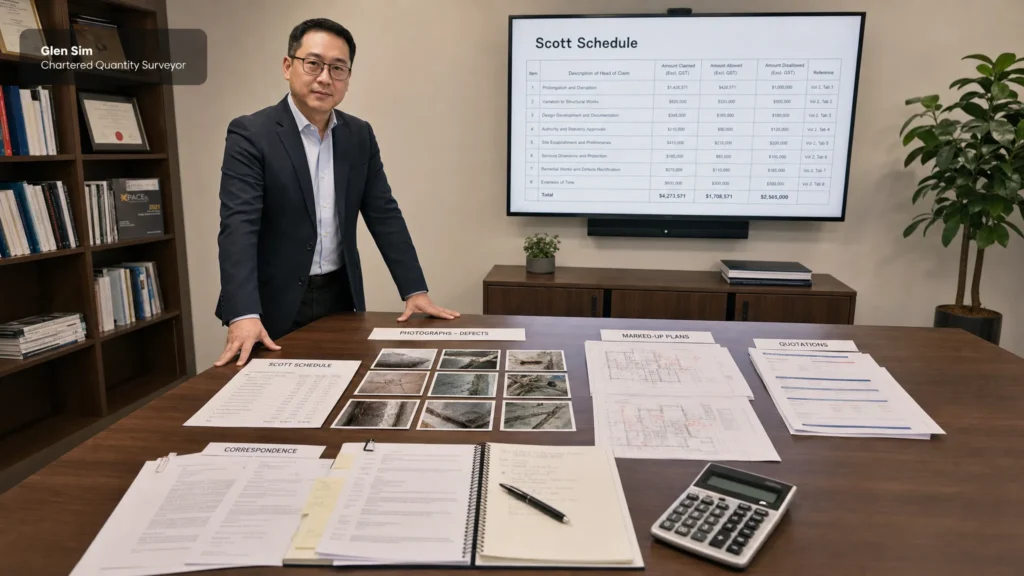
A Scott Schedule is only as useful as the thinking behind it. In NSW construction disputes, a good template can organise defects, incomplete work, variations, responses and costs into a format that NCAT, courts, lawyers and experts can work through efficiently. A poor one can do the opposite: blur the issues, duplicate claims and weaken otherwise valid evidence.
For home owners, builders and solicitors, the goal is not to create the longest spreadsheet. The goal is to create a clear, itemised document that answers three questions for every disputed item: what is alleged, what evidence supports it, and what amount is claimed or disputed?
Glen Sim, owner and director of Awesim Building Consultants, regularly assists with Scott Schedules, expert witness reports and building dispute support across NSW. In practice, the strongest schedules are not the most complicated ones. They are the ones that make it easy for the decision-maker to understand each issue, compare each party’s position and trace every dollar back to evidence.
What a Scott Schedule template does in a construction claim
A Scott Schedule is a structured table used to break a construction dispute into separate, manageable items. It is commonly used in building defect claims, residential building disputes, variation disputes, incomplete works claims and rectification cost disputes.
In a NSW claim, the schedule may be used during negotiation, mediation, expert conferencing, NCAT proceedings or court proceedings. It can help both sides narrow the dispute before a hearing, particularly where there are many alleged defects or disputed invoices.
A template does not prove the claim by itself. It is a framework for presenting evidence. Each row should connect the allegation to documents such as photographs, contracts, invoices, expert opinions, quotations, drawings, specifications or site records.
If you are still clarifying the broader purpose of this document, Awesim’s guide on what a Scott Schedule does in a building dispute is a useful companion to this template-focused guide.
When to use a Scott Schedule in NSW building disputes
A Scott Schedule is most useful when the dispute involves multiple items that would be difficult to explain in narrative form. It is often appropriate where the claim includes alleged defective work, incomplete scope, disputed variations, rectification costs, unpaid payment claims or competing expert opinions.
For NCAT matters, parties should always follow the directions made in their particular case. NCAT provides information about its building and construction disputes process, but each matter can have different procedural requirements depending on the type and stage of the dispute.
In court matters, the schedule may need to align with pleadings, affidavits, expert reports and any applicable expert evidence rules. Solicitors will usually decide how the Scott Schedule fits into the broader case strategy. A building consultant’s role is different: to assist with independent technical assessment, defect identification, scope clarification and cost analysis.
Recommended Scott Schedule template columns for construction claims
There is no single universal template that suits every dispute. However, most NSW construction Scott Schedules need enough detail to identify the issue, capture each party’s position and link the claimed cost to evidence.
The table below outlines a practical structure that can be adapted for defects, variations, incomplete works and rectification claims.
| Column | Purpose | Practical drafting tip |
|---|---|---|
| Item number | Gives each issue a stable reference | Do not renumber casually once documents have been exchanged |
| Location or trade | Identifies where the issue arises | Use specific rooms, elevations, levels or trade categories |
| Claim category | States whether the item is a defect, variation, incomplete work or cost dispute | Keep categories consistent throughout the schedule |
| Alleged issue | Describes the complaint or disputed work | Write in precise, neutral language rather than emotional wording |
| Contract, drawing or standard reference | Links the issue to the agreed scope or relevant benchmark | Refer to the contract, plans, specification, NCC or Australian Standard only where relevant |
| Claimant’s position | Sets out what the claimant says happened | Keep this concise and evidence-based |
| Respondent’s position | Sets out what the opposing party says in answer | Avoid leaving this blank once a response is available |
| Expert opinion | Summarises the independent technical view | This should align with the expert report, not contradict it |
| Evidence references | Identifies photos, reports, invoices, emails or other documents | Use document IDs, page numbers or photo references where possible |
| Rectification scope | Explains what work is required to fix or complete the item | Avoid vague phrases such as “repair as needed” |
| Amount claimed or assessed | Records the cost claimed, disputed or assessed | State whether GST, margins or contingencies are included |
| Status or comments | Tracks whether the item is admitted, disputed, withdrawn or resolved | Update this carefully as the matter progresses |
This structure is usually more useful than a bare list of defects because it allows the parties and the tribunal to see the technical issue, legal position and cost issue side by side.
A simple construction Scott Schedule example
The exact wording will depend on the contract, scope of works and evidence. The example below is deliberately simplified to show the logic of a row, not to provide a final evidentiary opinion.
| Item | Location | Alleged issue | Claimant’s position | Respondent’s position | Evidence | Rectification scope | Amount |
|---|---|---|---|---|---|---|---|
| 1 | Main bathroom shower | Alleged waterproofing failure and water staining to adjacent wall | Owner alleges waterproofing was defective and has caused moisture damage | Builder denies defective workmanship and says damage may be due to later use or maintenance | Expert report section 4.1, photos P1 to P6, moisture readings, quotation Q1 | Remove tiles as required, investigate substrate, reinstate waterproofing and tiling to compliant standard | $X, subject to quote and expert assessment |
The strength of this row depends on the supporting evidence. If the photos are unclear, the expert report is incomplete or the quotation does not match the rectification scope, the schedule may invite challenge.
How to fill out the template correctly
Start with the issues, not the costs. Many construction schedules become confusing because the dollar amount drives the row, while the alleged defect or disputed work is under-described. A better approach is to first identify the issue, then identify the evidence, then identify the appropriate rectification scope, and only then record the cost.
Use stable item numbers from the beginning. If Item 12 becomes Item 18 in a later version, every expert report, solicitor letter and hearing bundle reference can become harder to follow. If a new item must be added, consider using 12A or another controlled numbering method rather than rebuilding the entire schedule.
Keep each row to one main issue where possible. Combining waterproofing, tiling, drainage and painting into a single item may seem efficient, but it can make liability and quantum difficult to assess. Separate items are usually easier to admit, deny, price or resolve.
Use neutral wording. A Scott Schedule should not read like a complaint letter. Phrases such as “poor workmanship throughout” or “builder refused to do the job properly” are less useful than a specific statement such as “fall to floor waste in ensuite does not direct water to drain, as observed in expert report section 3.2.”
For NCAT-specific preparation guidance, Awesim’s article on how to prepare an NCAT Scott Schedule that holds up explains why item numbering, evidence references and consistent cost logic matter.
Evidence that should sit behind the schedule
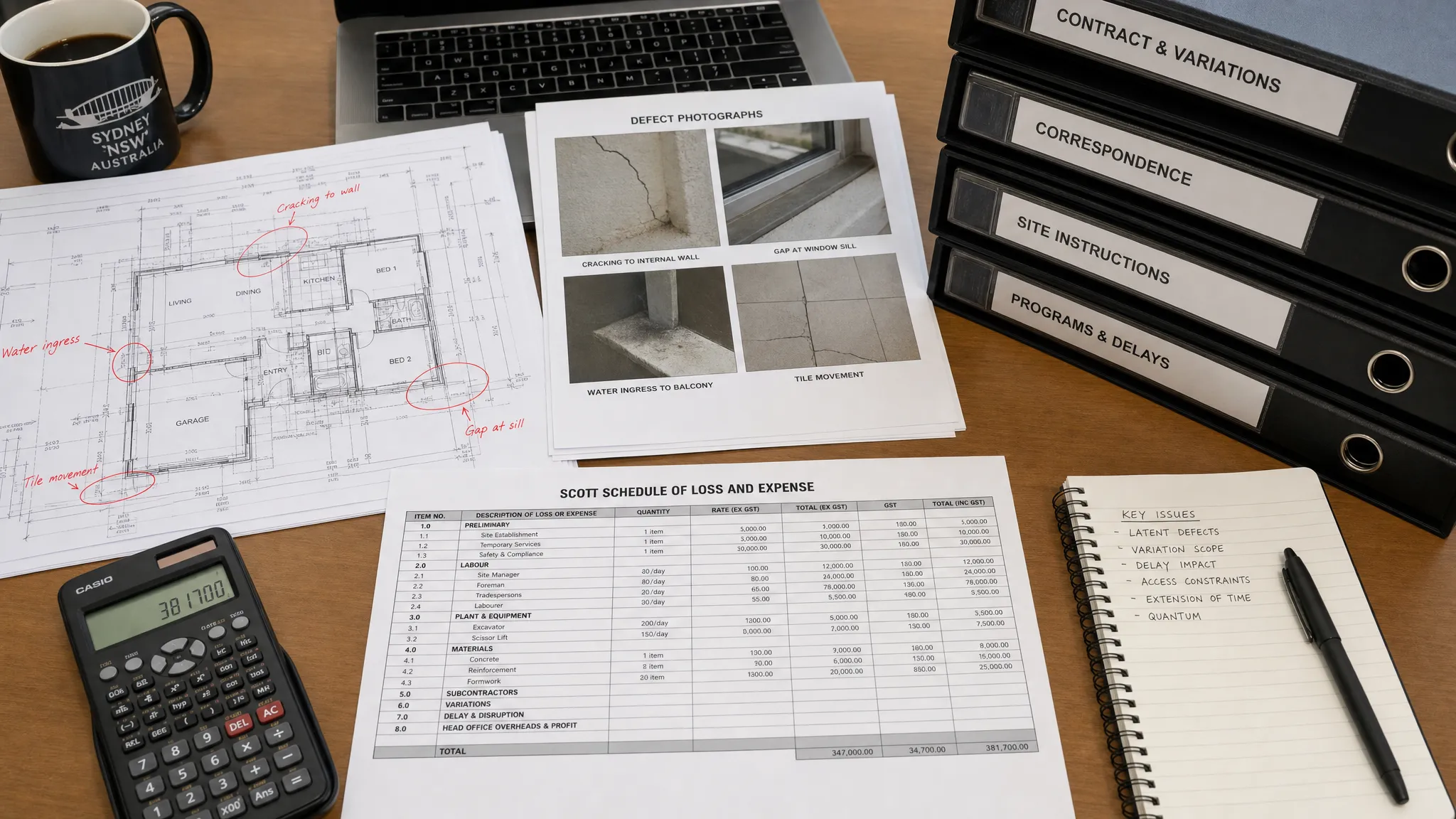
A Scott Schedule should never be separated from its evidence. The decision-maker needs to understand why a party says an item is defective, incomplete, overcharged or payable.
Common supporting material includes photographs, expert reports, contracts, approved plans, specifications, variation records, invoices, payment schedules, emails, site diaries, waterproofing certificates, engineering documents and rectification quotations. In some cases, references to the National Construction Code, Australian Standards or manufacturer installation requirements may also be relevant.
For residential building work in NSW, statutory warranties under the Home Building Act 1989 (NSW) may be important. However, the schedule should not simply assert a breach of warranty. It should identify the work, explain the alleged non-compliance and connect that allegation to evidence.
The best schedules make the evidence trail easy to follow. A solicitor, expert or tribunal member should be able to move from Item 7 in the schedule to the relevant photograph, report section and quotation without guessing.
Adapting the template for different claim types
A construction Scott Schedule template should change slightly depending on what is being claimed. Defect claims, variation claims and quantum meruit claims do not all require the same emphasis.
For a defect claim, the schedule should focus on the alleged defective work, the required standard, the evidence of non-compliance, the rectification methodology and the cost to rectify. The expert opinion column is often central.
For an incomplete works claim, the schedule should clearly identify the original scope, what remains incomplete, the value of that incomplete work and whether payment has already been made for it. The contract and payment history become very important.
For a variation dispute, the schedule should identify the alleged instruction, the date, the person who gave the instruction, the agreed or claimed price, and whether the work was actually carried out. Emails, text messages, site directions and invoices may be critical.
For a quantum meruit claim, the focus is often on the reasonable value of work performed where there is no agreed fixed price or where the contractual basis is disputed. This can require careful cost evidence, records of labour and materials, and independent assessment. Awesim provides quantum meruit reports as part of its NSW building dispute support, but the appropriate approach depends heavily on the facts of the matter.
Common mistakes that weaken a Scott Schedule
Even a well-designed template can fail if it is filled in poorly. These are the issues Glen Sim often sees undermine construction schedules in dispute work.
| Mistake | Why it creates problems | Better approach |
|---|---|---|
| Listing broad complaints | The other party cannot properly respond | Break the complaint into specific, inspectable items |
| Missing evidence references | The schedule becomes assertion rather than proof | Refer to report sections, photos, quotes and documents |
| Mixing defects and costs | It becomes unclear what is technically wrong | First state the issue, then state the rectification scope and cost |
| Changing item numbers | Later reports and submissions become difficult to reconcile | Keep stable numbering and track revisions |
| Using one lump sum quote | The cost cannot be matched to individual items | Ask for itemised quotations where possible |
| Ignoring the opposing position | The schedule does not narrow the dispute | Include responses once they are served or known |
| Overstating certainty | Unsupported conclusions can be challenged | Use wording consistent with the expert evidence |
A schedule should help narrow the dispute. If it makes the dispute harder to understand, the template needs to be revised.
Guidance for owners, builders and lawyers
Home owners should focus on clarity and evidence. It is not enough to say that work looks defective. The schedule should identify the item, location, relevant evidence and rectification cost. Where technical building issues are involved, independent expert input can be important.
Builders should respond item by item. A general denial rarely helps if the schedule contains 40 separate allegations. A builder’s response should explain whether the item is admitted, denied, already rectified, outside scope, caused by others, or disputed on cost. Records such as photos, certificates, subcontractor documents and correspondence can be valuable.
Lawyers should ensure the Scott Schedule aligns with the legal case. The schedule should not contradict pleadings, points of claim, expert reports or affidavits. It should also be version controlled so that every party knows which schedule is current.
Where expert evidence is needed, an independent building consultant can help convert site observations into a structured, evidence-based schedule. Awesim explains this broader role in its guide on what a building consultant can do for your case.
Practical template checklist before filing or serving
Before a Scott Schedule is filed, served or relied on in settlement negotiations, review it as if you are the person reading the dispute for the first time.
Check that every item has a clear location, a specific allegation or response, supporting evidence, a rectification scope and a cost basis where money is claimed. Confirm that the totals add correctly and that GST is treated consistently. Make sure the schedule matches the expert report, quotations and legal documents.
It is also sensible to confirm that withdrawn or resolved items are marked clearly rather than silently deleted. Removing rows without explanation can create confusion if earlier versions have already been exchanged.
A good final test is simple: can someone unfamiliar with the project understand what is disputed, why it matters and how the amount claimed was calculated? If not, the schedule needs more work.
Frequently Asked Questions
Can I use a generic Scott Schedule template for an NSW construction claim? Yes, but it should be adapted to the dispute. A generic template may be a useful starting point, but NSW building claims often need columns for evidence references, expert opinion, rectification scope and cost assessment.
Does a Scott Schedule prove my building claim? No. It organises the claim or response, but the proof comes from evidence such as expert reports, photographs, contracts, invoices, quotations and witness material.
Who should prepare a Scott Schedule? It may be prepared by a party, solicitor, expert or building consultant depending on the matter. In technical construction disputes, input from an independent building consultant can help ensure the schedule reflects building evidence accurately.
Should every defect have its own row? Usually, each distinct issue should have its own row. Separate rows make it easier for the other party to respond and for the tribunal or court to assess liability and quantum.
Can a Scott Schedule include variations and unpaid invoices? Yes. A Scott Schedule can be used for more than defects, but the columns may need adjustment. Variation and payment disputes should include contract references, instructions, dates, amounts claimed and supporting records.
Need help preparing a Scott Schedule for a NSW claim?
A Scott Schedule can be decisive in how clearly a construction dispute is presented. If the issues, evidence and costs are not organised properly, a valid claim or defence can become harder to prove.
Awesim Building Consultants provides independent building dispute support across NSW, including Scott Schedules, expert witness reports, NCAT dispute reports and quantum meruit reports. Led by Glen Sim, owner and director, Awesim helps owners, builders and lawyers present technical building issues in a clear, evidence-based format.
For independent assistance with a construction Scott Schedule or building dispute report, visit Awesim Building Consultants.

Related Posts

Schedule of Rates in Construction: How Disputes Arise in NSW
A Schedule of Rates contract prices construction work by unit rates applied to measured quantities, so the final cost varies
Read More »
NCAT Consumer Division: Steps From Lodgement to Hearing
Most people who end up at the NCAT Consumer and Commercial Division do not arrive there by choice. They arrive
Read More »
Statutory Warranty NSW: What Builders Must Fix and for How Long
Statutory warranty NSW obligations exist precisely for the moment a builder stops returning calls. A crack appears in the render.
Read More »