In a building dispute, everyone usually has a view. The owner may see unfinished or defective work. The builder may point to variations, site conditions, access delays or unpaid claims. A solicitor may need to convert a messy factual history into evidence that can be used in negotiation, NCAT or court.
That is where an independent construction consultant matters. Independence changes the quality of the conversation. Instead of relying on frustration, assumption or one-sided opinion, the parties get technical evidence that is structured, reasoned and tied to the relevant documents, standards and observed site conditions.
For NSW building disputes, this is not just useful. It can be decisive.
Independence means more than inspecting the work
An independent consultant is not there to be a cheerleader for the person who engaged them. Their value comes from applying building knowledge to the evidence without being tied to the outcome.
In practical terms, independence means the consultant should be able to:
- Identify what is defective, incomplete, non-compliant or disputed
- Explain why the issue exists, not just what it looks like
- Distinguish workmanship problems from design, documentation or maintenance issues
- Consider the contract, plans, specifications, variations and site history
- Give an opinion that remains useful even if it does not support every allegation
- Present findings in a way a solicitor, tribunal member, adjudicator or judge can follow
This is particularly important in NSW home building disputes, where rights and obligations may involve contract terms, statutory warranties under the Home Building Act 1989, Australian Standards, the National Construction Code and project-specific documentation.
A consultant who is independent does not avoid firm conclusions. If work is defective, that should be stated clearly. If a claimed defect is not supported by the evidence, that should also be stated clearly. That balance is what gives the opinion weight.
Why independence matters in NSW construction disputes
Building disputes often escalate because the parties are looking at the same facts through different lenses. A home owner may focus on visible damage or poor finish. A builder may focus on what was included in the scope, what was varied, or what was caused by others. A lawyer may need to know which issues are legally and evidentially worth pursuing.
An independent construction consultant helps separate the technical issues from the emotion of the dispute. That does not remove the stress, but it makes the next step clearer.
| Dispute issue | Without independent input | With independent consultant input |
|---|---|---|
| Defective work | Allegations may be broad or unsupported | Findings can be tied to observations, standards and documents |
| Incomplete work | Parties may disagree about scope | The consultant can compare work performed against the contract and agreed variations |
| Rectification | Quotes may be excessive, too narrow or inconsistent | Scope of rectification can be reasoned and itemised |
| Payment claims | Amounts may be argued without technical context | Work value, omissions and variations can be assessed more clearly |
| Expert evidence | Reports may appear partisan | A properly prepared opinion can assist NCAT or court decision-making |
For solicitors, that clarity helps with pleadings, evidence preparation, settlement strategy and hearing preparation. For builders and owners, it can prevent wasted time arguing about issues that a competent technical review can resolve quickly.
The consultant’s role is not the same as a builder, certifier or project manager
One reason disputes become confused is that different construction professionals have different roles. A builder is responsible for carrying out the work. A certifier has statutory functions in relation to approvals and compliance. A project manager may help coordinate delivery. An insurer, quantity surveyor or engineer may have an even more specialised role.
An independent construction consultant in a dispute context is different. Their role is to investigate, analyse and explain the building issues in a way that can support dispute resolution.
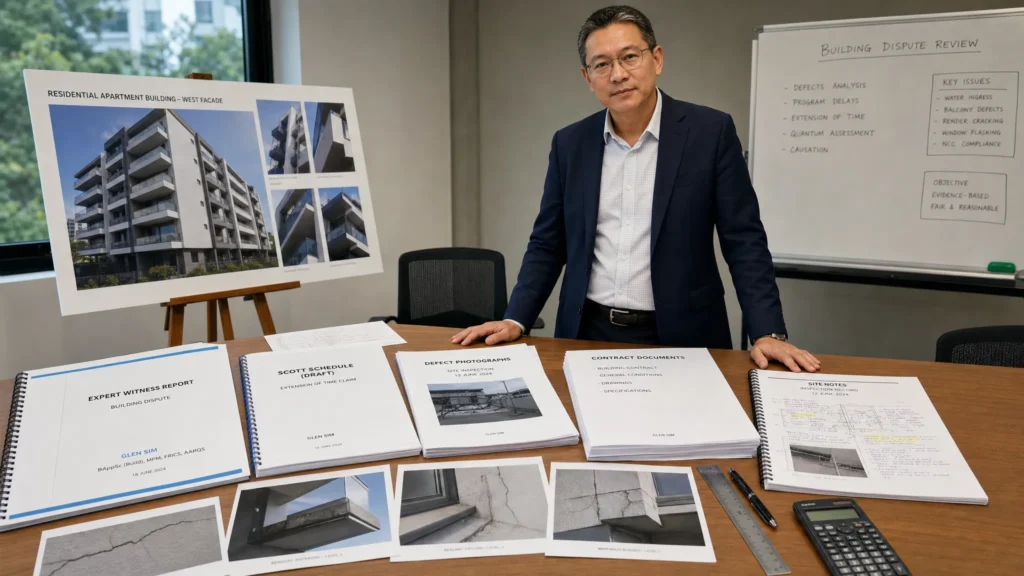
That may include reviewing photographs, contracts, drawings, invoices, inspection records, correspondence and site conditions. It may also include preparing expert witness reports, Scott Schedules, defect reports, rectification scopes or quantum meruit reports where the dispute involves the reasonable value of work performed.
Awesim has written separately about what a building consultant can do for your case, but the key point is this: the consultant’s job is not to win an argument at all costs. The job is to make the technical position understandable, defensible and useful.
Expert evidence must be impartial
If a dispute reaches NCAT or a court, independence becomes even more important. Expert evidence is expected to assist the decision-maker, not act as advocacy dressed up as opinion.
In NSW court proceedings, the Uniform Civil Procedure Rules 2005 Schedule 7 sets out an expert witness code of conduct. It requires expert witnesses to assist the court impartially and makes clear that an expert witness is not an advocate for a party. While every matter depends on its forum and directions, the same principle is central to credible building dispute work: the opinion should be independent, transparent and within the consultant’s expertise.
This matters because a report that simply repeats a client’s complaints may be easy to challenge. A report that identifies the documents reviewed, sets out assumptions, explains reasoning and acknowledges limitations is much harder to dismiss.
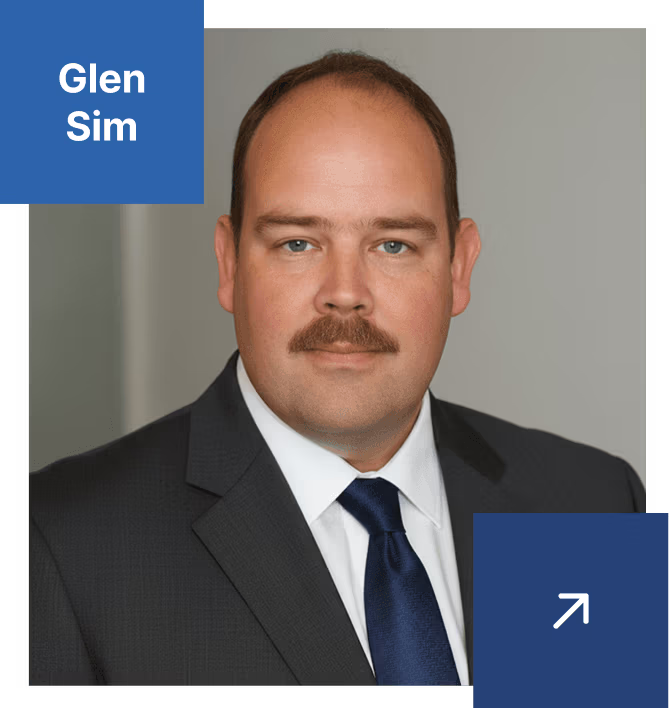
That is where experience matters. Glen Sim, owner and director of Awesim Building Consultants, leads the firm’s dispute-focused approach to expert reports, Scott Schedules and building defect assessments across NSW. His role is not just to inspect buildings, but to help turn complex building issues into evidence that can be properly considered.
How independence helps home owners
For home owners, a building dispute can feel personal. You may be living with water ingress, cracking, incomplete finishes, poor workmanship or a renovation that has become more expensive than expected. It is natural to want someone to confirm the problems and put pressure on the builder.
But the strongest support is not always the loudest opinion. It is the opinion that can withstand scrutiny.
An independent consultant can help home owners understand which issues are genuine defects, which items may be maintenance or design-related, and which complaints need further evidence. This can prevent a claim from being weakened by including too many marginal issues. It can also help focus the dispute on the items that matter most, such as safety, compliance, water penetration, structural concerns, major omissions or significant rectification costs.
If the matter is moving towards NCAT, expert evidence may need to be organised carefully. Awesim’s NCAT independent building inspections guide for NSW explains how inspection findings and dispute documents can be converted into a more structured form for tribunal use.
How independence helps builders
Builders also benefit from independent technical input. Not every complaint is valid. Some defects may be caused by design decisions, product limitations, owner-supplied materials, lack of maintenance, weather exposure, access restrictions or changes requested during the job.
A builder facing a dispute may need an independent consultant to identify what is truly defective, what is within tolerance, what has already been rectified, and what is outside the original scope. This can be especially important where a dispute has grown from a small list of complaints into a much larger claim.
An independent opinion can also help a builder make practical decisions. If there are valid defects, early confirmation can support a sensible rectification proposal. If allegations are overstated, a reasoned report can help narrow the dispute and reduce the risk of paying for work that is not properly attributable to the builder.
For builders, independence is not a threat. It is a way to replace speculation with evidence.
How independence helps lawyers and solicitors
Solicitors need evidence that is not only technically accurate, but also usable. A building report that is full of strong language but light on reasoning may create more work than it solves. A well-prepared consultant’s report can help a legal team identify the issues in dispute, advise on prospects, prepare evidence and negotiate from a stronger position.
In construction matters, lawyers often need answers to practical questions:
- What work is defective or incomplete?
- What standard or contractual obligation applies?
- What caused the defect?
- What rectification is reasonable?
- What work has been performed and what is its value?
- Which issues require another specialist, such as an engineer?
A consultant who understands dispute work can help a solicitor brief the right evidence at the right time. For matters involving formal expert evidence, Awesim’s article on how an expert witness helps in construction disputes gives further context on the role of expert reports in NSW proceedings.
The best results usually come when the consultant is briefed early enough to shape the evidence, not after positions have hardened and key records have been lost.
What a good independent assessment should include
A useful independent assessment is not just a list of defects. It should show the path from evidence to conclusion. That path is what makes the report persuasive.
A strong assessment will usually include a clear description of the property and works, the documents reviewed, the observed condition, the relevant standard or contractual requirement, the consultant’s opinion on defect or compliance, likely causation where appropriate, and a practical rectification recommendation.
For more complex disputes, a Scott Schedule may be used to set out each claimed item, the parties’ positions, the consultant’s opinion and the estimated rectification cost or value in a structured format. This can be particularly useful in NCAT or court matters where there are many individual defects, incomplete items or variation disputes.
Where the dispute is about payment for work without a fixed or enforceable price, a quantum meruit report may assist by assessing the reasonable value of the work performed. That type of report requires careful consideration of scope, evidence of work completed, quality issues, omissions and reasonable rates.
When should you engage an independent construction consultant?
The right time is usually earlier than people think. Many parties wait until a hearing date is approaching before obtaining technical advice. By then, important evidence may be missing, defects may have changed, rectification may have been carried out without documentation, and the dispute may have become more expensive.
Consider engaging a consultant when a defect list is growing, payment is being withheld, a builder has been asked to rectify work but the parties disagree on scope, a solicitor is preparing a letter of demand or response, an NCAT application is being considered, or expert evidence is likely to be required.
Early input does not mean every dispute needs a full expert report immediately. Sometimes an initial inspection or document review can help identify the real issues and decide whether formal reporting is justified. In other cases, especially where proceedings are already on foot, a properly structured expert report or Scott Schedule may be needed from the start.
What to provide before the inspection
The quality of the consultant’s opinion depends partly on the quality of the information provided. A site inspection is important, but documents often explain what should have been built, what changed and how the dispute developed.
Before briefing an independent consultant, gather the contract, plans, specifications, engineering documents, approvals, variation records, invoices, payment claims, photographs, emails, text messages, inspection reports and any defect lists exchanged between the parties.
It is also helpful to provide a short chronology. This does not need to be perfect. A clear timeline of key events, such as contract date, commencement, major variations, complaints, rectification attempts and payment disputes, can save time and reduce misunderstandings.
Choosing the right independent consultant
The right consultant for a dispute is not necessarily the person who gives the strongest first impression or the most dramatic opinion. Look for someone who understands building work, dispute processes and the importance of impartial reasoning.
A credible consultant should be willing to explain what they can and cannot comment on. They should distinguish between observed facts, client instructions, assumptions and expert opinion. They should also be comfortable identifying when another specialist may be required, such as a structural engineer, waterproofing specialist or quantity surveyor.
Be cautious if a consultant promises a guaranteed outcome, appears to adopt every allegation without checking it, refuses to consider documents that may weaken the client’s position, or uses language that sounds more like advocacy than expert analysis.
An independent construction consultant matters because the dispute process rewards evidence, not volume. The best report is not the one that says everything a client wants to hear. It is the one that helps the decision-maker understand what happened, why it matters and what should reasonably happen next.
Frequently Asked Questions
What is an independent construction consultant? An independent construction consultant is a building professional engaged to assess construction issues objectively. In dispute work, they may inspect defects, review documents, identify causation, assess incomplete work and prepare reports for negotiation, NCAT or court proceedings.
Why is independence important in a building dispute? Independence gives the opinion credibility. A consultant who is not acting as an advocate can separate valid defects from unsupported complaints, explain the technical basis for each conclusion and help the parties or decision-maker focus on evidence.
Can an independent consultant help before NCAT proceedings start? Yes. Early advice can help owners, builders and solicitors understand the strength of the issues, preserve evidence, narrow the dispute and decide whether a formal expert report, Scott Schedule or further specialist input is needed.
Does an independent consultant always support the person who pays for the report? No. A proper independent consultant should give an opinion based on the evidence and their expertise. That may support some parts of a client’s position and reject or qualify others.
What is the difference between a defect report and an expert witness report? A defect report may identify and describe building issues. An expert witness report is usually prepared for formal dispute proceedings and should be structured to meet expert evidence expectations, including impartial reasoning, assumptions, methodology and conclusions within the expert’s area of expertise.
Need independent building dispute support in NSW?
If you are facing a building dispute, the sooner the technical issues are clarified, the better. Awesim Building Consultants provides independent building dispute support across NSW, including expert witness reports, Scott Schedules, quantum meruit reports and defect assessments.
Led by Glen Sim, owner and director, Awesim helps home owners, builders and solicitors turn complex construction problems into clear, reasoned evidence. To discuss your matter, contact Awesim Building Consultants.