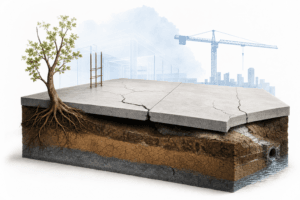

You’ve got cracks running across a wall, the builder says it’s cosmetic, and the owner’s corporation wants answers before the hearing starts. That’s the point where engineers expert witness NSW searches stop being abstract and become practical. A good engineer expert witness can turn visible damage, drawings, and site findings into evidence that a tribunal or court can use.
For NSW building disputes, the technical side matters just as much as the legal side. Engineers Australia reported 546,905 qualified engineers in Australia in 2021, with 433,353 in the labour force, which shows there’s a large professional pool to draw from for independent evidence in NSW matters (Engineers Australia overview). The hard part isn’t finding someone who calls themselves an expert, it’s finding one who can stay independent, explain the cause of the defect clearly, and write in a format NCAT or a court will accept.
Introduction to Engineering Expert Witnesses NSW
A homeowner opens an NCAT letter and sees a list of alleged defects, but the underlying issue is still foggy. Are the cracks from movement, poor workmanship, or something else entirely. Is the water ingress a membrane failure, a flashing defect, or a drainage problem. That’s where an engineering expert witness earns their place, because the role is to separate symptoms from cause.
In NSW building disputes, that difference matters. An engineer expert witness doesn’t just point at damage and say it looks bad. They trace the chain from observation to mechanism to conclusion, then explain the likely consequences in plain language a solicitor, tribunal member, or client can follow. When done properly, the report becomes a map through a messy dispute, not another layer of confusion.
Practical rule: if the report can’t show how the defect was found, tested, and reasoned through, it’s probably too weak for NCAT or court use.
Awesim Building Consultants brings 35+ years in Building & Construction and 15+ years providing litigation support to homeowners, builders, and lawyers, and its expert witness reporting and site investigation services are set up for NSW dispute work. For readers comparing service pages, an internal starting point is the Expert Witness Reports page, which sits alongside the practical dispute resources on the site.
The value of an engineering expert witness is not theatre, it’s structure. A tribunal member doesn’t need advocacy dressed up as certainty. They need a qualified person who can inspect, explain, and stay within the limits of specialised knowledge.
NCAT and Legal Requirements for Expert Evidence
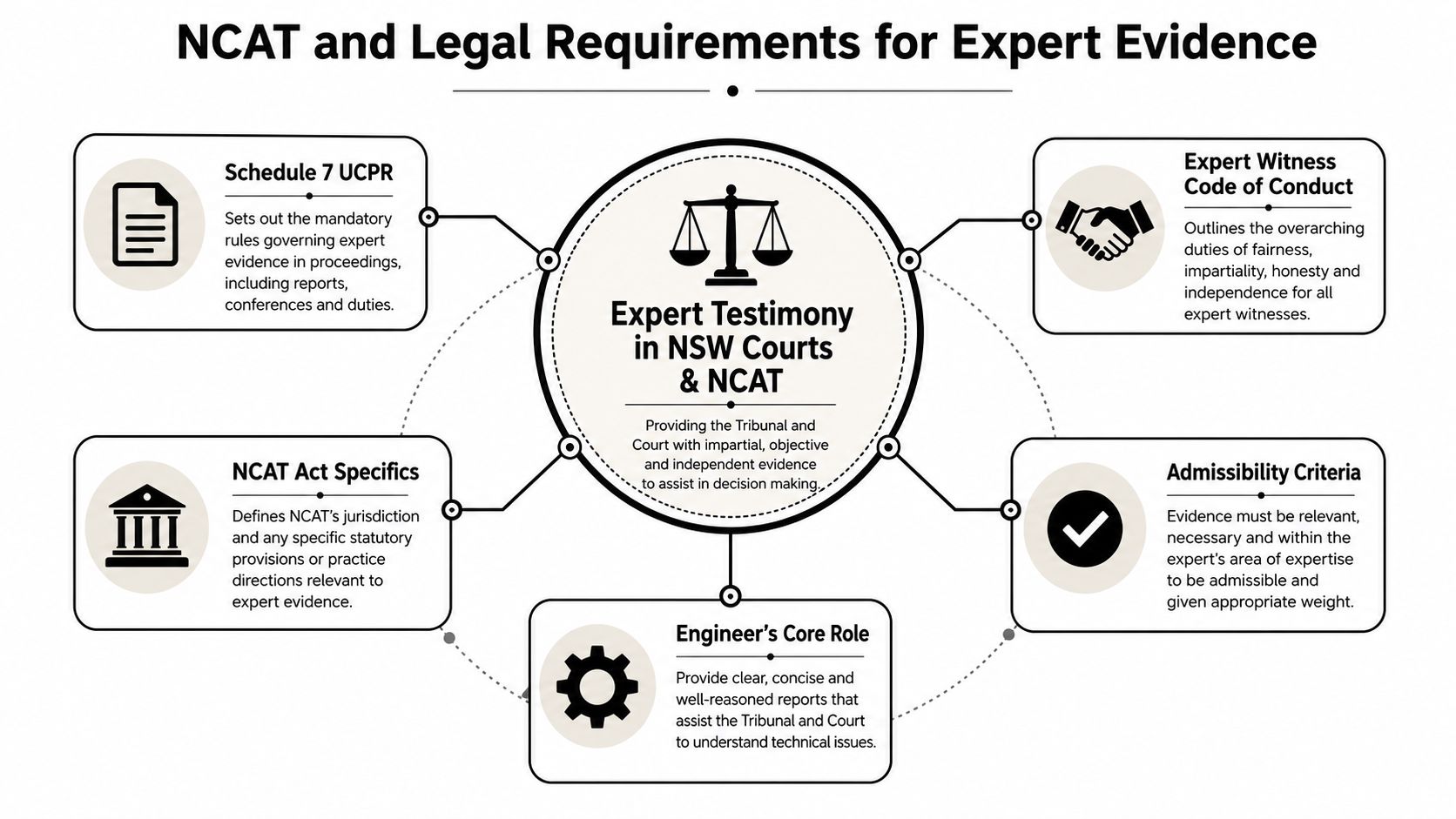
A defect report can look convincing on the page and still fail in NCAT if it does not meet the legal rules for expert evidence. In NSW, the starting point is simple, the tribunal wants help, not advocacy. The NSW Law Reform Commission stated that experts must assist the court, that no more than one expert in any specialty is required, and that expert evidence should be used only where it helps the tribunal or court (NSW Law Reform Commission Report 109). For engineers and solicitors, that means the report has to do a specific job, it must explain a technical issue clearly enough that the decision-maker can rely on it.
What independence means in practice
For NCAT and court use, the engineer’s duty is to the tribunal and the court, not to the person who gave the instructions. That point often surprises clients, because a report can be carefully prepared and still carry little weight if it sounds like it was written to win a side of the dispute.
The NSW Legal Education material on expert evidence says a report should state the expert’s qualifications, the facts and assumptions relied on, the reasons for each opinion, any limits on expertise, the literature used, and any examinations, tests, or investigations relied on. If the report is long or complex, it should begin with a short summary. The NSW expert witness code and duties guide sets that out in one place.
Why admissibility turns on more than credentials
A title alone does not make evidence admissible. The NSW Supreme Court explains that the witness must have specialised knowledge based on training, study, or experience, and the opinion must be wholly or substantially based on that knowledge and on proved or assumed facts that are identified in the evidence (NSW Supreme Court speech on expert evidence). In practical terms, the report has to show its work, the way an engineer’s calculations should show the steps from load to result.
That is why NCAT and the courts focus so heavily on the reasoning chain. The key question is not only, “What is the opinion?” It is, “How was that opinion formed, and can the tribunal follow each step?” In structural or civil matters, the opinion needs to sit inside a disciplined framework, with assumptions, inspection notes, and methods clearly recorded.
The NCAT procedural directions for expert evidence are worth reviewing early because they shape how evidence should be prepared before the hearing starts. In practice, that is the difference between handing over a loose bundle of observations and presenting a report that fits the tribunal process.
Essential Qualifications and Evidence Standards
An engineer acting as an expert witness needs more than a title on a business card. The report has to be anchored in specialised knowledge, and the evidence needs to show how that knowledge was applied to the site, the defect, and the governing standard. The NSW Land and Environment Court’s expert evidence paper makes the point directly, opinions in construction disputes must be supported by site observations, testing, drawings, and standards-based analysis (NSW expert evidence paper).
A defensible qualification checklist
A solicitor or client should look for four things before giving instructions:
- Relevant training: The engineer’s formal study should match the type of defect, such as structural movement, waterproofing, drainage, or façade issues.
- Relevant project experience: The expert should have dealt with the kind of building problem in dispute, not just a related discipline.
- Verifiable evidence habits: Site photos, inspection notes, drawings, and measured observations should be part of the working file.
- Insurance and professional standing: The expert should be able to show that their practice is professionally set up for dispute work.
A report that skips any of those pieces becomes harder to defend. In engineering disputes, the tribunal is rarely impressed by a broad statement like “it’s obvious the work was poor.” It wants the mechanism, the evidence, and the standards link.
How the reasoning should read
A good report walks from fact to conclusion in small steps. An example might be a flashing defect causing water to enter a cavity, then substrate deterioration, then the need for rectification. That’s much stronger than a report that only lists damp walls and calls them non-compliant.
The more clearly the report connects the observed defect to a measurable cause, the less room there is for challenge later.
For NSW construction matters, technical framing often separates a general comment from a defensible opinion. If the engineer can point to drawings, standards, and observations in the same paragraph, the report feels like evidence. If it only offers conclusions, it feels like advocacy.
Step-by-Step Engagement Process
A dispute usually becomes clearer once the engineer knows the exact question. The first call or email should set that question out plainly, because a report built on a vague brief can wander like a truck with no address on the docket. A short, precise instruction helps the expert focus on the engineering issue the tribunal or court needs answered.
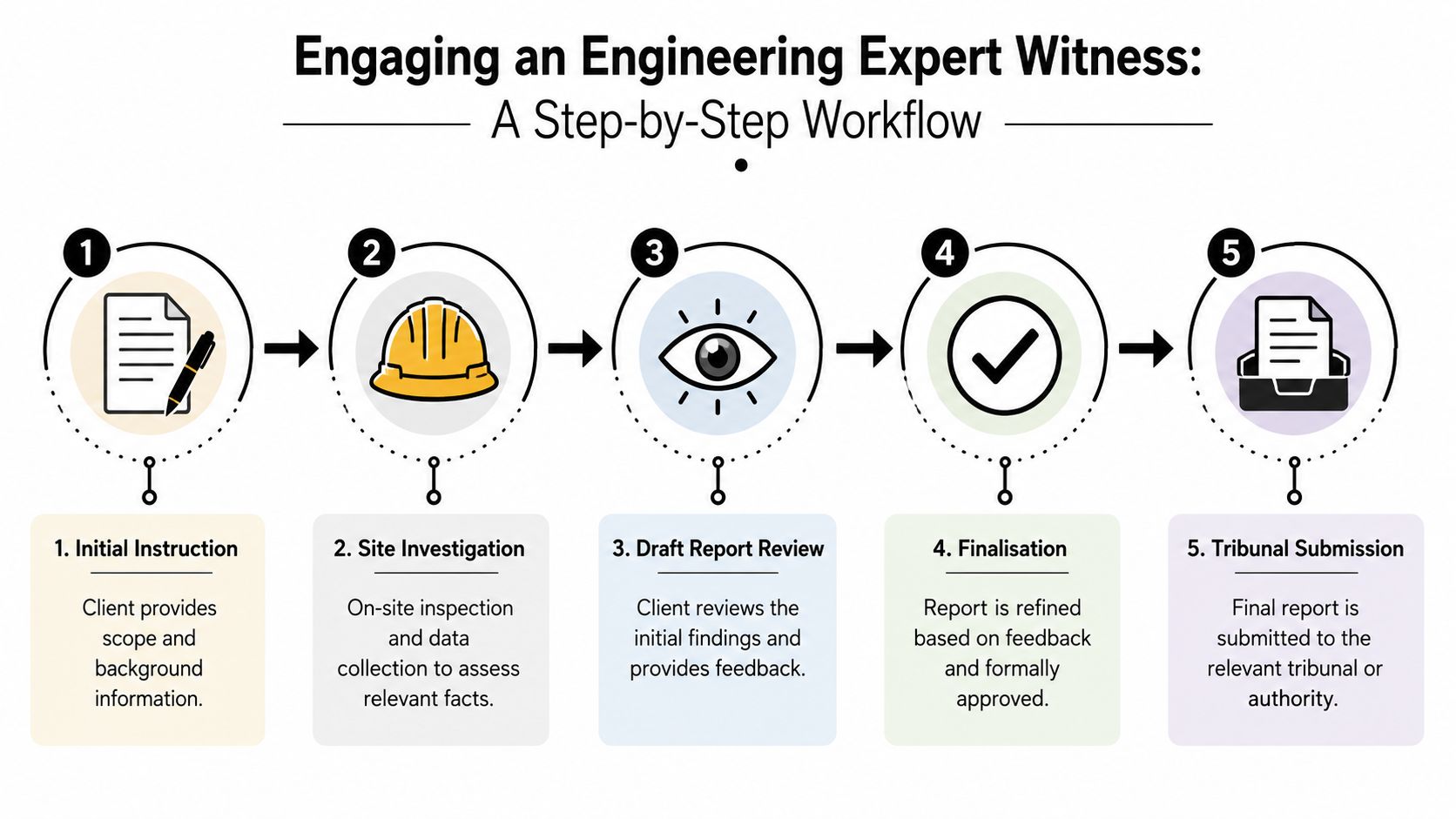
The five practical steps
- Initial instruction. The solicitor or client sends the dispute summary, the questions in issue, and the property details. The expert should be told what the tribunal needs answered, not just that “there are defects”.
- Site investigation. The engineer inspects the building, photographs defects, reviews drawings, and records observations that can later be tied back to the opinion. This stage is like gathering the pieces of a puzzle before deciding what the picture shows.
- Draft report review. The first draft is checked for scope gaps, factual errors, and unclear assumptions. Clear instructions matter here, because they help the expert stay inside the question and avoid drifting into unrelated commentary.
- Finalisation. The report is refined, summaries are tightened, and references to standards or code requirements are checked. Small wording changes often make the difference between a report that reads as a conclusion and one that reads as evidence.
- Tribunal submission. The final report is packaged for the relevant proceeding, often with supporting schedules or appendices. The goal is to hand up a document that is easy to follow, easy to test, and tied to the facts on site.
Regional access can affect how quickly that sequence happens. Travel outside metropolitan Sydney may add time to the inspection stage, so solicitors should build a little flexibility into deadlines rather than treat the site visit as an afterthought. A delay in access is a scheduling issue, not a weakness in the opinion, but it still needs to be managed early.
Service coordination also matters once the engineer is engaged. The process works better when the inspection, document review, and report drafting are planned together, because each step depends on the one before it. For matters spread across Sydney and regional NSW, the site investigation and report support page is a useful reference for how early inspection planning supports the whole evidence chain.
Typical Report Structure with Scott Schedules
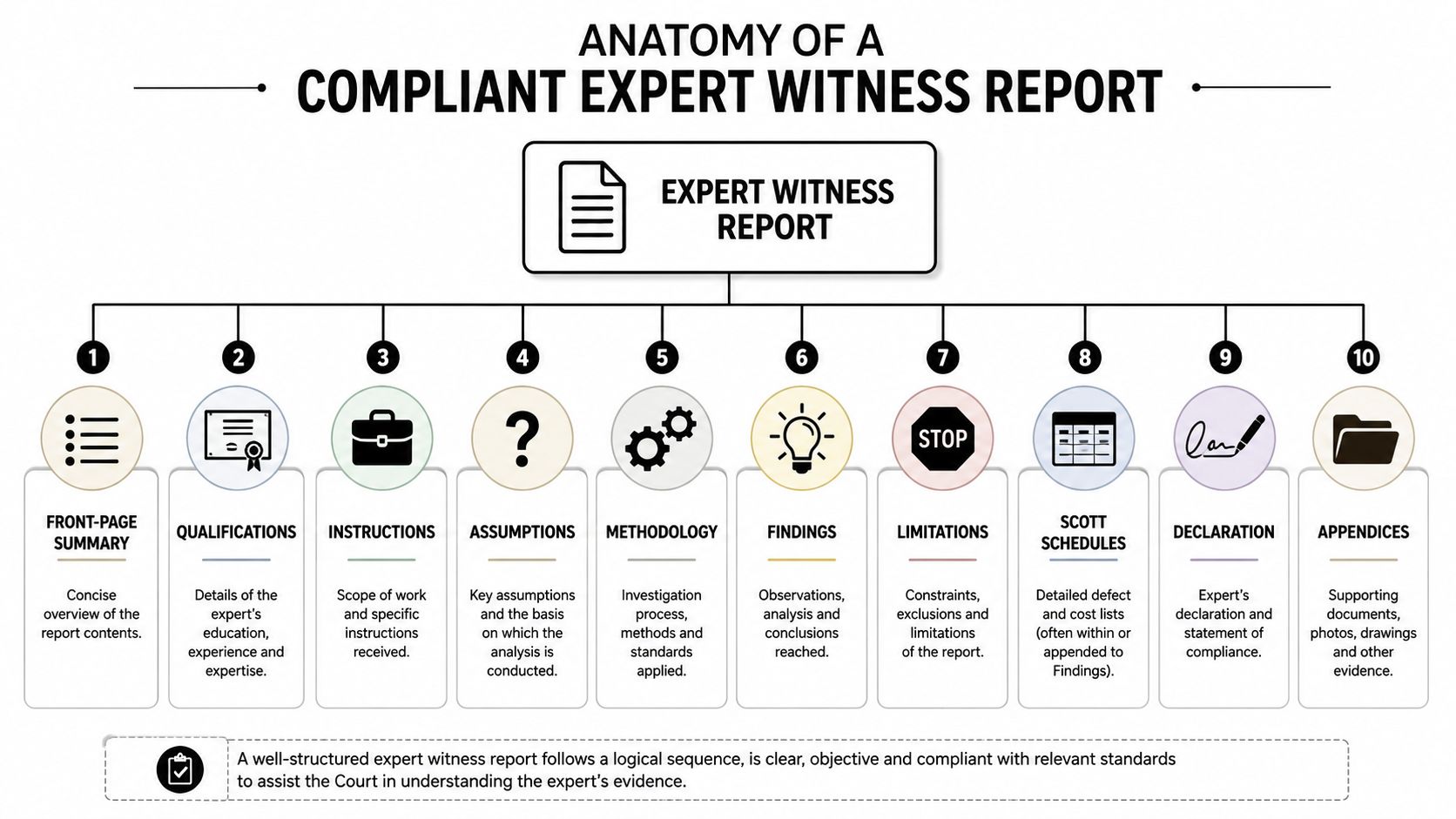
A tribunal-ready report works like a well-packed toolbox. Each part has one job, and nothing should be added just to make the document look fuller. For engineering expert evidence, the report should set out qualifications, assumptions, reasons, literature used, and any tests or investigations relied on. If the report is long or technically dense, it should start with a short summary. That structure is set out in the NSW expert witness code and duties guide, and it gives the tribunal a clear path through the evidence.
The core report components
A compliant report usually includes:
- Front-page summary: A short overview of the issue, the site, and the main opinions.
- Qualifications: The engineer’s relevant expertise and basis for acting as an expert.
- Instructions: The exact questions the report was asked to answer.
- Assumptions: Any facts accepted for the purpose of the opinion.
- Methodology: The inspection, testing, review of documents, and analysis process.
- Findings: The observed defects and what they mean technically.
- Limitations: Anything not inspected, tested, or verified.
- Declaration: The statement acknowledging the expert’s duty.
- Appendices: Photos, drawings, calculations, and supporting material.
The order matters because it lets the tribunal follow the logic in the same way a builder follows a set of plans. First comes the frame, then the detail. Lawyers also benefit from that layout, because it shows where further evidence may still be needed before a hearing.
Where the Scott Schedule fits
A Scott Schedule turns a long list of defects into a side-by-side comparison table. Each row usually identifies the item, the parties’ positions, the expert’s view, and the remedial scope or cost context. For NCAT matters, that format keeps attention on one defect at a time instead of letting the issues blend into a single blur.
The Scott Schedule guide for NSW tribunal matters shows how the schedule and the report support each other. The report explains the reasoning in words, while the schedule gives the tribunal a cleaner way to compare competing positions. Used together, they work like a map and a legend, one explains the route, the other shows how to read it.
Rule of thumb: if a defect cannot be pointed to in one row, one photo, and one clear opinion, it is usually not ready for a hearing bundle.
A lot of service pages miss the practical side of admissibility. The report still needs to line up with the report structure requirements, including qualifications, independence, assumptions, methodology, and literature references, as noted in the practical admissibility gap noted by Endeavour Engineering. A disciplined format matters because good engineering can still be weakened by poor presentation.
Timelines Fees and Regional Access Considerations
A dispute timetable can slip when the inspection date moves. Regional logistics matter just as much as the technical brief. Awesim notes that travel constraints outside metropolitan Sydney can add 2–5 business days to inspection schedules, which matters in urgent defect disputes. The Awesim expert witness report information page sets out that point clearly, and it fits this stage of the process because timing and access often decide whether an engineer can inspect, report, and respond in time.
Typical Fees and Turnaround for Expert Witness Services
| Service | Sydney Fee | Regional NSW Fee | Turnaround |
|---|---|---|---|
| Site investigation | By quote | By quote with travel allowance | Depends on access and scope |
| Expert witness report | By quote | By quote with travel allowance | Depends on defect complexity |
| Scott Schedule | By quote | By quote with travel allowance | Depends on report readiness |
The cost guidance page is useful when clients need to budget for inspections and reporting together. A scope-based quote early in the process helps avoid the common trap of treating the report as a single line item. An inexpensive report that cannot be used ends up costing more than a properly prepared one.
Why regional access changes strategy
A matter centred in Sydney often moves faster because the site is easier to reach. In regional NSW, the expert may need more lead time for travel, access coordination, and follow-up inspections. The report itself does not become less reliable, but the schedule usually needs more room, like a site plan that has to allow for longer paths between rooms.
For solicitors, the safer approach is to lock in inspection windows before setting hearing expectations. For owners corporations or builders, it also helps to check whether the expert can inspect, photograph, and finalise the report without needing multiple return trips. That question matters most when the evidence is time-sensitive, because each extra visit can stretch the timetable and make file management harder.
Choosing a Credible Expert and Avoiding Pitfalls
A persuasive report starts with the right witness. The first check should be simple, can the engineer prove their qualifications, show relevant project experience, and explain how they’ll stay independent. If the answer is vague, the risk rises quickly.
A common mistake is choosing someone who knows buildings but doesn’t know dispute work. The NSW system expects a report that is issue-specific, procedurally compliant, and tied to the legal questions in issue. A technically skilled person who writes a sprawling, unfocused opinion can still be the wrong expert for the job.
Red flags that weaken evidence weight
- Unclear expertise: The witness can’t point to relevant dispute experience or the right technical discipline.
- Overlong analysis: The report wanders into unnecessary commentary and loses the tribunal’s attention.
- Hidden conflict risk: The relationship to a party isn’t properly disclosed.
- Weak causation chain: The report lists defects but doesn’t explain why they happened.
- Loose standards references: It mentions “non-compliance” without tying the issue to a standard or code.
A report also needs to stay within its lane. An engineer should not make guesses outside their knowledge just because the case is pressing. The moment an opinion stretches beyond the evidence, cross-examination gets easier for the other side.
Awesim Building Consultants is one option in this space, particularly where site investigations, building and construction expert witness reports, and Scott Schedules are needed for NSW disputes. The relevant point for readers is not branding, it’s the method. A credible expert should inspect properly, write neutrally, and show the reasoning clearly enough that the tribunal can follow it without guesswork.
Sample Q&A for Solicitors and Clients
Can a report be used in NCAT if it only describes the defects?
Not safely. The report needs specialised knowledge, a factual basis, and reasons that connect the observations to the opinion. If it only lists damage, it usually leaves out the part the tribunal needs most.
What if the inspection is needed urgently?
Raise the deadline at instruction stage and confirm access immediately. Regional travel can add time, so the inspection window should be set before the hearing plan hardens.
Can an expert work on a regional NSW property from Sydney?
Yes, but travel and access need to be built into the schedule. The issue is not geography alone, it’s whether the inspection can happen early enough to preserve evidence quality.
Should fee discussions happen before the draft report?
Yes. Ask for scope-based pricing up front, including site work, reporting, and any Scott Schedule tasks. That way, the budget matches the work instead of becoming a surprise later.
For specific guidance, email admin@awesim.com.au or call 1800 293 746. A short conversation can save weeks of delay if the brief, access, or defect scope is still unclear.
A CTA for Awesim Building Consultants. If you need an engineering expert witness report, a site inspection, or a Scott Schedule for a NSW building dispute, email admin@awesim.com.au or call 1800 293 746 to discuss the next step.