
Brick Veneer Wall Construction Defects: What a Building Consultant Checks on Site
- What Makes Brick Veneer Different From Full Brick
- Key Areas a Building Consultant Inspects
- What the Inspection Report Documents
- When Construction Defects Become a Legal Matter
- Frequently Asked Questions
- Start With What the Wall Is Actually Telling You
Brick veneer is one of the most common wall systems in Australian residential construction. It looks solid, weathers well when built correctly, and suits the NSW climate. But when it goes wrong, the problems are rarely obvious from the street. Water gets in behind the brickwork, ties corrode, weep holes get blocked, and by the time you notice a stain on an internal wall, the damage has often been building for months or years.
If you’re dealing with a dispute over brick veneer construction defects, understanding what a building consultant actually looks for on site helps you ask better questions, document the right things, and approach any formal proceedings with a clearer picture of your claim.
What Makes Brick Veneer Different From Full Brick
Brick veneer is not a structural brick wall. The bricks form an outer skin attached to a timber or steel frame using wall ties. The frame carries the load; the brickwork provides weather protection and aesthetics. Between the two sits a cavity, and that cavity is where most of the critical construction details live.
When those details are missing or poorly executed, the wall system fails. Water enters the cavity, has nowhere to drain, and saturates the frame and internal lining. The consequences range from mould and rot to structural movement and lasting damage to the building envelope.
Key Areas a Building Consultant Inspects
Weep Holes and Cavity Drainage
Weep holes are small openings left in the mortar joints at the base of the brick skin. Their job is to let any water that enters the cavity drain out rather than pond against the frame, while also allowing the cavity to breathe and reduce moisture buildup.
On site, a consultant checks whether weep holes are present, correctly spaced — typically every third perpend joint at the base course — and clear of mortar droppings. Blocked weep holes are among the most common construction defects in brick veneer walls, and they’re often the direct cause of water ingress complaints.
The cavity itself also gets checked for mortar droppings that have fallen during construction and bridged the gap between the brick skin and the frame. A bridged cavity channels water straight to the frame instead of letting it drain away.
Flashings and Damp-Proof Courses
Flashings are the horizontal membranes installed at the base of the cavity, above openings like windows and doors, and at any point where water might collect. They direct water toward the weep holes and out of the wall.
A consultant checks whether flashings are present at all required locations, correctly lapped and sealed, and extended far enough to direct water to the exterior rather than back into the frame. Missing or incorrectly installed flashings are a significant source of construction defects in brick veneer buildings and frequently the subject of NCAT and court proceedings.
Damp-proof courses at the base of the wall are also inspected for continuity and correct installation height above finished ground level.
Wall Ties
Wall ties connect the brick skin to the frame, transferring lateral loads and keeping the veneer stable. In NSW, they must comply with the relevant Australian Standards for spacing, embedment depth, and corrosion resistance.
On site, a consultant assesses whether the correct tie type has been used for the exposure zone, whether spacing meets the standard, and whether ties show signs of corrosion or failure. Corroded ties are a serious structural defect. They’re not always visible from the surface, and a thorough inspection may require selective removal of brickwork to expose the tie condition.
Mortar Joint Quality and Perpend Alignment
Poorly filled mortar joints, joints raked too deeply, or open perpends all allow water to penetrate the face of the brickwork. A consultant checks joint consistency, fill quality, and whether any cracking has opened pathways for water.
Cracking in mortar joints can also indicate movement in the frame or inadequate provision for differential movement between the brick skin and the structure. Control joints are required at intervals to accommodate thermal and moisture movement — their absence or incorrect placement is a common defect.
Lintels Over Openings
Every opening in a brick veneer wall requires a lintel to carry the brickwork above it. Lintels must be correctly sized for the span, properly bedded, and protected against corrosion. A consultant checks lintel sizing against the span and load, looks for signs of deflection or cracking in the brickwork above openings, and confirms whether the lintel has a drip groove or flashing to prevent water tracking back into the wall.
Window and Door Junctions
The junction between the brick skin and window or door frames is a high-risk area for water ingress. Sealant joints at these locations age, crack, and fail. Flashings above openings must direct water away from the frame.
A consultant inspects sealant condition, checks for correct flashing installation above openings, and looks for water staining or internal lining damage that suggests the junction has been leaking.
What the Inspection Report Documents
When a building consultant inspects a brick veneer wall for a dispute, the findings aren’t just a list of observations. Each defect is documented with reference to the applicable standard, the nature of the departure from that standard, and the likely consequence.
For NCAT or court proceedings, the report must comply with the UCPR Schedule 7 Expert Witness Code of Conduct. That means the consultant is expressing an independent opinion based on their expertise — not advocating for the party who engaged them. The report identifies what was found, what should have been done, and what remediation is required.
A Scott Schedule is often prepared alongside or following the expert report. It itemises each defect, the applicable standard, the builder’s position, and the estimated cost to rectify. This format is specifically designed for tribunal and court use, giving the decision-maker a structured way to understand the scope and cost of the claim.
When Construction Defects Become a Legal Matter
Not every brick veneer defect ends up in NCAT or court. Many are resolved through direct negotiation or a formal complaint under the Home Building Act. But when a builder disputes liability, refuses to rectify, or the work warrants a formal claim, independent expert evidence becomes essential.
A building consultant with experience in NSW proceedings understands what a tribunal or court needs to see. The report needs to be technically credible, clearly structured, and compliant with the rules of evidence. One that falls short on any of those fronts can be rejected or given little weight — regardless of how serious the defects actually are.
Awesim Building Consultants has been preparing expert witness reports for NSW courts and tribunals since 1996, covering NCAT, District Court, and Supreme Court proceedings. If you’ve identified construction defects in a brick veneer wall and are considering formal action, a free initial consultation is available by calling 1800 293 746.
Frequently Asked Questions
What are the most common construction defects in brick veneer walls?
The most frequently identified defects are blocked or missing weep holes, incorrectly installed or absent flashings, mortar droppings bridging the cavity, corroded or incorrectly spaced wall ties, and failed sealant at window and door junctions. Each of these can allow water to enter the wall system and damage the frame and internal linings.
How does a building consultant access areas like wall ties or cavity conditions?
Some aspects of a brick veneer wall can be assessed visually from the exterior and interior. Where deeper investigation is needed — confirming wall tie condition or cavity cleanliness, for example — selective removal of brickwork may be required. A consultant will document what was opened, what was found, and what was reinstated.
Can a building consultant’s report be used in NCAT proceedings?
Yes, provided the report complies with the UCPR Schedule 7 Expert Witness Code of Conduct. Reports that don’t meet this standard may not be accepted as expert evidence. When engaging a consultant, confirm that their reports are prepared to satisfy this requirement.
What is a Scott Schedule and do I need one for a brick veneer defects claim?
A Scott Schedule itemises each defect, the applicable standard, the builder’s response, and the estimated cost of rectification. It’s commonly required or strongly recommended in NCAT building defect proceedings because it gives the tribunal a structured way to assess the claim. A building consultant can prepare both the expert report and the Scott Schedule.
How long does a brick veneer wall inspection take?
It depends on the size of the property and the scope of the defects. A standard residential inspection typically takes two to four hours on site, followed by report preparation. If selective opening of the wall is required, additional time and trades coordination may be needed.
What happens if the builder disputes the consultant’s findings?
In NCAT and court proceedings, both parties can engage their own expert, and the tribunal or court weighs the evidence from each. This is why the quality, independence, and compliance of the report matters. A consultant with documented court and tribunal experience is better placed to withstand cross-examination or challenge.
Do I need a solicitor before engaging a building consultant?
Not necessarily. Many homeowners engage a building consultant directly after identifying defects, before involving a solicitor. The consultant’s report can then inform whether legal action is warranted and what the claim is worth. Some solicitors recommend engaging a consultant early to assess the strength of the case before committing to formal proceedings.
Start With What the Wall Is Actually Telling You
Brick veneer defects rarely announce themselves dramatically. A damp patch. A stain on a plasterboard wall. A crack above a window that keeps reappearing after you patch it. These are signals worth taking seriously.
A thorough on-site inspection by an experienced building consultant turns those signals into documented evidence — and that documentation is what gives you a credible position, whether you’re negotiating directly with a builder or preparing for a formal hearing.
Awesim Building Consultants offers a free initial consultation to discuss your situation and what an inspection and report would involve. Call 1800 293 746 to get started.

Related Posts

Scott Schedule Template: What Columns a NSW Claim Needs
What Is a Scott Schedule? Why the Column Structure Matters The Core Columns in a NSW Scott Schedule Template Column
Read More »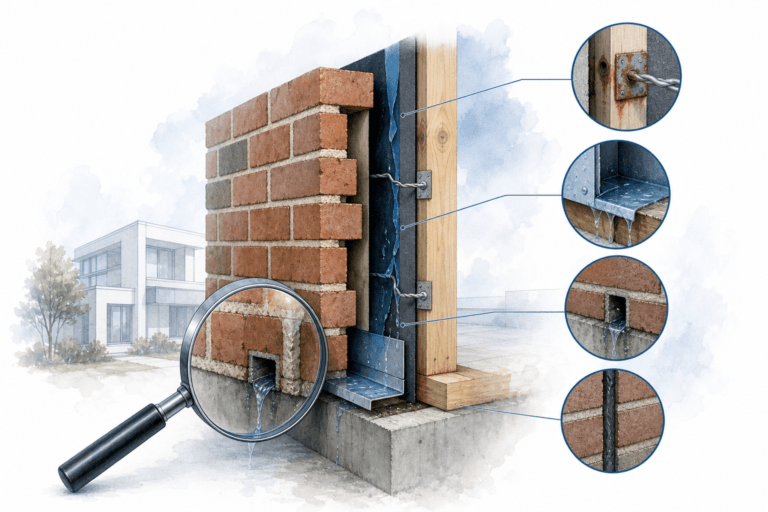
Brick Veneer Construction Defects: A Site Inspector’s View
What Brick Veneer Construction Actually Is The Most Common Brick Veneer Construction Defects Cracking in the Brickwork Missing or Blocked
Read More »
Liquidated Damages in Construction: How NSW Contracts Work
What Are Liquidated Damages in Construction? Why Contracts Use Them How Liquidated Damages Work in NSW Building Contracts Standard Contracts
Read More »