
Quantum Meruit Claim Definition: 2026 Guide for NSW Builders
A quantum meruit claim is a demand for the reasonable market value of work or materials supplied when no enforceable contract price exists or a variation falls outside the agreed scope. In NSW building disputes, that usually means a builder is chasing payment for work already done, not a bonus, and not hoped-for profit.
A homeowner rings after the job’s finished, the paperwork’s thin, and the invoice is now “under review”. The work is there, the benefit is there, but the signed variation isn’t, and that’s where quantum meruit becomes the practical fight.
When a Builder Has No Contract but Deserves Payment
A job starts with a few texts, a site meeting, and an owner pointing to where the work should go. The builder proceeds, materials arrive, labour is booked, and the work is finished, but the formal contract either never gets signed or never clearly covers the extra scope. Then the owner says the amount claimed is too high, or that nothing beyond the original price is payable.
That is the sort of dispute where quantum meruit matters. In Australian construction disputes, it is generally used where a builder or contractor seeks the reasonable value of work or materials when there is no enforceable price term, no valid contract for the work, or a variation falls outside the agreed scope, as set out in the construction law overview on quantum meruit (construction law reference).
What the claim really is
This is not a shortcut around bad paperwork. It is a recognised remedy tied to unjust enrichment, which means the recipient has accepted a measurable benefit in circumstances where payment would reasonably be expected. The legal idea is simple enough. If work was done, materials were supplied, and the other side kept the benefit, a tribunal or court can ask what that benefit was worth.
The argument is about value, not wishful pricing.
That distinction matters in the world. A builder who expects to recover a margin that was never agreed usually has a harder path than a builder who can show the fair market value of labour, materials, and extras delivered. The claim lives or dies on proof of what was done and what it was worth.
The practical lesson is blunt. If the contract doesn’t clearly cover the work, the fight moves away from the quoted price and towards whether the owner received a benefit that should be paid for. In NSW disputes, that shift often decides whether the matter is worth pressing in NCAT or whether the evidence needs tightening first.
The Four Legal Elements You Must Prove
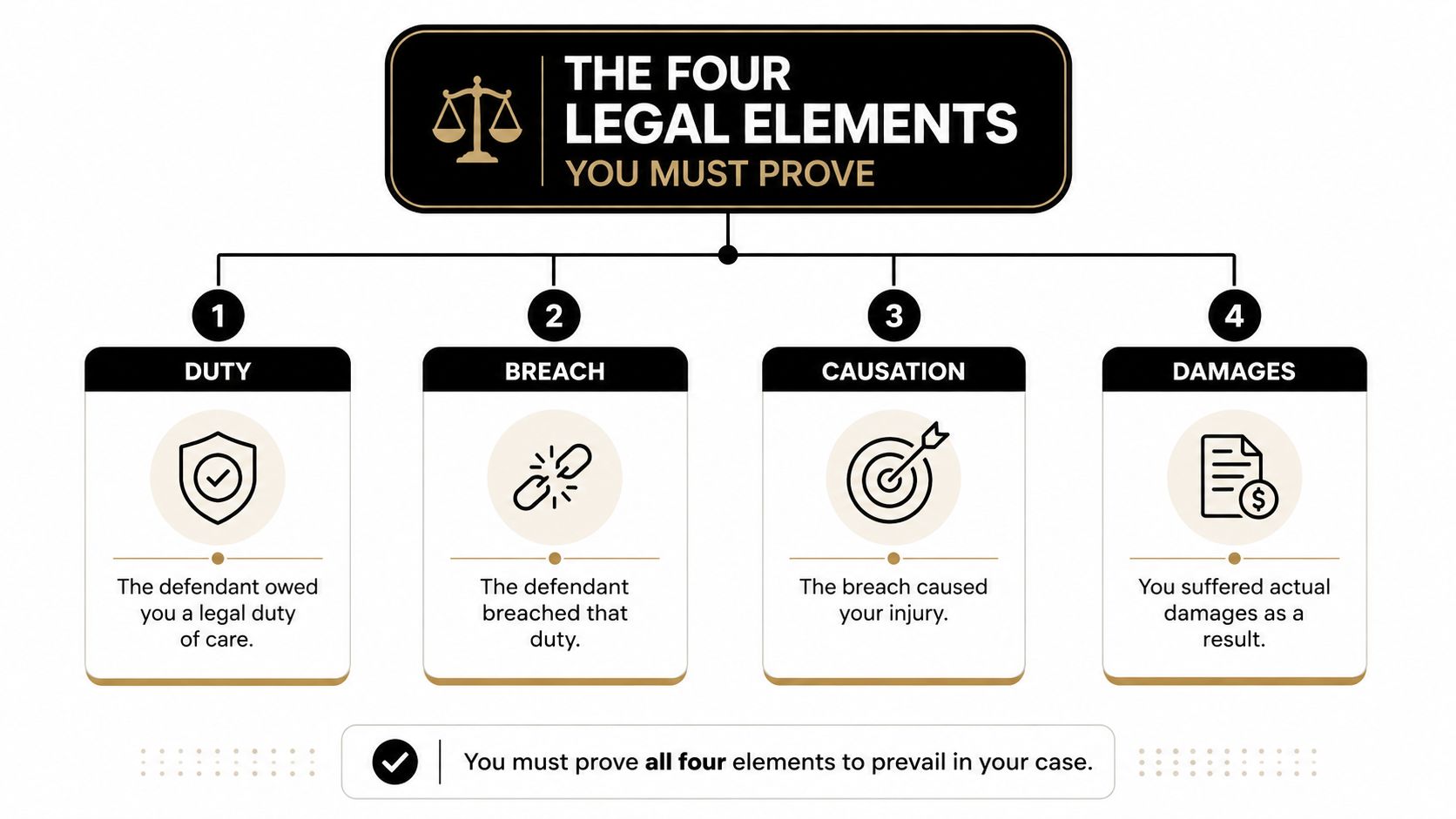
A quantum meruit claim is not just “we did the work, pay us”. The claimant has to prove a chain of facts that connects the work to the benefit and then to the fairness of payment. Legal guidance commonly frames the core elements as a request for services, performance of those services, receipt of a benefit by the defendant, and circumstances making it unjust for the defendant to keep that benefit without paying reasonable remuneration (elements reference).
Request, performance, benefit, injustice
A request for services might be the owner asking for a retaining wall, extra drainage, or an upgraded finish after the original scope was already underway. Performance means the wall was built, the drainage went in, or the extra finish was completed. Receipt of benefit is the owner now having that wall, drainage, or finish on the property.
The final element is the one that often gets underplayed. A tribunal still has to see why it would be unjust for the owner to keep the benefit without paying reasonable remuneration. That is where the claimant’s paperwork, witness evidence, and expert valuation all start pulling in the same direction.
The proof burden sits with the claimant
That burden is why careless job records sink so many otherwise sensible claims. If the builder cannot show who asked for the work, what was done, and how the amount claimed relates to objective value, the case becomes a story without a clean evidentiary trail. The tribunal is not there to rescue a weak file.
A useful way to test viability is to ask four questions:
- Was the work asked for? A clear instruction is much better than a vague nod on site.
- Was the work completed? Photos, diaries, and progress notes matter here.
- Did the owner receive a real benefit? The work has to improve or complete something the owner keeps.
- Can the value be defended? The number has to connect to market reality, not just the builder’s expectation.
That is the practical difference between a claim that sounds fair and a claim that can survive scrutiny.
Quantum Meruit Versus Contract Variation Claims
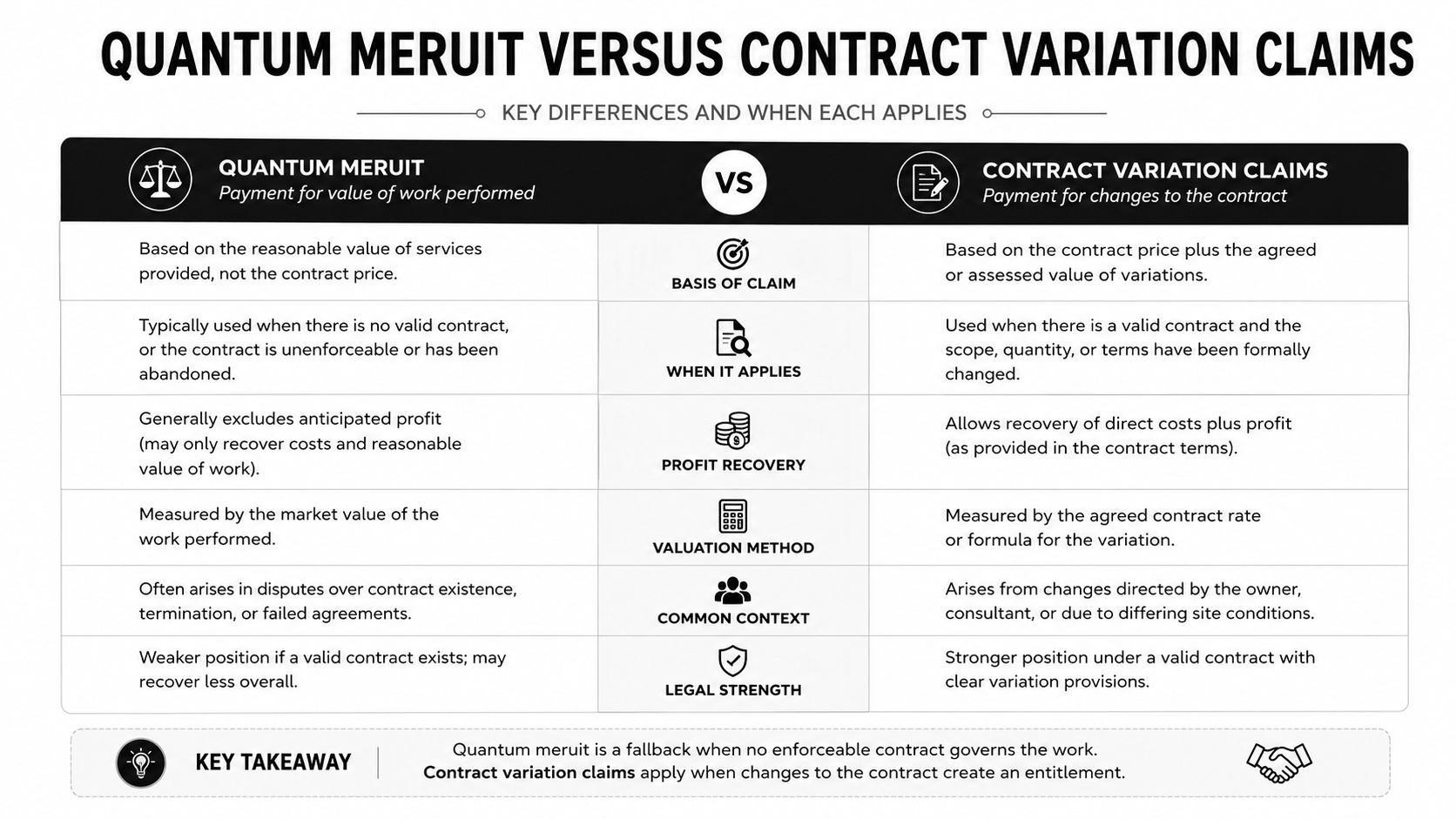
Builders and homeowners often use these ideas as if they’re interchangeable, but they aren’t. A contract variation claim starts with an existing enforceable contract and asks for payment under that contract’s variation mechanism or agreed pricing structure. Quantum meruit starts somewhere else. It is a restitutionary remedy for the reasonable value of services where no enforceable contract governs the work, or where the contract has broken down.
Australian construction disputes often turn on whether there is a valid contract, whether variations were approved, and whether the claim is really about enrichment rather than contract price, which is exactly the nuance many definition pages leave out (commercial law commentary).
Different starting points, different measures
A contract variation claim is anchored to the contract. The question is whether the extra work was approved and how the contract says it should be priced. Quantum meruit asks a different question, which is what the recipient got and what that benefit was worth.
That difference can change the outcome in NCAT. A builder may think the invoice should be paid in full because the work is obvious, but the tribunal may still assess a fair amount based on the evidence it accepts. On the other hand, a homeowner may think “no signed variation, no payment”, only to find that the work still attracts a reasonable payment if the benefit is proved.
If the variation paper trail is weak, don’t assume the claim is dead. The real issue is often whether the evidence can support a restitutionary claim instead of a contract price claim.
For builders, the strategy question is decisive. If there is a valid contract and a clear variation mechanism, the claim should usually be framed with that contract in mind. If the paperwork is missing, disputed, or incomplete, the focus shifts to value, benefit, and proof of the work supplied. That’s why getting the category right before filing can save months of friction.
For a practical example of how variation disputes tend to unravel, this internal guide is worth a look, which variations in construction commonly end in claims.
Building the Evidence NCAT Expects to See
NCAT does not reward big numbers with no backbone. The tribunal wants a file that shows how the claim was built, line by line, from site reality to dollar value. For NSW matters, the evidentiary target is not just proving work was done, but proving the market value of that work with objective support such as contemporaneous invoices, variation records, site diaries, supplier quotes, and comparable trade rates (evidence reference).
What the file should contain
A solid claim starts with the documents created at the time, not a reconstruction months later. Site diaries show sequencing. Progress photos show what was installed and when. Supplier invoices and delivery dockets help prove material quantities. Subcontractor timesheets and labour dockets help show who was on site and for how long.
A retrospective estimate on its own usually carries less weight than records created during the job. If you’re claiming additional drainage, for example, the tribunal will want to see the excavation records, materials purchased, labour hours, and why the work went beyond the original scope. The more direct the link between the work and the value, the stronger the claim.
Why trade breakdowns matter
A detailed trade breakdown becomes useful. Awesim Building Consultants has over 35+ years of estimating the costs of building and construction, and the useful part of that experience is not theory, it’s structure. A credible report usually separates labour, materials, hire equipment, deliveries, onsite costs, and offsite costs so the tribunal can see what drove the claimed figure.
A report that just repeats the invoice total leaves too much open to challenge. A trade-by-trade breakdown gives the member something to test against the site evidence. That’s especially important where the work includes mixed components, such as excavation, framing, drainage, and waste removal.
How experts organise the proof
A Scott Schedule is often the cleanest way to organise a disputed claim because it lays items side by side and makes the competing positions visible. For NCAT building matters, that structure helps separate the claimed work from the disputed work, and it reduces confusion when the file contains multiple variations and cross-claims.
If you’re preparing a file, the order should be disciplined:
- Collect contemporaneous records. Gather diaries, photos, invoices, dockets, texts, and site notes.
- Separate contract work from extra work. The tribunal needs to see what was already included and what was outside scope.
- Benchmark the value. Use comparable trade rates and supplier evidence, not guesswork.
- Commission an expert report. An independent breakdown helps present the claim in a way NCAT can work with.
- Use a Scott Schedule where the claim is contested. It keeps the dispute readable.
Awesim’s NCAT-oriented approach is set out on its NCAT document requirements for building disputes in NSW page, which is relevant when the file needs to be ready for tribunal scrutiny rather than just internal review.
The best evidence is boring in the right way. Dates, quantities, rates, and receipts beat dramatic statements every time.
Real Scenarios That Show Where Claims Succeed or Fail
One NSW matter I’d expect to survive scrutiny is the builder who gets a verbal instruction to extend landscaping and install drainage beyond the signed scope. The builder keeps daily notes, takes progress photos, saves supplier receipts, and records subcontractor hours as the job advances. When the owner later disputes payment, the file shows what was asked for, what was built, who benefited, and how the amount claimed was assembled.
That kind of claim has a path because the evidence matches the legal elements. The tribunal can follow the work from request to completion, and then compare the claim against the trade evidence. A tidy file doesn’t guarantee success, but it gives the decision-maker something real to work with.
Where weak claims fall apart
The failing version usually looks messier. A builder performs extra work based on vague text messages, but there’s no proper separation between contracted work and extras. The labour isn’t itemised, materials aren’t traced to supplier documents, and the amount claimed appears to be built from memory rather than market proof.
That’s where a quantum meruit claim often loses traction. The problem isn’t necessarily that the work never happened. The problem is that the builder can’t show the reasonable value of that work with objective support. Without that, the claim starts to look like an invoice dispute rather than a restitutionary case.
The common pitfalls are familiar:
- Inflated figures. If the amount claimed is well ahead of the supporting records, the tribunal is likely to test it hard.
- Mixed scope. If contract work and extra work are bundled together, the issue gets buried.
- No trade breakdown. A single lump sum can be hard to defend.
- Late reconstruction. Records created after the dispute begins are weaker than contemporaneous notes.
What usually separates the two outcomes
The winning file usually has the same quiet features. The job records are orderly. The value evidence is independent or at least objective. The claim is framed around benefit and market value, not emotion or inconvenience. The losing file usually has gaps where the numbers should be.
That is why tribunal preparation matters long before the filing date. By the time the matter reaches NCAT, the stories are usually already set. The core battle is whether the file can prove them.
Practical Steps Before Filing a Quantum Meruit Claim
Start with the records already in your hands, then build outward from there. Gather the original quote or contract, every variation note, text message, site diary entry, photo, delivery docket, invoice, and subcontractor timesheet you can find. Separate what was clearly included from what was additional, because that separation is where many claims become credible or collapse.
Build the value evidence before the argument
A quantum meruit claim stands on market value, so the evidence has to show more than the fact that work was done. Independent trade quotes, comparable rates, and a detailed cost analysis give the tribunal a benchmark it can test. That is the point where a building consultant or expert witness can add real value, especially if the claim includes multiple trades and mixed materials.
Awesim Building Consultants provides site investigations, Building & Construction Expert Witness Reports and Scott Schedules, and its when a quantum expert is needed in building matters guidance reflects the kind of file discipline that helps when the dispute turns technical. A properly structured expert report should separate the claim into labour, materials, hire equipment, deliveries, onsite costs, and offsite costs so the value is visible instead of buried in a lump sum.
Ask the right questions before filing
The practical filter is straightforward:
- Is there an enforceable contract price for this work? If yes, a variation claim may be the better pathway.
- Was the extra work requested or clearly accepted? If not, the evidentiary burden gets heavier.
- Can the value be shown objectively? If not, get the trade breakdown done before filing.
- Will a Scott Schedule help? If the dispute has multiple items, probably yes.
NCAT procedural directions and expert witness obligations matter here, because an expert report that isn’t organised properly can create more work than it saves. The goal is a file that reads cleanly, supports the market value of each item, and gives the tribunal a fair basis to assess payment.
For solicitors and firms that also care about matter intake and visibility, the guide to legal lead acquisition is a useful reminder that good enquiries still need good substance behind them. In building disputes, the same principle applies. The clearer the evidence, the easier it is to move a matter from complaint to claim.
Getting Expert Help for Your Building Dispute
A quantum meruit claim is legitimate when the work or materials were supplied without an enforceable price, but the case only stands up if the value is proved properly. That means contemporaneous records, a defensible trade breakdown, and a report that shows what was done, what it cost, and why the amount claimed is fair in the market.
Awesim Building Consultants brings over 35 years of estimating building and construction costs to NSW disputes, along with site investigations, expert witness reports, Scott Schedules, and detailed breakdowns for labour, materials, hire equipment, deliveries, and onsite and offsite costs. For a focused service option, see the Awesim quantum meruit report page and use it when the claim needs to be framed for tribunal scrutiny rather than just argued informally.
If you’re dealing with a disputed variation, missing paperwork, or an unpaid construction claim, Awesim Building Consultants can help you test the evidence before the matter hardens into a tribunal fight. Visit Awesim Building Consultants to review the quantum meruit reporting service, or call 1800 293 746 and email admin@awesim.com.au to discuss the file and the records you already have.

Related Posts

Water Damage in Homes: How to Track Down the Source
Water damage in a home rarely announces itself at the source. A stain on the ceiling, a musty smell in
Read More »
Waterproofing Membrane Types: Which Fails Most in NSW Bathrooms
Waterproofing failure is the single most common serious defect found in NSW apartments, and the type of membrane used, along
Read More »
Building Certifier NSW: Role, Limits, and When You Need More
A building certifier in NSW is a registered professional who issues construction certificates, conducts critical stage inspections, and grants occupation
Read More »