
Independent Inspector for Building: A NSW Owner’s Guide
An independent inspector for building work in NSW investigates defects, assesses compliance and prepares evidence separately from the builder, developer or insurer. In strata projects covered by the defects bond scheme, the inspector's interim report is due between 15 and 18 months after completion, while the final report is due between 21 months and two years, with the developer required to lodge a 2% bond before the occupation certificate is issued.
You may be looking at cracking beside a window, staining below a balcony or a renovation that never reached the standard promised in the contract. The builder says the work is acceptable, your solicitor asks for technical evidence, and photographs taken on a phone no longer seem sufficient. That's where an independent inspector for building work becomes more than someone who identifies defects. The right consultant turns site conditions into organised, technically reasoned material that can support negotiation, a Fair Trading process or an NCAT claim.
Awesim Building Consultants has 35+ years in Building & Construction, with over 15+ years providing litigation support to homeowners, builders and lawyers. Its work includes site investigations, Building & Construction Expert Witness Reports and Scott Schedules for disputed residential building matters.
What an Independent Inspector for Building Actually Does
An independent inspector for building work is engaged separately from the builder, developer, insurer or other party whose work is being questioned. The inspector examines the physical conditions, reviews relevant documents, identifies defects or incomplete work, considers compliance issues and records findings in a report that another person can understand and test.
That independence matters because the report must distinguish observation from opinion. “There's cracking” is an observation. A reasoned opinion considers where the cracking occurs, its pattern, width, surrounding construction, likely cause, relevant requirements and appropriate rectification. The inspector shouldn't act as an advocate for the person who commissioned the inspection. The role is to provide evidence that remains credible under challenge.
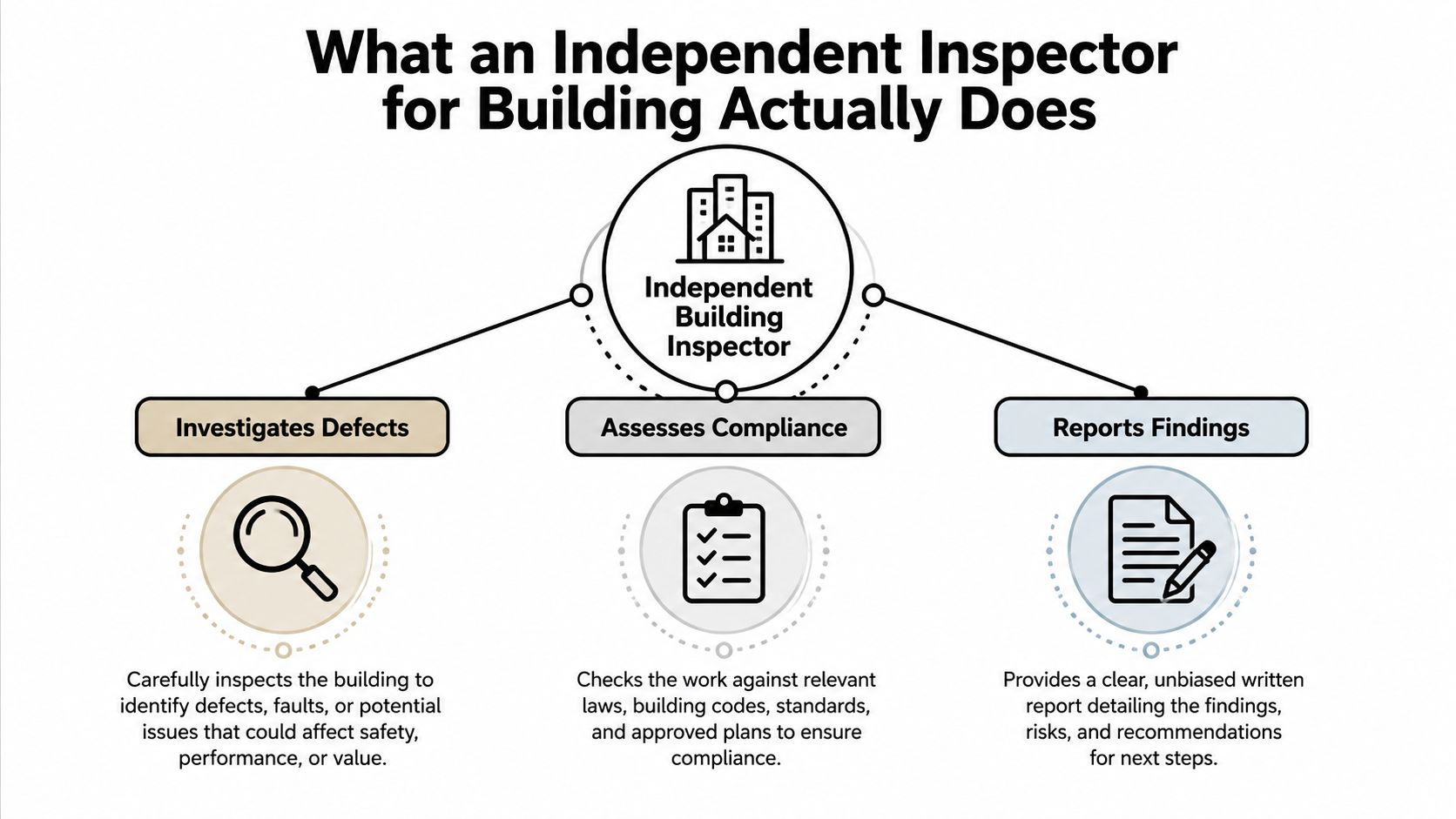
Three roles on one site
An inspector may be asked to:
- Investigate defects: inspect cracking, movement, water ingress, drainage, waterproofing, finishes, incomplete works or suspected construction faults.
- Assess compliance: compare the observed work with the contract, approved documents, applicable Australian Standards and relevant construction requirements.
- Report findings: produce photographs, measurements, defect schedules, opinions and recommendations suitable for the intended audience.
The role isn't interchangeable with other construction professionals. A council certifier performs statutory certification functions. A pre-purchase inspector generally helps a buyer understand a property's apparent condition before purchase. A builder's project manager supervises delivery for the builder. An independent inspector examines a defined issue without managing the builder's work or certifying the entire project.
NSW also gives inspection evidence a formal setting. Under the Strata Schemes Management Act 2015, the Strata Building Bond and Inspections Scheme requires relevant reports and inspections to follow approved processes. The approved inspection form requires interim and final inspections, and the inspection must be carried out in line with AS 4349.2:2018. The NSW Fair Trading building inspection form shows why a general opinion may not be enough.
For broader context on the role of independent professionals in construction disputes, these independent surveyor insights provide a useful comparison, although NSW work must still be assessed against NSW legislation and procedure.
When NSW Owners and Lawyers Actually Need One
A homeowner notices bubbling paint below a bathroom, then finds moisture at the skirting board. The builder attends, applies sealant and says the issue is resolved. Months later, the paint fails again. At that point, the useful question isn't whether there's water damage. It's whether the evidence can identify the location of entry, the affected building elements, the probable cause and the rectification needed to prevent recurrence.
That's a different assignment from a pre-purchase inspection. A dispute inspection usually starts with a defined history, a complaint, earlier correspondence, photographs, plans, specifications and any attempted repairs. The inspector then examines the site with the dispute in mind, records conditions that may change and explains which conclusions are supported by direct evidence and which require further investigation.
Situations that justify early engagement
An independent inspector is particularly useful where:
- Defects appeared after handover: cracking, movement, sticking doors, failed finishes or drainage problems may need a record before repairs conceal the original condition.
- Water ingress is disputed: waterproofing and balcony complaints often require moisture investigation, falls assessment, junction review and a distinction between symptom and source.
- Works remain incomplete: a structured inspection can separate incomplete contractual work from defective completed work.
- A renovation is contested: the issue may involve workmanship, product selection, scope changes or whether the completed work matches the contract.
- A claim is being prepared: a solicitor often needs technical opinions before deciding whether a claim is properly framed and what evidence should accompany it.
NSW warranty timing also makes delay risky. The state's statutory warranty rules require major defects to be raised within six years and other defects within two years, with a six-month extension in some cases, as recorded in the NSW strata defects research. Those periods don't mean an owner should wait. Early inspection can preserve conditions, identify urgent damage and clarify whether a repair attempt has addressed the cause.
Lawyers can use practical legal technology such as LegesGPT for lawyers to help organise legal research and matter information, but technology won't replace a site-based technical opinion. The next step is to preserve documents, avoid destructive repairs until the inspection strategy is settled and commission an inspector with a written scope.
The Legal and Regulatory Backdrop in NSW
A private independent inspector and a NSW Fair Trading inspector perform different functions. Fair Trading's home-building dispute process begins with an on-site complaint inspection involving the consumer and trader. If the parties don't agree, the Fair Trading inspector assesses whether the alleged defective or incomplete work is the trader's responsibility and may issue a Rectification Order. NSW Fair Trading has 20 building inspectors across the state, with inspection access extending to regional centres including Newcastle, Lismore, Coffs Harbour, Wollongong, Wagga Wagga and Dubbo, according to its home-building dispute resolution information.
A private inspector is commissioned by a homeowner, builder, solicitor, insurer, loss adjuster or other client. The private report doesn't become a Rectification Order. Its value lies in documenting facts and providing technical reasoning that can support settlement discussions, a statutory process or Tribunal evidence.

Strata defects follow a strict timetable
For relevant NSW strata buildings, the Strata Building Bond and Inspections Scheme requires an independent building inspector to be appointed and approved by the owners corporation. The developer lodges a bond equal to 2% of the contract price before the occupation certificate is issued. The inspector prepares an interim report no earlier than 15 months and no later than 18 months after completion, followed by a final report no earlier than 21 months and no later than two years after completion, as explained in this NSW strata building bond overview.
The staged process has a practical reason. Some defects become apparent only after weather exposure, settlement or repeated water ingress. A final inspection that merely repeats an early checklist can miss whether attempted rectification has worked.
The building inspector information manual also states that the Secretary-approved form is based on the AS 4349 suite and that the completed form must be provided to NSW Fair Trading within 14 days of completion. The NSW Fair Trading information manual demonstrates how standardisation and timing affect the reliability of evidence.
NCAT home-building proceedings may require expert reports, a Scott Schedule and a chronological bundle. NCAT Procedural Direction 3 requires expert evidence to address matters including whether rectification, demolition, repair or another alteration is needed. For a plain-language entry point to the principal statute, see Awesim's Home Building Act 1989 NSW guide. General code guidance can also be useful for comparison, such as these SW Michigan building code tips, but overseas material can't replace NSW-specific advice.
Core Services an Independent Inspector Provides
A building consultancy's work usually develops in layers. The first layer establishes what exists on site. The second turns those findings into expert opinion. The third organises disputed items so the parties and Tribunal can compare positions without losing track of the evidence.
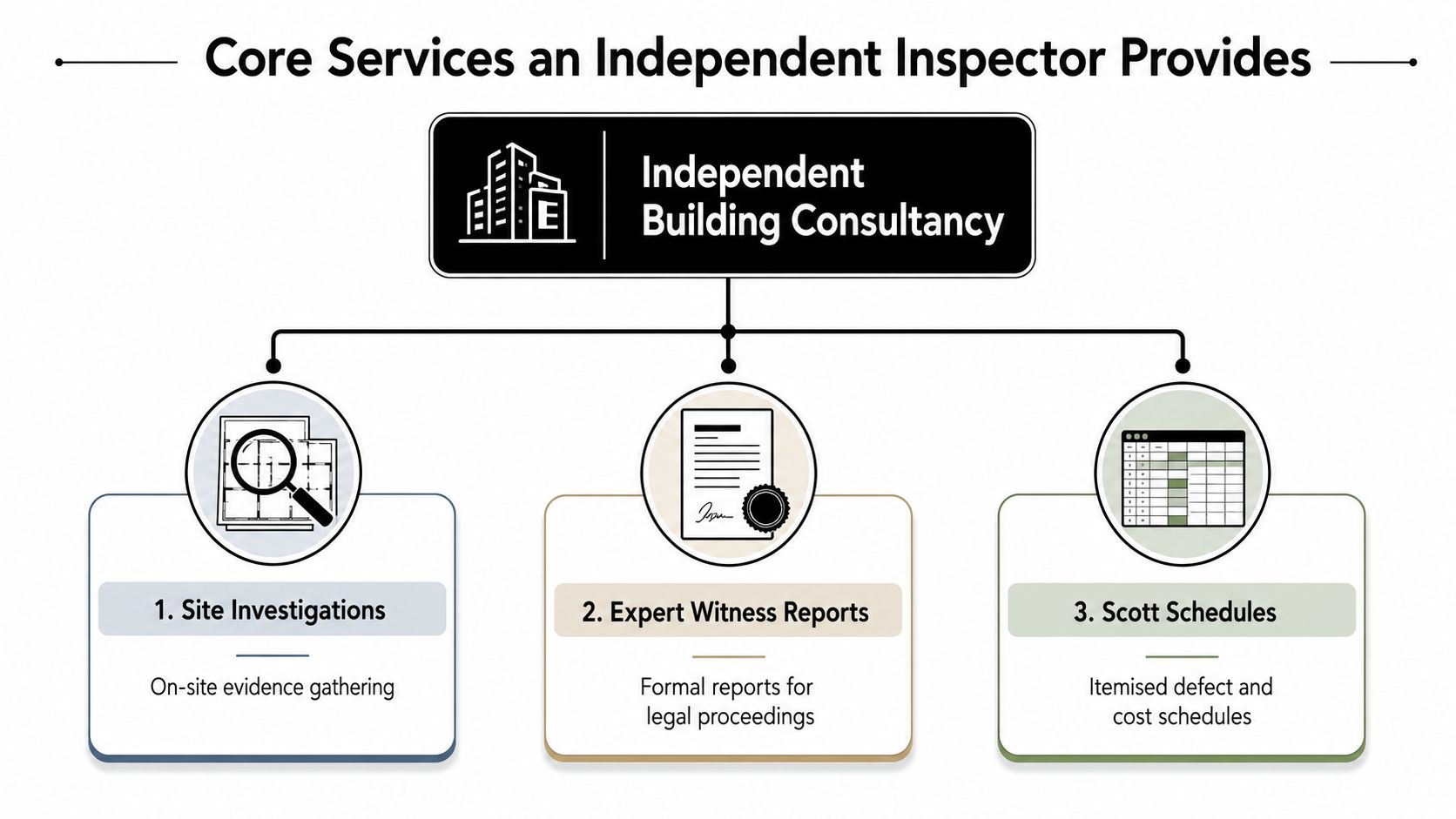
Site investigations
A site investigation is the diagnostic stage. The inspector records the property, takes photographs, measures relevant conditions and may use moisture readings or other suitable non-destructive techniques. The report should identify the precise location of each issue, not just state that “the bathroom leaks” or “the workmanship is poor”.
Owners often commission this service after a builder rejects a complaint. Builders may commission it to document the condition of completed work or respond to allegations. Solicitors, insurers and loss adjusters may need a technically independent assessment before deciding how to proceed.
A focused inspection can be appropriate for one balcony or a recurring leak. A wider investigation may be needed where multiple defects interact, such as drainage, slab movement and internal finishes.
Expert Witness Reports
An Expert Witness Report moves beyond a defect list. It explains the inspection scope, documents reviewed, factual observations, technical opinions, likely causation and the rectification methodology considered appropriate. Where the matter involves NCAT or court proceedings, the expert must understand the obligations that apply to expert evidence and must separate assistance to the Tribunal from argument on behalf of the client.
The report may address whether repair, demolition, replacement or another alteration is required. It should also identify limitations, inaccessible areas and information that could change the opinion.
Scott Schedules
A Scott Schedule gives each disputed item a common reference. It can identify the alleged defect, location, claimant's position, respondent's response, proposed rectification, cost information and supporting evidence. NCAT describes Scott Schedules as a way to itemise defective and incomplete works in complex home-building matters or matters involving multiple defects, as shown in its home-building guidance.
The Tribunal's materials also provide a Scott Schedule extras claimed form for home-building disputes. It's not a substitute for an expert opinion, but it gives the parties and decision-maker a disciplined way to track the dispute.
How to Choose a Qualified Independent Inspector
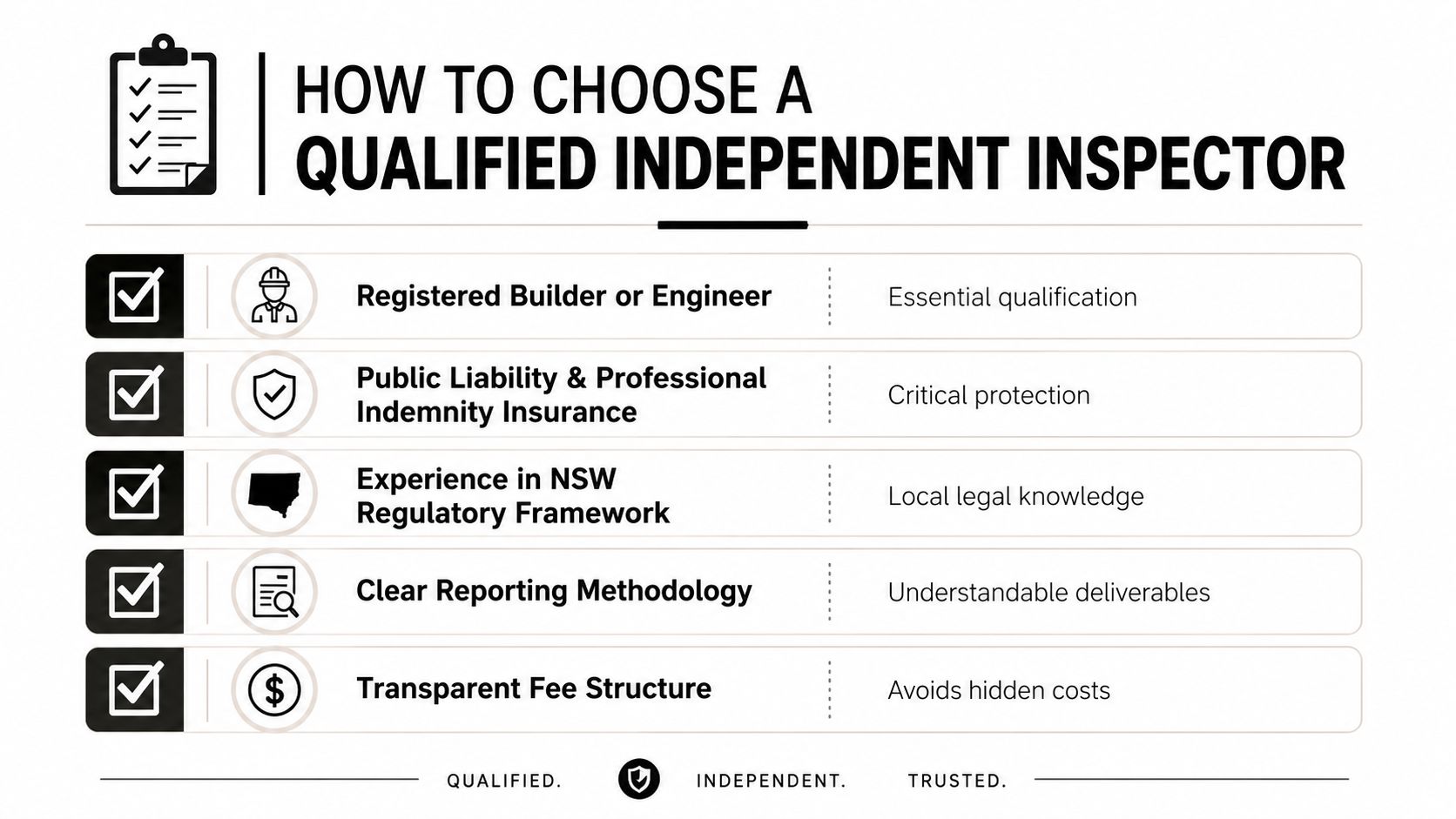
Start with competence, not availability. Ask whether the proposed inspector has practical construction experience relevant to the defect, documented NSW experience and the ability to explain technical findings in a report that lawyers and non-technical decision-makers can follow.
The shortlist questions
- What is your construction background? Look for a registered builder, engineer or building consultant whose experience matches the property and defect type.
- Have you prepared expert evidence? Ask whether the inspector has prepared reports for NCAT or related proceedings and can meet expert witness obligations.
- Are you independent? Confirm there's no current or recent commercial relationship with the builder, developer or insurer under scrutiny.
- How will you inspect the site? The answer should cover access, photographs, measurements, documents, limitations and whether specialist testing may be needed.
- Are you insured? Ask for evidence of appropriate public liability and professional indemnity insurance.
- Do you cover the location? Sydney, the New England region and rural NSW require practical arrangements for travel, access and follow-up inspections.
A good inspector will also explain what the engagement won't answer. For example, a visual inspection can document evidence without proving a concealed defect that requires opening-up. That limitation strengthens a report when it's stated clearly. It weakens one when the inspector presents an assumption as a fact.
Warning signs
Be cautious about a report with no photographs, no references to applicable Australian Standards, no clear scope, unexplained conclusions or generic recommendations such as “engage a contractor”. A consultant who can't explain how they would give evidence, respond to questions or attend a hearing may not be suitable for a contested matter.
Awesim's independent building consultant service in Sydney is one example of a service that combines site assessment with dispute-focused documentation. Compare any provider against the same practical criteria.
What a Quality Independent Inspection Report Looks Like
A litigation-grade report lets a reader follow the path from instruction to conclusion. It doesn't bury the important issue in a long catalogue of defects, and it doesn't ask the Tribunal to accept unexplained expertise.
The structure matters
A well-prepared report commonly includes:
- Instruction and scope: who engaged the inspector, what questions were asked and what the inspection did and didn't cover.
- Property particulars: address, building type, relevant areas and the date and conditions of inspection.
- Documents reviewed: contracts, variations, plans, specifications, certificates, correspondence, photographs and prior reports.
- Factual observations: what was seen, measured, tested or reported, with locations identified precisely.
- Photographic evidence: images linked to defect references, supported by captions and explanatory text.
- Technical assessment: consideration of the National Construction Code, relevant Australian Standards, contractual requirements and accepted construction practice.
- Expert opinion: likely cause, responsibility where the evidence supports an opinion, rectification methodology and any need for further investigation.
- Conclusion and limitations: a concise response to each question, including matters that remain uncertain.
A photograph of a swollen architrave proves the condition existed when photographed. It doesn't, by itself, prove the source of moisture or the party responsible. The report earns its weight by connecting the photograph with moisture evidence, building geometry, adjacent materials, construction details and relevant documentation.
Practical rule: A defect entry should tell the reader what is wrong, why it matters, what evidence supports the opinion and what work is needed to address it.
A marketing-style report often lists visible imperfections and uses broad language. A stronger report distinguishes cosmetic matters from functional or compliance issues, identifies the limits of a visual inspection and avoids claiming certainty where the structure is concealed. That discipline helps the report remain useful if negotiations fail and the matter reaches a hearing.
Price Expectations for Independent Building Inspections
There's no responsible single price for an independent inspection in NSW. A consultant might be asked to inspect one isolated defect, assess an entire home, prepare an Expert Witness Report, attend a conference of experts or produce a detailed Scott Schedule. Each assignment involves a different amount of site work, analysis, drafting and potential follow-up.
A focused site investigation is generally less demanding than a full-scope defects assessment. An Expert Witness Report costs more because the consultant must review instructions and documents, form defensible opinions, explain methodology and prepare material that may be tested. A Scott Schedule can be straightforward where the issues are limited, but becomes substantially more involved when multiple parties dispute responsibility, scope or cost.
What changes the fee
The main cost drivers include:
- Property size and access: larger or occupied buildings take longer to inspect and document.
- Defect complexity: water ingress, movement and concealed construction require more reasoning than a visible finish defect.
- Document volume: contracts, variations, plans, correspondence and earlier reports need careful review.
- Dispute status: contested matters require clearer opinion, comparative responses and possible conferences.
- Travel: regional and rural NSW work may involve additional travel and follow-up arrangements.
- Turnaround: urgent reporting can require priority scheduling and concentrated review time.
The cheapest report may be poor value if it omits the question your solicitor needs answered. Before accepting a fee, ask what deliverable is included, whether photographs and document review are covered, whether a Scott Schedule is separate, and what attendance at a conference or hearing would cost. Awesim's guide to building consultant fees in NSW can help owners frame those questions.
A fee pays for more than a site visit. In a dispute, you're paying for evidence that has a defined scope, a traceable method and an opinion capable of being explained.
Frequently Asked Questions for NSW Owners and Lawyers
How should I engage an independent inspector?
Send a short written brief describing the property, parties, defect history, desired outcome and any deadline. Attach the contract, variations, plans, photographs, notices, prior reports and builder correspondence. Ask for a written scope before the inspection so everyone understands whether the assignment is diagnostic, advisory or expert evidence preparation.
What should happen before the site visit?
Preserve the condition where possible. Don't remove finishes, repaint, apply sealant or authorise major rectification before the inspector considers whether the existing evidence needs recording. If urgent work is necessary to prevent damage or protect occupants, photograph the condition, retain invoices and keep removed materials where practical.
Is a Fair Trading inspector the same as a private inspector?
No. A Fair Trading inspector conducts a complaint inspection within the state dispute-resolution process and may issue a Rectification Order. A private independent inspector is engaged by a client and prepares technical material for negotiation, legal advice, insurance assessment or proceedings. Decide which pathway you're pursuing, then make sure the private report answers the questions that pathway requires.
Is a Scott Schedule always mandatory?
Not in every building disagreement. NCAT may direct parties to use one, particularly in complex matters or where there are multiple defective or incomplete works. NCAT's materials explain that experts attending a conclave sign a Memorandum of Outcome and that a revised joint Scott Schedule may then be sent to the Tribunal. Ask your solicitor whether the schedule should be prepared before filing, after expert review or in response to Tribunal directions.
How does my inspector deal with the builder's expert?
The independent inspector should identify areas of agreement and disagreement rather than repeat the original report. Provide the opposing expert's report and any response documents, then ask for a point-by-point review. The practical next step is to have the experts clarify whether the dispute concerns the existence of the defect, its cause, responsibility, rectification method or cost.
Awesim Building Consultants provides site investigations, Building & Construction Expert Witness Reports and Scott Schedules for homeowners, builders, lawyers, strata managers, insurers and loss adjusters dealing with NSW building disputes. Visit Awesim Building Consultants to arrange a clear scope for your inspection, or email admin@awesim.com.au or call 1800 293 746 to discuss the evidence your matter requires.

Related Posts

Strata Report: What Buyers Need to Read Before Signing
A strata report is the document that surfaces hidden obligations before you are legally committed to a purchase. A strata
Read More »
Inspection of Structures: What to Check Before You Buy
An inspection of structures examines a property's load-bearing elements, including foundations, walls, beams, roof framing, and floor systems, to identify
Read More »
Water Damage in Homes: How to Track Down the Source
Water damage in a home rarely announces itself at the source. A stain on the ceiling, a musty smell in
Read More »