
Independent Building Inspector: NSW Buyer’s Guide

You've found cracks beside a window, a damp mark on the ceiling, or tiles that sound hollow underfoot. The builder says the work is acceptable. You're not convinced, but you also don't know whether you need a basic inspection, a formal expert report, or documents prepared for NCAT.
That uncertainty causes avoidable trouble. A standard inspection can identify visible defects and help you negotiate. It may not, by itself, explain the precise non-compliance, establish causation, address the opposing party's response, or present evidence in a tribunal-ready format. The right independent building inspector helps you choose the correct level of evidence before the dispute becomes harder and more expensive to manage.
When You Realise Something Is Wrong With Your Build
A homeowner in a new strata apartment notices paint bubbling beneath a bathroom window. The builder calls it condensation. After the next storm, water appears in the skirting board and the adjoining carpet becomes damp. The visible stain is only the starting point. The key question is whether water is entering through failed waterproofing, a window junction, a balcony interface, or another part of the building envelope.
That distinction matters because a defect list that says “water damage to wall” gives the parties very little to work with. An effective inspection records the location, condition, surrounding materials, likely pathway, and evidence that supports the proposed cause. It also separates what the inspector observed from what still requires further investigation.
Practical rule: Don't wait for a defect to become dramatic before documenting it. Early photographs, correspondence, plans, approvals, contracts, and variations can be more useful than recollections formed after a dispute has escalated.
DIY checks have a place. You can photograph cracking, record dates, note when water appears, and keep copies of messages. You can't reliably determine from a visual symptom whether movement is structural, whether a waterproofing detail complies with the relevant requirements, or whether a repair has addressed the cause rather than covered the evidence.
An independent building inspector is most useful when the issue has technical consequences. That includes recurring moisture, cracking that changes, incomplete work, disputed workmanship, fire-safety concerns, or a repair proposal you don't trust. The inspector's job isn't to adopt the loudest position. It's to inspect agreed areas, record evidence, identify defective work where supported, and explain what the evidence can and can't establish.
What Independence Actually Means Under NSW Law
In NSW, independence has a regulatory meaning beyond a company describing itself as impartial. The Strata Schemes Management Act 2015 and Strata Schemes Management Regulation 2016 embed the role of an independent building inspector in the strata building bond and inspections scheme. The scheme requires a developer-paid building bond, along with mandatory defect inspections and reports by an independent building inspector for relevant strata developments. NSW strata building bond guidance explains that this creates a statutory independence requirement, rather than treating inspection as only a private service arrangement.
NSW Fair Trading's building inspector information manual states that an inspector must act impartially, must not seek or accept benefits, and doesn't represent the developer's interests while carrying out inspection functions. Those requirements matter when a report later supports rectification discussions, compliance reviews, a dispute, or expert evidence. A report gains probative value from the quality of its observations and reasoning, not from a prominent “independent” label.
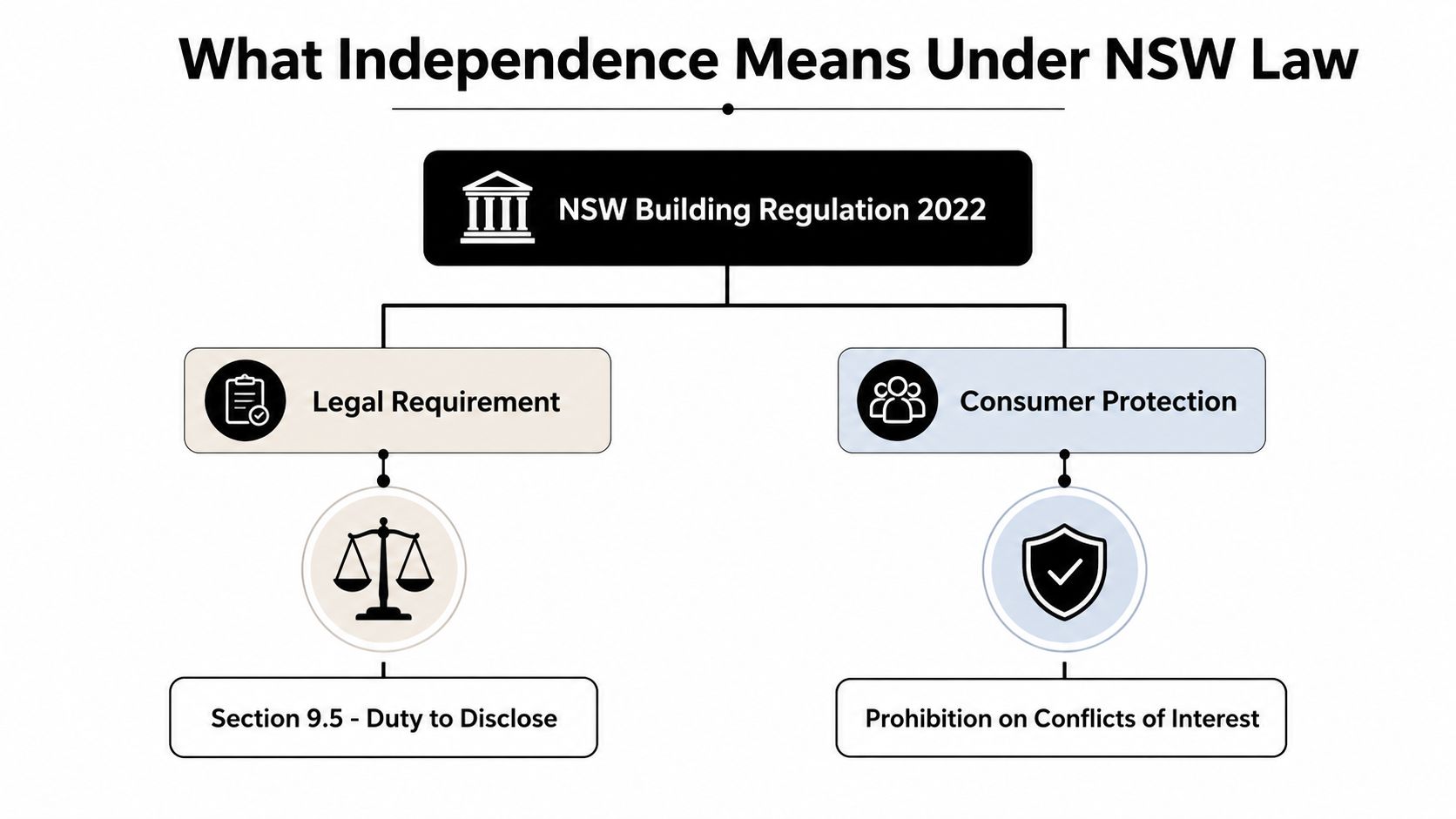
Independence requires more than qualifications
Before engagement, ask who the inspector has previously worked for, whether the inspector has any continuing relationship with the builder, developer, certifier, strata manager, insurer, or contractor, and whether the proposed scope identifies the client clearly. A technically capable person with an unmanaged conflict may produce a report that the other side attacks before the technical issues are even considered.
The report should also state limitations. Under the NSW framework, inspections are visual and non-destructive, using techniques that don't involve destructive testing. The interim report must identify defective building work and, where reasonably practicable, the cause of that work. NSW expert witness code of conduct guidance is relevant when the inspection findings need to be developed into independent evidence for a legal process.
The Three Core Services Independent Inspectors Provide
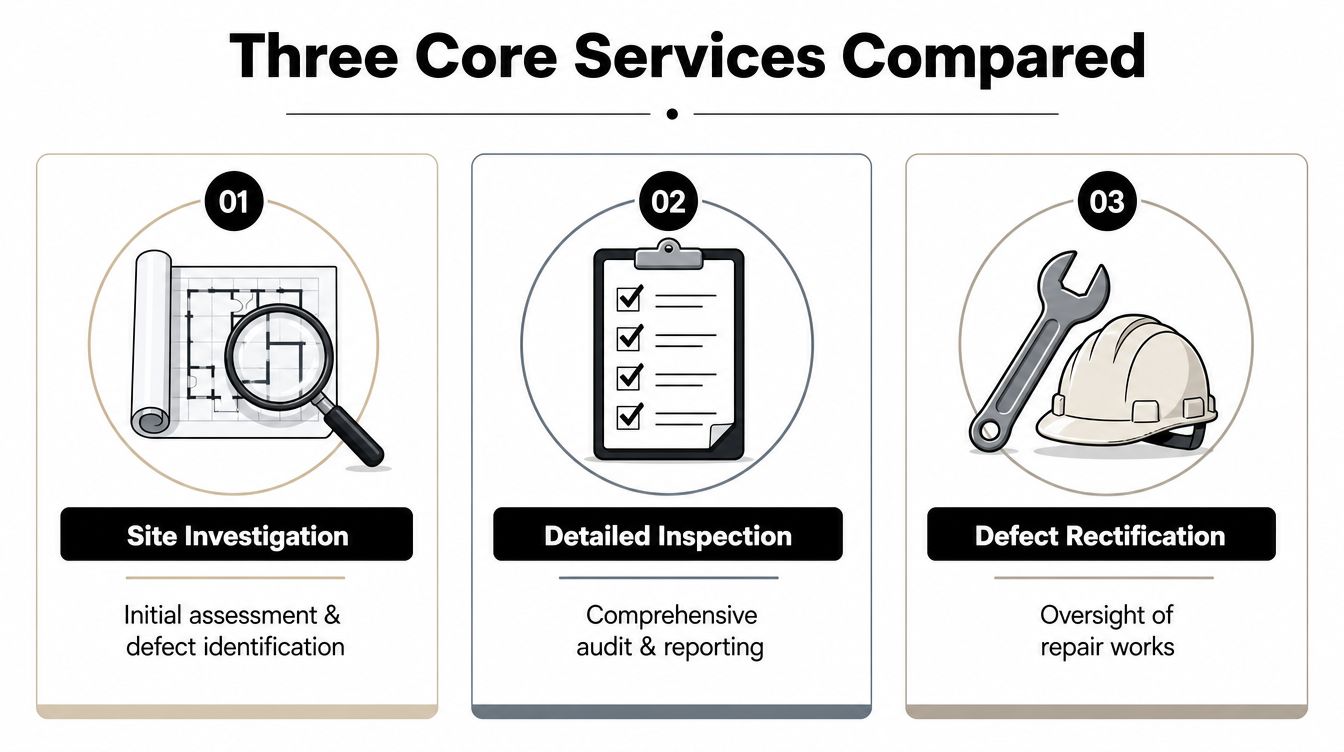
Property owners often ask for “an inspection report” when they need one of several different services. The distinction affects the scope of work, the questions asked on site, and the way the final document can be used.
Site investigation and defect assessment
A site investigation starts with the physical problem. The inspector attends the property, examines agreed areas, takes photographs, reviews available documents, and records defects or incomplete work. The report may identify likely causes, recommend further testing, and describe rectification considerations.
This is often the appropriate first step when you're still establishing the facts. For example, if a builder disputes whether a balcony leak exists, an independent inspection can document the condition and provide a technical basis for a site meeting or negotiation. It's also useful before sending a detailed defect notice, because the wording can distinguish observed defects from assumptions.
Building and Construction Expert Witness Reports
A Building and Construction Expert Witness Report is prepared for a more formal purpose. It should address the issues in dispute, identify the material relied on, explain the inspection methodology and limitations, set out the technical opinion, and connect the opinion to the relevant building requirements or contractual obligations.
The report must remain independent even when one party pays for it. An expert isn't an advocate who selects only favourable facts. If the evidence doesn't support a requested conclusion, the report should say so. That discipline is what makes expert evidence useful to a lawyer, decision-maker, builder, or homeowner assessing the strength of a position.
Scott Schedules for structured disputes
A Scott Schedule itemises defects and incomplete works in a structured format. NCAT says Scott Schedules are generally used in complex home-building matters or matters involving a number of defects, with the Tribunal Member giving directions about their use where required. NCAT procedural directions and guidelines provides that procedural context, while the NCAT Scott Schedule search and template resources show the table-based approach used to address defects, responses, and rectification issues.
A schedule isn't just a long narrative. It lets the claimant identify an item, the respondent answer it, and the parties address the proposed rectification or dispute. The inspector may prepare it from investigation findings, an expert report, or both.
Inspection Versus Expert Evidence Which Do You Need
The right document depends on where the dispute is, not only on how severe the defect appears.
If you've just discovered defective tiling, incomplete joinery, or a possible leak, begin by gathering evidence. A site inspection can clarify what exists, what may be causing it, and whether the builder's proposed response addresses the underlying issue. At that stage, the report's value lies in giving both sides a shared technical reference for negotiation.
NSW Government guidance says building disputes can be addressed through Building Commission NSW, and both parties must consent to that process. The process can involve a site meeting, telephone discussions, and review of documents or other material. An inspection therefore forms part of a broader dispute-resolution pathway, rather than automatically replacing it. NSW guidance on resolving building disputes sets out that consent-based context.
A practical decision test
| Your position | Usually useful first | When to consider escalation |
|---|---|---|
| The defect has only recently been identified | Site investigation and defect assessment | When the cause, scope, or responsibility remains disputed |
| The parties are negotiating rectification | Inspection report with photographs and technical reasoning | When each side needs formal opinions on compliance or causation |
| NCAT proceedings involve many disputed items | Expert report and structured defect schedule | When the Tribunal or lawyer requires defined expert evidence |
| The builder's proposed repair is unclear | Independent review of the proposed method | When the adequacy of the repair becomes a central issue |
A visual report may be enough for an early negotiation. It may not be enough for NCAT if the tribunal needs an opinion on compliance, causation, rectification, or the technical response to the other party's case. A Scott Schedule can organise the issues, but it doesn't replace the expert reasoning needed to support each disputed item.
The difference between a building defect report and an expert witness report is therefore procedural as much as technical. Engage early, preserve evidence, and ask the inspector to recommend the next level of work rather than ordering the most extensive package without understanding the forum.
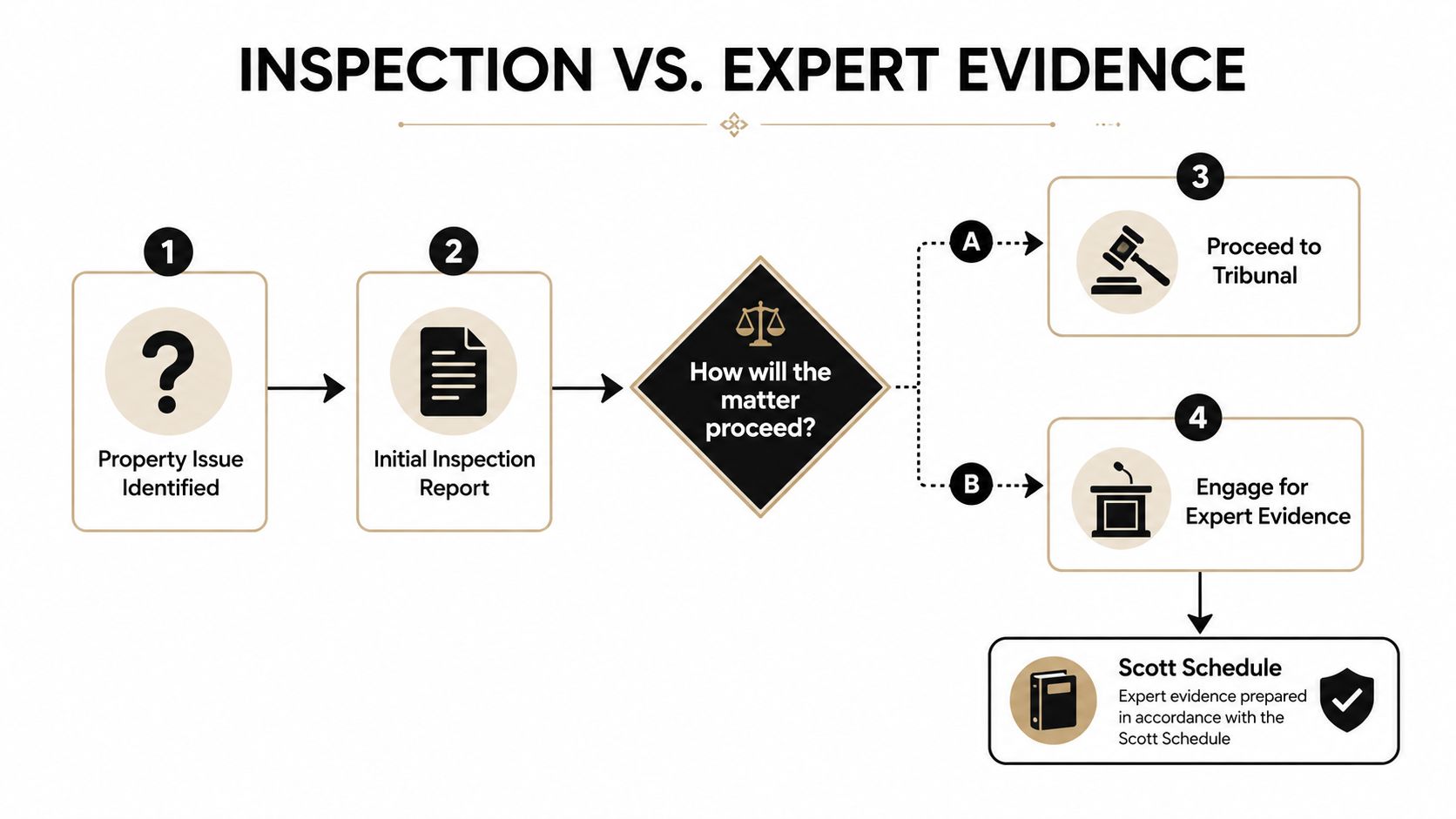
The following video provides additional visual context for the relationship between inspection findings, tribunal processes, and expert evidence.
What Inspectors Actually Look For in NSW Properties
An independent building inspector doesn't treat every visible imperfection as equally important. The inspection starts with the building's risk profile, the reported symptoms, the documents available, and the likely consequences if the defect remains unresolved.
Building Commission NSW reported serious defects in 53% of buildings surveyed in 2025. The reported categories included waterproofing defects at 22%, fire-safety defects at 16%, key services at 14%, enclosures at 15%, and structural defects at 10%. The NSW strata defects infographic provides those figures and explains the environment in which inspectors assess common-property risk.
The practical consequence is clear. Inspectors pay close attention to moisture ingress pathways, interfaces around fire systems, service penetrations, façade and enclosure junctions, and signs of structural movement. A hairline crack may be minor, but cracking around openings, changes in floor level, sticking doors, or associated moisture can alter the investigation.
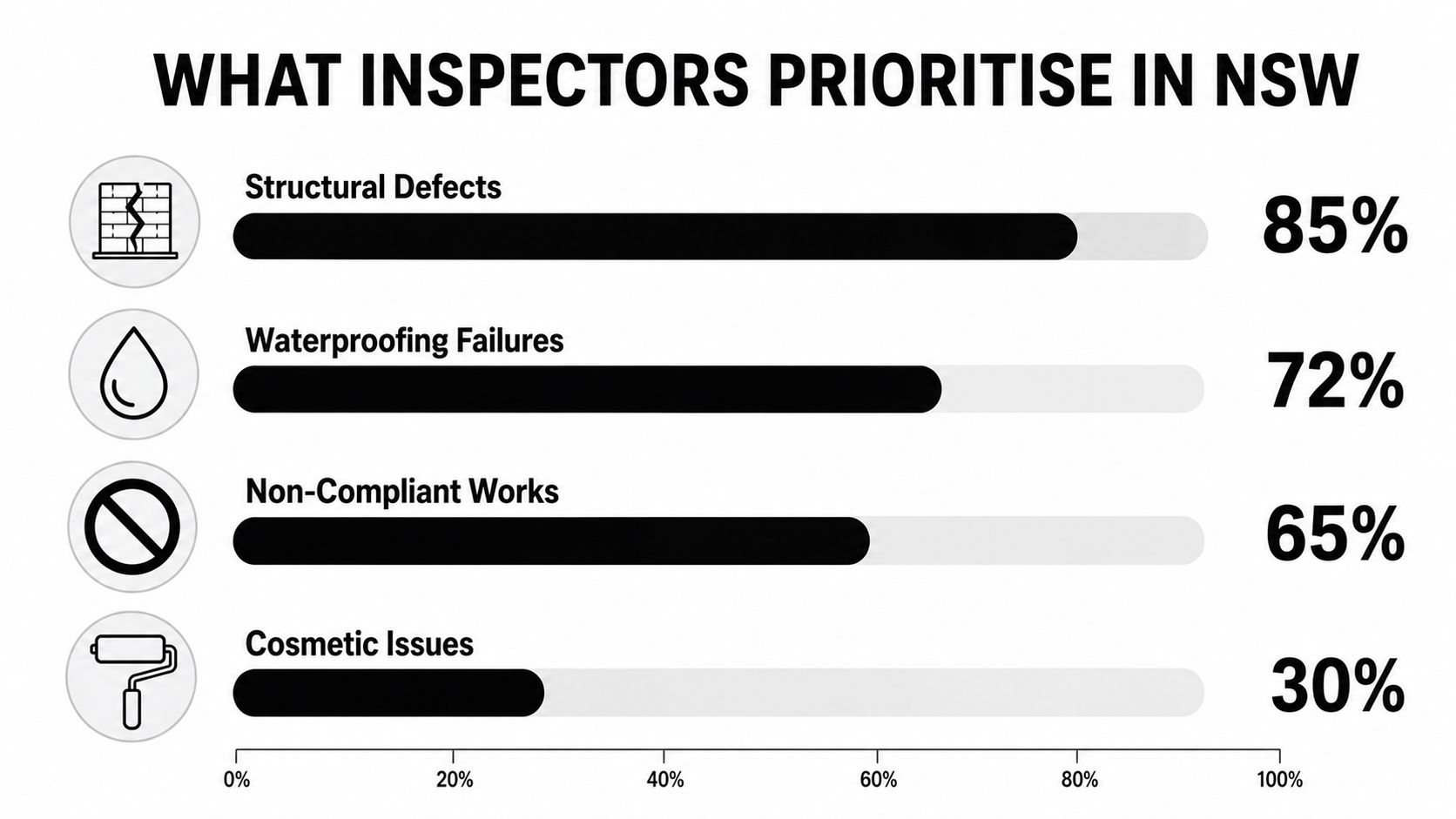
The evidence trail matters
NSW's independent inspector framework is non-destructive and evidence-led. The inspector carries out a visual assessment of agreed areas and uses photographs, notes, plans, specifications, correspondence, and available records to connect a defect with a likely cause. The task isn't to certify that every concealed component is compliant. It's to explain what the inspection supports and identify where further testing or specialist input is required.
Good as-built records can make that reasoning more reliable. For owners and project teams trying to understand how completed work relates to documented construction, Virtual Tour Easy's as-built documentation resource offers useful background on organising project information.
The final report must be issued no earlier than 21 months and no later than 2 years after completion of the building work, and copies must be given to the developer, owners corporation, Secretary, and builder within 14 days, as set out in the NSW Fair Trading inspection and reporting document. That timing reinforces why reports need clear defect-to-cause links, not a collection of unexplained photographs.
How to Assess an Inspector's Qualifications and Independence
Credentials are useful, but they're only the starting point. A sound appointment depends on whether the inspector has the practical experience, technical knowledge, and independence controls needed for the particular dispute.
Ask questions before the inspection
Request clear answers to these questions:
- Relevant experience: Has the inspector investigated the type of defect involved, such as waterproofing, structural movement, fire-safety interfaces, or incomplete work?
- Technical scope: Will the report address observations, likely cause, relevant requirements, limitations, and possible rectification pathways?
- Conflict controls: Has the inspector worked for the builder, developer, certifier, strata manager, insurer, or contractor involved?
- Forum experience: Can the inspector prepare evidence suitable for negotiation, mediation, or NCAT, depending on the dispute stage?
- Site access: Will the agreed inspection areas, documents, photographs, and intrusive limitations be recorded clearly?
A report that labels items “poor workmanship” leaves the reader asking why. A stronger report identifies the observable condition, explains the applicable technical issue, states the basis for the opinion, and avoids claiming more than a visual inspection can establish.
Look for probative value
Practical construction experience helps an inspector recognise how water travels, how movement presents, and how workmanship affects adjoining building elements. Regulatory knowledge helps the inspector identify the exact requirement in issue, whether the problem concerns the National Construction Code, an applicable Australian Standard, the contract, or the Home Building Act 1989 (NSW).
Red flags include a report that promises a predetermined result, refuses to disclose conflicts, uses photographs without locations or explanations, or treats every item as equally serious. Independence isn't proven by a logo or a long qualifications list. It's demonstrated through transparent methodology, balanced reasoning, and a willingness to identify limitations.
Why Early Engagement Changes Everything
Early engagement gives you options. You can document the condition before a repair changes it, give the builder a technically coherent response, and decide whether negotiation, Building Commission NSW, expert evidence, or NCAT is the appropriate next step.
NSW Building Commission says its dispute resolution service assists with about 2,500 building disputes each year, and over 80% are resolved without enforcement action. It also reports that 70% of disputes are resolved at the initial mediation or inspection stage, reducing matters reaching NCAT by about 30%. NSW Building Commission's dispute-resolution information provides those performance figures.
The service also reports that complainants are contacted within 2 working days in 98% of cases, inspections occur on average within 22 working days, and complaint resolution, including rectification, averages 39 days. Those figures don't guarantee an outcome for your matter. They do show why an inspection should be treated as part of an active resolution process, rather than paperwork saved for the end of a failed negotiation.
Timing matters: The strongest technical evidence is often gathered before the parties become committed to incompatible explanations.
A sensible sequence is to preserve documents and photographs, obtain an independent investigation, notify the other party with a focused defect list, and use the findings in a site meeting or mediation. Escalate to a Building and Construction Expert Witness Report when liability, compliance, causation, or rectification remains contested. Add a Scott Schedule when the dispute contains multiple items that need structured responses.
The same principle applies before problems surface. A pre-purchase building inspection in NSW can identify concerns before contractual and practical positions become fixed. For owners already in dispute, Awesim Building Consultants has 35+ years in Building & Construction and over 15+ years providing litigation support to homeowners, builders, and lawyers, with site investigations, Building and Construction Expert Witness Reports, and Scott Schedules available for matters requiring structured technical evidence.
Awesim Building Consultants can investigate building defects, prepare independent Building and Construction Expert Witness Reports, and develop Scott Schedules for homeowners, builders, and lawyers dealing with NSW disputes. Visit Awesim Building Consultants, email admin@awesim.com.au, or call 1800 293 746 to discuss the property, the dispute stage, and the evidence you need.

Related Posts
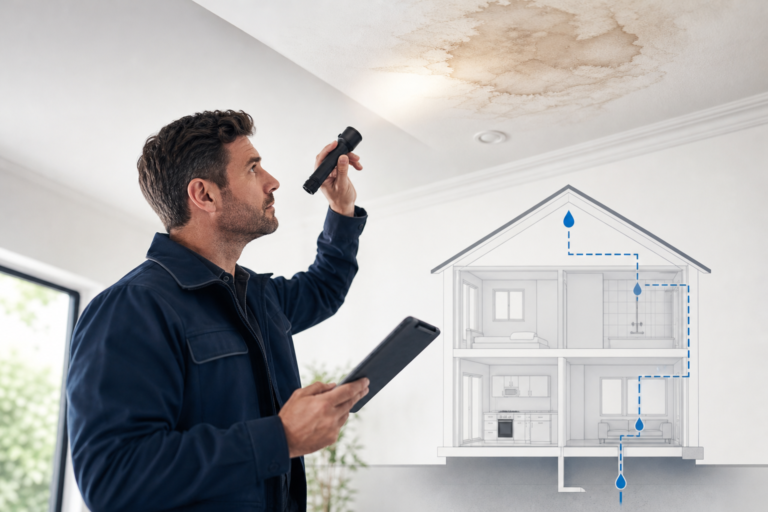
Water Damage in Homes: How to Track Down the Source
Water damage in a home rarely announces itself at the source. A stain on the ceiling, a musty smell in
Read More »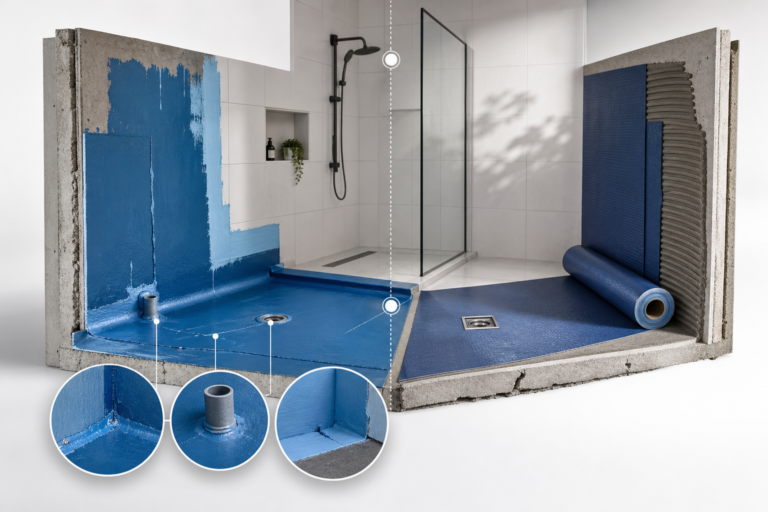
Waterproofing Membrane Types: Which Fails Most in NSW Bathrooms
Waterproofing failure is the single most common serious defect found in NSW apartments, and the type of membrane used, along
Read More »
Building Certifier NSW: Role, Limits, and When You Need More
A building certifier in NSW is a registered professional who issues construction certificates, conducts critical stage inspections, and grants occupation
Read More »