
Home Building Act 1989 NSW: A Practical Guide
You've probably got a job on the go, or a dispute brewing. The bathroom's half-finished, the new slab has cracked again, the builder says the issue is “minor”, or the homeowner says a variation was never agreed. That's where the Home Building Act 1989 NSW stops being abstract and starts deciding who can do the work, what paperwork should exist, how long defects stay alive, and where the fight ends up.
In NSW building work, the Act sits underneath the whole job. It affects licensing, contracts, statutory warranties, home warranty insurance, and the tribunal pathway when things go sideways. If you're trying to work out whether your project is inside the Act, whether the claim is still in time, or whether your file is ready for NCAT, the practical answer usually starts here.
Why the Home Building Act 1989 NSW Matters to You
A lot of people only reach for the Act after the defect list starts growing. The tiles are lifting, water is getting behind the membrane, the ceiling keeps cracking, or the builder has walked off site after a dispute about a variation. At that point, the argument is no longer only about workmanship. It becomes a question of whether the work was residential building work, whether the right contract existed, whether the defect is still in time, and what evidence will still carry weight if the matter ends up in a tribunal or court.
The Home Building Act 1989 NSW controls that entire chain. It was assented to on 7 November 1989, was formally identified as NSW Act No. 147 of 1989, and NSW Legislation notes that it was formerly the Building Services Corporation Act 1989 before the renaming took effect. That history matters because the Act was designed as a consumer-protection statute, not just a licensing rulebook. The same practical point still holds on real jobs today, the statute is written to shape how residential work is priced, documented, supervised, and tested when a dispute breaks out.
A practical reading of the Act helps before the disagreement hardens.
If the work, the money, and the paperwork line up, the Act will usually sit at the centre of the dispute.
On a live site, that becomes obvious quickly. A homeowner thinks they hired someone for “a bit of renovation”. The builder thinks it was a small job with informal directions. Then the invoices, the scope, and the defects start showing that the Act may govern the relationship much more tightly than either side expected. Once that happens, the issue stops being a casual complaint about quality and becomes a regulated NSW building matter, with licensing, contract form, and evidence all affecting the result.
What the Act Actually Covers and Defines
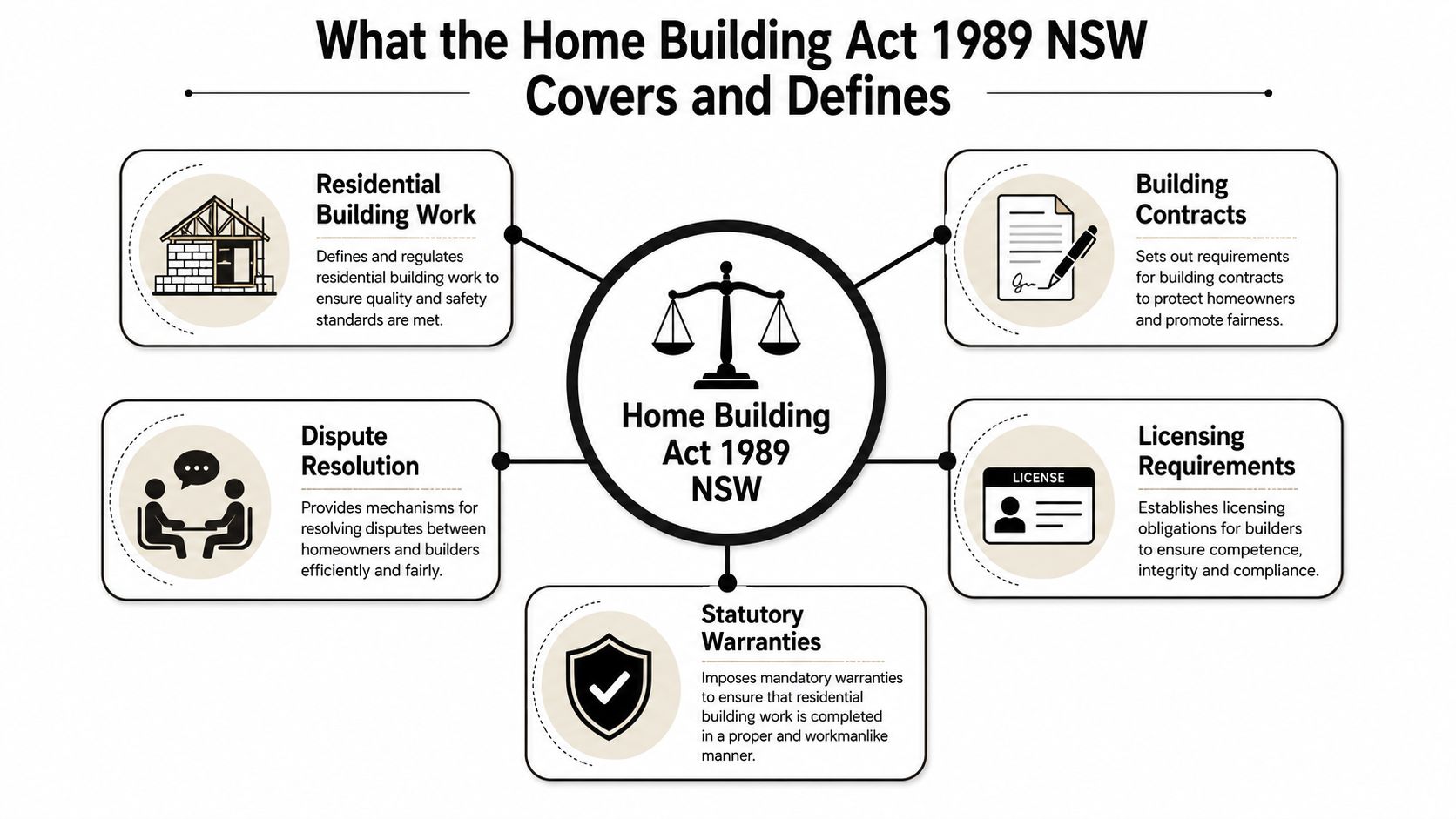
A job can look straightforward on site and still sit squarely inside the Home Building Act 1989 NSW. The Act uses the term residential building work, and that definition reaches well beyond full-house construction. It covers construction, alterations and additions, and repair, renovation, decoration, and protective treatment of a dwelling. It also expressly picks up roof plumbing, specialist work, and the installation of fixed heating, cooling, water-heating, ventilation, or pool and spa filtration fixtures connected to a dwelling.
That breadth matters because the label on the quote is rarely the whole story. Once the work falls inside the Act, the statutory warranties, contract rules, and licensing obligations can follow it. A project described as a “small renovation” can still be regulated work if the actual tasks, the dwelling, and the money involved bring it within the statute.
Where the line gets tested in real disputes
Difficult cases are rarely the obvious ones. Internal painting might be part of a larger regulated renovation. Tiling often sits inside a bathroom or kitchen job that is clearly residential building work. Demolition, project management only agreements, and some owner-builder or strata setups can change the assessment, especially where the job has been split across trades or staged over time. The Act's definition is broad, so the core question is what was performed, not just what the paperwork called it.
A practical check starts with the documents and ends with the site record.
- What was promised? Read the written scope, the plans, and any variation notes.
- What was physically done? Separate real building work from administration or coordination.
- What kind of dwelling or structure is involved? Completion events and defect periods can shift depending on the building type and how the work was completed.
After 35 years of defect inspections, I have learned that the site record usually tells the cleaner story. A contractor may write “project management only” on a quote, yet the photos, messages, invoices, and directions on site may show they were directing specialist work and coordinating the build in a way that brought the Act into play.
Licensing Thresholds and Specialist Work Requirements
On a real job, the first fight is often over the threshold, not the defect. A homeowner sees a “small” renovation, while the paperwork, labour, materials, and specialist trades tell a different story. That matters because the licensing trigger turns on the value and nature of the work, and a contractor can fall inside the Act even where the job looks modest at first glance. If the work crosses the licensing line, the question is no longer academic. It goes to whether the work was lawfully taken on in the first place.
The Home Building Compensation Fund sits on a separate track, and that creates another practical checkpoint. The Act's insurance obligation is triggered at contract values over $20,000 (AustLII notes on the Home Building Act 1989). That is where many disputes start to sharpen. Owners often assume “insured” means the builder carries some general cover for everything, but the Act is narrower than that, and the contract value can decide whether the insurance obligation exists at all.
Specialist work also pulls the job inside the regime
General building is only part of the picture. The Act and review material also catch electrical wiring, plumbing, draining, gasfitting, and air-conditioning and refrigeration work (Parliament of NSW review material). That matters on mixed-scope jobs, where the overall project may look straightforward but one trade package brings the licensing issue back into focus.
| Trigger | Cost Threshold | What It Activates |
|---|---|---|
| Residential building work licensing trigger | More than $1,000 in secondary review material, and $5,000 in the Act's operational framework | Licence requirement for contracting, subcontracting, or advertising, depending on the material relied on |
| Residential building work threshold | More than $5,000 | Regulated residential building work under the Act |
| Home warranty insurance trigger | Over $20,000 | Home Building Compensation Fund obligations |
If the quote is split into fragments to keep each line under a threshold, the paper trail matters even more than the invoices.
That is the practical trade-off. A low-value job can still be regulated, and specialist work does not become optional because the overall project feels small. For homeowners, the safe habit is to check the scope and the total value before any money changes hands. For builders, licence status, subcontractor arrangements, and contract value need to line up from day one.
Statutory Warranties and Limitation Periods Explained
Statutory warranties are the backbone of NSW residential defect claims. They attach to the work because the Act says they do, not because the builder wrote them into the contract. That's why disputes often turn on whether the defect is inside the warranty window, not on whether the builder feels the issue is fair or unfair.
For work completed after 1 February 2012, NSW case-law commentary states that the limitation regime is 6 years for structural defects and 2 years for all other defects, replacing the earlier 7-year approach (Clayton Utz commentary). Section 18E is also described as creating two different limitation periods, with proceedings needing to be commenced within 6 years for a breach resulting in a major defect and within 2 years in any other case (Lexology summary of section 18E). Those time limits can control the whole strategy.
How the defect classification changes the case
A crack in a rendered wall may be cosmetic, or it may point to movement. A leaking shower can be a simple finish issue, or it can trace back to waterproofing failure. The legal label matters because it changes the window for a claim, but the technical evidence matters just as much because it drives that label in the first place.
The first task is triage.
- Identify the defect type. Structural, major, or ordinary defect.
- Fix the completion date. The warranty clock starts from completion, not from when the homeowner first gets annoyed.
- Preserve evidence immediately. Photos, moisture readings, emails, and inspection notes become critical fast.
- Compare the issue against the time limit. If the window has passed, the claim may be out of time before anyone argues the substance.
For a practical guide to the time mechanics that often trip up builders and owners, see defect liability period and builder obligations.
A long defect fight usually gets lost in the same place, delay. People wait for a second opinion, then wait for quotes, then wait for the builder to respond, and by the time the file is properly assembled the limitation issue has already hardened. That's why early classification and document preservation are not admin tasks. They're case strategy.
Contracts, Consumer Building Guide and Home Warranty Insurance
The paper trail under the Act is where a lot of NSW disputes start to wobble. Before most residential work begins, the builder must have a written residential building contract in place, the owner should receive the Consumer Building Guide before signing, and the insurance rules are tied to the higher contract-value threshold noted earlier. Those requirements are not there to satisfy a formality. They pin down the scope, the price, the parties' obligations, and the evidence each side will rely on if the job goes off course.
When the written contract is missing, thin, or full of gaps, the dispute becomes harder to resolve. Scope blurs, variations turn into arguments, and each side starts telling a different story about what was authorised. In that setting, claims based on quantum meruit can arise, especially where the work was carried out as if a deal existed, but the legal paperwork was never properly put in order.
What to check before the first shovel goes in
- Written contract in hand. The scope, price, and key terms should be clear before the job starts.
- Consumer Building Guide delivered. If that guide was not given, compliance is already on shaky ground.
- Home Building Compensation Fund position confirmed. The insurance issue matters most when the contract value crosses the threshold.
- Variations recorded in writing. Oral changes are where many NSW disputes become expensive.
- Payment claims matched to the agreed scope. If the invoice does not reflect the contract, the argument starts there.
For a practical explanation of what the insurance does and does not cover, see Home Warranty Insurance in NSW and the Home Building Compensation Fund.
The trade-off is straightforward. A handshake arrangement feels quicker at the start, but it usually costs more once defects or variations are disputed. A written contract, the required guide, and the insurance check slow the start a little, then save a lot of reconstruction later when the job is being tested against the Act and the evidence.
Enforcement, Penalties and Where Disputes Are Heard
A breach of the Act does not all go through the same door. Some matters are prosecuted as offences, and NSW material explains that those proceedings are dealt with summarily in the Local Court or, in some cases, the Supreme Court in its summary jurisdiction, with offence proceedings needing to start within 3 years after the offence. That sits in a different lane from a civil claim about defective work or a breach of statutory warranty.
The civil side is where many homeowners end up. Defect disputes, licence problems, and warranty claims are commonly handled through NSW forums rather than ordinary civil litigation, and the NSW Civil and Administrative Tribunal is often the place where the main dispute is decided. The practical question for both a builder and a homeowner is not just what the Act says, but what evidence the tribunal or court will ultimately rely on before it makes orders.
Why the forum changes the evidence you need
A prosecution file needs a different bundle of material from a rectification claim. In a penalty matter, the issue is whether an offence can be proved in time. In a defect claim, the issue is whether the breach exists, how serious it is, and what order should follow. One site can create both problems, but the evidence should not be thrown together as if they were the same case.
Phone calls, site discussions, and variation approvals are often where disputes later turn sour. If you want a cleaner record before that happens, a tool that helps preserve those conversations can be useful, and one option is dispute-proof your phone calls, especially where the argument comes down to who said what and when.
For a clearer view of the tribunal path, NCAT and home building disputes gives a practical starting point.
In hearings, the clearest file usually wins the most time.
That is the site-level lesson. A builder who keeps records, or a homeowner who logs defects early, can often narrow the dispute before it spreads. Once a matter becomes a tribunal file, loose recollections and vague promises stop carrying much weight.
A Practical Checklist for Homeowners and Builders
The fastest way to lose control of a NSW building dispute is to start collecting documents after the hearing date is already floating around. The smarter move is to build the file as soon as the defect, delay, or variation issue appears. That applies whether you're the homeowner, the builder, or the lawyer trying to sort the evidence into something NCAT can use.
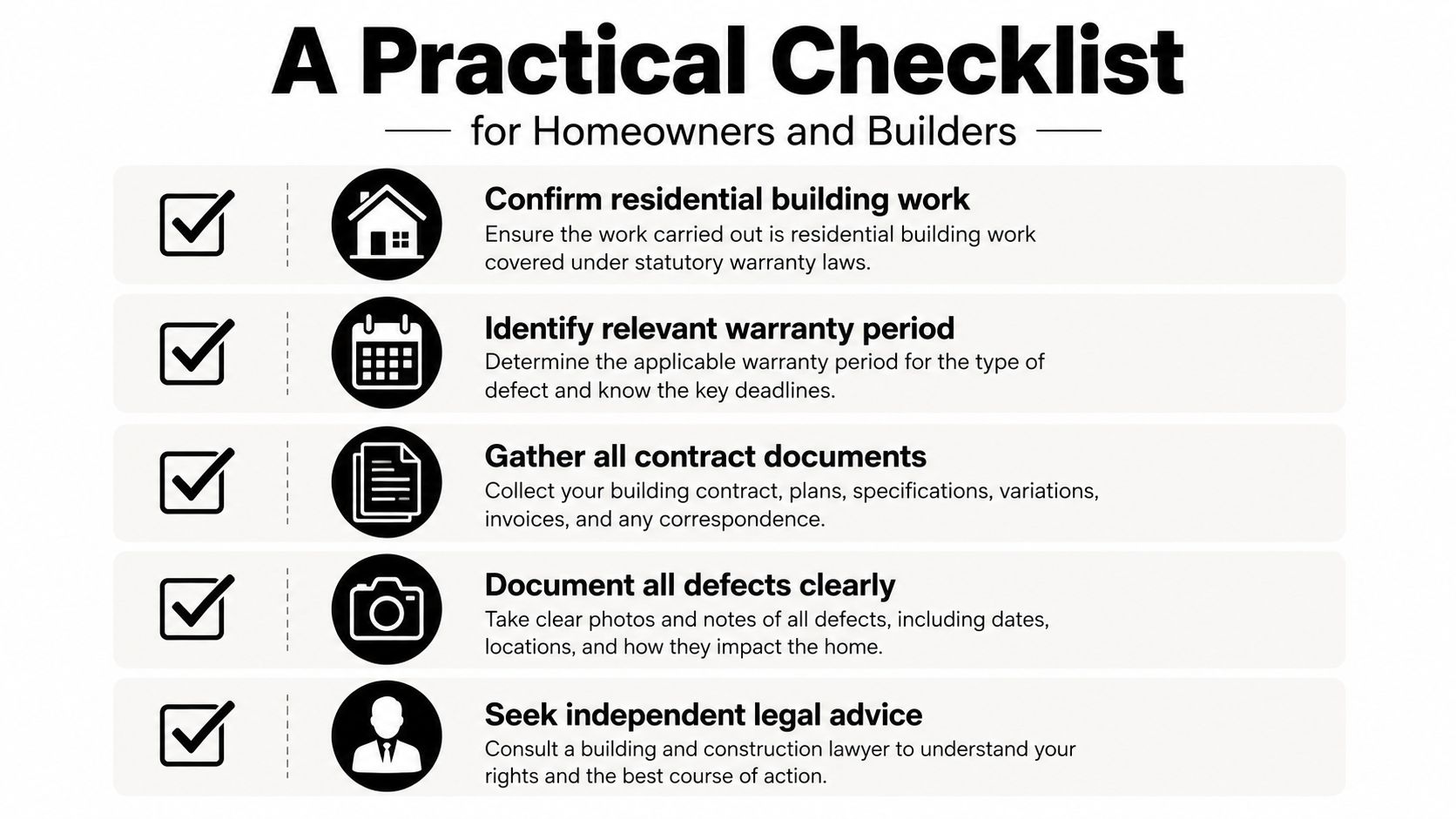
Homeowner checklist
- Confirm residential building work. Work out whether the job sits inside the Act before arguing about the defect itself.
- Identify the relevant warranty period. Check completion dates and the defect type, then compare that against the limitation window.
- Gather all contract documents. Keep the contract, plans, selections, variations, invoices, and emails together.
- Document defects clearly. Take dated photos, note the location, and write down when the problem first appeared.
- Seek independent legal advice. A lawyer can help with the claim framing before the limitation clock gets any tighter.
Builder checklist
- Check licence and contract compliance. Make sure the work, the price, and the scope align with the regulatory trigger.
- Retain insurance and guide records. Keep proof of the Consumer Building Guide and any relevant insurance position.
- Respond in writing without overcommitting. Don't admit a defect until you've inspected it and checked the cause.
- Match every variation to the paperwork. Oral instructions are risky, especially when the job value or scope changes.
- Prepare for tribunal-style evidence. Photos, inspection notes, and defect lists should be organised before the dispute escalates.
A proper Scott Schedule is often the turning point when a matter is heading to NCAT. It helps align each defect, each response, and each claimed remedy in a format the tribunal can follow. An independent site investigation can also stop the argument from becoming guesswork, especially where waterproofing, movement, or concealed defects are involved.
When to Bring in a Building Consultant and Expert Witness
The best time to bring in a consultant is before the file gets messy. Once photos are missing, trades have left, and everyone's story has drifted, the expert is trying to reconstruct a timeline instead of testing a defect. That's a harder job, and it usually costs more in time and friction.
A consultant helps in three practical ways. First, an independent site investigation can identify the technical cause of the issue. Second, an Expert Witness Report can turn those observations into evidence that fits tribunal or court expectations. Third, a properly prepared Scott Schedule can narrow the hearing and push both sides towards a better settlement position.
Awesim Building Consultants have 35+ years in building and construction, with over 15+ years providing litigation support to homeowners, builders, and lawyers through site investigations, Expert Witness Reports, and Scott Schedules (Awesim publisher information). That kind of field experience matters in NSW disputes because the technical question is rarely just “is there a defect”. It's usually “what caused it, how serious is it, and what does the evidence say the tribunal should do”.
If contract value, scope, or variations are still disputed, a quantum meruit assessment can also be part of the discussion. That's especially relevant where the paperwork is thin but the work is real. The earlier an expert is involved, the less likely it is that the dispute hardens around incomplete assumptions.
If you're dealing with a NSW residential building dispute, Awesim Building Consultants can help with site investigations, Expert Witness Reports, and Scott Schedules that fit the practical realities of the Home Building Act 1989 NSW. Visit Awesim Building Consultants, or email admin@awesim.com.au or call 1800 293 746 to discuss the defect, contract, or tribunal evidence you need to get moving.

Related Posts

Water Damage in Homes: How to Track Down the Source
Water damage in a home rarely announces itself at the source. A stain on the ceiling, a musty smell in
Read More »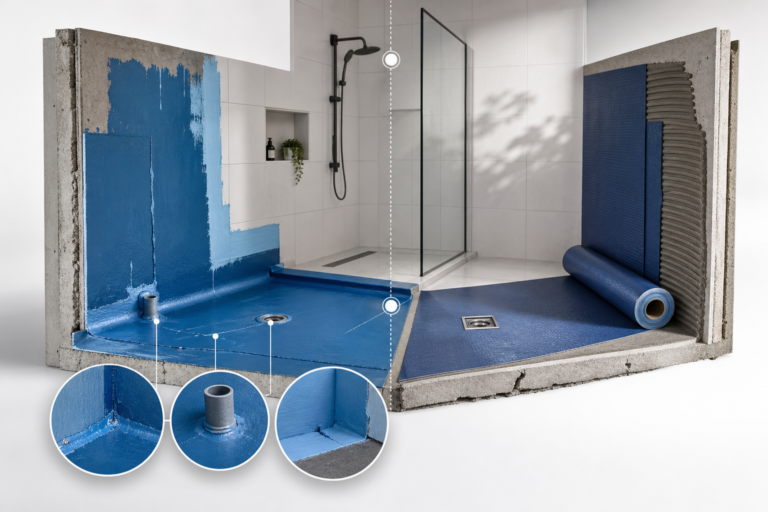
Waterproofing Membrane Types: Which Fails Most in NSW Bathrooms
Waterproofing failure is the single most common serious defect found in NSW apartments, and the type of membrane used, along
Read More »
Building Certifier NSW: Role, Limits, and When You Need More
A building certifier in NSW is a registered professional who issues construction certificates, conducts critical stage inspections, and grants occupation
Read More »