
What is a Threshold Water Stop? A Guide for NSW Homeowners

A lot of people start asking what is a threshold water stop only after something has already gone wrong. The carpet outside the bathroom feels damp. The skirting starts to swell. A timber jamb darkens at the base. Someone reseals the shower screen, blames the grout, or says to “keep an eye on it”.
By the time the matter reaches a builder, consultant, or solicitor, the underlying issue is usually much narrower. Water has crossed a floor transition that should have contained it. That small transition detail often becomes one of the clearest pieces of evidence in a waterproofing dispute.
For NSW owners and lawyers, the question isn’t only what the component is. The more important questions are whether it was required, whether it was installed to the approved detail, and whether its finished height and connection to the waterproofing system comply with Australian practice.
The Hidden Cause of Costly Water Damage
A common dispute pattern looks like this. The bathroom presents well at handover. Tiles are clean, silicone looks neat, and the doorway seems finished. Months later, the dry side of the threshold starts showing the first signs of trouble. Carpet underlay holds moisture. Architraves swell. Paint at the base of the jamb lifts. Occupants think the leak is coming from the plumbing or the shower screen.
Often, the failure is at the threshold itself. Water escapes the wet area, passes beyond the intended containment line, and reaches materials that were never meant to get wet. Once that happens, the argument quickly shifts from maintenance to compliance.
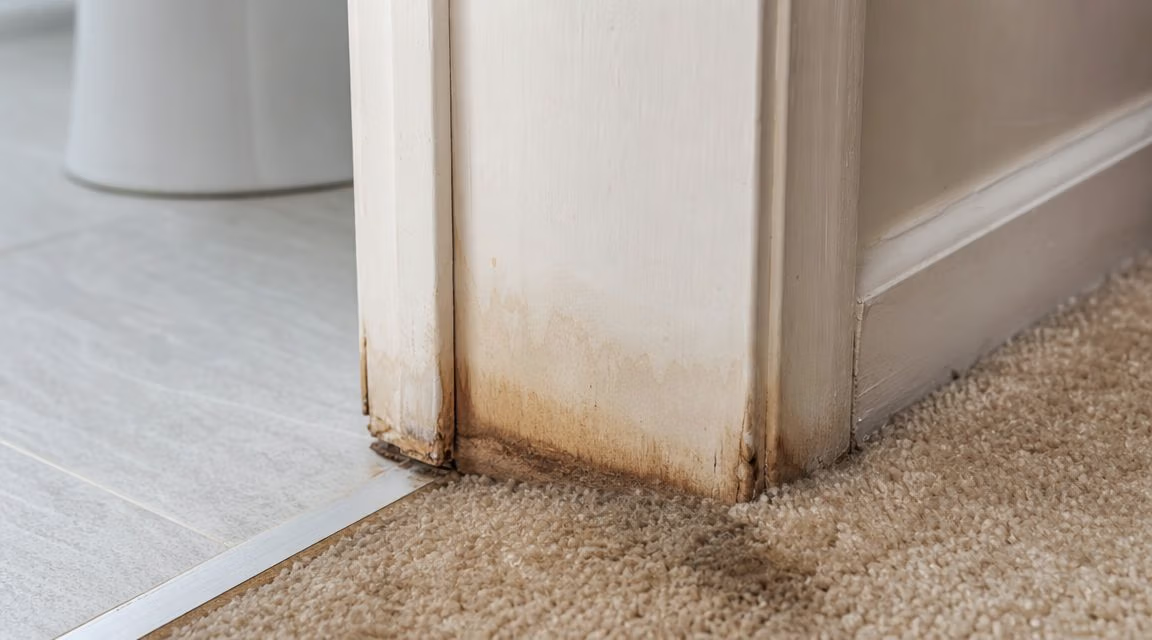
The practical problem is that consumer explanations usually stop at “it helps keep water in”. They rarely deal with the actual Australian dispute question. Is the threshold water stop allowed in that location, and was the installed detail the one required by the NCC and AS 3740? That compliance gap is well recognised in public commentary on NSW and Australian practice, particularly where disputes turn on whether the detail matched the approved design rather than whether it merely slowed water movement (discussion of compliance and legal use in NSW and Australia).
Why this detail matters in disputes
When I inspect wet area failures, the threshold is rarely a cosmetic issue. It’s usually one of these:
- A missing barrier where one should have been built into the waterproofing line.
- A barrier at the wrong height for the shower or doorway configuration.
- A disconnected barrier that stops in the wrong place or isn’t tied into adjoining waterproofing.
- A detail chosen for appearance without proper regard to containment or accessibility.
Practical rule: If water can leave the wet area at the threshold, the defect isn’t minor. It can expose framing, floor finishes, door components, and adjoining rooms to ongoing moisture.
If you’re also dealing with broader moisture risks around openings and floor transitions, general guidance on protecting your home from water can help owners understand how small entry failures lead to larger repair work.
Defining the Threshold Water Stop
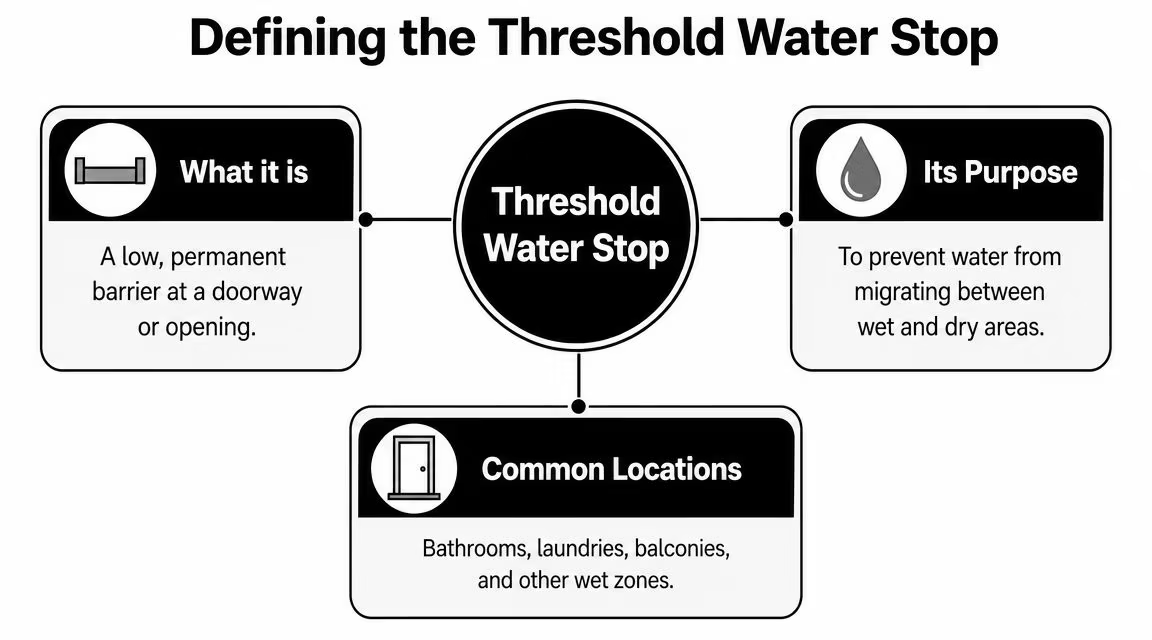
A threshold water stop is best understood as a small built-in dam at a floor transition. In domestic wet areas, it sits at the point where water must be contained before it reaches the dry side of the room. The visible edge might look simple, often aluminium, PVC, or a proprietary profile, but its function is much more serious than a trim piece.
Under Australian wet area terminology, the closest formal term is waterstop under AS 3740:2021. Australian guidance describes it as a “vertical extension of the waterproofing system forming a barrier to prevent the passage of moisture in the floor or vertically in a wall” (Australian guidance on waterstops under AS 3740).
It’s part of a system, not a strip of metal
That definition matters because many defects start with the wrong assumption. People treat the threshold water stop as a standalone fitting. It isn’t. In compliant wet area construction, the waterstop forms part of the complete waterproofing system, which also includes the primer, membrane, reinforcing fabric where required, sealants, and the finished floor build-up.
If the profile is installed after the fact without proper integration, it may look complete but still fail in service. Water doesn’t care whether a detail appears neat. It follows the path left open by discontinuities.
Where you’ll usually find one
In practical NSW residential work, threshold water stops are commonly associated with:
- Bathroom doorways where water needs to be contained within the wet area.
- Shower entrances including walk-in and other low-threshold arrangements.
- Bath installations on a hob where perimeter control forms part of the overall waterproofing approach.
A useful way to think about it is this:
| Location | What the waterstop is trying to do |
|---|---|
| Bathroom doorway | Stop escaped water reaching carpet, timber, or other absorbent finishes outside the room |
| Shower entry | Keep water within the intended shower area and direct it back to drainage |
| Perimeter detail near bath or hob | Prevent hidden migration into adjoining floor and wall junctions |
A threshold water stop only works when the membrane, floor finish, falls, and junction treatment all support it. On its own, it can’t rescue a poor waterproofing build.
That is the answer to what is a threshold water stop in practical terms. It’s not decoration. It’s the point where the waterproofing system is expected to hold the line.
Types of Water Stops and Their Applications
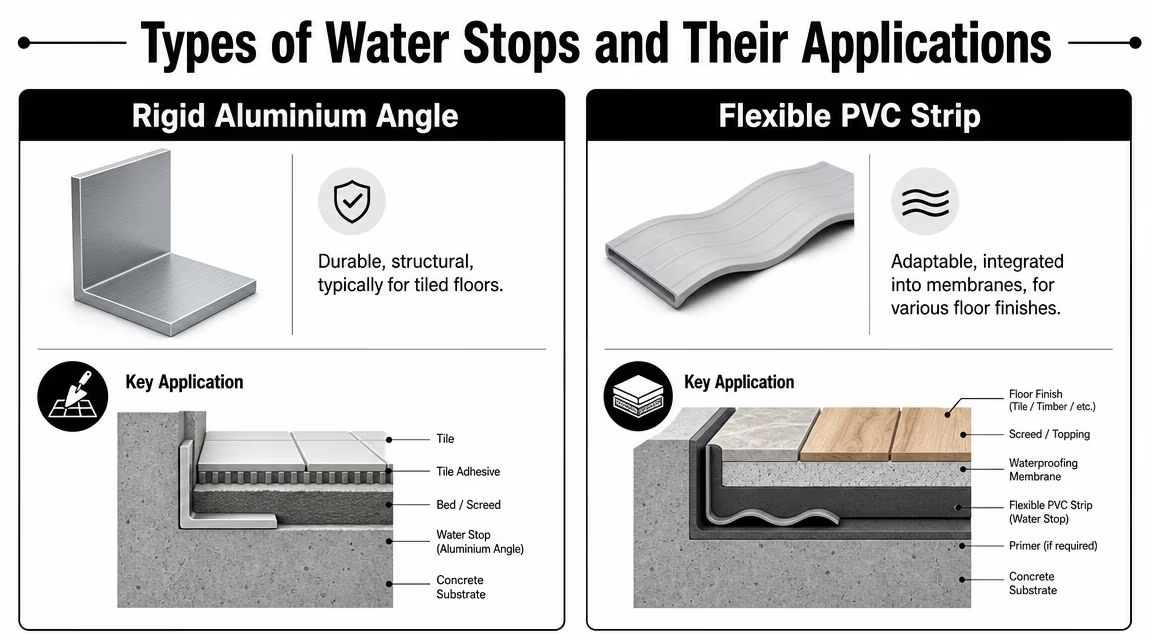
On site, threshold water stops appear in several forms. The most common are rigid aluminium angle profiles, flexible PVC or similar membrane-compatible strips, and proprietary threshold assemblies designed around a specific flooring or door condition. The right choice depends on where the water is coming from, how the floor is finished, and whether the detail is trying to contain internal overflow, resist external weather, or both.
Common forms used in practice
Rigid aluminium angle is familiar because it gives a clear vertical leg and a firm edge under tiled finishes. It’s often used where the finished floor build-up allows a defined barrier and the installer needs a straight, inspectable profile.
Flexible PVC-style systems are useful where the waterstop needs to integrate more easily with membrane work or where the floor assembly demands a less rigid transition. They can suit some proprietary systems well, but they still depend on correct substrate preparation and continuity at junctions.
A simple comparison helps:
| Type | Typical strength | Typical limitation |
|---|---|---|
| Rigid aluminium angle | Clear shape, durable edge, suits tiled wet areas | Can create finishing issues if set at the wrong level |
| Flexible PVC strip | Adaptable, easier integration with some membrane systems | Performance depends heavily on correct bonding and continuity |
| Proprietary threshold assemblies | Can address specific door or finish conditions | Selection is only as good as the design detail behind it |
Internal wet areas and external openings are not the same problem
Poor specifications are often evident. A shower entry in a bathroom and a weather-exposed balcony door are both “thresholds”, but they do not face the same water behaviour.
For internal wet areas, the task is usually containment and redirection. The detail needs to stop water crossing from wet to dry space and support the waterproofing line below the tiles or other finish.
For external doors or exposed openings, the task may include wind-driven rain, door leaf sealing, sill design, and maintenance of moving parts. Public-facing product material often talks about performance in broad terms, but the available data is usually marketed rather than properly quantified. One practical clue in that material is that a panic threshold or bumper-seal setup is promoted as better against wind-driven rain than a standard saddle threshold because it seals against the face of the door (commentary on threshold selection and wind-driven rain performance).
What tends to work and what usually doesn’t
From a defect perspective, these trade-offs matter:
- For tiled internal wet areas, a simple, well-integrated barrier usually performs better than a complicated retrofit.
- For walk-in showers, low-profile aesthetics can conflict with containment if the detail is not designed exactly right.
- For weather-exposed doors, a threshold alone rarely solves the problem. The seal to the door leaf and surrounding assembly matter just as much.
- For retrofits, surface-fixed strips often disappoint when they’re used to compensate for a deeper waterproofing failure underneath.
Product selection should follow the water path, not the catalogue photo. A threshold that suits a commercial door may be the wrong detail for a residential wet area floor.
Navigating Australian Standards and Compliance
Most threshold disputes in NSW turn on a simple point. The installed detail must match the applicable wet area requirements. If the waterstop is too low, set in the wrong position, or not integrated with the surrounding waterproofing, the argument isn’t about preference. It’s about non-conformance.
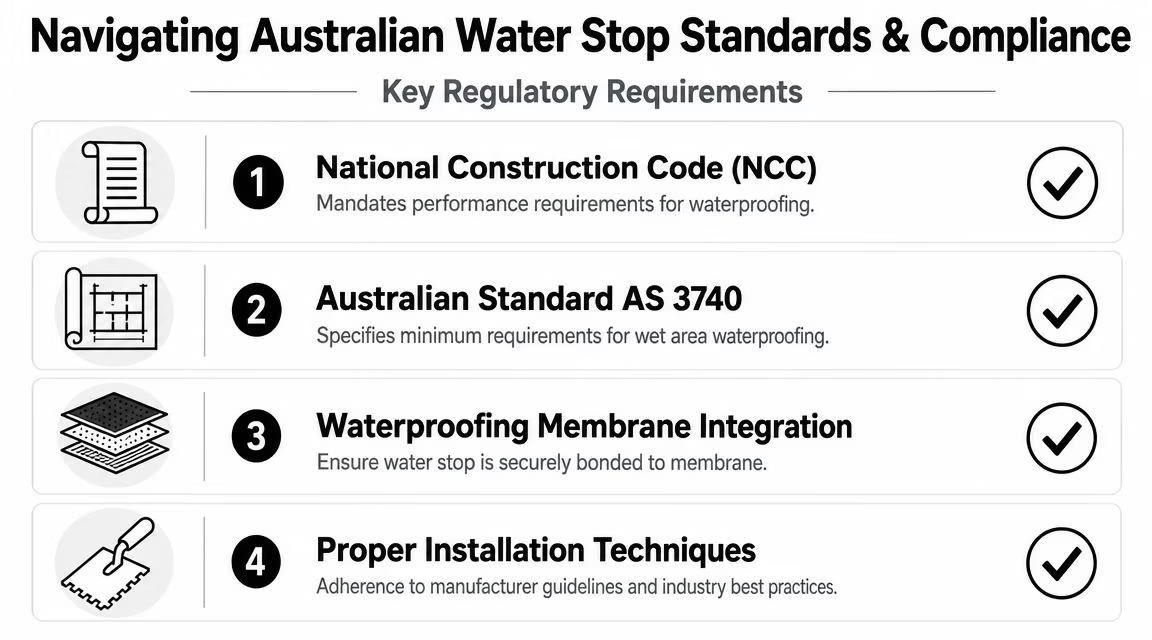
Australian guidance referencing AS 3740 states that for enclosed showers where no hob or set-down exists, the vertical leg of the waterstop must finish a minimum of 5 mm above the finished floor level. For unenclosed showers, the requirements differ and often call for the waterstop to finish flush with the finished floor surface. These dimensional requirements are critical and are a common source of non-conformance (guidance on waterstop height and shower configuration under AS 3740).
Why the finished height matters
A lot of defects come from installers treating every threshold the same. They aren’t the same.
If an enclosed shower with no hob or set-down has a waterstop that finishes flush with the tile, it may fail to provide the required barrier. If an unenclosed shower detail is raised where the applicable arrangement calls for flush treatment, the result may create a trip issue, a finish problem, or both.
That’s why these dimensions matter in reports. They are measurable.
Here’s the practical distinction:
Enclosed shower with no hob or set-down
The vertical leg must finish a minimum of 5 mm above the finished floor level.Unenclosed shower configurations
The rules vary by arrangement, and the waterstop may need to finish flush with the finished floor surface.Wall junctions at these details
The junctions must also be waterproof. A compliant threshold can still fail if the adjoining wall connection is incomplete.
For readers wanting additional trade-level commentary, these Australian waterproofing guidelines are a useful supplementary reference when reviewing wet area detailing.
Compliance is about the whole assembly
The waterstop cannot be assessed in isolation. During inspection, I look at the threshold together with:
- Floor falls toward the drain.
- Membrane continuity at the threshold and wall junctions.
- Finished floor level relative to the vertical leg.
- Shower type because enclosed and unenclosed details are treated differently.
- Accessibility implications where a raised profile may conflict with the intended use of the room.
One reason this issue keeps surfacing in disputes is that the legal question is often poorly documented during design and construction. Someone chooses a sleek threshold detail without clearly recording why that detail is acceptable for the shower type, floor level, and access requirements.
This video gives a useful visual reference point for wet area waterproofing issues in practice.
Where people usually go wrong
The most common compliance failures are not exotic. They are basic execution errors:
- Wrong finished level relative to the applicable shower detail.
- Threshold installed as trim only without true membrane integration.
- Discontinuous corners and returns where water bypasses the barrier.
- Unclear documentation showing no coherent reason why that threshold detail was selected.
Awesim’s own guidance on bathroom waterstops is relevant here because the dispute usually turns on measurable site conditions, not broad statements about “best practice”.
Common Defects and How to Spot Them
A threshold water stop defect often leaves clues long before anyone opens the floor. You can usually see the pattern at the doorway, the shower opening, or the lower corners of the jambs. The key is to inspect the detail as part of the waterproofing system, not as a standalone trim line.
Historically, waterstops began as a way of controlling water ingress at concrete joints, where leaks predictably form at interruptions in the structure. Their use in domestic wet areas reflects the same logic. The barrier is there because water will exploit joints, transitions, and penetrations unless the detail is continuous and properly formed (background on the development and accepted role of waterstops).
What to inspect first
Start with the simple observations. You don’t need destructive testing to identify many threshold defects.
Look for these signs:
- Moisture on the dry side. Damp carpet edge, swollen skirting, or staining beyond the bathroom line suggests water has crossed the threshold.
- Visible profile issues. A waterstop may appear too low, too high, crooked, or incomplete at one end.
- Failed junctions. Corners, returns, and intersections with walls are frequent bypass points.
- Patch repairs. Fresh silicone over an old threshold often means someone treated the symptom rather than the cause.
Defects that commonly appear in reports
Some failures are repeatedly seen in NSW residential work.
Incorrect height
The vertical leg finishes at the wrong level for the shower configuration. This is one of the clearest measurable defects.Poor continuity at corners
The threshold stops short, isn’t properly returned, or leaves a weak point where water can bypass the barrier.No real integration with membrane
The profile is present, but it was fitted like an accessory rather than incorporated into the waterproofing assembly.Breaks at wall junctions
The floor threshold detail may be visible and neat, yet the adjoining wall connection remains vulnerable.
If the threshold looks tidy but adjacent materials outside the wet area are showing moisture distress, inspect the hidden continuity before accepting the visible finish as evidence of compliance.
How to document it properly
For homeowners and solicitors, good evidence starts with disciplined photographs. Don’t just take one close-up of the damaged trim.
Record the issue in layers:
- Context photo showing the entire doorway or shower opening.
- Mid-range photo showing the threshold in relation to the finished floor.
- Close-up photo of the vertical leg, joints, and any visible gaps.
- Damage photo showing effects outside the wet area, such as staining or swelling.
- Level reference photo if a straightedge or measuring method can show the finished height relationship.
If the matter is headed toward NCAT or formal correspondence, note the room location, date, and whether the shower is enclosed or unenclosed. Those details shape the compliance analysis.
Water Stops in Disputes and Expert Reports
In a dispute, threshold water stops matter because they convert a vague complaint into a technical issue that can be inspected, measured, and explained. “Water escaped the bathroom” is a symptom. “The installed threshold detail did not comply with the required configuration and failed to contain water within the wet area” is an assessable defect proposition.
That distinction is important in NCAT matters. Builders, owners, and lawyers often argue around maintenance, cleaning, or shower use. A proper inspection brings the focus back to the construction detail itself.
How a defect becomes evidence
A threshold issue becomes useful evidence when the report can answer four questions clearly:
| Question | Why it matters |
|---|---|
| Was a waterstop required in this location? | Establishes whether the detail was necessary, not optional |
| What was actually installed? | Records the physical condition on site |
| Does the finished detail match the applicable requirement? | Turns observation into compliance analysis |
| What damage or risk followed from the defect? | Connects the non-conformance to practical consequence |
That is why report wording has to be precise. It should identify the location, the observed condition, the compliance issue, and the consequence.
The strongest waterproofing opinions are specific. They identify the threshold, the shower type, the finished floor relationship, and the defect mechanism.
A typical expert-style statement might read like this:
At the shower entrance, the installed waterstop finishes flush with the surrounding tiled floor. Based on the enclosed shower arrangement and the absence of a hob or set-down, this threshold detail does not satisfy the required minimum raised finish above the completed floor level. In my opinion, this constitutes a building defect because the installed threshold does not provide the prescribed barrier at the shower opening.
That style of wording avoids exaggeration. It states what is there, why it matters, and what conclusion follows.
When an expert report is needed
You usually need a formal consultant report when:
- The builder denies the defect and says the threshold is normal.
- Water damage has spread beyond the wet area.
- The parties disagree on compliance, especially where accessibility or design intent is raised.
- NCAT, insurers, or solicitors need a measured opinion tied to standards and observed site conditions.
Where the matter is already in dispute, an independent waterproofing defect report can help organise the issues into defect description, causation, rectification scope, and evidence.
If you need an independent opinion on a wet area threshold, shower waterstop, or broader waterproofing defect, Awesim Building Consultants can assist with site investigations, Expert Witness Reports, and Scott Schedules for homeowners, builders, and lawyers across NSW. With over 35 years in building and construction and more than 15 years providing litigation support, the focus is on factual site evidence, compliance analysis, and clear reporting for dispute use. For enquiries, email admin@awesim.com.au or call 1800 293 746.

Related Posts
Waterproof Membrane Failure: How Inspectors Find the Cause
Waterproof membrane failure is diagnosed by tracing the water entry point, reviewing design documents, exposing the membrane for visual inspection,
Read More »
Cornice Cracking: How to Tell If the Damage Is Serious
Cornice cracking is one of the most common concerns Australian homeowners raise, and the hard part is not spotting the
Read More »
Digital Construction Consultant Australia: What They Do
A digital construction consultant in Australia manages the technology-driven side of building projects: BIM coordination, clash detection, asset data handover,
Read More »