
Waterproofing Defect Report: Your NCAT & Legal Guide (2026)
A water stain rarely arrives with a neat explanation. It starts as a faint mark near a skirting board, bubbling paint outside a bathroom, a musty smell in a wardrobe, or efflorescence showing up where there shouldn’t be any moisture at all. By the time an owner realises it isn’t “just condensation” or a one-off spill, the conversation has usually shifted from maintenance to defect liability.
That’s the point where a waterproofing defect report stops being a nice-to-have and becomes the document that determines what happens next. If the issue ends in a repair dispute, an insurance argument, or NCAT proceedings, the outcome often turns on whether the defect was properly identified, tied to the right standard, and documented in a form the Tribunal can effectively use.
The Spreading Stain and the Sinking Feeling
Homeowners typically don’t call a building consultant when the problem first appears. They wipe it down. They regrout a shower corner. They ask the builder to “just have a look”. They hope it’s minor.
Then the stain grows. Tiles start drumming hollow. Silicone gets replaced, but the leak returns. A downstairs ceiling shows damage that clearly didn’t come from nowhere. At that stage, owners usually have two problems, not one. They have moisture ingress, and they have uncertainty about cause, responsibility, and the right repair.
That uncertainty matters because waterproofing defects aren’t rare. In 2023, the NSW Strata Defects Survey identified waterproofing as the number-one defect type in new strata apartment buildings, affecting 42% of inspected buildings, and the average total defect rectification cost reached approximately $160,000 per affected apartment building according to the NSW strata waterproofing defect survey summary.
Water doesn’t need a large opening. It only needs time, a path, and a weak detail.
A proper report gives you control again. It answers the questions that drive every next step:
- Where is the failure point and is it the same as the visible damage?
- What standard or construction requirement has been breached?
- What repair is likely to work, and what patch job is likely to fail?
- What evidence will stand up if the matter moves into a formal dispute?
Homeowners want clarity. Builders want the defect identified properly, not exaggerated. Lawyers want a report that’s usable. A waterproofing defect report sits in the middle of all three.
What Is a Waterproofing Defect Report Really?
A lot of people think a waterproofing defect report is a written opinion that says, “the shower leaks” or “the balcony membrane has failed”. That’s not enough. A useful report is a forensic document. It needs to trace the path from symptom to cause, and from cause to rectification.
It is a diagnostic blueprint
Visible damage is only the surface evidence. The actual failure may sit at a wall-floor junction, under a hob, at a balcony threshold, around a floor waste, behind cladding, or in a below-grade detail that was never installed correctly in the first place.
A proper report distinguishes between:
- Damage location and failure location
- Moisture entry and moisture migration
- Temporary water management issues and genuine waterproofing non-compliance
That distinction is where many informal inspections go wrong. If someone only looks at stained plasterboard and doesn’t investigate the path of ingress, they can recommend a repair to the wrong element.
It is a rectification roadmap
A report also needs to say what should be done next. Not in vague terms like “repair waterproofing as required”, but in practical terms that a contractor, owner, or Tribunal can follow.
That usually means identifying:
- the defective building element
- the likely cause of failure
- the relevant standard or code issue
- the scope of opening up required
- whether localised repair is realistic or whether full replacement is more appropriate
- the sequence of rectification works
Practical rule: If the report can’t guide a competent contractor on what needs to be opened, removed, repaired, retested, and reinstated, it’s not finished.
The trade-off is straightforward. A narrow report may cost less up front, but it often creates bigger downstream arguments because it leaves too much room for competing interpretations.
It is an evidentiary cornerstone
In a dispute, the report’s job changes again. It becomes evidence. That means it must be factual, measured, and written in a way that can survive scrutiny from the other side.
A quote is not a defect report. A builder’s email saying “membrane issue suspected” is not a defect report. A report prepared for legal use should record instructions, observations, testing, relevant standards, reasoning, and conclusions in a structured way. It should also separate fact from opinion.
That’s the difference between a document that helps settle a matter and one that adds noise.
Why NCAT Prioritises Expert Defect Reports
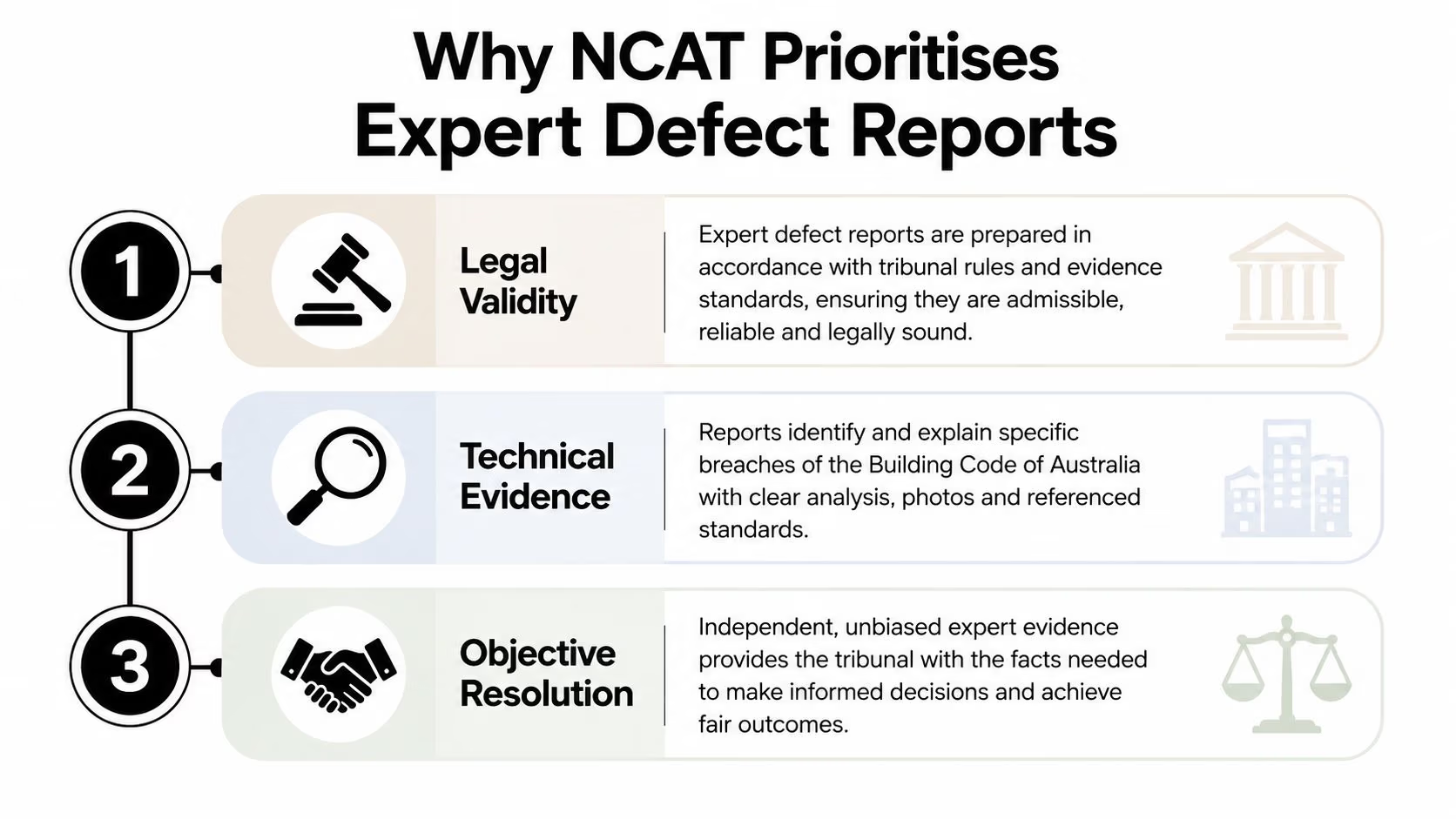
When waterproofing disputes reach NCAT, the Tribunal isn’t there to guess what went wrong on site. It needs clear evidence. Waterproofing failures often involve hidden construction details, sequencing issues, multiple trades, and arguments about whether the problem is workmanship, movement, maintenance, design, or a combination of them.
That’s why expert defect reports carry so much weight. They translate site conditions into findings the Tribunal can assess.
NCAT needs evidence it can work with
In NSW, waterproofing disputes comprise 32% of residential cases in NCAT, and NCAT’s Procedural Direction 3 (2025) requires defect claims to be structured in a Scott Schedule. A waterproofing defect report provides the verifiable evidence needed to populate that document and support expert witness testimony as noted in this overview of NCAT waterproofing disputes and Scott Schedule requirements.
That requirement catches many owners off guard. They assume photos and invoices will carry the case. Usually they won’t. Photos show symptoms. Quotes show what someone wants to charge. NCAT still needs the defect articulated in a technically defensible form.
A builder’s quote won’t do the same job
A quote can be useful for pricing. It doesn’t usually deal with causation, code compliance, or competing explanations. It also won’t usually identify whether the visible leak is the result of failed membrane continuity, poor falls, unsealed penetrations, movement cracking, or a completely different moisture source.
An expert report is different because it should do all of the following:
- State the defect clearly so the allegation is precise
- Link the defect to evidence such as inspection findings, testing, and photographs
- Reference the relevant standards so the issue isn’t framed as mere preference
- Set out a rectification pathway that can be tested by the other side
For matters that proceed formally, that evidence often has to be converted into a Scott Schedule. If you’re dealing with that stage, it helps to understand how an expert’s duties are framed under the NCAT expert witness code of conduct, because independence matters as much as technical competence.
Good reports narrow disputes
A strong report doesn’t just help at hearing. It often helps before hearing. Once the defects are isolated and set out properly, some arguments fall away. Parties can then focus on liability, scope, and methodology instead of arguing over basic site facts.
That’s one of the practical benefits people miss. A well-prepared report doesn’t inflame a dispute. Often, it gives the dispute boundaries.
Anatomy of a NCAT-Compliant Waterproofing Report
A report that works in NCAT has to do more than describe a leak. It has to let a tribunal member, solicitor, or opposing expert trace the path from complaint, to evidence, to breach, to rectification. If that chain is missing, the report may still be useful technically, but it will be harder to use in a formal claim.
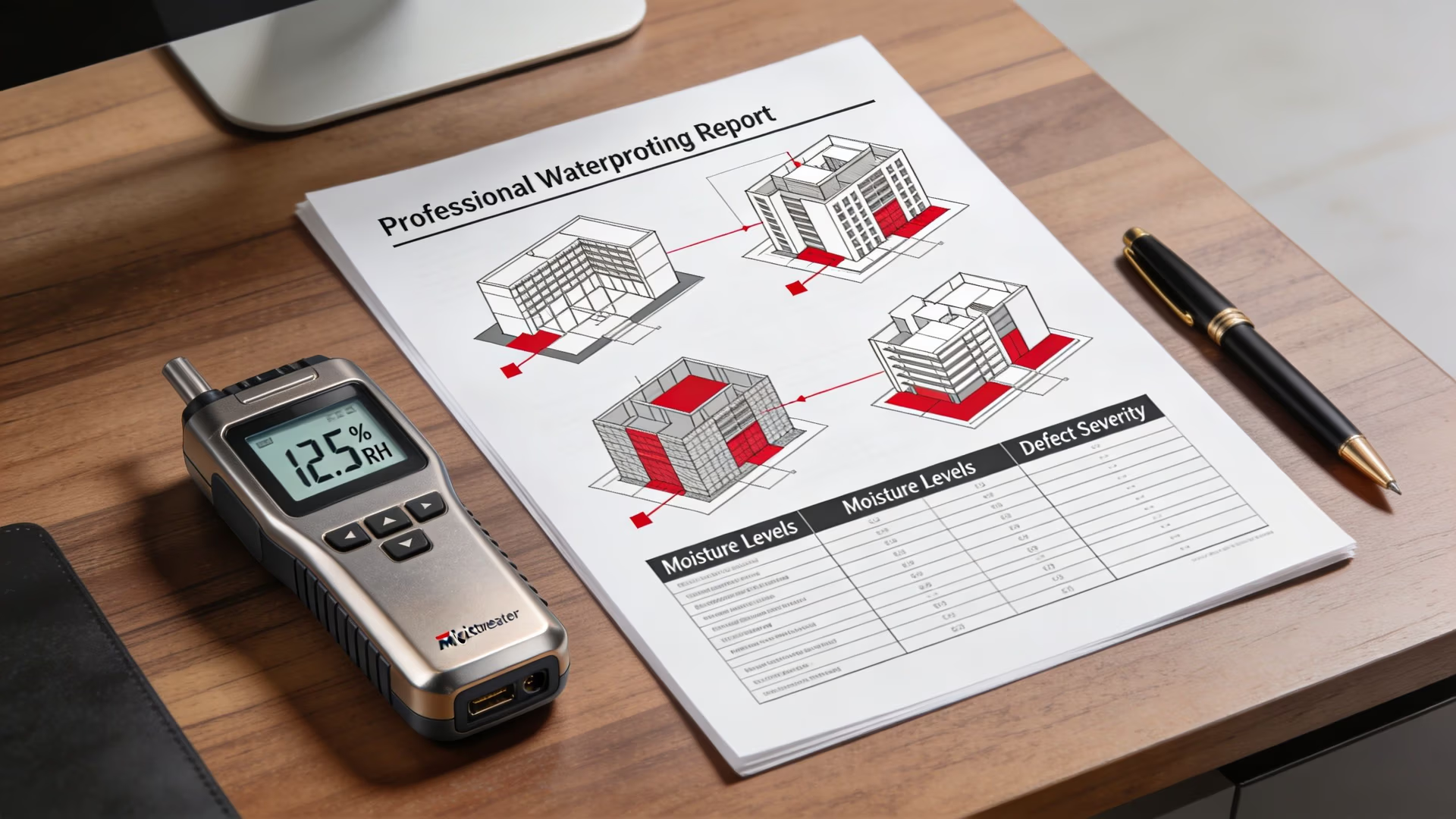
What the report should contain
| Section | Purpose |
|---|---|
| Executive summary | Gives a concise overview of the defect, likely cause, and recommended action |
| Client instructions and scope | Records what the consultant was asked to do and any inspection limits |
| Site description | Identifies the property, affected areas, and relevant construction context |
| Observations and photographs | Captures visible damage, junction details, and defect locations with annotated images |
| Testing and investigation | Records non-destructive and, where approved, destructive inspection findings |
| Defect analysis | Explains what failed and why, with reference to standards and construction principles |
| Causation opinion | Distinguishes likely source from secondary damage or unrelated issues |
| Rectification scope | Outlines what should be removed, repaired, replaced, and retested |
| Costing or cost guidance | Assists settlement discussions and formal claim preparation |
| Limitations and assumptions | States what could not be confirmed without further opening up or specialist testing |
The better reports also separate observed fact from professional opinion. That sounds basic, but it matters in disputes. “Moisture meter readings were high at the bathroom entry” is an observation. “The membrane has failed at the hob junction” is an opinion that needs supporting reasoning.
Clause references matter
General criticism rarely survives close scrutiny. A useful report identifies the failed detail, the relevant standard, and the way that failure allowed water to escape the waterproofed area. In wet areas, AS 3740 is commonly central. If the issue is an inadequate upturn, poor bond breaker treatment, missing puddle flange detailing, or insufficient lap at a junction, the report should say so directly and tie that point to the evidence on site.
That level of detail is what turns a complaint into a claim that can be tested. “Poor waterproofing” is too loose. A finding that the membrane termination or lap does not comply with the applicable requirement gives the other side something specific to admit, deny, or rebut.
Evidence has to be organised for the tribunal process
Owners often have photos, emails, repair invoices, plumber notes, and screenshots spread across months or years. Raw material helps, but NCAT does not benefit from a bundle of disconnected documents. The report should sort that material into a usable structure.
A good report usually includes:
- A defect-by-defect format so each issue can stand on its own
- Photo references linked to each item rather than an image dump at the end
- Testing results explained in plain terms so the reader understands what the readings do and do not prove
- A chronology where timing matters such as repeated leaks after patch repairs
- Clear limitations where access, finishes, or occupancy prevented further investigation
I have seen many matters drift because the evidence was technically sound but badly arranged. Lawyers then spend time rebuilding the file into a form the tribunal can use.
Where alternative causes are in play, the report should deal with them. A balcony leak may be a membrane failure, but it may also involve door threshold detailing, blocked drainage, cracked cappings, or adjacent plumbing. In some matters, the moisture source turns out to sit outside the waterproofing trade altogether, including stormwater or sanitary issues that call for residential drain leak solutions rather than membrane replacement. A report that ignores those possibilities leaves room for avoidable dispute.
Scott Schedule compatibility is part of the job
Many generic guides stop at “get an expert report.” In NCAT, that is only part of the work. If the matter proceeds, the defects often need to be translated into a Scott Schedule, item by item, with locations, descriptions, contractual or code references, and rectification positions set out in a disciplined format.
For that reason, experienced consultants often structure the report from the start so it can be converted with minimal rewriting. Defect numbering, room identifiers, clause references, and concise descriptions save time and reduce argument later. The same discipline sits behind work prepared in line with the NCAT expert witness code of conduct, because independence, clarity, and proper reasoning are as important as the inspection itself.
The practical test is simple. If a solicitor can lift defect items from the report and place them into a Scott Schedule without guessing what the consultant meant, the report is doing its job.
Common Failures and How We Find Them
A bathroom can look tidy, a balcony can dry out after rain, and a lower-ground wall can show only a faint tide mark. None of that answers the fundamental question. In defect work, the job is to identify the entry point, the travel path, and the failed building element in a way that stands up later if the matter reaches NCAT.
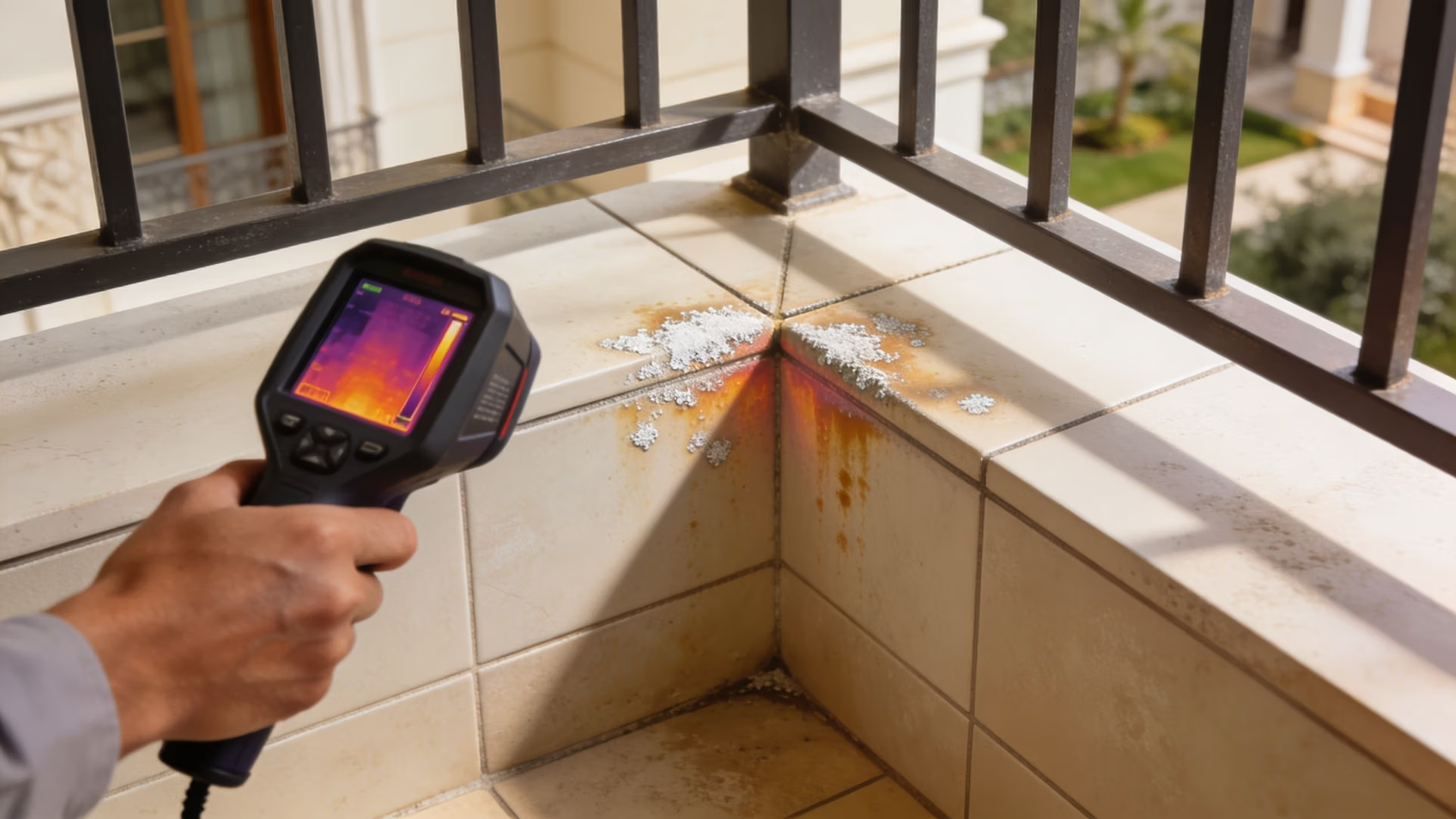
Wet areas and balconies
Showers remain a steady source of dispute. The difficulty is rarely the visible symptom alone. It is the repair history. Fresh silicone, regrouting, tile replacement, and isolated sealing works often interrupt the evidence while leaving the original defect untouched beneath the surface.
Balconies fail differently. Thresholds are commonly too low or incorrectly detailed. Falls may direct water to a dead point. Outlets clog. Membranes stop short at edges, door tracks, balustrade posts, or slab junctions. Planter boxes add another layer of risk because the moisture load is constant and the visible staining often appears well away from the actual breach.
The inspection method has to match the allegation and the available access. Depending on the site, I will usually use one or more of the following:
- Moisture mapping to establish spread patterns and likely migration routes
- Thermal imaging to identify temperature variation consistent with damp material
- Controlled flood testing where the area can be isolated and the risk is acceptable
- Selective opening up to confirm membrane presence, continuity, substrate preparation, and terminations
Used properly, those steps separate a failed membrane from a failed junction detail, a drainage issue, or a maintenance problem. That distinction often decides whether a claim is narrow and provable or broad and poorly framed.
Below-grade and foundation ingress
Lower-ground leaks produce some of the most expensive mistakes in defect litigation. Owners see dampness on an internal wall and assume the cause must be outside the wall. Sometimes that is correct. Sometimes the issue is vapour movement, slab edge moisture, hydrostatic pressure, missing protection to the waterproofing, or a drainage defect presenting with similar symptoms.
As noted in this reference on foundation and below-grade waterproofing defects, foundation waterproofing defects are common, often due to failures in terminating damp-proofing at the correct height relative to finished grade. The same reference notes that blind-side waterproofing failures are increasing with urban density, and that low-voltage electric leak detection can help identify breaches without costly excavation.
The distinction is important because below-grade repairs are expensive and disruptive. If the report misidentifies the failed element, the rectification scope can blow out quickly and still miss the cause.
Do not assume every lower-wall damp issue is a drainage defect. A site can drain reasonably well and still have incorrect membrane detailing.
Not every moisture complaint starts in the waterproofing layer either. Surface water management, plumbing leaks, and concealed drainage failures can imitate membrane defects closely enough to mislead an inexperienced assessor. Where the evidence points in that direction, it is sensible to consider specialist checks such as residential drain leak solutions before committing to a full waterproofing rectification case.
Blind-side failures need different thinking
Blind-side systems on infill sites and boundary construction need a different investigation strategy. External access is often impossible. Excavation may affect neighbouring property, retained soil, services, or structural support. In those matters, generic advice is not much use.
Low-voltage electric leak detection can help narrow breach locations without treating the entire wall as defective. Targeted testing also helps define the claim properly. For NCAT purposes, that means the alleged defect, its location, and the proposed rectification can be set out with far more precision, which makes later Scott Schedule drafting much cleaner.
Here’s a short visual explanation of how leak pathways can be investigated in the field:
Commissioning a Report, Process, Costs and Finding the Right Expert
Most clients want to know three things straight away. How does the process work, how much will it involve, and who should they trust to do it properly?
The process itself is usually straightforward. The quality gap appears in the investigation, not in the booking form.

What usually happens
A typical engagement starts with background documents. Plans, previous reports, photos, complaint history, builder correspondence, and any repair attempts all help. The site inspection follows. After that, the consultant reviews findings, identifies whether further testing is needed, and prepares the report.
Some matters can be assessed with a targeted inspection and document review. Others need staged investigation because the visible symptoms don’t answer the causation question.
What affects cost
There isn’t one standard fee for a waterproofing defect report because the scope varies too much. Cost usually turns on:
- Property complexity such as apartments, townhouses, split-level sites, or below-grade construction
- Access issues including occupied premises, limited destructive inspection, or strata approvals
- Number of affected areas because one leaking shower is not the same task as multiple balconies and basement walls
- Purpose of the report since a litigation-ready report generally requires more rigour than a preliminary diagnostic memo
- Need for extra testing such as flood testing, thermal imaging, or coordinated trade opening-up
Cheapest is rarely cheapest if the report has to be redone for a legal forum. That happens more often than it should.
How to vet the expert
Don’t appoint solely on price or on whether someone says they’ve “seen plenty of leaks”. You want a consultant who understands both building practice and dispute procedure.
Look for:
- Construction depth. Someone with real site experience will often identify sequencing failures and trade interfaces faster.
- Forensic discipline. They need to distinguish observation from conclusion and avoid jumping to blame.
- Standards knowledge. Waterproofing disputes turn on details, not broad impressions.
- NCAT familiarity. Reports written for repair advice alone can fall short once the matter becomes contested.
- Ability to prepare Scott Schedules. That saves time if the dispute escalates.
With 35+ years in building and construction and 15+ years providing litigation support to homeowners, builders and lawyers, that combination is exactly what many parties should be looking for when selecting a consultant for a disputed defect.
Using Your Report to Resolve the Dispute
The report has real value before anyone steps into a hearing room. Once the defect is identified properly, many owners and builders finally start discussing the same problem instead of arguing past each other.
Prepare properly for the inspection
Clients can help the process a great deal. Good preparation saves time and often improves the quality of evidence.
Before the consultant arrives, it helps to have:
- A defect timeline listing when the issue was first observed and what changed over time
- Repair history including regrouting, resealing, plumbing attendance, or builder return visits
- Relevant documents such as plans, waterproofing certificates if available, contracts, and defect notices
- Access arranged to adjoining rooms, lower levels, plant rooms, courtyards, or strata areas where related damage may show
If solicitors are involved, organised document handling makes a difference. For firms managing large volumes of material, support staff such as Legal assistants can help assemble chronology, correspondence, and annexures so the expert receives a cleaner brief.
Use the report to negotiate first
A sound report often sharpens settlement discussions because it does three useful things at once. It defines the defect, narrows the repair scope, and gives the parties a reference point that isn’t just advocacy.
That doesn’t mean agreement is automatic. Builders may still dispute cause or scope. Owners may still be sceptical after failed repairs. But the discussion becomes more concrete once the evidence is organised.
A report is often most effective when it changes the argument from “nothing is wrong” to “what is the proper scope of rectification?”
If the matter proceeds, the report becomes the working base
When negotiation fails, the report usually becomes the platform for formal steps. Defects need to be itemised, expressed clearly, and carried through into the claim material. That is where the connection between the technical report and the litigation documents becomes critical.
If your matter is heading further, the next practical step is usually to align the findings with a dispute pathway such as a waterproofing building dispute process. That’s where the consultant’s earlier choices in numbering, clause references, and defect wording start paying off.
Take Control of Your Building Defect
A waterproofing defect report isn’t just paperwork. It’s the document that turns a vague moisture problem into an identified defect with a cause, a standard, a repair path, and a form of evidence that can be used.
That matters whether you’re a homeowner trying to get a builder back to the table, a strata manager dealing with common property damage, a builder responding to allegations, or a solicitor preparing for NCAT. Without a proper report, people argue about symptoms. With one, they can deal with facts.
The right report also helps avoid two expensive mistakes. The first is repairing the wrong thing. The second is entering a dispute with evidence that doesn’t meet the moment.
If you’re facing recurring leaks, failed balcony or bathroom waterproofing, below-grade ingress, or a matter that may proceed to NCAT, get the defect investigated properly and documented in a way that supports the next step.
If you need a waterproofing defect report, Scott Schedule support, or an expert investigation for a building dispute, contact Awesim Building Consultants. Email admin@awesim.com.au or call 1800 293 746 to discuss the defect, the inspection process, and the documentation needed for repair negotiations or NCAT proceedings.

Related Posts

Schedule of Rates in Construction: How Disputes Arise in NSW
A Schedule of Rates contract prices construction work by unit rates applied to measured quantities, so the final cost varies
Read More »
NCAT Consumer Division: Steps From Lodgement to Hearing
Most people who end up at the NCAT Consumer and Commercial Division do not arrive there by choice. They arrive
Read More »
Statutory Warranty NSW: What Builders Must Fix and for How Long
Statutory warranty NSW obligations exist precisely for the moment a builder stops returning calls. A crack appears in the render.
Read More »